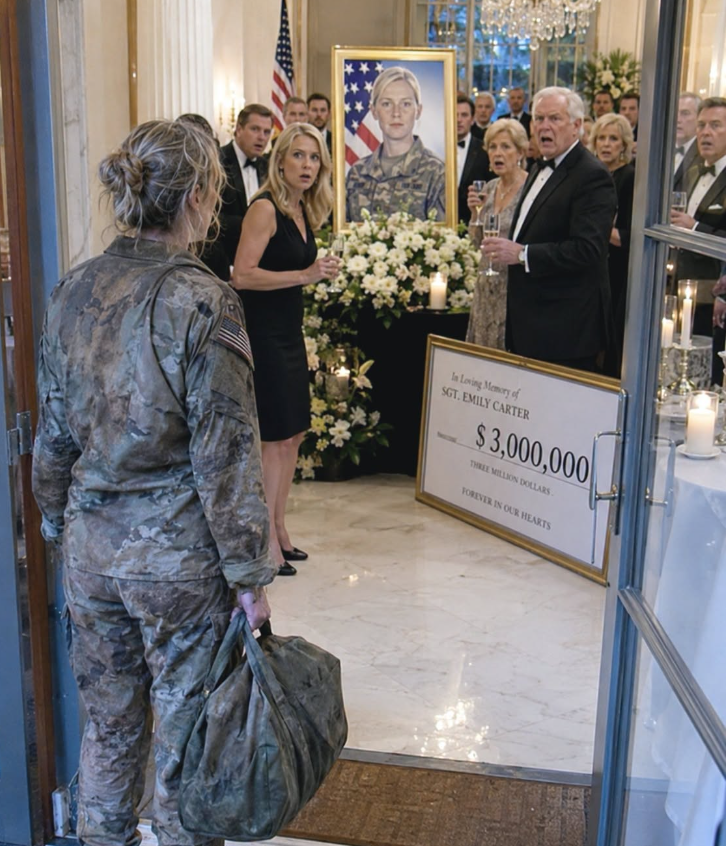
The valet’s gloved hand hovered inches from my field pack, his posture a careful blend of deference and dismissal. “Allow me, ma’am.” I gripped the strap tighter, the rough canvas biting into my palm like an old friend. “No.”
He hesitated, eyes flicking over me—short-cropped hair still jagged from a field knife, the faint white scar tracing my left cheek like a map of survival, boots caked in the red dust of places that had tried to swallow me whole. I was not the polished daughter who once belonged here. Not anymore. Captain Maren Vale had died six months ago in the jagged hills near the Horn of Africa. At least, that was what the official reports claimed.
The helicopter had gone down in a storm of gunfire and smoke. Beacon failed. Radios silent. The world moved on, and so had my family, apparently.
I stood beneath the unforgiving Charleston sun, the iron gates of my childhood home looming like the bars of a gilded cage. Behind them stretched the manicured lawns where I had first learned the art of vanishing—smiling when expected, fading when my brother’s accomplishments demanded the spotlight. The air hummed with distant music, not the somber strings of mourning, but the bright, lively notes of celebration. A string quartet danced near the fountain, their melody drifting across the lawn like champagne bubbles.
My parents were not grieving. They were feasting.
I almost turned away then. The weight of six months in hostile territory—starvation, betrayal, nights spent counting my own heartbeat to stay sane—pressed down on me. What was the point of revealing myself to people who had already buried me so elegantly? But something held me. A soldier’s instinct, perhaps. Or the deeper, quieter voice of a daughter who had never truly been seen.
At the main entrance, a security guard offered a polished smile. “Invitation, please.”
“I don’t have one.”
His expression hardened into practiced regret. “Private event, ma’am. I’m afraid I’ll have to ask you to leave.”
Private. In the house where I took my first steps. Where my mother once pinned medals on my uniform for the cameras, her smile as bright and false as the pearls around her neck.
I nodded once, as if conceding, and slipped away from the lights. Patience had kept me alive in the desert. It would serve me here.
The eastern fence line was unchanged, hidden behind ancient live oaks whose branches whispered secrets to the Ashley River. As a girl, I had escaped through this very gap during my mother’s lavish charity galas—events staged not for the suffering, but for the applause. Children’s wings in hospitals, scholarships for veterans, relief funds that always seemed to photograph better than they performed. She wore service like couture.
The loose panel gave way easily under my hands. I moved like a shadow along the hedges, the air thick with the scent of fresh-cut grass, briny river wind, expensive perfume, and searing steak. A waiter hurried past, close enough that I caught the label on the bottle cradled in his arms: Briarcliff Reserve, twenty-nine years aged. My father used to grumble about five-dollar coffee. Now he poured liquid gold for his guests.
Through the tall French doors of the ballroom, I watched them. Three hundred souls glittering beneath crystal chandeliers—judges with their measured laughs, bankers in bespoke suits, shipping magnates and politicians my father collected like trophies. The kind of circle where loyalty was currency and blood was just another transaction.
Then my eyes found the banner, suspended above the grand staircase, bathed in warm golden light.
The Maren Vale Memorial Foundation.
The words hit like a silenced round—silent, precise, devastating. Not a memorial service. A foundation. A brand. My death, repackaged into legacy, networking, and tax advantages. My stomach did not drop; it simply went hollow, a vast, echoing stillness more terrifying than rage.
I had survived ambushes, dehydration, and the slow erosion of hope in enemy territory. I had crawled through sand and blood to come home. And here, in the heart of everything I once called family, they had turned my absence into an opportunity.
My gaze drifted across the room, seeking the familiar faces of my parents. They stood near the center, radiant, accepting condolences with graceful nods. My mother’s hand rested on my father’s arm, her diamonds catching the light like captured stars. Beside them, on a velvet-draped table, lay stacks of glossy brochures and—there it was.
A oversized ceremonial check, the kind used for photo ops. Bold black ink proclaimed the amount: $3,000,000.
Three million dollars. For the memory of a daughter who was never quite enough alive to them.
The air thickened in my lungs. I had been ready to walk away, to let the dead stay buried and find a new life in the shadows. But that check changed everything. It wasn’t grief they were honoring. It was profit. Calculation. The final, elegant erasure of Maren Vale.
Ten minutes. That was all it would take to cross the threshold and rewrite the narrative.
I stepped forward from the hedges, the scar on my face burning like a fresh wound under the afternoon sun. The French doors were just ahead. Inside, the laughter swelled, oblivious.
My hand brushed the door handle, cool and unyielding.
PART 2
The French doors swung open with a soft sigh, as if the house itself recognized me before anyone else did. Cool air from the ballroom washed over my sun-baked skin, carrying the mingled scents of aged whiskey, lilies, and expensive regret. Conversations faltered like a record scratching mid-note. Heads turned. Champagne flutes hovered halfway to painted lips.
I stepped inside.
For one crystalline moment, the entire room seemed to hold its breath. My boots left faint dusty prints on the marble—red African earth on pristine white Charleston stone. A quiet, deliberate desecration.
My mother saw me first. Eleanor Vale, queen of curated compassion, froze mid-laugh, her perfectly arched brows knitting in confusion. The color drained from her face in slow motion, like ink bleeding across wet paper. She clutched my father’s sleeve, knuckles whitening.
“Darling, what—” my father began, turning. Colonel Richard Vale, retired, master of boardrooms and battlefields alike. His eyes met mine, and the practiced statesman’s mask shattered. Recognition slammed into him like a rifle butt to the chest. The $3 million check on the table behind him suddenly looked obscene, its bold figures mocking the living ghost standing before it.
A waiter dropped a tray. Crystal exploded across the floor in a symphony of breakage.
“Maren?” The word escaped my mother’s lips in a broken whisper, half prayer, half accusation.
I didn’t smile. I didn’t cry. Six months of survival had burned away the girl who once needed their approval. What remained was something sharper, quieter, and far more dangerous.
“Yes,” I said, my voice low but carrying through the sudden silence like a blade drawn in the dark. “Captain Maren Vale. Reporting for duty.”
Gasps rippled outward. Someone screamed. An elderly judge stumbled backward into a waiter, sending more glasses crashing. The string quartet faltered, their bows scraping discordantly across strings before falling silent.
My brother, Ethan, stood near the banner bearing my name, his arm around a woman I didn’t recognize. The golden child. The one who had always shone brighter in their eyes. His face went slack, the practiced politician’s smile dissolving into raw, animal panic.
“You’re… you’re dead,” he stammered. “The reports— the military confirmed—”
“Confirmed by people who wanted me gone,” I replied, stepping further into the room. My scar caught the chandelier light, a livid reminder of the price I had paid. “Convenient, wasn’t it? A dead daughter makes for such an inspiring foundation. Three million dollars for my memory. Tell me, Father—how much of that actually goes to veterans, and how much lines the pockets of the people smiling at you right now?”
The silence that followed was heavier than any desert night. My mother swayed, her hand fluttering to her throat as if she might faint. My father’s jaw worked soundlessly, the man who had once commanded battalions now speechless in his own ballroom.
I walked toward the table, my steps measured. Every eye tracked me. The living memorial. The ghost who refused to stay buried.
“You threw a party,” I continued, voice deepening with the weight of every lonely night I had spent wondering if coming home was worth it. “For service. For sacrifice. For me. Yet here I am—alive, scarred, and inconvenient. So tell me, while everyone’s watching… what exactly are we celebrating?”
My mother’s eyes rolled back. She crumpled first, collapsing into my father’s arms with a soft, theatrical gasp. He staggered under her weight, his own face ashen, the $3 million check now a glaring indictment behind them.
Ethan took one stumbling step forward, then another, before his legs gave out. He dropped to his knees amid the shattered crystal, staring up at me as if I were judgment incarnate.
Chaos bloomed. Voices rose in a cacophony of shock and disbelief. Phones appeared. Whispers turned to shouts. The perfect façade of the Vale family—wealth, legacy, service—cracked wide open for all their glittering guests to see.
I stood at the center of the storm I had become, heart pounding with a mixture of triumph, grief, and something deeper: the cold clarity of a truth long denied. They had buried me for profit and convenience. Now the dead had come home to collect.
And this was only the beginning.
PART 3
The torn fragments of the $3 million check lay scattered across the marble like fallen leaves, fragile and meaningless now. The silence in the ballroom was absolute—no music, no clinking glasses, only the ragged breathing of people whose carefully constructed world had just been pierced by an inconvenient truth.
My mother pushed herself upright, mascara tracing dark rivers down her porcelain cheeks. For the first time, she looked at me not as an extension of the family brand, but as a stranger who had outgrown every expectation they’d ever placed on her. “Maren… we mourned you. The foundation was our way of keeping you alive in the only way we knew how.”
I met her gaze without flinching. “You kept my name alive. My absence was the perfect daughter—silent, heroic, profitable. The real me was always too loud, too stubborn, too unwilling to disappear when the spotlight needed to shine on Ethan’s latest promotion or Father’s political donations.”
My father’s shoulders sagged, the retired colonel stripped of command. “We were wrong,” he admitted, the words scraping out like gravel. “The reports were definitive. No survivors. We… we moved forward because standing still would have destroyed us.”
“Moving forward by erasing me entirely?” I asked quietly. My voice carried the depth of desert nights spent staring at unfamiliar stars, wondering if blood and memory were all that remained of Captain Maren Vale. “I didn’t crawl out of that wreckage, survive interrogations, and walk across borders just to become another line item in your legacy. I came home to find out who I still was without your approval.”
Ethan stepped forward, glass crunching beneath his polished shoes. His eyes, once so quick to dismiss me, now held a haunted recognition. “You were always the strong one. We resented it. I resented it. Easier to mourn a hero than compete with one who refused to stay in the shadows.”
The confession hung between us, raw and fragile. Around the room, guests shifted uncomfortably, witnesses to a reckoning no invitation had prepared them for. Some slipped toward the exits, others filmed discreetly, but none of it mattered anymore.
I walked to the banner bearing my name and pulled it down with one firm tug. The fabric pooled at my feet like a surrendered flag. “The foundation stays,” I said, turning back to them. “But it becomes what it pretended to be. No more galas. No more photo opportunities. Real aid. Real transparency. Or I will dismantle it myself—publicly.”
My mother reached out a trembling hand. For a moment, I considered taking it. Instead, I placed my scarred palm over hers briefly, a bridge across years of distance.
“I forgive you,” I whispered. “Not because you deserve it. But because carrying hatred back into the world I fought to return to would mean they won. The ones who tried to bury me the first time.”
I stepped away then, through the same French doors, into the golden light of a Charleston afternoon that no longer felt like judgment. The river whispered beyond the oaks, indifferent and eternal. My boots left faint red prints on the stone steps—marks of a journey that had led me not back to who I was, but forward to who I could become.
Behind me, the party was over. The Vale family would never be the same. And neither would I.
I had finally made it home. Not to the house, but to myself.
THE END