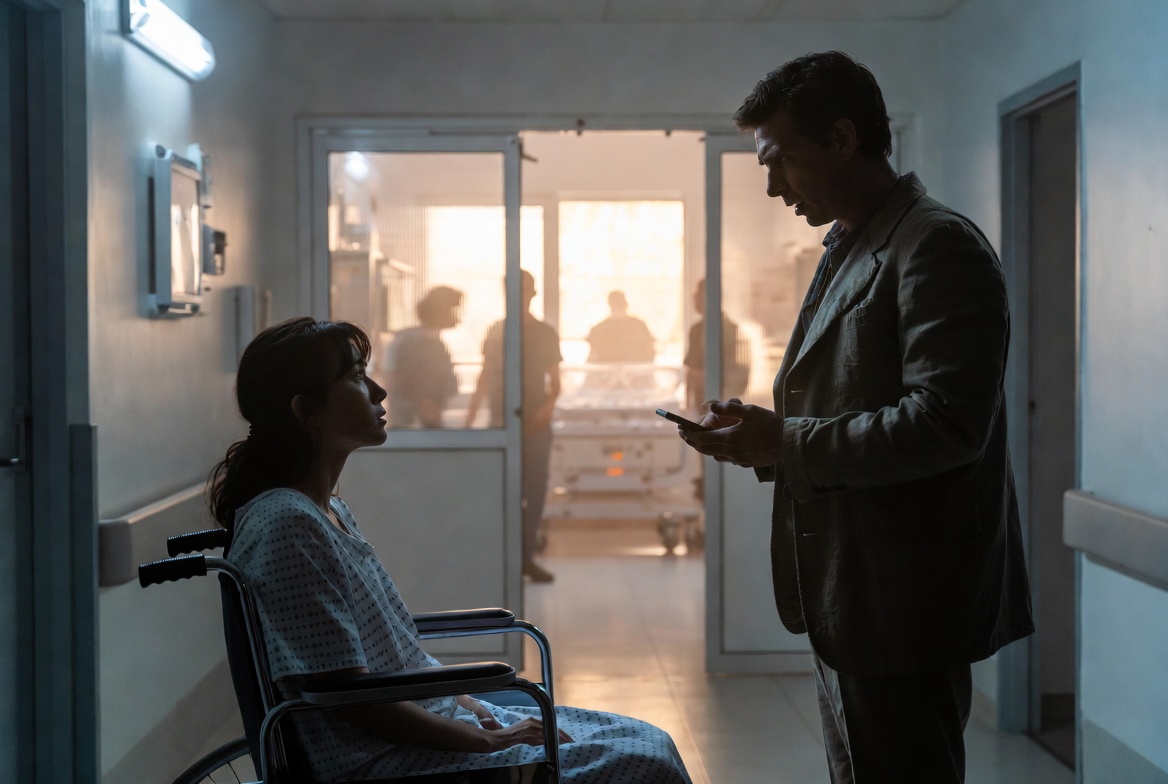
The scent of antiseptic clings to memory like a ghost that refuses to leave. It was the first thing I noticed when consciousness returned—sharp, metallic, laced with the faint undercurrent of fear
Three days earlier, in the sterile chaos of the delivery room, I had crossed into a place few return from. My body, heavy with the weight of three lives, had rebelled in the final hours. The monitors screamed. The world narrowed to a tunnel of white light and fading voices.
I died for four minutes and seventeen seconds.
The doctors later told me the exact count, as if precision could somehow soften the horror. My heart stopped while they fought to deliver the triplets through an emergency C-section. Three tiny hearts kept beating—fragile, furious, alive. Mine did not. They shocked me, intubated me, poured their expertise and desperation into a vessel that had already begun to slip away. I became a battlefield, my chest rising and falling only because machines willed it so.
And outside the ICU, in the hushed corridor where fluorescent lights buzzed like indifferent insects, my husband waited.
Grant Holloway did not pace. He did not press his forehead against the cold glass or whisper prayers into clenched fists. He stood motionless in a charcoal suit cut so perfectly it seemed forged for this exact moment of detachment. The fabric whispered of boardrooms and private jets, of empires built on calculated risks. His attorney, a man whose face I would later learn wore the permanent shadow of moral compromise, handed him the papers.
“Mr. Holloway,” the lawyer murmured, eyes flicking toward the sealed doors, “she’s in critical condition. Perhaps we should wait—”
Grant’s pen moved across the pages with the same efficient grace he used to close multimillion-dollar deals. Signature after signature. No tremor. No hesitation.
A doctor emerged then, scrubs damp with sweat, eyes hollowed by exhaustion. “Your wife is stabilized for now, but we need authorization for further interventions. Family consent—”
Grant closed the folder with a soft snap. “I am no longer her husband.”
The words hung in the air like smoke after a silenced gunshot. The doctor blinked, as if the sentence had been spoken in a foreign tongue.
“As of two minutes ago,” Grant added, checking the sleek face of his watch. “Update your records accordingly.”
Silence swallowed the hallway. Even the machines behind the glass seemed to quiet in disbelief.
He turned away without asking about me. Without inquiring after the children—our children—whose first breaths had come while mine faltered. The elevator doors closed behind him with a mechanical sigh, and his phone illuminated in the descending light.
A message from her. The woman whose name I would come to know too well.
Is it done?
Grant’s lips curved into something that might have been mistaken for relief on a lesser man.
Yes.
He believed he had severed the cord. A burdensome, critically ill wife. Three newborns who represented nothing but obligation and expense. The mounting weight of a life that no longer served his ascent. With the stroke of a pen, he had erased me from his ledger.
What Grant Holloway did not know—what no one in that corridor could have imagined—was that love, even when shattered, leaves behind sharper edges than hatred ever could. And some documents, once signed, do not simply end a marriage.
They awaken something far older.
Three days later, I opened my eyes to a world that had been rewritten without my consent.
The room swam into focus: beeping monitors, the soft cries of infants somewhere down the hall, and a quiet administrator who approached my bedside with the reluctance of someone delivering a death sentence. She spoke in gentle tones, but the words carved deep.
Your insurance coverage has been terminated.
Because of the change in marital status, the triplets have been placed under administrative review. Legally… you are no longer listed as immediate family.
I couldn’t speak. The air in my lungs felt stolen, just as my future had been. The man who had once vowed to stand beside me through every storm had chosen to become the storm itself. In the haze of pain and medication, fragments returned: the way he used to trace circles on my swollen belly, promising the world to the lives growing inside me. The private island escapes. The whispered declarations that I was the only real thing in his manufactured empire.
Lies, all of them. Or perhaps worse—they had been true once, until convenience demanded otherwise.
I lay there, heart monitor spiking with each fractured realization, and wondered how a person could die twice in one lifetime: once on the operating table, and again in the knowledge that the father of your children had chosen paperwork over your final breath.
But survival has a way of sharpening the mind. As nurses adjusted IV lines and whispered encouragement, a single question began to burn through the fog.
What had Grant truly set in motion?
Years before our marriage, in the quiet offices of old family attorneys, a trust had been established. Not the kind Grant ever bothered to fully understand—something archaic, protective, woven into the Holloway legacy long before his ruthless ambition reshaped it. A clause so deeply buried it required specific triggers: divorce under circumstances of abandonment during medical crisis, particularly involving heirs.
He thought he had freed himself.
Instead, he had lit the fuse.
When his call finally came—“We need to talk”—his voice carried that familiar tone of command, the expectation that the world would always bend. But by then, the mechanisms were already turning. Irreversible. Ancient gears of consequence grinding forward, hungry for the man who believed money could insulate him from every consequence.
For the first time in his gilded life, Grant Holloway was about to discover that some debts cannot be paid with wealth.
They are collected in ruin.
PART 2
The call came on the fifth day.
I was still tethered to machines, my body a map of bruises and surgical precision, but my mind had grown razor-sharp in the silence. The triplets—Elias, Sophia, and Luca—lay in the neonatal unit, tiny warriors fighting their own quiet battles. I had not yet held them. The hospital’s legal team moved like shadows, their whispers heavy with caution. Grant’s signature had not only dissolved a marriage; it had unraveled the fragile scaffolding of my existence.
Then my phone vibrated on the bedside table. His name flashed across the screen like a dare.
I answered without speaking.
“Elena.” His voice was smooth, polished, the same tone he used to close acquisitions. “We need to talk. This has gone far enough.”
A bitter laugh escaped my cracked lips. “Far enough? You signed me away while I was dying, Grant. You walked out on your children before they even had names.”
He exhaled, the sound of a man who still believed control was his birthright. “The papers were necessary. You knew our arrangement was… evolving. The medical bills alone would have been catastrophic. I protected what matters.”
“Protected?” The word tasted like ash. “You erased us.”
A long pause. In the background, I heard the low hum of his private jet, the clink of crystal. Even now, he moved through the world untouched.
“I’m prepared to be generous,” he said finally. “A settlement. Discreet. The children will be cared for. You’ll want for nothing. But we do this quietly, Elena. No scandals. No lawsuits. My reputation—”
I closed my eyes, feeling the hidden clause awaken like a living thing in the depths of old legal vaults. The family trust—crafted by his grandfather in an era when honor still carried weight—had been triggered the moment the divorce became final under those exact conditions: abandonment during life-threatening childbirth, with heirs involved. Irrevocable. Exponential.
“You still don’t understand,” I whispered. “It’s already too late.”
He laughed then, that low, confident sound that once made me feel safe. “Darling, I own half the lawyers in this city. Whatever loophole you think you’ve found—”
The line clicked with an incoming notification on his end. I heard his breath catch.
“What the hell…?”
I could picture it: alerts flooding his screen. Accounts freezing. Shell companies unraveling like threads pulled from an expensive suit. The trust’s executors—silent guardians of the Holloway fortune—had begun their work. Not a simple division of assets, but a cascading collapse. Voting shares transferred. Offshore holdings locked. Philanthropic foundations redirected toward the children he had tried to orphan.
“Elena,” he growled, voice losing its sheen, “what have you done?”
“Nothing,” I replied, the words steady for the first time since waking. “You did this. The moment you chose convenience over compassion. The moment you decided three innocent lives and their dying mother were liabilities to be discarded.”
He was shouting now, demands turning to threats, then to something closer to panic. In the background, assistants scrambled. I heard doors slamming, frantic typing. The empire he had built on calculation was being dismantled by the very bloodline he had betrayed.
But the true weight settled deeper than money.
That night, as I was finally wheeled to the neonatal unit, the nurse placed Elias in my arms first. His tiny fingers wrapped around mine with surprising strength. Sophia and Luca followed, warm and real against my chest. Three hearts that had survived because mine had refused to quit.
In that moment, I understood the depth of his miscalculation. He had not merely lost wealth. He had severed the last illusion of his invincibility. The man who feared nothing had finally encountered a force greater than his ambition: consequence, pure and unrelenting.
By morning, the headlines would begin.
“Holloway Heir in Financial Freefall Amid Shocking Divorce Scandal.”
But Grant wasn’t finished fighting. Desperate men never are.
He arrived at the hospital at dawn, flanked by security and attorneys, his face a mask of thunder. The elevator doors opened, and there he stood—disheveled for the first time in his privileged life, eyes burning with something raw and dangerous.
“Elena,” he said, voice low as he approached my room, ignoring the staff who tried to intervene. “This ends now. You will sign whatever I put in front of you, or I swear—”
The alarms in the neonatal unit began to wail.
One of the triplets—our son Luca—had taken a sudden turn.
In that instant, as doctors rushed past us, the full horror of what he had unleashed crashed over Grant’s face. Not the money. Not the empire. But the possibility that his children might slip away while he stood here, still trying to negotiate their erasure.
He reached for me, not in love, but in the frantic need to control the narrative one last time.
And in that frozen second, with machines screaming and my heart pounding against the fragile lives we had created, I saw the precipice yawning before him.
This was only the beginning of his fall.
PART 3
The neonatal alarms tore through the corridor like judgment itself.
Luca’s tiny chest rose and fell in erratic bursts on the monitor. Nurses swarmed. Doctors barked orders. And in the midst of it all, Grant Holloway stood frozen in the doorway of my room—his empire crumbling on his phone, his son fighting for life just meters away, and the woman he had tried to bury now staring back at him with eyes that had seen death and returned sharper.
“Get out,” I said, my voice low but carrying the weight of mountains.
He didn’t move. For the first time, the polished mask had shattered completely. Sweat beaded on his forehead. His custom suit, once a symbol of untouchable power, hung on him like a costume. “Elena… please. He’s my son too.”
“Your son?” The words left me like venom and grief intertwined. “You forfeited that right in a hospital hallway while I coded on the table. You chose a text message and another woman over three newborns and their mother. Don’t you dare claim them now.”
The trust’s machinery had accelerated overnight. By the time Grant arrived, half his liquid assets were locked. The other half funneled inexorably toward irrevocable trusts for the children—guardianship clauses that named me sole authority, with provisions that would strip him of any paternal rights if he contested. His grandfather’s final act of quiet wisdom, protecting the bloodline from future predators wearing the family name.
Grant stepped closer, desperation cracking his voice. “I was scared. The pregnancy… the risks… I panicked. We can fix this. Counseling. A new agreement. I’ll give you everything.”
I looked at him—at the man I had once loved with the reckless faith of youth—and felt only the cold clarity of survival. “You didn’t panic, Grant. You calculated. And now the numbers have turned against you.”
Luca stabilized. The crisis passed like a storm that had tested us all. When the nurses finally allowed me to hold him again, his small body warm against mine, I understood the true inheritance my children would receive: not billions, but the unyielding knowledge that they were wanted. Chosen. Fought for.
Grant sank into a chair, head in his hands. The billionaire reduced to a man confronting the hollowness of his victories. “I thought I could control it all,” he whispered. “The business. The image. You. But I never saw… this.”
“No one ever does,” I replied softly. “Until the illusion breaks.”
In the weeks that followed, the world watched the fall of Grant Holloway with the hungry fascination reserved for fallen gods. Headlines dissected the scandal. Former associates distanced themselves. The other woman vanished into whatever shadows had spawned her. Lawsuits bloomed like weeds, but the trust held firm—ironclad, merciless in its justice.
I did not gloat. Revenge, I learned, is not the fire that sustains you. My strength came from midnight feedings, from three small faces that looked at me with absolute trust, from the slow rebuilding of a life stripped bare and made new.
Grant was not destroyed entirely. No man with his resources ever is. But he was diminished—cut off from the legacy he had poisoned, forced to watch from a distance as his children grew under my care. Occasional supervised visits, heavily monitored. A ghost in the story he once dominated.
Years later, on a quiet autumn afternoon, I watched Elias, Sophia, and Luca chase falling leaves in the garden of our new home. Their laughter rang clear and bright, unburdened by the shadows of their beginning. I thought of the woman who had died on that operating table, and the mother who had risen in her place—stronger, wiser, whole.
Grant had signed away more than a marriage that day. He had signed away his right to witness this: the ordinary miracle of family forged in fire.
And I, Elena Holloway no more, had discovered the most profound truth of all.
Some deaths are endings.
Others are the beginning of everything that truly matters.
THE END