Netflix Viewers Expected a Quiet Little Drama. Maggie Smith’s Masterpiece Delivered Something Far More Devastating.
At first glance, The Lady in the Van looks like the kind of gentle, slightly eccentric British film that arrives on streaming platforms and quietly settles into the background. A lonely writer. An odd woman living in a battered old van. A few wry smiles, some polite English awkwardness, and a tidy emotional payoff before the credits roll. That is exactly what many Netflix viewers thought they were signing up for when they pressed play.
They were completely unprepared.
What begins as a seemingly simple story about coexistence quickly peels back layers of heartbreak, hidden trauma, quiet sacrifices, and the complicated ways people care for one another when the world has already written them off. By the final moments, countless viewers report sitting in stunned silence long after the screen goes dark. Many are now calling it one of Dame Maggie Smith’s most unforgettable performances — a late-career triumph that cuts deeper than almost anything she did in her celebrated decades on stage and screen.
And there is one heartbreaking revelation near the end that changes everything.
A Mostly True Story That Refuses to Stay Polite
The film, directed by Nicholas Hytner and written by Alan Bennett himself, is based on Bennett’s own extraordinary real-life experience. In the early 1970s, the celebrated playwright and essayist moved into a comfortable house on Gloucester Crescent in Camden, London. Not long afterward, he encountered Miss Mary Shepherd (played with ferocious brilliance by Maggie Smith), an elderly, deeply eccentric, religious, and thoroughly unsanitary woman who had been living in a dilapidated Bedford van on the street.
What started as temporary parking permission turned into a fifteen-year residency in Bennett’s driveway. From 1974 to 1989, Miss Shepherd lived there — through weather, illness, neighbors’ complaints, and her own fiercely guarded secrets. Bennett eventually turned the experience into a memoir, a hit stage play (also starring Smith), a radio adaptation, and finally this 2015 film.
The movie is careful to label itself “a mostly true story,” and that “mostly” does a lot of work. Bennett splits himself into two characters on screen — the private man living the experience and the public writer observing and recording it — played with delicious self-deprecation by Alex Jennings. The device allows the film to explore the ethical and emotional mess of turning real suffering into art without ever becoming pretentious.
Yet the heart of the film is not Bennett. It is Miss Shepherd.
Maggie Smith’s Performance: Ferocious, Funny, and Heartbreaking
Maggie Smith was 80 when she filmed The Lady in the Van. She had already given the world the steely Violet Crawley in Downton Abbey, the sharp-tongued Professor McGonagall, and a gallery of unforgettable characters stretching back to the 1950s. Nothing quite prepares you for what she does here.
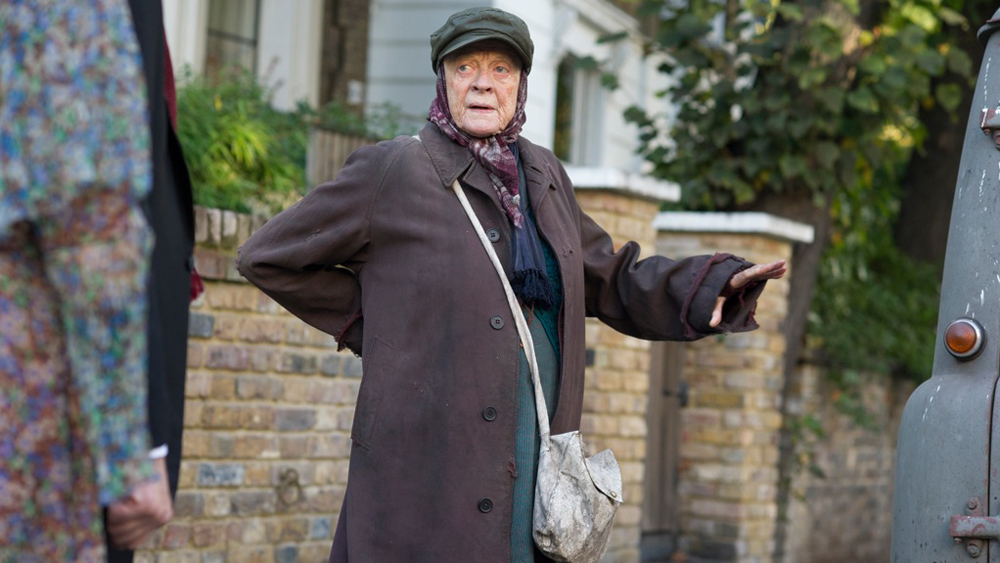
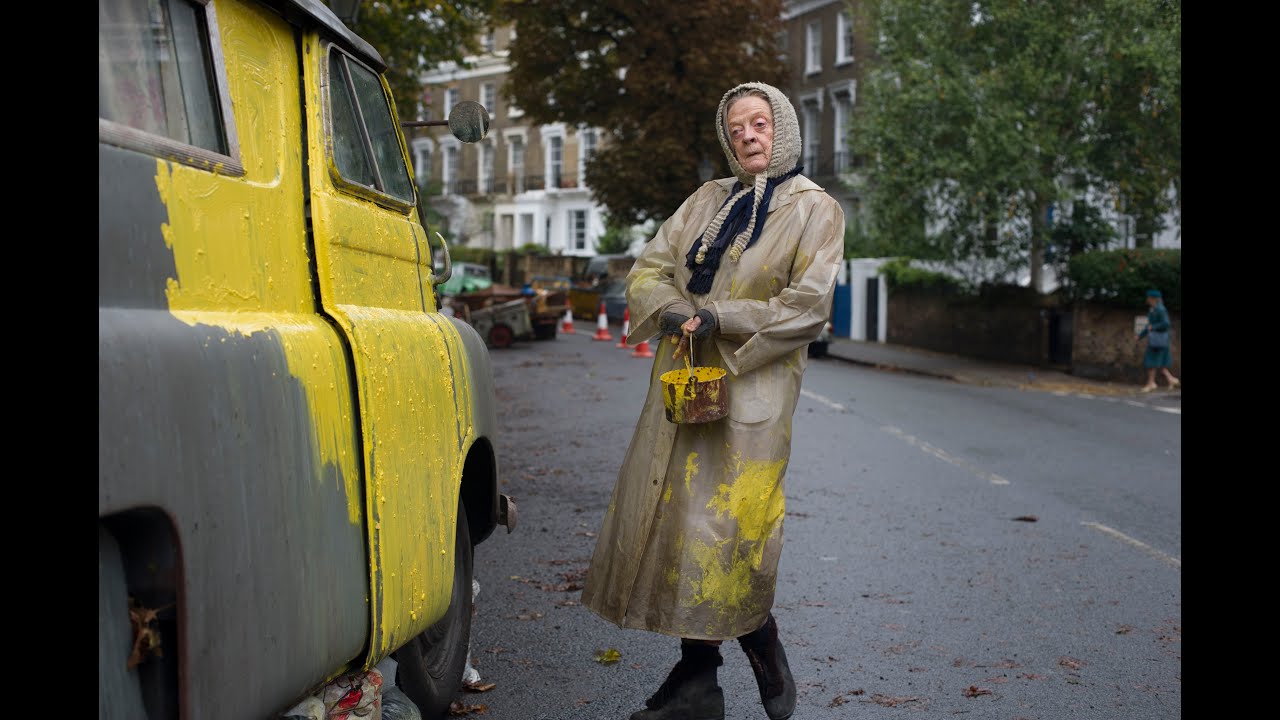
Her Miss Shepherd is a force of nature wrapped in layers of filthy coats, scarves, and a battered hat. She is rude, demanding, paranoid, devout, and utterly unwilling to perform gratitude. She pees in plastic bags. She paints her van in slapdash yellow while muttering prayers. She refuses to say thank you. She treats kindness as a potential trap. And somehow, Smith makes her not only watchable but magnetic.
Critics at the time called the performance “towering,” “Oscar-caliber,” and “one of the most tailor-made leading roles of her late career.” Audiences discovering the film on Netflix years later are saying the same thing in even stronger terms. There is something almost unbearable in the way Smith captures the dignity and the degradation of old age, poverty, and mental fragility at the same time. You laugh at Miss Shepherd’s outrageous demands one moment and feel your chest tighten the next when the mask slips and you glimpse the terror underneath.
The physical transformation is total. Smith disappears into the posture, the voice, the restless hands, the way Miss Shepherd clutches her belongings as if they are the last remaining pieces of a self the world has tried to erase. Yet the performance never feels like caricature. Every eccentricity is rooted in a life that has been shattered and then stubbornly rebuilt inside a metal box on wheels.
The Unlikely Bond That Changes Everything
The relationship between Bennett and Miss Shepherd is the film’s quiet engine. It is not a friendship in any conventional sense. There is no mutual understanding, no heartfelt confessions over tea. Bennett offers practical help — a place to park, occasional shopping, a bath when things get truly dire — while remaining half-appalled and half-fascinated. Miss Shepherd accepts the help with suspicion and never, ever softens into sentimentality.
What grows between them is something rarer and more complicated: a kind of mutual witness. Bennett sees a woman the rest of society prefers to look away from. Miss Shepherd, in her own prickly way, forces Bennett to confront his own emotional reserve, his guilt about his ailing mother, and the comfortable distance he has built between himself and the messiness of other people’s lives.
The film is full of small, devastating moments that accumulate. A reluctant hand held. A shared silence. The quiet horror of realizing how easily a human being can fall through every social safety net and still refuse to be pitied. These scenes do not announce themselves with swelling music or tearful monologues. They simply happen, and they leave bruises.
Many viewers have said the final act left them sitting motionless on the couch. The film earns that silence. Without spoiling the revelation that lands near the end, it is enough to say that everything you thought you understood about Miss Shepherd — her past, her fears, her stubborn independence — is suddenly recontextualized. The eccentricity stops looking like eccentricity. It starts looking like survival.
A Film That Understands Loneliness Better Than Most
The Lady in the Van is often described as a comedy-drama, and it is genuinely funny. Smith’s deadpan delivery of outrageous lines, the neighbors’ polite British horror at the yellow van permanently parked on the crescent, Bennett’s dry narration — all of it sparkles. But the humor is the spoonful of sugar that makes the medicine go down. Beneath it runs a deep current of loneliness, aging, class, mental health, and the limits of charity.
The film never lectures. It simply shows. It shows what it costs a person to remain free when society has decided freedom looks like squalor. It shows how easy it is for middle-class kindness to become a form of control. It shows the strange intimacy that can grow between people who have almost nothing in common except proximity and time.
In an era when streaming libraries are packed with glossy prestige dramas and high-concept thrillers, The Lady in the Van feels almost radical in its quietness. It trusts the audience to sit with discomfort. It trusts Maggie Smith to carry an entire emotional world in the set of her shoulders and the flicker of her eyes. And it trusts that a story about two lonely people on a London street can somehow feel universal.

Why This Film Hits Harder Now
The timing of the film’s renewed popularity on Netflix is bittersweet. Dame Maggie Smith passed away in 2024, and many viewers are returning to her work with fresh eyes and heavier hearts. The Lady in the Van has become one of the titles most frequently mentioned when people discuss her greatest late performances. It sits alongside The Lonely Passion of Judith Hearne and her stage work as evidence that Smith never stopped growing as an actress, even into her ninth decade.
There is also the simple fact that the film is scheduled to leave Netflix in some regions soon. That urgency has driven a new wave of first-time viewers who might otherwise have scrolled past a 2015 British drama. Those who arrive expecting something gentle are leaving shaken. Social media is full of variations on the same reaction: “I thought this would be a cozy watch. I was not okay.”
The film’s power lies in how ordinary its tragedy feels. Miss Shepherd is not a saint. Bennett is not a hero. Their story does not resolve into neat lessons about compassion. Instead, it leaves you with the uneasy knowledge that somewhere, right now, there is someone living in a van or a doorway or a room that smells of neglect, and the people walking past have no idea what they are carrying.
A Masterclass in Restraint and Revelation
Nicholas Hytner’s direction is elegant and unshowy. Filmed on the actual street and in the actual house where the events took place, the movie has a lived-in authenticity that big-budget productions rarely achieve. The supporting cast — Jim Broadbent, Frances de la Tour, Roger Allam, and others — provide a rich texture of Camden life without ever stealing focus from the central duo.
But make no mistake: this is Maggie Smith’s film. She dominates every frame she appears in, and even when she is off-screen, her presence lingers like the smell of the van. It is a performance of extraordinary control and even more extraordinary vulnerability. She makes you understand a woman who would rather freeze than ask for help, who would rather offend than be pitied, who has built an entire existence around the refusal to disappear.
When the final moments arrive — the ones that leave viewers sitting in silence — they feel earned. Not because the film has manipulated you with sentiment, but because it has spent nearly two hours showing you the full, complicated, sometimes infuriating humanity of a person most of us would have crossed the street to avoid.
Don’t Wait Until It’s Gone
The Lady in the Van is not a loud film. It does not announce its greatness with trailers full of explosions or tearful speeches. It simply tells a true story about two people who changed each other in ways neither of them fully understood at the time. And in doing so, it becomes something far more powerful than the quiet drama it first appears to be.
If you have been scrolling past it on Netflix, stop. If you have been waiting for the right mood, this is the right mood. Pour yourself something strong, settle in, and prepare to have your expectations quietly dismantled.
Because once the credits roll and the silence settles, you will understand why so many viewers are calling this one of Maggie Smith’s finest hours. You will understand why the final revelation hits like a quiet thunderclap. And you will understand why a simple story about a lonely writer and a woman in a yellow van has the power to leave you completely unprepared for the weight of what you have just witnessed.
Some films entertain. Some films move you. A rare few rearrange something inside you and then leave you sitting in the dark, wondering how something so small could feel so enormous.
The Lady in the Van is one of those rare few.
Watch it before it slips quietly out of reach. You will not forget Miss Shepherd. And you will never look at a battered old van the same way again.
