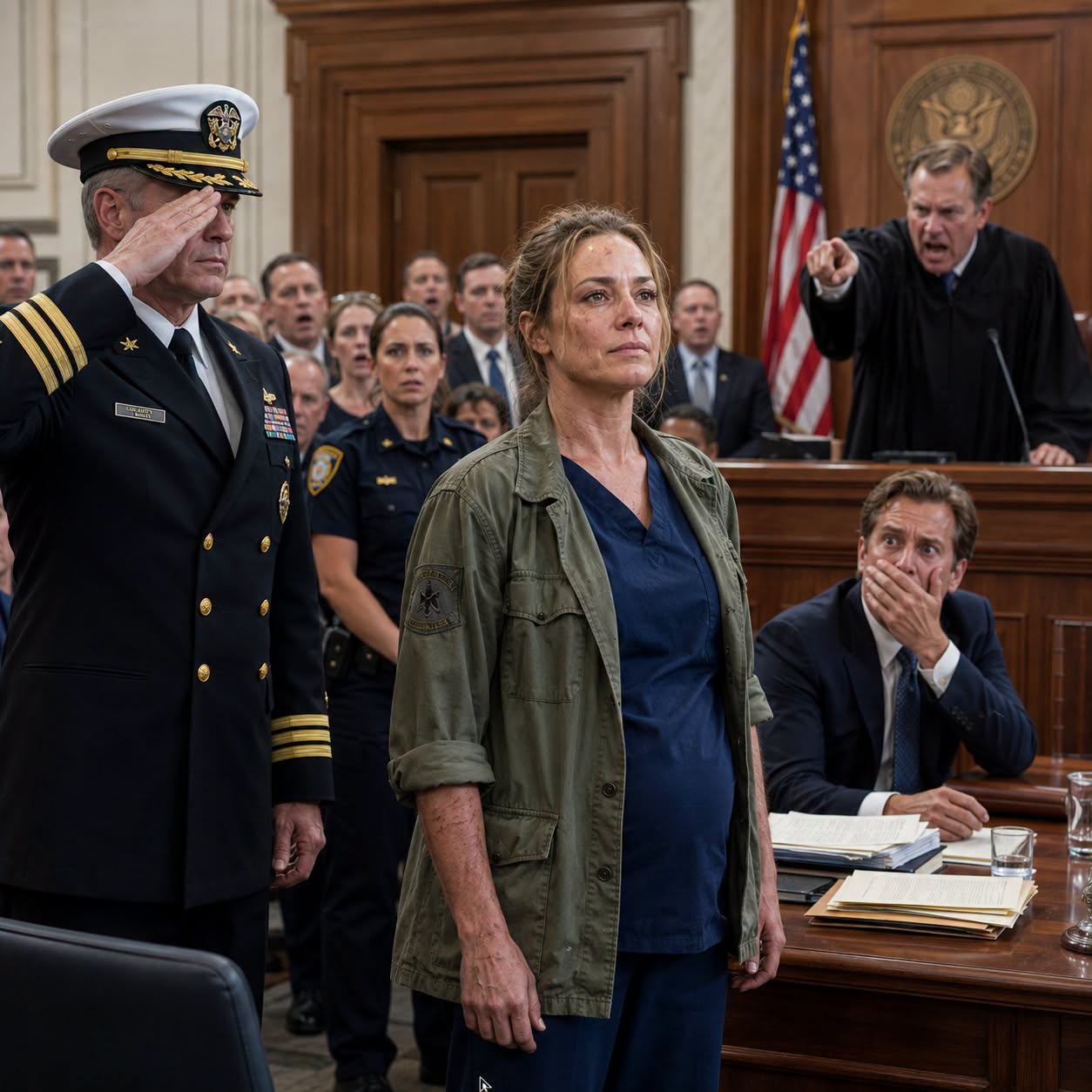
The courtroom smelled of polished oak, stale coffee, and fear—the kind of fear that wore a three-thousand-dollar suit and smiled like it had already won.
“Take that filthy jacket off,” Judge Everett Sloan commanded, his voice dripping with contempt, “or I’ll have you dragged out in handcuffs.”
Two court officers moved in, their hands hovering near their belts. In the gallery, Harrison Langston leaned back, arms crossed, the picture of paternal grief and civic virtue. His smile was small, almost imperceptible, but to me it screamed victory. He believed the truth had been purchased, buried under layers of influence, and sealed with silence.
He was wrong.
I stood before the bench in my bloodstained navy scrubs, the ghost of a thirty-six-hour shift still clinging to my skin. The Interstate 5 pileup had been merciless: twisted metal, shattered glass, and seventeen souls fighting for breath under fluorescent lights. I could still hear the mother’s broken whisper about her son’s graduation. The dried blood on my knees had cracked like old earth when I sat down. There hadn’t been time to change. Only time to grab the one thing that still made me feel armored.
My old olive tactical jacket.
Its left shoulder bore a scorched scar from a past I rarely revisited. The cuffs were frayed from years of hard use. On the right sleeve, a subdued black patch read PHANTOM 4. I hadn’t worn it in public for years. Today, the cold hospital air had made the old burns on my arms scream, and long sleeves were my only mercy against curious stares. I had hoped the jacket would let me fade into the background.
Instead, it painted a target on my back.
“Your Honor,” I said quietly, “I came here straight from a mass-casualty incident under subpoena. These are the clothes I had.”
Sloan’s silver hair caught the light like a crown. His black robe hung impeccably, unwrinkled by any real labor. He looked like a man who had never tasted cold coffee over a dying patient or felt his soul fracture under the weight of impossible choices.
“I didn’t ask for your excuses, Ms. Donnelly,” he replied, leaning forward. “I ordered you to remove that… costume.”
A ripple of uneasy laughter swept the gallery. Harrison Langston’s chuckle joined it, low and satisfied.
Mason Keen sat at the defense table, pale but steady. Our eyes met for a fraction of a second. He gave the slightest shake of his head: Don’t. He knew what this jacket represented. He had never asked, never pried into the shadows I carried, but he understood the cost of revealing them.
We had met eight months earlier in the dim basement of a Methodist church, surrounded by folding chairs and faded banners for food drives. A veterans’ support group where words often failed. He had sat with arms crossed, silent as stone. I had done the same. Afterward, when the phantom nerve pain twisted my left wrist like a vice, he simply set a cold water bottle beside me and walked away. No questions. No pity. Just recognition—two survivors acknowledging the invisible wounds we both carried.
Not romance. Not even friendship in the ordinary sense. Something quieter. Deeper. A shared understanding that some pains didn’t need language.
Now, here we were. Mason, the former Army medic who had saved a young waitress from hell, was on trial for it. Harrison Langston’s son Trevor had cornered Paige Moreno in the alley behind the Harbor Light Diner. Knife to her ribs. Friends blocking the exit. Her plea—“Please don’t make me scream”—still echoed in the dark corners of my mind.
Mason had moved like the medic he was: disarmed the threat, neutralized the accomplices, and kept Trevor breathing with an improvised hollow ballpoint tube when blood filled the boy’s airway. Heroism born of instinct.
Harrison had responded with power. The knife vanished from evidence. Paige stopped answering calls. Old, dismissed charges were exhumed and polished into a narrative of “unprovoked veteran rage.” Money spoke. The city listened.
But I had found the knife. And more. Receipts. Transfers. Whispered conversations caught in digital amber. Harrison had buried the truth, but graves this shallow never stayed hidden.
Sloan tapped his gavel. “Remove the jacket, Ms. Donnelly, or spend forty-eight hours in county lockup contemplating contempt.”
The air thickened. I glanced at the red recording light above the jury box, steady and unblinking.
“Is this courtroom fully on record, Your Honor?” I asked.
Sloan’s jaw tightened. “Everything here is documented, counselor.”
“Even your directive to have officers forcibly remove clothing from a female material witness?”
The temperature in the room dropped. Aaron Delaney, Mason’s attorney, hid a sharp exhale that might have been laughter. Harrison’s smile faltered for the first time.
Sloan recovered smoothly. “No one said strip, Ms. Donnelly. Simply remove the jacket. Your preferences are irrelevant in my courtroom.”
Preferences. The word landed like a scalpel on old scar tissue.
Four years ago, in a smoke-choked cave in Yemen, preferences had meant nothing. Only the relentless calculus of blood loss, collapsing time, and the fire rolling toward us. I had kept my hands moving long after the nerves in my arms burned like molten wire, dragging lives back from the edge while the world narrowed to the next heartbeat, the next breath. I had learned then that power roared loudest when it believed no one of consequence was listening.
I stood motionless.
Sloan nodded to the officers. “Assist her.”
They stepped forward.
My body answered before thought could intervene. Feet rooted. Shoulders squared. The chronic pain in my arms submerged beneath a colder, older current—training that had never truly slept.
“Don’t touch me,” I said. My voice was low, steady, carrying the weight of caves and triage tents and nights no one should survive.
The officers hesitated.
Sloan’s gaze narrowed on the patch. “Phantom Four? Some kind of… tactical cosplay?”
Harrison snorted derisively.
The judge leaned in, ready to twist the knife further for the gallery’s amusement.
But he didn’t know the courtroom door had never latched properly.
He didn’t know that Admiral Conrad Barrett—four-star, legend of quiet corridors and decisive action—stood just beyond it in the hallway.
And none of them knew that the first thread of Harrison Langston’s carefully woven lie was already unraveling in plain sight.
I reached for the jacket’s zipper.
Not to obey.
To reveal.
The admiral’s shadow fell across the threshold as the patch came fully into view.
Everything Harrison had paid to bury was about to surface.
PART 2
The zipper whispered down like a confession.
I shrugged the olive jacket from my shoulders with deliberate slowness, letting the weight of it settle across the back of my chair. The courtroom lights caught the faded fabric, illuminating every scar and stain it carried. Beneath it, my scrubs were still flecked with the morning’s blood—reminders that some wars never truly ended; they simply changed venues.
Admiral Conrad Barrett stepped fully into the room.
He moved with the quiet authority of a man who had commanded fleets and buried brothers in foreign sand. Tall, silver-haired, his dress uniform immaculate, he filled the doorway like a verdict no one had expected. His eyes—sharp, storm-gray—locked immediately on the patch on my sleeve.
PHANTOM 4.
For a heartbeat, the entire courtroom seemed to inhale and hold its breath.
“Captain Donnelly,” the Admiral said, his voice low but carrying the resonance of command. He used my old rank without hesitation, as if the years between us had dissolved the moment he saw that patch.
Judge Sloan’s gavel hovered mid-air. “Admiral Barrett, this is a closed proceeding—”
“Not anymore,” Barrett cut in, stepping past the bailiff who had frozen in place. His gaze swept the room: Harrison Langston’s suddenly rigid posture, Mason’s quiet astonishment, and finally, me. “I was in the hallway reviewing documents for an unrelated matter when I heard raised voices. Then I saw the patch. Phantom Four doesn’t appear by coincidence, Everett.”
I felt the old weight settle on my chest—not fear, but the gravity of truth finally demanding its due. Four years ago, in that Yemeni cave, Barrett had been the voice on the radio guiding us through hell. He had made the call that saved what could be saved, even as the fire closed in. He knew what the patch meant: a classified joint special operations medical team that had operated in shadows most Americans would never believe existed. We didn’t wear it for glory. We wore it because some ghosts needed a name.
Harrison Langston rose halfway from his seat, his polished facade cracking. “This is outrageous. This woman is trying to derail justice for my son—”
“Your son,” I said, turning to face him fully for the first time, “tried to carve his entitlement into a terrified waitress’s ribs.” My voice remained calm, but each word was honed. “Mason Keen stopped him. He saved her life. And you’ve spent the last three weeks trying to crucify him for it.”
I reached into the inner pocket of the jacket I had just removed and withdrew a sealed evidence bag. Inside it gleamed Trevor Langston’s folding knife—blood still crusted along the blade where forensics had been conveniently “overlooked.” Beside it, I placed a slim folder on the witness stand.
“Receipts, Your Honor. Bank transfers from Langston Development Group to a detective sergeant. To the waitress’s former landlord. Even to the technician who ‘lost’ the original body-cam footage.” My hands didn’t shake. They had performed surgeries under worse conditions. “I didn’t come here just to testify. I came because silence has a body count.”
The gallery erupted in murmurs. Sloan’s face had gone the color of old ash. He banged the gavel repeatedly, but the sound was lost beneath the rising tide.
Admiral Barrett approached the bench, his presence alone commanding attention. “Judge Sloan, I suggest you recess immediately. Phantom Four was never a costume. It was a unit that pulled wounded operators out of places where politicians like Mr. Langston send young men and women to die, then pretend their sacrifices don’t exist. If this court is being used to silence a witness with that kind of service record… well.” His smile was thin and winter-cold. “The Navy still has friends in high places.”
Harrison’s lawyer began sputtering objections, but Harrison himself had gone very still. The kind of stillness that comes when a man realizes the ground beneath his empire is sand.
Mason looked at me across the distance, something fierce and grateful breaking through the exhaustion in his eyes. For the first time since the arrest, he looked like the man who had once pressed a water bottle into my hand without a word—someone who understood that survival wasn’t just about staying alive. It was about refusing to let the darkness win by default.
But as the bailiff moved toward the evidence, and Admiral Barrett reached for his phone to make calls that would echo far beyond this courtroom, I felt the true weight of what was coming.
Because the knife and the receipts were only the beginning.
Harrison Langston had buried more than one truth that night. And some of those truths had teeth.
The courtroom doors burst open wider as additional personnel entered—federal marshals this time, not local officers. Barrett’s doing. The recording light above the jury box burned brighter, mercilessly capturing every fractured expression.
Harrison finally found his voice, rising fully now, face twisted. “You have no idea what you’re unleashing—”
I met his eyes without flinching.
PART 3
Chaos did not explode—it unfolded like a slow, inevitable tide.
Harrison Langston’s outburst died in his throat as two federal marshals stepped into the courtroom behind Admiral Barrett. The recording light continued its impassive stare, capturing every bead of sweat forming on the developer’s forehead, every tremor in his once-steady hands.
“You think a few pieces of paper and some washed-up soldier’s testimony can touch me?” Harrison snarled, but the bravado rang hollow. His lawyer had already begun quietly gathering documents, eyes darting toward the exits like a man calculating escape routes.
Admiral Barrett’s voice cut through the tension like a scalpel. “Captain Donnelly didn’t come with pieces of paper, Mr. Langston. She came with the truth. And unlike you, she never needed to buy it.”
I stood taller than I had in years, the weight of the jacket now resting on the chair like shed armor. The burns on my arms still throbbed, but they felt different now—badges of endurance rather than hidden shame. In the cave in Yemen, I had learned that some fires forge instead of destroy. Today, that lesson was being tested again.
Sloan, for the first time, looked small behind his elevated bench. “This… this is highly irregular—”
“Irregular?” Barrett stepped forward, placing a hand on the folder I had presented. “What’s irregular is a sitting judge allowing influence to pervert justice in his courtroom. I’ve already spoken with the Chief Justice and the U.S. Attorney’s office. Expect visitors shortly, Everett.”
The gavel slipped from Sloan’s fingers.
I turned to the gallery, my voice steady but laced with the hard-won wisdom of triage: some wounds must be exposed before they can heal. “Trevor Langston didn’t just assault Paige Moreno that night. Hospital records—records Harrison tried to erase—show prior incidents. Settlements paid in silence. This wasn’t a one-time mistake. It was a pattern protected by money and connections.”
Mason rose slowly from the defense table. Our eyes met, and in that gaze passed everything we had never needed to say: the quiet recognition in church basements, the shared understanding of invisible scars, the choice to stand when staying silent would have been easier.
Aaron Delaney, Mason’s attorney, was already on his feet. “Your Honor, in light of this new evidence, I move for immediate dismissal of all charges against my client and request an investigation into witness tampering and evidence suppression.”
Sloan had no choice. The words came out choked. “Motion granted. Charges dismissed. Mr. Keen… you’re free to go.”
A stunned silence fell, then fractured into murmurs that grew into something like applause from the scattered observers who had come expecting spectacle and witnessed justice instead.
Harrison lunged forward, face purple with rage. “This isn’t over! I’ll have every one of you—”
“You’ll do nothing,” Admiral Barrett said quietly, his tone more devastating than any shout. “Because the moment you stepped on Captain Donnelly, you stepped on the wrong ghost. Phantom Four wasn’t just a unit. It was a promise that those who serve in the dark don’t get forgotten when they step back into the light.”
Two marshals moved in, cuffs ready. Harrison’s protests dissolved into legal jargon as they led him away. For the first time, the wealthy father who had buried truths looked exactly like what he was: a small man who had finally run out of dirt to hide behind.
Later, in the hallway outside the courtroom, the afternoon light slanted through tall windows, painting everything in shades of gold and dust. Mason stood beside me, close enough that I could feel the warmth of his presence without the need for touch.
“You didn’t have to burn everything down for me,” he said softly.
“I didn’t,” I replied, tracing the edge of the Phantom 4 patch with my thumb. “I burned it for every person who was ever told their pain didn’t matter. For every voice silenced by power. And maybe… for the version of myself who once believed she had to stay invisible.”
Admiral Barrett approached, offering a firm handshake that carried the weight of old battles remembered. “The Navy’s going to want to hear your full account, Captain. But off the record? Thank you. Some fires still need good hands to keep them burning right.”
As he walked away, Mason reached out and gently took the jacket from my arm, folding it with the reverence of a man who understood its true cost. “Coffee?” he asked. “Or something stronger? No cold hospital stuff this time.”
I smiled—truly smiled—for the first time in what felt like years. “Something stronger. And this time, we talk about the things we’ve been carrying. No more shadows.”
Outside, the city of San Diego moved on, unaware that in a small courtroom, the balance had shifted. Not perfectly. Justice was never perfect. But it had remembered its name.
And in the quiet spaces between heartbeats, two survivors began the long walk toward something that might, one day, resemble peace.
THE END