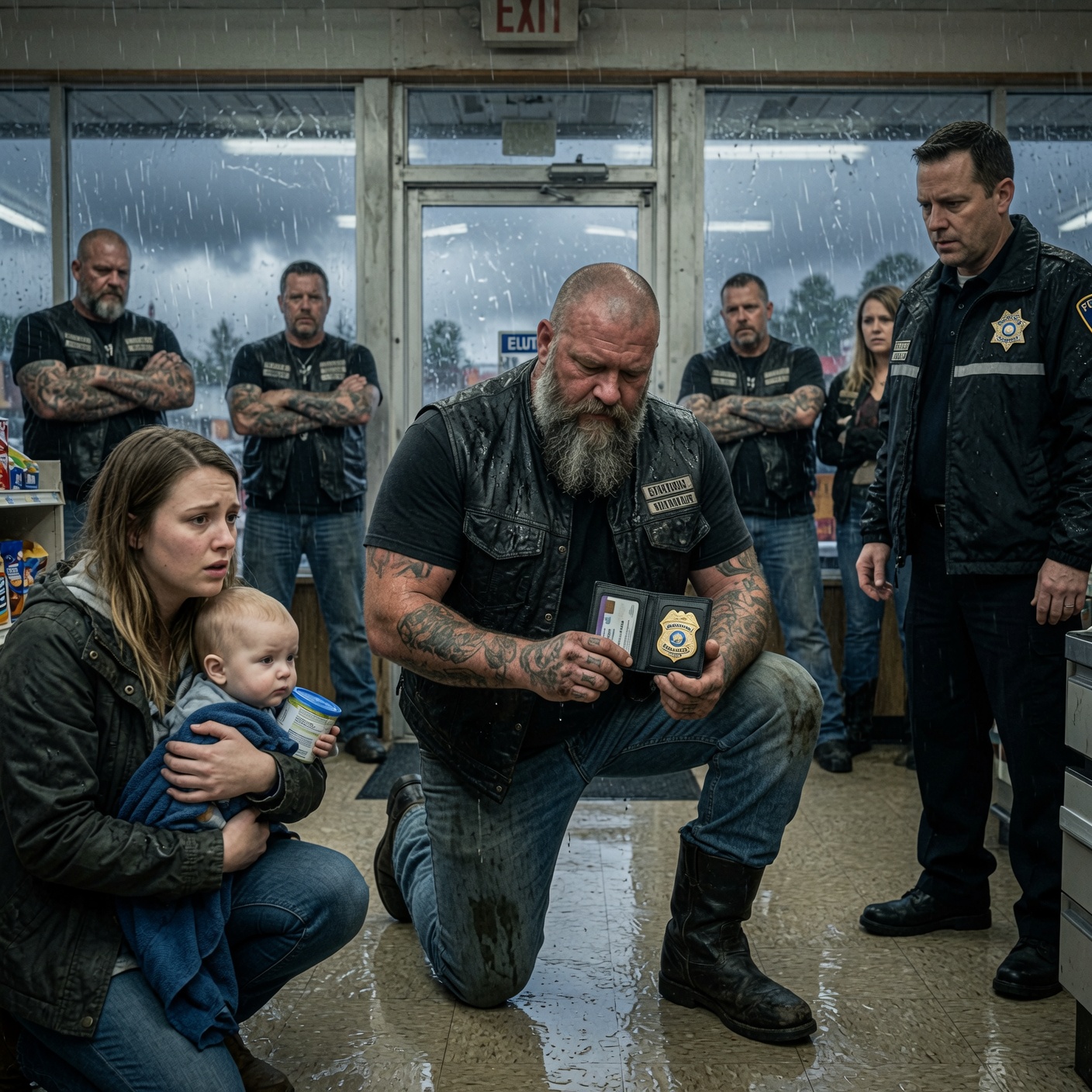
PART 3 — THE SAFE HOUSE
The investigation exploded within forty-eight hours.
Federal agents joined the sheriff’s office after discovering that several missing women had been illegally located through corrupt private investigators and fake law-enforcement credentials.
Nathan Brooks disappeared before officers reached his property.
Most people assumed he had escaped.
Brick didn’t.
“He isn’t running away,” he told the investigators.
“He’s running toward Hannah.”
Those words proved true three nights later.
The biker club had quietly moved Caleb and me to a secure farmhouse owned by one of their retired members.
Nobody posted photographs.
Nobody checked in online.
Nobody spoke about the location.
They simply stood watch.
Every night.
In shifts.
Rain had finally stopped when a pickup rolled slowly toward the gate just after midnight.
Brick was already outside.
He had been sitting in a folding chair with a thermos of coffee.
Waiting.
Nathan stepped from the truck.
He wasn’t carrying flowers.
Or apologies.
Only anger.
“You’ve got my wife.”
Brick answered calmly.
“No.”
“We’re protecting a woman who chose to leave.”
Nathan laughed bitterly.
“You bikers think you’re heroes?”
Brick shook his head.
“No.”
“I think you’re about to make another mistake.”
Nathan lunged.
He never reached the porch.
Three floodlights switched on.
Hidden cameras recorded everything.
Deputies who had been waiting a quarter mile away arrived less than thirty seconds later.
Nathan was arrested without a single punch being thrown.
As officers searched his truck, they recovered forged custody paperwork, burner phones, GPS trackers, and detailed files on several women who had fled abusive relationships.
The evidence linked him directly to the operation uncovered in Travis’s truck.
Months later, Nathan pleaded guilty to multiple federal and state charges.
Several missing women were located alive because investigators followed the records found in his network.
The day I testified, Brick sat quietly in the back of the courtroom.
He never spoke.
He didn’t need to.
After the hearing, Caleb—now walking with the unsteady confidence of a toddler—wandered across the courthouse lawn.
Instead of running toward me…
He ran toward Brick.
The enormous biker looked completely panicked.
“I don’t know what to do.”
“Pick him up,” I laughed.
“I might drop him.”
“You won’t.”
Brick slowly lifted Caleb into his arms.
The little boy rested his head against the giant’s beard as though he’d known him forever.
Brick smiled for the first time since we’d met.
Months later, I repaid the dollar he’d spent on that can of formula.
I tucked it into a thank-you card.
Inside I wrote:
“You didn’t buy baby formula that night.
You bought us enough time to find people who believed the truth before fear found us again.”
Brick kept the dollar inside his old leather wallet.
Not because it was worth anything.
But because every time he saw it, he remembered that sometimes the smallest act of kindness isn’t the dollar someone gives.
It’s the single question they choose to ask.
“Show me the warrant.”
That question saved two lives.
And it exposed a man who had counted on nobody asking it.