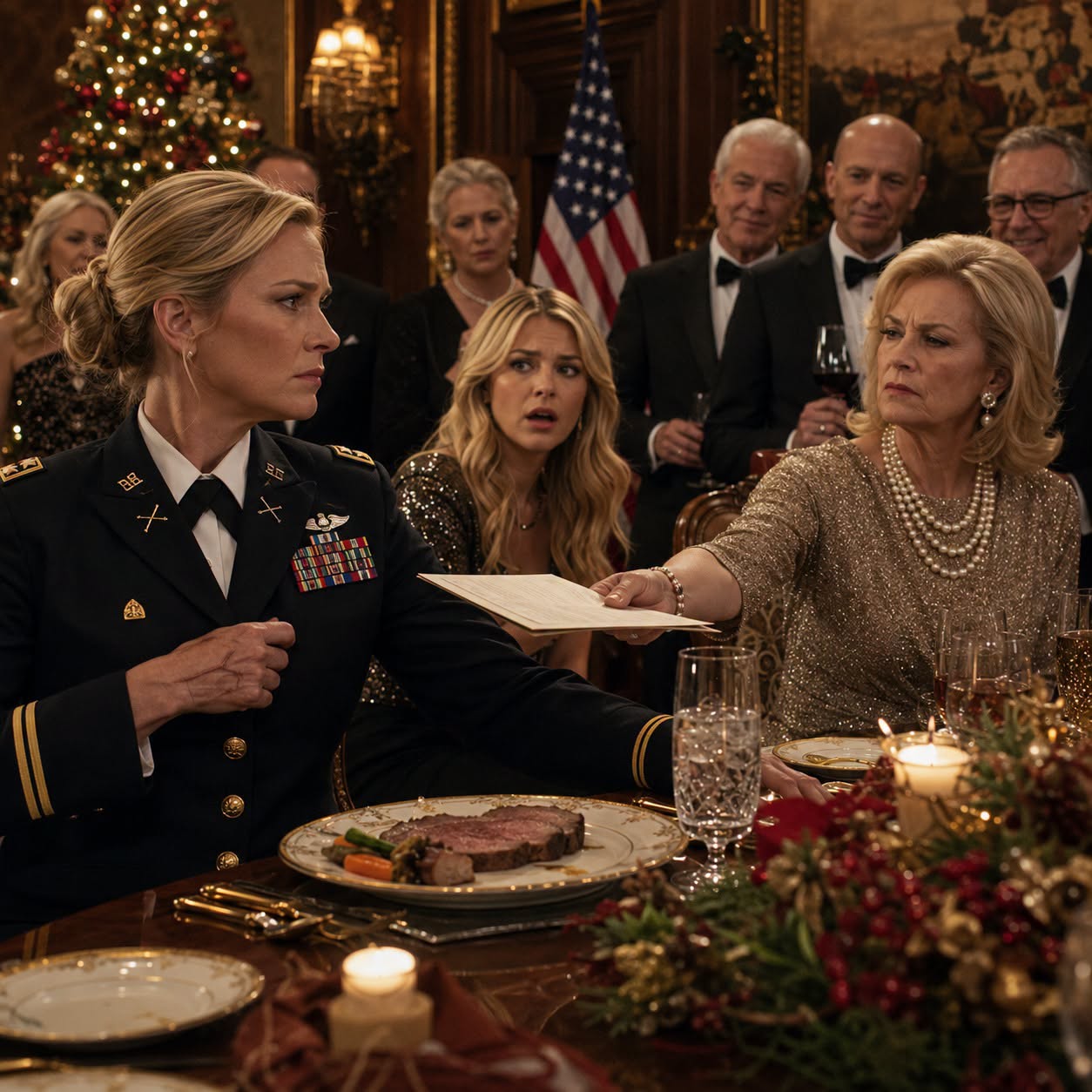
The envelope hit the table like a verdict. Not a Christmas card. Not a gift. Just thick, expensive paper sliding across crystal and linen, stopping beside a slice of prime rib I hadn’t touched and a sweating water glass that had already ruined the swan-folded napkin. My mother’s red nails rested on the edge of it as if she were pinning something dead in place
“Sign it,” she said, “and stop embarrassing this family.”
No Merry Christmas. No You’re home. No You look tired after twenty-eight years. Only that.
The Sterling dining room glittered around us like a holiday catalog that had never met real weather. A twenty-foot tree dripping gold. Garland thick enough to strangle on. Outside the tall windows, American flags snapped in the cold wind beside cars that cost more than most houses in the town I grew up in. Inside, the air smelled of roasted meat, butter, and my mother’s perfume—sharp, expensive, and slightly desperate.
Lily sat two chairs away, the color of skim milk. Her fiancé, Nathan Sterling, kept glancing at the envelope the way a man watches a fuse. His father, Charles, silver-haired and unblinking, studied me the way bankers study risk. Victoria Sterling’s smile never reached her eyes; it hovered there like something practiced in mirrors.
I opened the envelope.
Renunciation of Family Rights.
The words were bold, black, and arrogant. The paper itself felt like it had been chosen to intimidate.
My mother leaned forward. “I will not have you leeching off Lily’s future. Not after she marries into the Sterling family. You’re a low-paid soldier. A burden. A problem. A stain.”
Stain.
That one settled into the room and stayed.
I looked down at my hands. Scarred knuckles. A pale burn trailing along the wrist from a helicopter that had tried to kill me outside Fallujah and failed. The old field jacket I still wore carried the faint ghosts of diesel, snow, and black coffee from bases most people never heard of. To my mother it was proof of failure. To me it was simply the truth of who I had become without anyone’s permission.
She pointed at the document again. “You will sign away every claim. Every inheritance. Every right to interfere with Lily’s wedding or her new life. You may attend—back row, no uniform, no photographs, no speech. Ideally, no one needs to know you exist.”
Lily’s voice cracked. “Mom—”
“Quiet.”
Lily went silent.
That silence hurt more than the paper. I had carried that girl on my back the day she broke her ankle at twelve. I had skipped my own graduation celebration because she was sick and our mother was busy charming a church donor. I had sent birthday cards from places that smelled of sand, blood, and burnt metal. And now she sat there in cream silk, choosing comfort over courage.
I folded the document once. Clean crease. Then again. Sharp corners. I set it beside my plate and rested my hand on top of it.
“No.”
My mother’s smile vanished so quickly it almost made a sound. Victoria Sterling’s tiny gasp was pure theater. Charles Sterling’s eyes narrowed a fraction.
“You selfish little embarrassment,” my mother hissed. “You show up in that filthy jacket, park that smoking piece of junk in their driveway, track mud across marble, and now you want to play proud?”
I took a slow sip of water. Cold. Clean. Almost funny.
She thought she was watching me break.
She had no idea I had spent the last year watching her load the gun she was now pointing at herself.
It had begun the day Lily brought Nathan Sterling home.
Before that, my mother had been vain and petty, the sort of woman who complained about too much pepper in the church mac and cheese and then went back for seconds. After Nathan, something hungrier woke up inside her. Our small-town house suddenly looked “trash-adjacent.” The hallway photograph of me in uniform vanished into a cardboard box with cracked holiday decorations. In its place appeared a cheap oil painting she couldn’t afford, bought on a credit card she would never admit she couldn’t pay.
She started telling people I was stationed overseas permanently—convenient, distant, almost dead.
One rainy October night in a downtown restaurant she screamed at an elderly waitress named Martha because three drops of water had landed on her sleeve. Martha stood trembling, apologizing, saying her grandson was sick and she couldn’t lose the job. I reached for my wallet. My mother snatched the cash from my hand.
“Do not reward incompetence.”
That was the night I stopped calling her mother in my head. I began cataloging her instead—the way you catalog weather, or a weapon being assembled in a quiet room.
She never knew the rest.
She never knew I was an active-duty two-star Major General in the United States Marine Corps. She never knew the “cheap soldier salary” she despised was not what kept the lights on in her house. She never knew that six years earlier, in a hospital room that smelled of bleach and vending-machine coffee, my father had signed the entire Hopkins family trust over to me. He had gripped my hand with surprising strength and whispered, “Let your mother believe you have nothing. Then watch what she does.”
Forty seconds later the heart monitor went flat.
I kept the promise.
I drove the old Jeep. I wore the frayed jacket. I let her spend and preen and rewrite history. I let her believe power was loud and inheritance was something you could simply demand.
Now the final insult lay on the table in expensive black ink.
And my hand was already moving toward the inside pocket of my coat.
PART 2
I drew the thin black folder from the inside pocket of my jacket and laid it on the table with the same quiet precision I once used to place a sidearm on a briefing table.
No flourish. No speech. Just the soft, final sound of leather against glass.
My mother’s eyes flicked to it. Then to my face. Then back again, as if the folder might disappear if she stared hard enough.
“What is that?” she demanded.
I didn’t answer. I opened it.
The first page was a photograph. Not the formal portrait they put in newspapers. This one was taken in the field: me in full combat gear, dust on my face, the two stars on my collar catching the desert light. Behind me, a line of Marines who would have followed me into fire without question. The date stamp in the corner was only eleven months old.
I slid the photograph across the table until it stopped in front of Charles Sterling.
Then came the second page. Official letterhead. United States Marine Corps. The promotion orders confirming my rank as Major General, signed and sealed. Active duty. Current. Not retired. Not reserve. Not some dusty plaque on a wall.
Charles Sterling’s expression did not change, but the temperature in the room did.
Victoria’s smile finally cracked.
Lily’s hand rose halfway to her mouth and froze there.
My mother laughed—a short, brittle sound that tried to be contempt and failed.
“That’s a costume,” she said. “Some photo you staged to impress people. You’re still the same pathetic—”
I turned the next page.
The Hopkins Family Trust.
Full control transferred to me six years earlier. Every asset. Every account. Every property my father had spent a lifetime building while my mother spent a lifetime pretending the money appeared by magic. The signature at the bottom was his. The date matched the day the heart monitor went flat. The lawyer’s notary stamp was dark and final.
I placed the document in the exact center of the table, equidistant from every plate of untouched Christmas dinner.
No one spoke.
Somewhere in the house a grandfather clock ticked once, loud as a gunshot.
My mother reached for the trust papers the way a drowning person reaches for air. I did not stop her. I simply watched her eyes move across the lines, watched the color drain from her face the way it drains from a man who realizes the ground under his feet is no longer solid.
When she looked up, something ugly and frightened lived behind her eyes.
“You… you lied,” she whispered.
“No,” I said. “I simply never corrected your version of the story.”
Nathan Sterling cleared his throat, the first sound he had made in minutes. “This changes the wedding negotiations. Significantly.”
Charles Sterling finally spoke, voice low and careful. “Major General. I was not informed of your rank.”
“You weren’t meant to be,” I answered. “Neither was she.”
I looked at my mother. Really looked. The pearls. The silk. The carefully painted face that had spent years rewriting me into a burden so she could feel lighter.
“You spent six years calling me a stain,” I said. “You hid my photograph. You told people I was gone. You snatched money out of my hand so an old woman wouldn’t feel seen. And tonight you tried to make me sign myself out of existence so you could keep pretending the money was yours.”
I closed the folder.
“It was never yours.”
Lily made a small, broken sound. My mother opened her mouth, closed it, opened it again. No words came.
Outside, the wind pushed hard against the tall windows. Inside, the Christmas tree lights kept blinking on and off like they hadn’t noticed the world had just tilted.
I stood.
The chair scraped softly against marble.
“I’m not signing your paper,” I said. “And I’m not staying for dessert.”
I picked up the folder, slid it back inside my jacket, and turned toward the long hallway that led to the front doors.
Behind me, my mother’s voice finally found itself—high, cracked, desperate.
“You can’t just walk out. This is still my family. This is still—”
I stopped with my hand on the heavy front door.
I did not turn around.
“No,” I said, quiet enough that only the people who needed to hear it would. “It stopped being yours the day you decided I was disposable.”
I opened the door.
Cold night air rushed in, sharp and clean.
And that was when the headlights of three black government vehicles swept across the marble foyer, painting everything—tree, gold ornaments, the entire Sterling family—in hard, official light.
The black vehicles did not idle.
Doors opened in perfect sequence. Three Marine officers in dress blues stepped onto the gravel, the gold of their rank insignia catching the Christmas lights like quiet warnings. The tallest one, a colonel I had known since the early years in Helmand, gave a single nod when he saw me standing in the doorway.
No sirens. No drama. Just the measured presence of people who understood exactly who walked out of that house.
I stepped onto the cold stone porch. The night air smelled of pine and coming snow.
Behind me, the dining room had gone utterly still. I could feel their eyes on my back the way you feel a scope on your shoulder—sharp, temporary, already losing relevance.
My mother’s voice tried one last time, thinner now, almost childlike.
“You can’t leave like this. After everything I’ve done for this family—”
I turned.
Just once.
She stood in the center of the marble foyer, pearls askew, the renunciation papers still lying where I had left them like an accusation no one wanted to touch. Lily had risen from her chair but hadn’t moved closer. Nathan Sterling looked as if someone had quietly rewritten the terms of a deal he thought he controlled. Charles Sterling simply watched, calculating, already adjusting.
I met my mother’s eyes for the final time.
“You didn’t do anything for this family,” I said. “You did things to it. There’s a difference.”
I looked at Lily then. The sister I had carried, protected, written to from places that tried to erase people. Her face was wet, but she still didn’t speak.
“You get to choose who you become after tonight,” I told her. “That’s more than most people get.”
I didn’t wait for an answer.
The colonel opened the rear door of the lead vehicle. I slid inside. The leather was warm. The door closed with a solid, final sound that shut the Sterling mansion out of my life the way a vault closes.
As the convoy pulled away down the long brick driveway, I watched the house shrink in the side mirror—gold lights, American flags, the entire carefully constructed performance growing smaller and smaller until it was only a bright smear against the dark.
I did not look back again.
Somewhere in the folder still resting against my ribs was a second set of papers I had never needed to show them: the quiet instructions I had already signed months earlier, transferring a modest, irrevocable trust to Lily—enough to stand on her own if she ever decided the Sterlings’ world was not worth the price of her silence. The rest of the Hopkins fortune would go where my father had always intended: to the people who actually built things, protected things, and never needed an audience to know their own worth.
The road opened ahead, black and clean.
I leaned my head against the window and, for the first time in years, allowed myself a single, private breath that belonged to no one else.
The war I had been fighting in that house was over.
I had won it the only way that ever mattered—
by refusing to become the person they needed me to be in order to keep their story intact.
Outside, the first real snow of the season began to fall, soft and relentless, covering the tire tracks that led away from the mansion as if the night itself had decided some roads should not be followed back.