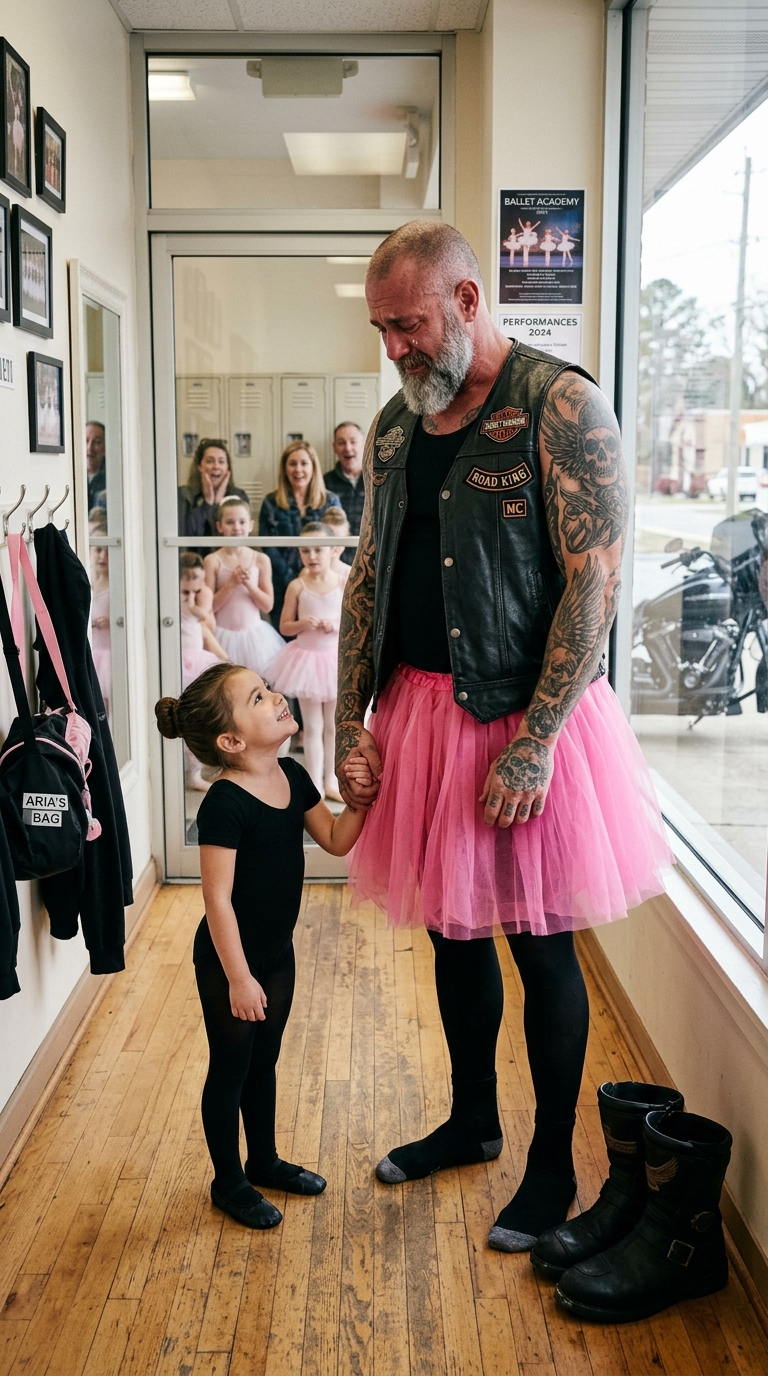
Part 2: A 300-Pound Biker Wore a Pink Tutu to Ballet Class for a Year—Then His Shy Daughter Stepped Onto the Stage Alone
Part 2 — The Girl Who Danced Only After Dark
I met Owen Callahan fourteen months before the pink tutu appeared.
He arrived at my studio on a September afternoon carrying a pair of ballet slippers as if they were delicate machine parts. Lily walked beside him in a faded denim jacket, one hand wrapped around two of his fingers because her palm could not close around his entire hand.
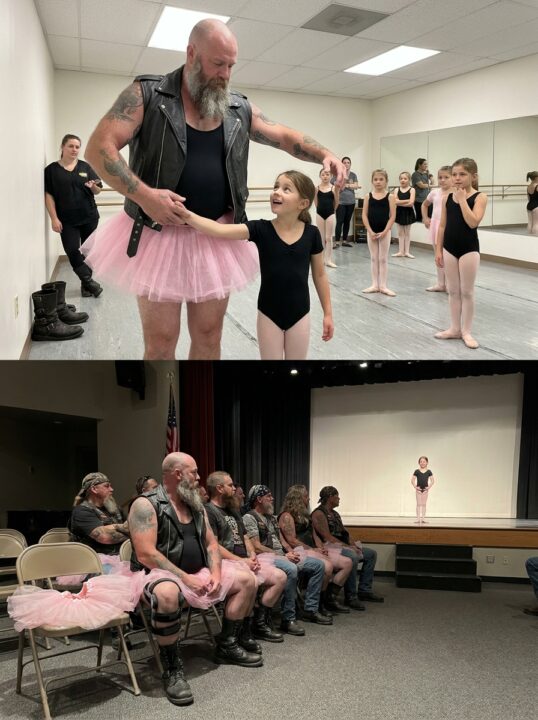
Other parents noticed the motorcycle first.
It was an older black Harley-Davidson Road King, clean but not polished, with worn leather saddlebags and a small passenger backrest Bear had reinforced himself. A child’s purple helmet hung from one handlebar.
Then they noticed him.
Bear had served nine years as a vehicle recovery specialist in the Army before returning to Iowa with a damaged left knee, two fingers that no longer straightened completely, and a habit of examining every exit whenever he entered a room. He did not discuss combat. When people thanked him for his service, he usually nodded and changed the subject.
After the Army, he opened Callahan Diesel & Recovery beside Highway 20. His shop handled disabled trucks, winter rollovers, and farm equipment that failed at the worst possible hour. He slept with his phone beside the bed and kept boots near the door.
His motorcycle club was not an outlaw club, though their worn leather, loud engines, and collection of scarred faces made explanations necessary whenever they held a fundraiser. The Iron Vale Riders escorted veterans’ funerals, repaired ramps for disabled residents, and delivered winter coats to two rural schools.
They also behaved like men who believed mockery was a form of affection.
Bear had learned to live inside that contradiction.
Lily’s mother, Rachel, had understood it too. She was a pediatric respiratory therapist with small hands, a quick temper, and a habit of keeping ballet music playing while she cooked. She met Bear when his Harley broke down outside the hospital after he had delivered toys during a Christmas ride.
Rachel stopped because she thought he was having a heart attack.
Bear was only swearing at a failed starter.
They argued for twelve minutes. She helped him push the bike. He bought her coffee the next morning. Seven years later, Lily was born.
Rachel wanted their daughter to dance, but she never forced the idea. She would move through the kitchen while Lily sat beneath the table, watching her feet. Sometimes Rachel lifted the little girl onto her toes and slowly turned her between the refrigerator and the sink.
Bear called it kitchen ballet.
Then Rachel became ill.
What began as exhaustion became a diagnosis of an aggressive heart condition complicated by damage from a childhood infection. She remained on the transplant list for eleven months. A suitable heart never arrived.
Lily was six when her mother died.
For nearly a year afterward, she refused music.
Bear removed the speaker from the kitchen but left Rachel’s ballet shoes in the hall closet. He did not know whether keeping them was healthy. He only knew throwing them away felt impossible.
The Iron Vale Riders tried to help.
Club president Hank “Deacon” Morris arranged meals. Mack Sloan fixed the leaking gutter. A prospect named Tyler mowed Bear’s lawn until snow covered it. Men who could rebuild transmissions stood helpless when Lily hid beneath the kitchen table and would not eat.
Bear never asked them to solve her.
He asked them to stay.
Gradually, Lily began speaking again. She talked to Bear, her teacher, and two girls at school, but unfamiliar rooms closed her voice. Crowds were worse. Being watched made her hands shake.
The first ballet brochure came home inside her school folder.
Bear found it folded into a square no larger than a postage stamp.
“Want to try?” he asked.
Lily shrugged.
Bear waited.
“Mom wanted me to,” she finally said.
“What do you want?”
She unfolded the paper, smoothed it on the table, and traced the photograph of a girl in white slippers.
“I want to want to.”
That was enough.
Bear called my studio.
During her first lesson, Lily stood in the back and copied every movement at half size. When the class raised both arms, hers reached her shoulders. When they crossed the room, she took three steps and stopped.
Bear watched through the glass.
He never pushed.
At home, however, Lily danced in the garage while Bear worked. She used a yellow floor stripe as her stage, moving between the hydraulic lift and a stack of winter tires while wrenches clicked and the radio played softly.
Bear began turning down work every Thursday afternoon.
That cost him money.
He said nothing about it.
The first small crisis came when another parent complained about his leather cut. She said the skull-shaped patch frightened her five-year-old and asked whether Bear could wait outside.
The skull was part of a memorial patch bearing the name of a club brother killed by a distracted driver. Bear could have explained that.
He did not.
He removed the cut, folded it over his arm, and sat in a black T-shirt that revealed more tattoos than the vest had covered. The parent did not complain again.
Lily noticed.
She noticed everything involving her father.
At school, two boys began calling him “the jail biker.” Bear had never been incarcerated, but facts have weak legs beside playground rumors. One child said men with neck tattoos hurt people. Another claimed motorcycle clubs stole children.
Lily punched neither boy.
She stopped telling classmates that Bear was her father.
A teacher discovered the change when Lily asked to use her mother’s last name on a family-tree assignment. The teacher sent a note home asking Bear to discuss “identity consistency.”
He read the note twice, folded it, and stitched it inside his leather cut.
The sentence that mattered was written in Lily’s pencil beneath the teacher’s message:
If they know he is mine, they will look at me too.
Bear carried those words against his chest for the next year.
He did not confront Lily.
He understood that shame grows stronger when dragged into the light before a child has words for it. Instead, he began searching for ways to make being seen feel survivable.
The opportunity arrived on a Thursday when Lily refused to enter ballet class.
Sitting beside her beneath the paper ballerinas, Bear asked what made the room different from the garage.
“In the garage, nobody watches.”
“What do you think they see here?”
She studied his knuckles.
“Somebody wrong.”
Bear looked through the glass at nine girls wearing matching black leotards.
“Wrong how?”
“Not like them.”
Then came the sentence that put him in pink tulle.
“I don’t want to be the strangest one.”
Bear drove directly from my studio to a costume shop beside the highway.
He had made a decision.
He would take that position from her.