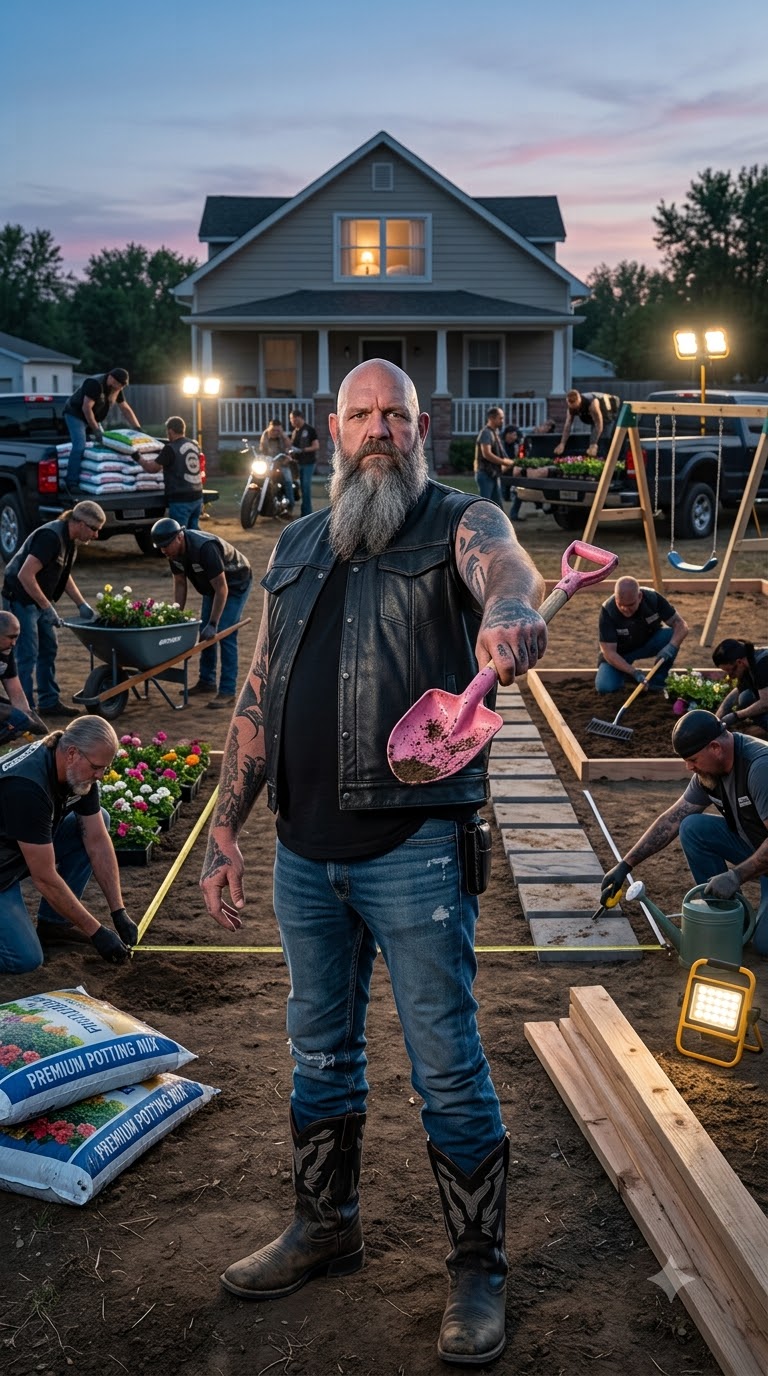
Forty Bikers Invaded an Abandoned Lot at 1:17 A.M. While My Sick Daughter Slept—By Sunrise, the View From Her Window Had Become Something No One Could Explain
Part 3, The Night the Club Almost Broke
The Iron Lantern clubhouse had once been a freight warehouse. Its roof leaked in six places, the furnace worked only when kicked, and one wall leaned far enough that members avoided parking motorcycles beside it.
For two years, the club had saved money for repairs.
Bear asked them to spend it on weeds.
According to Reuben Cole, the white-bearded rider who had met Bear outside our house, the first vote was seventeen in favor and twenty-two against.
Nobody opposed helping Ellie.
They opposed losing the clubhouse.
The Iron Lanterns were not wealthy men and women. They were mechanics, roofers, truck drivers, school custodians, warehouse workers, two retired firefighters, one dental assistant, and a woman named Nia Brooks who delivered mail six days a week.
The clubhouse was where they held fundraisers, stored tools, and gathered after funerals. Its kitchen fed families when a rider lost work. During winter, several members without stable housing slept in the upstairs office.
“If the wall comes down,” Reuben said, “we don’t have another place.”
Bear stood at the end of the workbench, one hand resting beside Ellie’s drawing.
“She leaves Thursday.”
“So build it next month.”
“She won’t be looking through that window next month.”
“We don’t even own the lot.”
“Then we buy it.”
“With what?”
Bear glanced toward the leaking ceiling.
Nobody spoke.
A younger rider named Troy pushed back his chair. “You want us homeless for a fairy garden?”
Bear’s jaw tightened. Twenty years earlier, that question might have started a fight. He had been quick with his hands then, slow with everything else.
Now he said, “I want you to vote again after you know why.”
Bear removed the pink shovel from beneath the workbench.
A faded name ran along its handle in purple marker.
SADIE.
Bear’s daughter had been seven when she died.
Most of the newer riders knew Bear had lost a child, but few knew the details. He did not carry photographs in his wallet. He did not mark the date publicly. When people offered easy phrases about angels and better places, he walked away.
Sadie had developed bacterial meningitis at six. She survived, but complications left her unable to walk and weakened her lungs. For the last eleven months of her life, she spent most days in a bedroom above Bear’s mother’s house.
Outside that window sat Bear’s garage.
It was not an ugly view, he told the club. It was worse.
It was an empty one.
Bear had been thirty-two, drinking heavily and serving eighteen months for an assault committed outside a bar. Sadie sent him drawings of fairy houses she wanted built beneath the garage windows.
Her last letter contained a list.
Blue door.
Stone bridge.
Purple flowers.
A mailbox for wishes.
Bear promised to build everything when he came home.
Sadie died six weeks before his release.
He returned to a locked garage filled with wood, paint, and miniature windows his mother had purchased for the project. Bear closed the door and did not open it again for twenty years.
The club went silent.
Reuben asked, “The stuff still in there?”
“Most of it.”
“You kept it?”
“Couldn’t throw it away. Couldn’t touch it.”
Nia picked up Ellie’s drawing. It showed a blue door, a stone bridge, purple flowers, and a mailbox for wishes.
The similarities were not supernatural. Children draw the same kinds of magic. But to Bear, the four familiar objects felt less like a coincidence than an unfinished instruction.
Troy crossed his arms. “And if we spend the roof money, what happens when the snow comes?”
Bear looked around the warehouse.
“I sell my bike.”
Every rider knew what Bear’s Harley meant to him. He had rebuilt it after leaving prison, replacing one part at a time while getting sober. The motorcycle had carried him to recovery meetings, job interviews, and the cemetery where Sadie was buried.
Reuben shook his head.
“We’re not selling your bike.”
“Then find another roof.”
The second vote passed by one.
Twenty in favor.
Nineteen against.
Troy walked out before it ended.
The work began immediately. Nia tracked down the lot’s tangled ownership history. Franklin Investments had dissolved after unpaid taxes. The city had scheduled the property for a land-bank auction, but no buyer wanted the cleanup costs.
The club pooled its repair fund, Bear’s savings, and a short-term loan secured against his shop tools. They purchased the parcel for little more than the tax debt, though environmental testing and disposal fees nearly doubled the cost.
They had the land.
They did not have time.
Ellie would leave at nine Thursday morning. The transfer documents were finalized at four Wednesday afternoon. Forty riders had seventeen hours to clear the lot, build the garden, and position every feature where she could see it from bed.
At six, rain began.
At seven, the rented excavator failed to start.
At eight, the supplier called to say the load of soil would not arrive until morning.
At nine, Reuben found Bear alone inside his garage, staring at twenty years of dust.
Unfinished fairy houses covered the shelves. Small bridges leaned against boxes. Glass jars held blue tiles and smooth white stones. On a child-sized table sat a purple wooden mailbox.
Bear had not moved.
Reuben stepped beside him.
“We don’t have to use these.”
“Then what was I saving them for?”
Bear picked up the pink shovel.
His hand shook.
At 9:23 p.m., the Iron Lanterns opened Sadie’s boxes.
At 10:05, Troy returned with his employer’s excavator, three licensed operators, and enough donated soil to fill two dump trucks.
At 11:40, the first motorcycles turned onto Linden Avenue.
At 1:17 a.m., I called the police.
Part 4, What the Police Found in the Dirt
Two officers entered the lot while I watched from behind my kitchen curtain. One kept a hand near his belt. The other raised a flashlight toward Bear.
“Step away from the tools.”
Bear put down the sledgehammer.
The riders stopped working one by one. Forty leather-clad figures stood beneath construction lights while rain ticked against wheelbarrows and motorcycle seats.
The scene looked criminal.
A broken chain lay at the entrance. A deep trench crossed the lot. Two riders were cutting apart the burned sofa. Another group loaded rusty metal into a trailer. Bear’s boots and jeans were covered in mud.
Officer Daniel Price asked who owned the property.
Bear handed him a folder protected inside a freezer bag.
“We do.”
“Since when?”
“Four this afternoon.”
Officer Price examined the deed, insurance documents, temporary work permit, and waste-disposal authorization. The club had prepared everything it could prepare. What they did not have was permission to run power tools after the city’s noise cutoff.
The younger officer looked toward our house.
“We received a report that you were watching a child’s bedroom.”
Bear pointed across the lot.
“Second-floor window. She’s ten. Bedridden. Leaves for the hospital at nine.”
“That doesn’t answer the question.”
“We’re building to that sightline.”
“For what?”
Bear lifted the pink shovel from the ground.
“A better morning.”
Officer Price walked through the mud with his flashlight. He saw wooden arches stacked beside bags of soil. He saw tiny houses painted in soft colors, a stone path laid out on tarps, and hundreds of solar lights waiting in cardboard boxes.
He also saw the cracks in the older pieces.
“These new?”
“No.”
“Whose were they?”
“My daughter’s.”
Bear offered nothing more.
Officer Price looked toward Ellie’s dark window. He had two choices. He could shut down the work and issue citations, which would almost certainly prevent the garden from being completed before she left. Or he could enforce the quiet-hours ordinance differently.
“No engines,” he said. “No power saws until six. Keep voices down. I don’t want one nail or piece of glass left near the sidewalk.”
Bear nodded.
The younger officer lowered his radio. “That’s it?”
“That’s it if they stay quiet.”
Mr. Alvarez emerged from his house carrying a thermos. I watched him cross the street in slippers and hand coffee to the officers.
Then he picked up a rake.
My phone remained in my hand.
Guilt arrived slowly. Fear had made sense ten minutes earlier. Now it had nowhere to go.
I pulled on my coat and went outside.
Bear saw me at the curb. Mud streaked his beard. The pink shovel rested over one shoulder.
“You called?” he asked.
“Yes.”
“Good.”
That was not the answer I expected.
“You’re not angry?”
“You didn’t know us.”
“You could have told me.”
“You might have told her.”
He glanced at Ellie’s window.
“We get one sunrise.”
Up close, the fairy structures were more delicate than I imagined. Someone had carved windows into hollow logs. Small bridges crossed shallow trenches lined with blue stone. Metal flowers made from old motorcycle parts stood among real plants.
I noticed a purple mailbox on a workbench.
The paint was faded. One corner had been repaired with wire.
“Was that your daughter’s?”
Bear’s face closed.
“Was supposed to be.”
I waited.
He did not explain.
Bikers spoke to him as they worked. “Bear, path is three inches high.” “Bear, we need another load.” “Bear, drainage is backing up.”
Each time, he answered with a few words and returned to the dirt.
The club worked without the power tools. They carried broken concrete by hand. They pulled weeds with gloves and pry bars. Nia knelt in the rain arranging white stones into the shape of wings.
At 2:38, the drainage ditch overflowed.
Water rushed across the lower half of the lot, lifting bark mulch and pushing two unfinished fairy houses toward the street.
“Kill the lights,” Bear shouted.
For a second, I thought he was giving up.
Then forty riders moved.
They formed a line from the flooded trench to the higher ground. Buckets passed hand to hand. Others dug a diversion channel with shovels. Reuben used pieces of the dismantled sofa frame to reinforce the path.
Bear waded into water above his boots to rescue the purple mailbox.
A board shifted beneath him. He fell to one knee and disappeared behind the weeds. Several riders reached for him, but he stood again holding the mailbox against his chest.
The repaired corner had split open.
A folded piece of paper slipped into the mud.
Bear caught it before the water did.
I saw a child’s handwriting.
When he realized I had seen it, he turned away.
At 3:10, the rain stopped.
At 3:25, a hospital transport coordinator called to say Ellie’s ambulance would arrive an hour earlier than scheduled. Her latest blood results were worse. We had to leave at eight.
The bikers had less than five hours.
Half the lot remained weeds and mud.
Bear looked at the washed-out path, the scattered stones, and the unopened flower trays. Then he looked toward Ellie’s window.
“We don’t need perfect,” he told the club.
“What do we need?” Troy asked.
Bear planted Sadie’s pink shovel in the soil.
“Something worth waking up to.”
Forty riders went back to work.
So did I.
Part 5, Sunrise for One Window
At 4:00 a.m., I entered the lot carrying every outdoor extension cord I owned.
By 4:15, Mr. Alvarez had awakened half the block. A bakery owner brought coffee and day-old rolls. Two teenagers arrived with headlamps. Officer Price returned after his shift wearing work gloves instead of his uniform.
Nobody discussed my complaint.
There was too much to finish.
Bear assigned me to the flower beds nearest Ellie’s sightline. Purple salvia went in the back, white alyssum along the path, yellow marigolds beside the tiny houses. The colors were chosen for visibility from the second floor.
Every detail had a reason.
The solar lanterns followed the curve Ellie could see from her pillow. The blue-stone stream caught the morning light. Taller structures stood near the rear fence so they would not disappear behind the flowers.
Even the fairy doors faced her window.
At 5:12, Bear climbed a ladder and tied thin silver bells to the branches of a young maple tree the club had planted in the center. A breeze moved through them, creating a sound so faint I had to hold my breath to hear it.
“Sadie wanted bells,” Reuben told me.
Bear pretended not to hear.
The story came to me in pieces while we worked. Sadie’s illness. Bear’s prison sentence. The letters. The promise he had not kept.
I looked at the wooden houses being carried from his trailer.
“This was her garden.”
Reuben shook his head.
“No. It never became hers.”
That difference mattered.
Bear was not giving away something Sadie had enjoyed. He was finishing something she had waited for and redirecting it toward a child who still had time to see it.
At 5:40, Troy connected the final section of irrigation hose. At 5:53, Nia filled the purple mailbox with folded paper stars made by club members’ children.
At 6:01, city noise restrictions ended.
The saws started.
Nobody on Linden Avenue complained.
Bear worked on the last structure himself. It was a small blue door set into the base of the maple tree. He sanded the edges, repainted one hinge, and attached a round brass knob.
Inside the tiny doorway, he placed the mud-stained letter that had fallen from the mailbox.
I did not ask what it said.
At 6:35, the burned sofa was gone.
At 6:52, the final load of weeds left in Troy’s trailer.
At 7:06, forty motorcycles were moved into two silent rows along the back fence. Their chrome reflected the pale morning sky, but none blocked the garden.
At 7:15, Bear climbed onto the sidewalk and examined the lot from beneath Ellie’s window.
“Too much red on the left,” he said.
Nia stared at him. “We have forty-five minutes.”
“She hates red.”
“How do you know?”
“She told me it looks angry.”
Six bikers moved the red begonias.
At 7:31, I returned inside.
Ellie was still sleeping. Her face looked smaller against the pillow than it had the previous night. The transplant bag waited beside the bedroom door. Hospital forms covered my desk.
Outside, the riders turned off every work light.
The garden disappeared briefly into the gray before sunrise.
Bear stood alone beside the maple tree. The pink shovel rested in his hands.
I opened the window.
He looked up.
“She wake easy?” he asked.
“Not anymore.”
“We can wait.”
The ambulance would arrive in twenty minutes. We did not have time to wait, but I could not bring myself to shake Ellie awake.
Then the bells moved.
A breeze crossed the garden, touched the maple branches, and sent a soft silver sound toward her window.
Ellie’s eyes opened.
She looked at me first.
Then she heard the bells again.
“What’s that?”
“I don’t know.”
I helped raise her bed. The motor hummed slowly. As her view cleared the windowsill, morning light reached the blue stones across the street.
She stopped breathing for a second.
The abandoned lot was gone.
In its place stood a winding garden filled with purple and yellow flowers. Tiny bridges crossed a blue-stone stream. Fairy houses leaned beneath ferns. Silver bells hung from the maple. Forty small lanterns marked the path, one for every rider who had worked through the night.
Ellie pressed both hands against the glass.
“Mom.”
I could not answer.
“The fairies came.”
Across the street, forty bikers stood behind the garden. Mud covered their boots. Their leather vests were soaked. Several had bandages around blistered hands.
Bear remained near the tree.
To Ellie, he was not a frightening man who had spent half his life carrying regret.
He was the ogre guarding the fairies.
She opened the window.
“Did you do this?”
Bear looked around as though the question surprised him.
“Do what?”
“My garden.”
He lifted the pink shovel.
“Fairies did the skilled work. We moved dirt.”
Ellie laughed.
It was not a large laugh. Treatment had taken the strength from it. But every biker heard.
Forty hardened faces changed at once.
Some smiled. Some looked at the ground. Reuben removed his glasses and cleaned lenses that were not dirty.
Ellie searched the garden until she found the blue door beneath the maple.
“Who lives there?”
Bear’s hand tightened around the shovel.
“Someone who waited a long time.”
“For what?”
He looked up at my daughter.
“For another kid to find the door.”
The ambulance turned onto Linden Avenue.
Ellie’s smile disappeared.
“I have to go.”
Bear nodded. “Garden will be here.”
“What if I don’t come back soon?”
“We know how to wait.”
She studied him through the glass.
Then she placed one of her drawings against the window. It showed an enormous ogre sitting outside a fairy castle, wearing a leather vest and holding a pink shovel.
Bear lowered his head.
The other riders gave him space.
He stood there until the paramedics carried Ellie downstairs.
Part 6, The Mailbox for Wishes
We left the house at 8:04.
Every biker removed his or her hat as Ellie’s stretcher passed. No engines started. No one crowded her. The riders simply formed two lines along the garden path.
Bear stood at the end.
Ellie asked the paramedics to stop.
She lifted one hand toward him.
“You forgot something.”
Bear stepped closer.
“What?”
“Your shovel.”
He looked down at the faded pink plastic in his hand.
“Thought I’d leave it with the garden.”
“Okay. But you have to use it.”
“For what?”
“More flowers.”
Bear nodded. “Yes, ma’am.”
At the hospital, Ellie’s procedure was delayed after new tests showed an infection. The delay became three days, then nine. Her transplant began the following week.
For forty-one days, she could not return home.
Bear sent no speeches and made no promises about recovery. Each morning, someone from the Iron Lanterns photographed one small section of the garden for me to show Ellie.
A yellow flower opening.
Rain collected on a fairy roof.
The first butterfly beside the blue door.
A squirrel stealing a paper star from the purple mailbox.
The garden changed while Ellie did.
Her transplant brought fever, mouth sores, exhaustion, and several frightening nights when monitors refused to stay quiet. Some mornings she asked for photographs. Other mornings she turned her face away.
Bear understood that hope could become another demand when a child was too tired to perform it.
On those days, he sent only a photograph of the ogre he had carved from an old fence post. The figure sat beneath the maple wearing a tiny leather vest.
Ellie named him Mr. Grumble.
The purple mailbox became a neighborhood ritual. Children placed wishes inside, believing the fairies collected them after dark. The Iron Lanterns opened the box every Friday—not to read private wishes for entertainment, but to look for things they could quietly fix.
One child wished for a bicycle tire.
Another wanted flowers for his grandmother’s grave.
A boy asked for warm gloves for his father.
The club fulfilled what it could without signing its name.
Bear never opened letters addressed to the fairies alone.
Three months after the transplant, Ellie came home in a wheelchair.
The garden was no longer visible only from her window. The club had built a smooth path wide enough for her chair, including a gentle ramp from the sidewalk.
Bear waited near the blue door.
He had placed Sadie’s pink shovel beneath the tree, sealed inside a clear case to protect it from rain.
Ellie rolled closer.
“Was Sadie your fairy?” she asked.
Bear looked at me. I had never told her the name.
Ellie pointed to the tiny door. Inside, behind the brass knob, she had found the edge of a folded letter.
Bear opened the door and removed it.
The paper was stained and fragile. Sadie had written it at seven years old:
Dad, if I can’t use the garden, make it for somebody who needs magic more.
Bear had carried those words for two decades without obeying them.
He handed the letter to Ellie.
“She was my daughter.”
“Did she come home?”
“No.”
Ellie read the sentence again.
“Maybe this is still her garden.”
Bear shook his head.
“It’s yours.”
“It can be both.”
He looked away toward the motorcycles.
Ellie reached out and touched his scarred hand.
“There’s enough room.”
Bear did not cry. He closed his fingers around hers and stood quietly beside the blue door.
For once, he let a child correct him.
Part 7, The Ogre’s Night Shift
The Iron Lantern clubhouse survived that winter.
Troy and Reuben contacted every roofing company whose vehicles had ever been repaired at Bear’s shop. Materials appeared first. Then volunteers. On a cold Saturday in November, riders, neighbors, police officers, and three construction crews replaced the roof together.
Nobody sold a motorcycle.
The fairy garden survived too.
The abandoned lot became a small neighborhood trust managed by residents and the Iron Lanterns. There were no admission fees, donation boxes, or plaques praising the club. Bear refused every suggestion to name it after him.
The only sign stood beside the path:
FOR ANYONE WHO NEEDS A BETTER WINDOW.
Ellie grew stronger slowly. She still used her wheelchair on difficult days, but by spring she could walk from the sidewalk to the blue door with braces and Bear’s hand beneath her elbow.
They counted the steps.
Not eight.
Forty.
One for each rider.
Every year, on the night before Ellie’s transplant anniversary, the Iron Lanterns returned after sunset. They repaired roofs, repainted doors, replaced dead flowers, and filled the purple mailbox with paper stars.
Bear always worked beside the maple.
He kept Sadie’s shovel nearby, though he rarely used it in hard soil. The plastic had grown brittle with age.
One night, I asked why the club still worked after dark when they could easily return during the day.
Bear adjusted a lantern beside the blue-stone stream.
“Morning should get the credit.”
Ellie was twelve the first time she joined their overnight work. She wore a small plain denim vest the club had made for her and carried a stronger pink shovel Bear bought at a garden store.
At dawn, a new family moved into the house beside ours. Their little boy pressed his face to an upstairs window and stared at the fairy doors.
Ellie saw him.
She looked at Bear.
“Another window,” she said.
Bear rested both hands on his shovel.
“Yeah.”
“What do we do?”
He glanced toward the forty motorcycles waiting beside the curb, their engines quiet beneath the paling sky.
“We make the view better.”
The bells stirred above them.
Follow our page for more powerful biker stories about intimidating strangers, quiet acts of kindness, and the communities transformed beneath their leather.