The Handshake That Had Tennis Fans Looking Twice: Alex Eala, Qinwen Zheng, and the Moment That Sparked a Wave of Speculation
Alex Eala left the court in Washington with a comeback victory, but it was the few seconds immediately after the match that unexpectedly became a talking point of its own.
Eala defeated Qinwen Zheng 4-6, 6-4, 6-1 in the first round of the Mubadala Citi DC Open, recovering from a set and a break down to complete another impressive comeback. The victory was significant on its own: it leveled their overall head-to-head at 1-1, after Zheng had won their previous meeting at the 2023 Asian Games.
But online discussion quickly moved away from the scoreline.
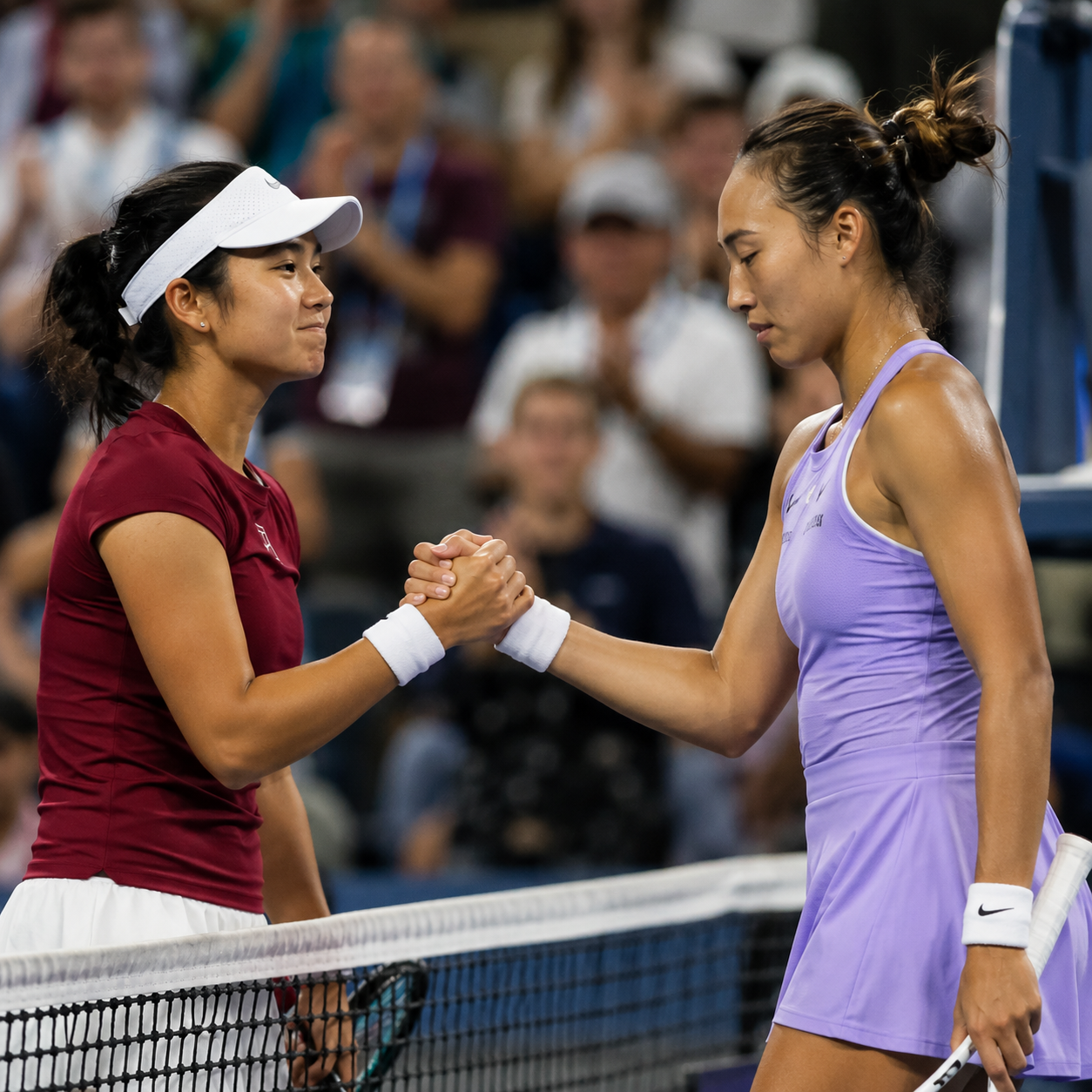
Instead, attention centered on the handshake at the net.
Sports Illustrated described Zheng’s handshake as “frosty,” noting that she briefly clasped Eala’s hand before turning toward the umpire’s chair. A clip of the moment circulated on social media and prompted fans to comment on Zheng’s demeanor immediately after the defeat.
For a sport in which post-match handshakes are often treated as a final gesture of respect, even a brief interaction can become highly visible when cameras are already trained on the players.
And that is precisely what happened.
The moment was short. There was no confrontation. There were no words exchanged publicly that suggested a dispute. Yet the visual was enough to send fans into speculation mode, with some interpreting the handshake as unusually cold or distant.
That interpretation, however, needs an important dose of context.
Zheng has previously addressed the way she handles post-match interactions. In January 2025, she explained that she considers a handshake the basic form of respect after a match, regardless of whether she wins or loses. She also said she does not usually hug opponents and does not necessarily smile after a defeat because, in her view, losing a match is not a happy moment.
That earlier explanation changes the way the Washington moment can reasonably be viewed.
What some viewers saw as a message directed at Eala may simply have been a familiar expression of Zheng’s competitive frustration.
That distinction matters because the match itself was a highly emotional comeback.
Eala did not simply win in straight sets. She had to turn the match around.
After taking the opening set 6-4, Zheng broke Eala at 4-3 in the second set, moving to within two games of victory. Eala immediately responded by breaking back at love. From there, the momentum shifted dramatically. She won the next six games, forcing a deciding set and then building a 4-0 lead in the third.
Eventually, Eala closed the match 4-6, 6-4, 6-1.
For Eala, the result was another demonstration of the quality that has become increasingly associated with her game: the ability to stay composed when a match begins to move away from her.
Speaking after the victory, Eala said she believed the fighting mentality had always been part of her. What had changed, she suggested, was her experience. The more three-set matches she had played against strong opponents, the more comfortable she had become in those moments.
That bigger story is arguably more important than the handshake.
Eala entered Washington as the world’s No. 28 player and immediately faced one of the tournament’s most experienced opponents. Zheng, a former World No. 4 and 2024 Olympic gold medalist, had already established herself as one of the biggest names in women’s tennis. At the time of the match, Zheng was ranked No. 123.
The contrast made the result especially striking.
Eala was the rising star carrying enormous momentum from Wimbledon.
Zheng was the established champion trying to regain consistency.
And for nearly two sets, it appeared that experience and power might prevail.
Then Eala changed the direction of the match.
That comeback also explains why the handshake attracted so much attention. It came at the end of a match in which one player had dramatically reversed the momentum after appearing to be in serious danger of losing.
A tense ending was almost inevitable.
But tennis fans are increasingly accustomed to reading meaning into every gesture involving high-profile players, particularly when the match itself has already created a strong emotional narrative.
Online culture amplifies that tendency.
A few seconds can be isolated from an entire contest and turned into the centerpiece of the story. One frame can circulate more widely than an hour and a half of actual tennis.
That appears to be what happened here.
The clip shared online drew immediate attention, with reactions focusing on the brief handshake and Zheng’s expression. Sports Illustrated itself framed the moment as notable, while also emphasizing that Zheng’s behavior should not automatically be interpreted as disrespect.
That last point is crucial.
There is currently no public evidence from the players establishing a feud between Eala and Zheng.
There is no confirmed statement from Eala accusing Zheng of disrespect.
There is no public declaration from Zheng indicating hostility toward Eala.
What exists is a visible moment, a large online audience, and different interpretations of what that moment might mean.
That distinction creates the perfect environment for speculation, but it does not turn speculation into fact.
The most defensible reading is therefore a simple one: Zheng was frustrated after losing a match she had controlled for significant stretches, and the handshake was notably brief. Her own previous comments about post-match handshakes provide a plausible explanation for that behavior.
At the same time, the fact that the moment attracted attention tells us something important about Alex Eala’s growing profile.
A year ago, a handshake involving Eala might have passed almost unnoticed outside dedicated tennis circles.
Now, her matches are becoming events.
The WTA itself highlighted just how significant Eala’s presence had become in Washington. Tournament chairman Mark Ein said that at least 80 percent of ticketing inquiries over the previous month were related to when Eala would be playing, and suggested the real figure could be even higher. He described her growing following as a phenomenon spreading beyond the Philippines.
That context helps explain why a tiny moment at the net could suddenly become part of a larger online conversation.
Eala is no longer simply participating in tournaments.
People are watching her.
People are discussing her.
And increasingly, people are examining the details around her matches just as closely as the matches themselves.
That can be a sign of stardom.
It can also create problems.
When a player becomes a major social-media figure, neutral moments are more likely to be turned into narratives. A glance can become “tension.” A short handshake can become “feud.” A disappointed expression can become “anger.” The temptation to build a larger story from a tiny visual moment becomes almost irresistible.
Yet professional sport is full of emotionally charged moments that mean much less than they appear to mean on camera.
For Eala and Zheng, the clearest evidence remains on the scoreboard.
Eala won.
She recovered from a difficult position.
She found another level under pressure.
And she moved into the second round.
The handshake came afterward.
That should probably keep the moment in perspective.
Still, the fascination is understandable.
Eala’s rise has made her one of the most closely followed young players in tennis, while Zheng remains a major figure whose competitiveness and intense personality have already generated strong reactions in the past. Their first meeting in Washington therefore carried much more narrative weight than an ordinary opening-round match.
There is also an intriguing competitive thread between them.
Before Washington, Zheng had already defeated Eala at the 2023 Asian Games in a three-hour battle. Their meeting in D.C. became the first time they faced each other on the WTA Tour, and Eala’s comeback victory brought their overall head-to-head level at 1-1.
That means the next chapter, should it come, already has a storyline.
Two young stars.
One win each.
Very different career trajectories.
And a growing audience watching everything.
That is why the handshake has become more than a handshake for some fans.
Not because it proves a rivalry.
Not because it confirms bad blood.
But because, in today’s tennis environment, even the smallest moment between two highly watched players can become a story.
And Alex Eala has now reached the point where people are paying attention to every chapter.
The most fascinating part may be that the real story was never the handshake at all.
It was the comeback that happened before it.
And if Eala’s current trajectory continues, there may be many more moments like this—on court, at the net, and everywhere else the cameras happen to be watching.