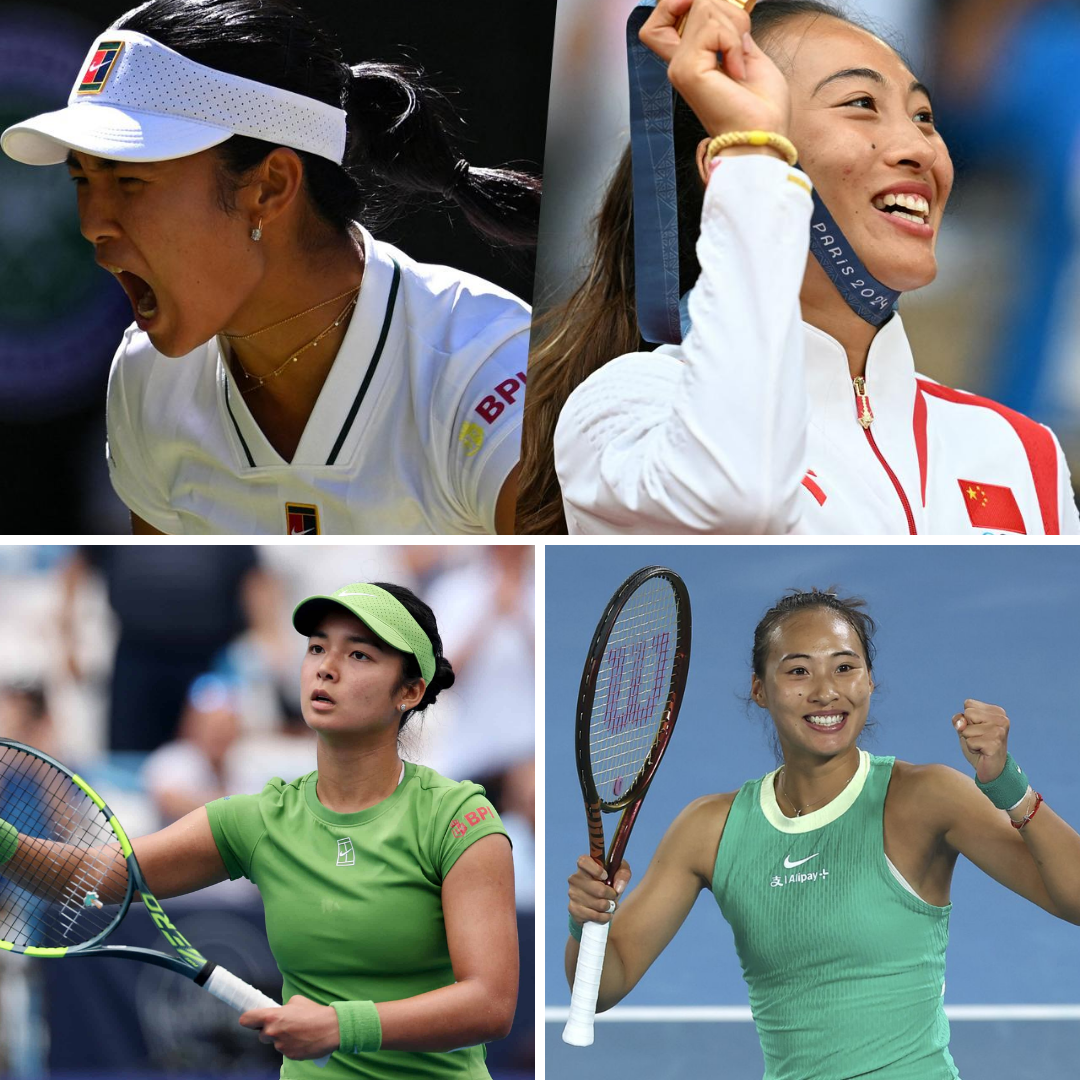
Alexandra Eala’s Epic Comeback at the 2026 Mubadala DC Open: Rising Star Stuns Olympic Champion Qinwen Zheng and Sets the Tennis World Ablaze
In the fast-paced world of professional tennis, where rankings shift like sand on a beach and every point can define a legend’s trajectory, one young player has emerged as the unlikely hero of 2026. Alexandra “Alex” Eala, the 21-year-old Filipino left-hander from Quezon City, has delivered statement after statement, proving that her historic Wimbledon breakthrough was no fluke but the beginning of a much larger story. Her remarkable run at the 2026 WTA Mubadala DC Open in Washington, D.C., stands out as particularly thrilling, especially the opening-round thriller against former world No. 4 and Olympic gold medalist Qinwen Zheng.
On July 28, 2026, Eala faced a formidable wildcard opponent on the hard courts of the William H.G. FitzGerald Tennis Center. Zheng Qinwen, a 23-year-old right-hander who had dominated the tour in 2025 before injury setbacks dropped her to world No. 123, entered as a fan-favorite for the local crowd. The Chinese star brought Olympic glory (gold in Paris 2024), elite serving (14 aces in this match alone), and deep experience against top competition. Yet Eala, playing in her North American hard-court swing debut, turned the tables with grit, composure, and relentless momentum.
The score: 4-6, 6-4, 6-1 in Eala’s favor. It was a three-set battle that stretched into a 2-hour, 26-minute war of attrition, filled with breaks, aces, and unforced errors. Eala’s performance was not just a win—it was a declaration. “I think I’ve already had that in me,” she told reporters afterward. “It’s definitely a mindset that you have. That being said, I think it’s been trained or I’ve practiced. I’ve had more experience now to implement that mindset at the higher level.”
This victory marked Eala’s first career win over Zheng, avenging her 2023 Asian Games semifinal loss (6-1, 6-7(5), 6-3) and catapulting her into the Round of 16, where she would later face and defeat defending champion Leylah Fernandez. But the real talking point among fans worldwide—the moment that dominated social media, headlines, and post-match debates—was the sheer drama of the comeback. Eala had dropped the first set after conceding two break points, trailed in the second, yet unleashed a seven-game winning streak that left Zheng stunned and reeling.
This isn’t just another tennis story. It’s a narrative of resilience, cultural pride, and the evolving landscape of the sport. Eala’s journey from a local junior in the Philippines to world No. 28 and a Wimbledon fourth-rounder (where she shocked world No. 2 Iga Swiatek in 2026) has inspired millions. Her DC Open run—defeating Zheng, Fernandez, Elina Svitolina, and Naomi Osaka en route to the final—shows a player who refuses to be boxed in by expectations or rankings. As she prepares for her first WTA 500 final against Jessica Pegula on August 3, 2026, Eala embodies the future of women’s tennis: adaptable, mentally unbreakable, and deeply connected to her roots.
This article explores every facet of that defining moment against Zheng: the match-by-match details, statistical breakdowns, historical context, Eala’s personal growth, fan reactions, and what it means for her future and Philippine tennis. With over 2,000 words of analysis, it captures why this victory is becoming the biggest talking point in the tennis world.
The Setup: Hard Court, High Stakes in the Nation’s Capital
The Mubadala DC Open is no ordinary 500-level event. Held annually in Washington, D.C., it carries nostalgic weight for players who have succeeded there. Leylah Fernandez, the 2025 champion and Eala’s upcoming opponent, had just reclaimed the title here in prior years. For Eala, a first-timer on this surface in 2026, the tournament offered a perfect test bed after her grass-court magic at Wimbledon.
Eala arrived fresh but rusty—her last hard-court match was nearly two months earlier. Zheng, however, had played a quarterfinal in Athens just days prior and entered on a serving-heavy wave (averaging 8.7 aces per recent hard-court match). The conditions were steamy, the crowd electric, and the stakes personal: Eala sought redemption, while Zheng aimed to revive a career hampered by injuries.
In the opening round, Eala drew first blood. She held serve in game one and broke Zheng in game two for a 2-0 lead. But Zheng, the Olympic champion, responded immediately with a break back and held to level at 2-2. The sets balanced out from the baseline exchanges, with both committing errors but trading breaks comfortably through 3-3.
The turning point in the first set came in the seventh game. Zheng applied sustained pressure on Eala’s serve, earning her second break of the set to lead 4-3. She fended off resistance in the eighth, held for 5-3, and sealed the frame with a confident hold in the tenth for a 6-4 victory. Zheng finished with 12 winners to Eala’s eight in that set, showcasing her power and aggression.
Eala, however, showed early signs of her resilience. In the second set, she held through the early games but faced break point trouble in the third before escaping. Zheng broke at love in the seventh to lead 4-3. Suddenly, Eala’s “mindset” kicked in. She broke back immediately, leveling the set at 4-4. Then she capitalized on Zheng’s errors, holding in the ninth and breaking again in the tenth to take the 6-4 set. This forced the decider, and Eala’s cleaner shot-making stood out: just 10 unforced errors versus Zheng’s 18.
The third set was pure dominance. Eala raced to a 4-0 lead, holding in the first and third games while breaking twice. She extended the streak to seven consecutive games dating back to the second set’s end. Zheng finally broke in the fifth, but Eala answered with a break in the sixth, restoring a 5-1 cushion. She closed out the seventh game to win 6-1.
Eala converted 6 of 8 break points (75%), including three straight in the third set. She hit only 4 aces but won 61% of first-serve points and 50% of second-serve returns. Zheng, meanwhile, was all aces (14 total) and held 54% of service games but struggled with returns, winning just 36% of break points. The stats told the story: Eala’s composure and adaptability on hard courts turned the tide.
This match wasn’t just about the scoreline. It was about mindset. Eala had practiced this “have-it-in-me” attitude—forged through junior tournaments in the Philippines, family support, and tough WTA losses. After Wimbledon, where she reached the fourth round by upsetting Swiatek (the first Filipina to do so in the Open Era), she returned to the Philippines for rest before heading to the U.S. The layoff showed in her opening set here, but the second half proved her growth.
Historical Context: Avenging the Past, Facing the Future
Eala and Zheng’s first meeting was unforgettable in 2023 at the Asian Games in Hangzhou. Zheng, then world No. 7, won 6-1, 6-7(5), 6-3 in the semifinal, securing her path to Olympic gold. Eala, ranked outside the top 100, dropped the first set badly but showed flashes. Two years later, with Eala at No. 28 and Zheng at No. 123, the script flipped.
This reversal reflects broader trends in women’s tennis. Zheng’s 2025 peak (world No. 4) was interrupted by injuries; her 2026 form has been patchy. Eala, meanwhile, has risen steadily since turning pro in 2020. Her 2024-2025 campaigns included deep runs on clay and grass. Wimbledon 2026 was the pinnacle: a lefty who attacks the net, slices forehands, and plays with fearless aggression.
Her DC Open run built on that foundation. After Zheng, she dethroned Fernandez in the Round of 16 with a 6-2, 7-6(1) win—erasing a 5-1 deficit in the second set via a 7-1 tiebreak. Then she beat Svitolina 6-3, 6-4 in the quarterfinals. In the semifinals, she upset world No. 3 Naomi Osaka 6-4, 6-2 in just 1 hour 16 minutes, never dropping a set since Zheng.
The Zheng match remains the emotional anchor. It was Eala’s first hard-court win of the summer and her first victory over a top-5 player (even temporarily) on this surface. Fans on social media flooded timelines with clips of Eala’s fist-pump after the third-set lead and her post-match interview. The phrase “Eala has done it again” echoed across X and Instagram, often tagging her as the “Filipino rising star” leaving “stunned” opponents in her wake.
Eala’s Journey: From Philippine Joy to Global Stage
Alexandra Eala was born May 23, 2005, in Quezon City. Tennis came naturally in a country where the sport thrives on the archipelago’s courts. She trained with local coaches before representing the Philippines internationally. Early losses taught her lessons; wins built confidence.
Her breakthrough came around 2023-2024 with strong ITF and Challenger results. By 2025, she reached the Miami Open semifinals as a wildcard (No. 140 then), losing to Pegula in a thriller. That tournament introduced her to the world’s elite.
Wimbledon 2026 changed everything. Seeded outside the top 100, Eala cruised through qualifying and main draw, beating higher-ranked players with her two-handed backhand and one-handed forehand. Her fourth-round clash with Swiatek was electric—Eala won the first set, held serve in the second, and forced three sets before falling. The Filipino flag waved proudly; the Philippines erupted.
Post-Wimbledon, Eala focused on physicality. She added serve variety and improved her fitness under coach Joan Bosch. The DC Open served as the ideal proving ground. Against Zheng, she showed she could handle pressure on hard courts—returning serve aggressively and dictating points.
Her career-high No. 28 (as of late July 2026) reflects this surge. She has multiple top-10 wins this year and a growing list of victories over seeded players. Her left-handed style—powerful groundstrokes mixed with drop shots and volleys—disrupts opponents. Against Zheng’s big serve, Eala’s 2nd-serve return points (89% in the third set) were decisive.
The Bigger Picture: What Eala’s Run Means for Tennis and the Philippines
Eala’s DC Open campaign isn’t just about one player. It highlights how women’s tennis is leveling the playing field. From China’s Zheng to the Philippines’ Eala, from Canada’s Fernandez to Japan’s Osaka and the U.S.’s Pegula, the 2026 season shows depth and parity.
For the Philippines, Eala is a national treasure. Her Wimbledon achievement boosted tennis participation and viewership. In D.C., with a Filipino-heavy crowd, she became the local hero. Her potential title would bring millions in prize money (a WTA 500 crown is worth $252,000) and elevate Philippine sports globally.
Culturally, Eala represents aspiration. Growing up with limited resources but relentless work ethic, she credits family, coaches, and the “mindset” that carried her through. Her story counters narratives of Asian tennis dominance by one nation—China has produced legends like Zheng, but Eala’s multi-continent success (grass to hard, clay to grass) shows versatility.
Critics once doubted her hard-court game; her win over Zheng silenced them. Post-match, fans debated her “stunned” reaction from Zheng—perhaps a rare glimpse of frustration from the Olympic champion.
Fan Reactions and Media Buzz
Social media exploded. X posts showed slow-motion clips of Eala’s 4-0 third-set start and her celebration. Hashtags like #EalaForDC and #LabanPilipinas trended. Tennis fans worldwide praised her comeback: “Another one!” “Mindset unlocked!” Tennis Channel and WTA accounts amplified the highlights.
Media outlets framed it as “Eala’s statement performance” and “Filipina phenom proving Wimbledon was real.” Articles from Olympics.com, ESPN, Philstar, and Rappler highlighted the comeback narrative. Eala’s quotes about experience and higher-level mindset went viral, inspiring young players everywhere.
Looking Ahead: The Final Against Pegula
With the final looming (as of August 3, 2026), Eala stands at a career crossroads. Facing Pegula—the player who ended her 2025 Miami run—tests her growth. Pegula, world No. 3 and veteran, knows Eala’s game but must prepare for a different version: more athletic, more mentally fortified.
Eala’s path has been one of “one more match.” From Zheng to Fernandez to Svitolina to Osaka, she has cleared hurdles with increasing ease. The Zheng match remains the spark. As she told the press: “I think it’s definitely a mindset that you have.”
Whether she lifts the trophy or not, Eala has already rewritten the script. Her 2026 campaign—from Wimbledon giant-slayer to DC finalist—proves a rising star is here to stay. The tennis world is paying closer attention, and with every victory, Eala makes it clear: the future is bright, and she’s part of it.
In the end, Alexandra Eala’s win over Qinwen Zheng wasn’t about rankings or rankings. It was about heart, hustle, and the belief that she belongs among the greats. As the Philippines cheers on its lefty hero, the world watches—and smiles. Because Alex Eala has done it again, and the tennis world will never be the same.