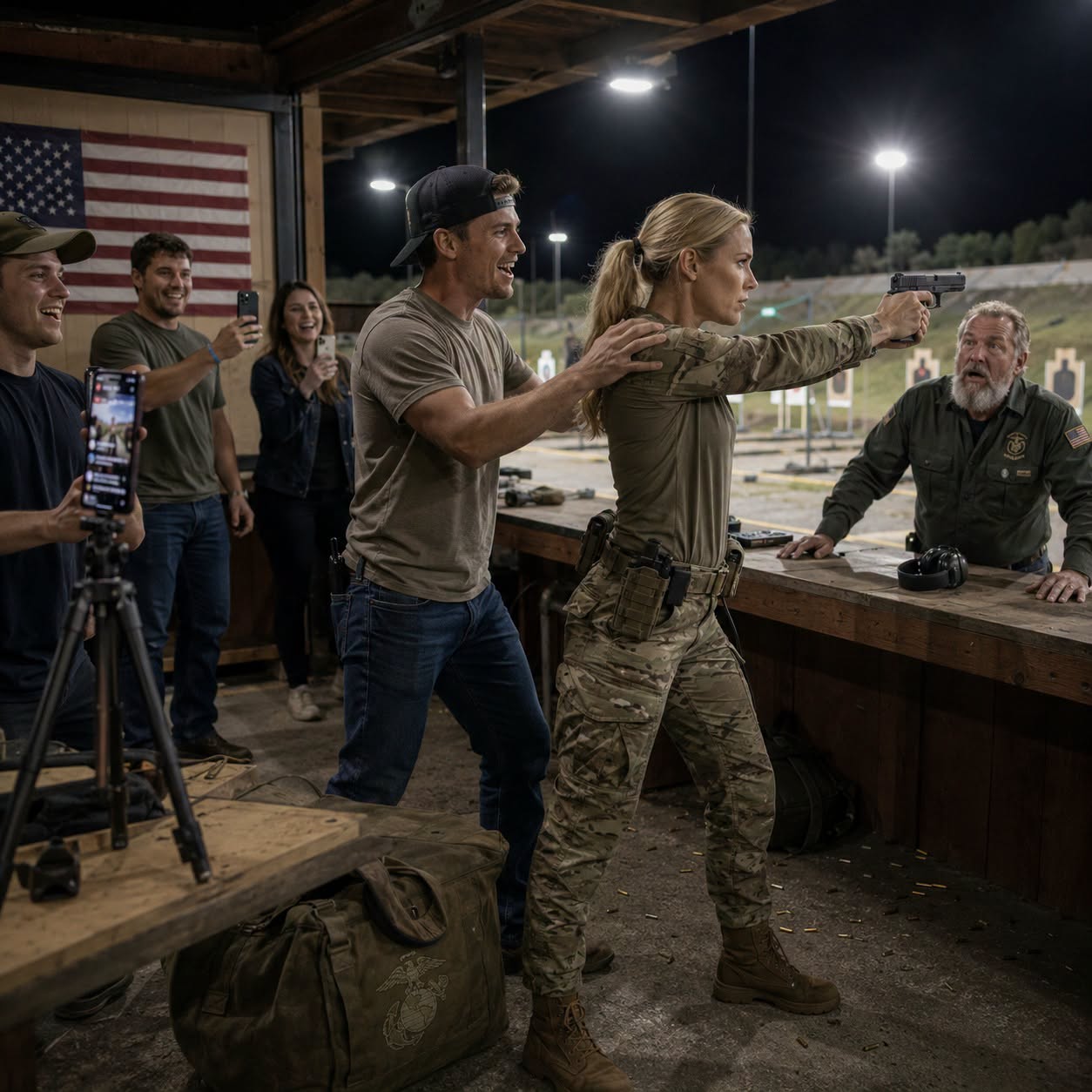
He Livestreamed My Humiliation at the Gun Range — Then the Owner Called Me “Captain”
PART 1
Jackson’s voice carried easily across the bay.
“Try not to shoot your own foot, Olive. Mom would make me explain why her helpless daughter needed surgery.”
The four men behind us laughed on cue. Tyler’s phone caught every word. The red LIVE icon glowed steadily in the corner of the screen. Forty-three viewers already. One comment asked if I would cry. Another told Jackson to stand farther back in case I dropped the gun again.
He had posted the stream that morning under a title he clearly found clever: WAREHOUSE SISTER LEARNS REAL-WORLD SKILLS.
This was not a lesson. It was content.
The indoor range smelled of burnt coffee, hot brass, and gun oil. Fluorescent tubes hummed overhead. Somewhere three lanes down a rifle cracked, and fine dust drifted from the black acoustic panels. Jackson’s hand closed around my shoulder the way one steadies a nervous child.
“Finger off the trigger until a grown-up tells you otherwise.”
More laughter. More comments.
At the far end of the bay, the range owner, Gary Wynn, paused beside a yellow mop bucket. Gray mustache. Faded cap. Shoulders shaped by decades of hard work. His gaze moved from Jackson’s grip on my shoulder to the way I stood, then settled on the battered black duffel resting behind my boots.
Recognition flickered across his face.
Jackson never saw it. He rarely noticed anything quieter than himself.
“Come on,” he said, pushing the customized Glock toward me. “Don’t freeze now.”
Three days earlier the family had gathered around Mom’s Thanksgiving table in Fayetteville, passing sweet potatoes and deciding the shape of my life without once asking me.
The house still smelled of sage stuffing, furniture polish, and the cinnamon candle Dad had favored. Six years after his death she still set his carving knife beside the turkey. I arrived in a ten-year-old Ford Ranger with a rusted bumper and Carolina mud under the wheel wells. Jackson’s lifted black Silverado claimed most of the driveway—chrome wheels, perfect paint, tires that had never known anything rougher than a Costco parking lot.
Before I went inside I hid the deployment bag beneath an old blanket and took out the beige purse I carried for family occasions. The purse was part of the costume. So were the loose sweater, the plain boots, and the answer I had repeated for nearly a decade.
I work in logistics.
Technically true. Wars run on ammunition, fuel, food, vehicles, time, and the people who arrive exactly where they are needed. But I did not count socks in a warehouse. I was Captain Olive Fulton, United States Army, assigned to a joint special operations unit at Fort Bragg.
Forty-eight hours before that Thanksgiving meal I had been lying under torn camouflage netting in wet foreign soil, watching a road through thermal optics while rain worked its way down my sleeves.
By Thursday evening Mom was frowning at my boots, worried they looked unfeminine.
“I thought the warehouse trapped you again,” she said from the kitchen.
“Traffic.”
Jackson was already drinking beer in the dining room, a Spartan-helmet shirt stretched across his stomach.
“There she is. America’s most mysterious box counter.”
My younger sister Blanca smiled despite herself. That small smile hurt more than it should have. Blanca had just become marketing director at a hospital network. She wore success in a language our family understood: tailored dress, diamond ring, rooftop restaurants, a beach-condo down payment already in motion. I loved her. Love does not make comparison painless.
“Blanca may buy near Wilmington,” Mom said. “And you? Any plans beyond that little apartment?”
No husband. No children. No kitchen island. Nothing she could explain at church in a single sentence.
“I’m fine where I am.”
“You always say that.”
Jackson leaned back in his chair. “She likes being invisible. It’s safe.”
The sentence landed harder than he knew.
I had spent years learning invisibility as a professional skill—how to lower my voice when others raised theirs, how to notice exits and windows and the small changes in a person’s breathing, how to let fear pass through the body without ever allowing it to make decisions. My family called that passivity. They mistook silence for weakness because silence had never been required to keep them alive.
Dinner continued in careful, familiar cuts. Mom asked whether I planned to waste my thirties in uniform. Blanca mentioned dating apps. Jackson explained modern warfare between bites of turkey, drawing on podcasts, online videos, and a tactical club that met behind a tire shop. Calibers. Room clearing. Civil unrest. The warrior mindset. Every opinion borrowed and delivered as though it were field experience.
Then he smiled.
“I bought a custom Glock. Two grand after the optic and trigger work. Come Saturday. I’ll teach you.”
“Teach me what?”
“How to shoot.”
Blanca covered a laugh with her wineglass. Mom frowned.
“Olive doesn’t like loud noises.”
I watched steam rise from my coffee and said nothing.
Years earlier, after my first deployment, I had told my parents about a training accident. I kept the story small—just enough to explain the scar near my shoulder. Mom’s chest tightened before I finished speaking. An ambulance came. At the hospital Dad stood beside a vending machine with both hands buried in his coat pockets.
“She cannot carry this,” he told me quietly. “Not the details.” His face looked ten years older under the emergency-room lights. “Keep her safe, Olive.”
So I did.
I became logistics. I became ordinary. I let them believe I had chosen the safest corner of the Army because fear already lived inside my mother, and I refused to feed it.
After Dad died, the lie grew easier for everyone else and heavier for me.
Jackson tapped the table. “Saturday. Nine o’clock. Wear shoes you can stand in. No heels.”
“I don’t wear heels.”
“Exactly.” He slapped my shoulder. “I’ll make sure you don’t embarrass yourself.”
Something inside me went still. Not angry. Finished.
“All right,” I said. “I’ll come.”
Jackson blinked, then opened the family group chat and began planning my humiliation before Mom even served the pie. He believed I had agreed to become his joke.
He did not understand that I had simply decided to stop protecting him from the truth.
Under the range lights his hand still rested on my shoulder while the comments scrolled and the LIVE icon burned. Gary Wynn had not moved from the mop bucket. His eyes remained fixed on the battered duffel and on the way I stood.
Jackson thought he had staged my humiliation.
PART 2
Jackson’s fingers pressed harder into my shoulder as he forced the Glock into my hands.
The polymer was warm from his grip. The optic sat high and bright. Everything about the pistol had been chosen to look expensive and serious—custom trigger, stippled frame, the kind of modifications men bought when they wanted the world to know they were prepared for a war that would never come for them.
“Two hands,” he instructed, louder than necessary. “Like this. Don’t lock your elbows. And for God’s sake, keep the muzzle pointed downrange so you don’t put a hole in the ceiling. Or yourself.”
Laughter rolled from the men behind us. On the livestream the comments accelerated.
She’s shaking. Bro this is going to be painful. Warehouse girl about to discover gravity.
I felt the familiar weight settle into my palms. The texture of the grip. The precise resistance of the trigger. The balance point that told me, without thought, exactly where the front sight would rest when the weapon rose.
Three days of silence at the Thanksgiving table, ten years of carefully constructed ordinary life, all of it compressed into the space between one breath and the next.
I did not correct my stance. I did not adjust my grip. I simply stood the way the weapon wanted me to stand.
Jackson kept talking. He always did when he felt powerful.
“Okay, safety’s on the left. See it? Flip it down when I say. Then you’re going to—”
Gary Wynn’s boots stopped three feet away.
The mop bucket sat forgotten. The old man no longer looked at the yellow plastic or the damp concrete. His eyes were fixed on the battered black duffel behind my heels, then on the way my fingers had already found the natural index point along the frame, then on the quiet stillness of my shoulders.
Recognition was no longer a flicker. It had settled into something heavier. Something that belonged to men who had spent decades watching people handle weapons and learning the difference between those who performed competence and those who possessed it.
Jackson still hadn’t noticed.
He leaned closer, voice thick with mock patience. “Olive. Honey. You need to actually point the gun at the target eventually. The paper isn’t going to shoot itself.”
One of the men behind us snorted. Tyler angled the phone for a better angle, determined not to miss the moment I failed.
I raised my eyes to the target thirty yards downrange. The black silhouette waited under the fluorescent glare, edges soft with distance and heat haze from the neighboring lanes.
The range felt smaller suddenly. The air thicker. Every sound—brass hitting concrete, the distant crack of another rifle, the low hum of the ventilation—sharpened until it seemed the entire bay was holding its breath without knowing why.
Gary’s voice, when it came, was quiet. Almost careful.
“Ma’am.”
Jackson turned, irritated at the interruption. “We’re a little busy here, Gary. Private lesson.”
Gary didn’t look at him.
His gaze remained on me, on the duffel, on the unremarkable way I held a two-thousand-dollar custom Glock as if it were any other tool that had lived in my hands for years.
“That bag,” he said. “I’ve only seen one other like it in the last fifteen years. Came through here with a team out of Bragg. Quiet people. The kind who don’t advertise.”
Jackson laughed, sharp and dismissive. “It’s just an old Army surplus bag. She works in logistics. Warehouse stuff. Boxes and manifests. Nothing special.”
Gary’s mustache twitched once.
He took one slow step closer. The fluorescent light caught the deep lines around his eyes.
“Logistics,” he repeated, tasting the word. Then, softer, almost to himself: “That’s what they always say.”
The livestream comments kept coming, oblivious.
Who’s the old guy? Jackson hurry up and make her shoot already. This is taking forever.
But inside the bay something had shifted. The four men behind us had gone quieter. Tyler’s phone remained raised, yet his finger hovered near the screen as if uncertain whether to keep recording.
Jackson finally felt it—the change in the air, the way Gary was looking at me instead of him. His hand left my shoulder. The easy confidence in his posture stiffened.
“What are you talking about?” he demanded. “She’s my sister. She counts inventory for a living.”
Gary’s eyes never left mine.
In that silence I understood the exact weight of the moment Jackson had created without realizing it. He had brought me here to perform helplessness for an audience. He had handed me a weapon in front of witnesses. He had staged the reveal of my weakness.
And in doing so, he had placed me in the one place where the truth could no longer stay buried.
I turned the Glock slightly in my hands—not aiming, not threatening, simply letting the weapon settle into the position it had known for a decade. The motion was small. Almost nothing.
Yet Gary saw it.
His expression changed in a way that had nothing to do with surprise and everything to do with confirmation.
Jackson opened his mouth to speak again.
He never got the chance.
Because Gary Wynn, range owner, former Marine, man who had watched thousands of people handle firearms, finally said the words that ended the performance.
“Captain.”
The single title dropped into the bay like a spent casing.
Everything stopped.
PART 3
The word hung in the air like smoke after a single shot.
Captain.
Gary did not raise his voice. He did not need to. The title carried its own weight, and every man in the bay felt it settle over them.
Jackson’s face went blank, then tight, then something close to panic. His mouth opened and closed once without sound. Tyler’s phone remained raised, but the LIVE icon suddenly felt like a liability rather than a prize. The comments on the screen kept arriving for a few more seconds—confused, joking, still expecting failure—before the silence in the range itself began to infect the stream.
No one laughed.
I lowered the Glock with the same economy I had raised it, muzzle safe, finger indexed high along the frame. The motion was automatic, unthinking, the product of years that Jackson had never been allowed to see. I set the weapon carefully on the bench, slide locked back, chamber empty, the way any professional would leave a firearm they no longer needed.
Then I turned to face my brother.
For a long moment neither of us spoke. The fluorescent lights hummed. Somewhere far down the line another shooter finished a string and the brass stopped falling. The entire bay seemed to lean inward, listening.
Jackson found his voice first, thin and defensive.
“What the hell is he talking about?”
I could have softened it. I could have given him the version that protected Mom, the careful half-truths I had carried for a decade. The old instinct rose out of habit—keep the fear contained, keep the family intact, keep the quiet.
But the decision I had made at the Thanksgiving table still held.
“I’m not logistics,” I said.
The words were simple. They did not need decoration.
Jackson stared at me as if I had spoken a foreign language. Behind him, one of the men who had been laughing shifted his weight and looked away. Tyler slowly lowered the phone. The red LIVE icon disappeared.
Gary remained where he was, silent now, watching with the calm of a man who had already seen enough to understand.
I kept my voice even.
“I’ve spent the last ten years doing work that doesn’t show up on the kind of paperwork families discuss at dinner. The bag is mine. The scar is mine. The silence was deliberate.” I paused, letting the truth find its own shape. “I kept it that way because Dad asked me to. Because Mom couldn’t carry the details. Because you and Blanca didn’t need them.”
Jackson’s throat worked. Color had risen high in his face, a mixture of humiliation and something sharper—anger at being made the fool in front of an audience he himself had invited.
“You’re lying,” he said, but the conviction was already gone from it.
“I’m not.”
I reached down, unzipped the battered duffel just far enough for the edge of a faded unit patch and the corner of a worn range qualification card to show. Nothing dramatic. Nothing theatrical. Just evidence that required no speech.
Gary gave a single, slow nod, as if confirming what he had already known the moment he saw the bag and the stance.
Jackson looked from the open duffel to my face and back again. The customized Glock on the bench between us suddenly looked like a prop from someone else’s life.
The livestream comments, those that still arrived before the connection fully died, had changed tone completely.
No more jokes. Only questions. And then silence.
I zipped the bag closed again.
“You wanted to teach me how to shoot,” I said quietly. “You wanted an audience to watch me fail. You got the audience. You just didn’t get the ending you planned.”
Jackson said nothing. There was nothing left that would not sound small.
Around us the range began to breathe again—distant voices, the scrape of a chair, the soft metallic sound of someone clearing a weapon two lanes over. Ordinary noise returning after something irreversible had passed through the room.
I picked up the duffel, the weight of it familiar and honest against my shoulder.
Gary stepped aside without a word, giving me a clear path to the door. As I walked past him he spoke one last time, low enough that only I could hear.
“Welcome home, Captain.”
I nodded once.
Outside, the late afternoon light was sharp and clean. The parking lot smelled of hot asphalt and pine. Jackson’s lifted Silverado still sat gleaming in its space, chrome catching the sun like a boast that no longer mattered.
I did not look back.
Some truths, once spoken in the open, do not need to be repeated. They simply exist, and everything around them has to rearrange itself to make room.
I walked to my old Ford Ranger, set the duffel on the passenger seat, and started the engine.
For the first time in ten years, the silence that followed me was no longer a disguise.
It was simply mine.
THE END