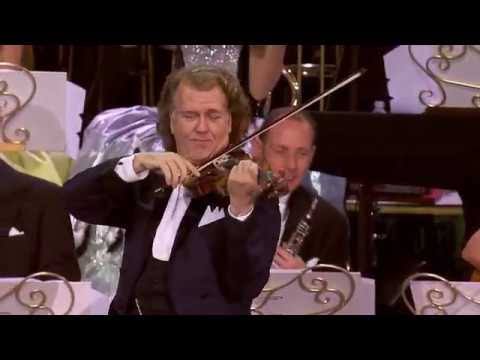
**Before André Rieu Became a Global Icon, There Was Just One Woman Beside Him…**
Long before André Rieu stood center stage in sold-out concert halls across the globe, before his Johann Strauss Orchestra filled arenas with the irresistible melody of waltzes, before his violin soared into a stratosphere of fame, there was one woman who stood beside him—not in the spotlight, but at the heart of everything. That woman was Marjorie Rieu, his wife, his partner, his quiet strength, and the first person who truly believed in his dreams. Together, in 1974, they shared a deeply emotional performance of Jules Massenet’s *Méditation* at Maastricht University—an intimate, heartfelt moment that captured the essence of their story: a love built on trust, shared passion, and unwavering harmony.
This article tells the full, inspiring journey of André Rieu and Marjorie Kochmann from their first meeting to their enduring partnership. It is a tale of a young violinist’s determination, a woman’s belief, and a marriage that turned personal love into global musical magic. Their story reveals how one woman’s support can transform a life, and how music, when played with genuine emotion, can touch millions.
### The Early Years: A Musical Family in Maastricht
André Léon Marie Nicolas Rieu was born on October 1, 1949, in Maastricht, the Netherlands, into a family deeply immersed in music. His father, Andries Antonie Rieu, was the conductor of the Maastricht Symphony Orchestra—a stern, disciplined man whose strict Catholic upbringing left little room for affection or casual laughter. Young André, the third of six children, showed early talent on the violin. At just five years old, his mother handed him a tiny instrument, and from that moment, his world revolved around music. He dreamed of playing on stage for thousands, of making people happy through the power of melody.
The Rieu household was a strict environment. André later recalled in interviews that he never heard “I love you” from his parents, and the atmosphere left him seeking love and validation elsewhere. Yet this childhood shaped his discipline and emotional depth. Violin lessons began twice a week, with additional practice each day. The family’s love for music extended to records—78rpm shells from earlier eras, including light classical pieces that would later influence his repertoire.
Meanwhile, in the same city, a girl named Marjorie Kochmann was growing up in a household shaped by her parents’ history. Her father had fled Berlin during the rise of Nazism, carrying only one box of records; her mother, a Dutch resistance fighter, had helped him hide during the war. The family emphasized resilience, hard work, and the value of being “the best or not at all.” Marjorie, an only child, was bright and artistic. She studied German at the University of Nijmegen and later became a language teacher, fluent in multiple languages. She also wrote her own compositions and was a talented harpist in her youth.
In 1962, when André was 13 and Marjorie 15, their paths crossed for the first time at a Sinterklaas (St. Nicholas) party held at the Rieu family home. Marjorie had been placed in the same class as André’s older sister Teresia. She stood out with her curly hair amid the group of girls. André later described it as love at first sight, though they were far too young for romance. Their families, both devoutly Catholic, initially discouraged any connection—André’s parents found Marjorie’s flower-power style (a mini-skirt and loose demeanor) too unconventional.
### The Reconnection and the Spark of Love
Life moved on for both. André studied at the Conservatorium Maastricht and the Royal Conservatory in Liège, Belgium, honing his craft under teachers like Jo Juda and Herman Krebbers. He later moved to Brussels for advanced training with the legendary Hungarian violinist André Gertler. It was a period of intense focus, loneliness in the big city, and occasional reunions with Marjorie, who had moved to Nijmegen for university.
The turning point came around 1974. Marjorie, now a German teacher at the Rieu family’s school and an accomplished harpist, invited her former classmate Teresia to perform a concert. André, returning from Brussels, attended to support his sister. What began as a platonic evening—discussing Mahler over a shared ashtray—evolved into something profound. They reconnected after 12 years. “We were so young,” André reflected in interviews, “but something special lingered. When we met again, the flame reignited.”
Their relationship deepened quickly. Despite her family’s reservations and André’s parents’ disapproval, they held on. Marjorie was the first person to tell André “I love you”—a phrase he had never heard from his own parents. She saw in him a gifted violinist whose discipline and talent could shine on his own terms. “Marjorie believed in me,” he would say years later. “She was the first to say, ‘You play beautifully, and you can make money from it.’” Her encouragement lifted him from a life of strict discipline and occasional unhappiness into a world of possibility.
### A Private Wedding and the Birth of a Vision
In 1975, just two years before the emotional performance at Maastricht University, André and Marjorie married. He was still a struggling student, while she worked to support them. Their honeymoon was simple—André played violin for her, and she responded with her own musical gifts. Theirs was a partnership of equals from the start. Marjorie, with her college degree, became their breadwinner, teaching languages and handling finances. André, meanwhile, played in the Limburg Symphony Orchestra and a small salon ensemble, but his true passion lay in lighter, more accessible classical music—waltzes, salon pieces, and melodies that could unite audiences.
In 1978, with their first son Marc on the way, André founded the Maastricht Salon Orchestra. The idea was revolutionary: a 12-piece ensemble blending classical and light classical, played with joy and emotion rather than stiff formality. Marjorie, pregnant and practical, suggested they start small—perhaps even a market stall—and gradually build. “She encouraged me to follow my dream,” he recalled. Together, they rehearsed repertoire, often from old 78rpm records, since much of the sheet music was unavailable. André’s violin would lead; Marjorie’s organizational skills and artistic vision kept the project alive.
Their love was not flashy or dramatic. It was quiet, steady, and complementary. They shared the same sense of humor and values. When André played on stage, Marjorie was often the first to hear his performances. Their home life revolved around music, children, and growth. They raised Marc and later Pierre in their beloved castle—Huis de Torentjes in Maastricht, a 15th-century structure André had visited as a boy for piano lessons and dreamed of someday filling with chandeliers and paintings. The castle became their sanctuary.
### The Emotional Performance at Maastricht University in 1974
The specific moment highlighted in the query—the performance of *Méditation* from Jules Massenet’s opera *Thaïs* at Maastricht University in 1974—occurred in the early years of their marriage, just before the founding of the official Johann Strauss Orchestra in 1987. While André’s full orchestra launched later, in 1974 he was still building his career, performing with smaller ensembles and working in symphony settings. The university concert, likely an intimate academic event, showcased their personal connection to the piece.
*Méditation* is a beautiful, flowing violin solo that expresses longing, devotion, and spiritual serenity. In the hands of a young André, supported by Marjorie’s quiet presence in the audience or perhaps on stage in a supportive role, it became more than a musical piece. It was a private declaration. The performance revealed “something words never could”—a bond forged through years of love, trust, and harmony. Their eyes would meet across the stage; their smiles would acknowledge the shared history. The music seemed to speak directly to their story: two souls who had waited years for each other, now ready to create beauty together.
Fans and family remember such moments as the foundation of André’s emotional style. Later performances in massive arenas or the Vrijthof square in Maastricht would echo this intimacy, but in 1974, it was raw and personal. Marjorie, still working as a teacher and avoiding the limelight, stood in the wings or in the audience, her support invisible to the crowds but felt deeply by André. That day at the university was a preview of what was to come: music as a vehicle for love.
### Building the Empire: From Salon Ensemble to Global Phenomenon
The 1970s and 1980s were years of trial and triumph. André’s parents initially questioned his choices, favoring traditional symphonic work. But Marjorie’s belief sustained him. In 1978, with the birth of their son Marc, the couple launched the Maastricht Salon Orchestra. It began modestly—performing in nursing homes and small venues—then grew. In 1987, they rebranded as the Johann Strauss Orchestra, expanding to 12, then 50, then 60+ members. André arranged countless waltzes, including his famous rendition of Shostakovich’s Waltz No. 2 (played in a 1994 halftime show at Ajax Stadium that sold 200,000 CDs).
Marjorie managed the business side, including productions and tours. She wrote parts of the biography *My Music, My Life* (revised multiple times) to capture their journey. She avoided public appearances, preferring to let André shine while maintaining the family’s private life. Their sons—Marc, now a producer, and Pierre—grew up around rehearsals and performances. The family lives in the castle, where André still practices daily.
Their philosophy is simple yet profound: classical music should be joyful, accessible, and emotional. André wants audiences to feel the same connection he felt with Marjorie—heart-to-heart, not stiff formality. Concerts feature humor, banter, and a sense of community, drawing millions who travel from around the world to experience the magic.
### A Love That Endures: Challenges and Triumphs
The Rieu marriage has faced its share of public scrutiny—rumors of infidelity, career pressures, and the strain of André’s fame—but it has remained rock-solid. Marjorie has never complained publicly. In interviews, André describes their bond as complementary: they think alike, finish each other’s sentences, and share the same values. “Without her, I would be in the gutter,” he once said. “She was the one who believed in me first.”
Childhood traumas were addressed through therapy together—four years of work to open up emotionally. André’s strict upbringing and Marjorie’s own challenges with parental expectations taught them boundaries and unconditional love. Today, they have two sons and five grandchildren. André remains active, touring the world, while Marjorie supports from the background, sometimes traveling under her maiden name.
Their story is one of resilience. André’s father eventually acknowledged his son’s success. Marjorie’s Jewish heritage and her father’s survival story added layers of strength. Together, they proved that behind every great man (and woman) is a partner who sees the potential when the world does not.
### The Legacy: Music That Connects Hearts
André Rieu’s global icon status—over 40 million CDs sold, hundreds of platinum records, tours across continents—owes much to Marjorie. She encouraged the shift from heavy classical to accessible waltzes. She handled logistics, finances, and the emotional side of a long marriage. Her presence in 1974 at the university concert symbolized the foundation: a woman who chose love over fame, who supported a dream without seeking credit.
Their performances celebrate life’s joys—laughter, tears, romance. André flirts with female orchestra members on stage not out of distraction, but to create connection. “Romance is very important,” he says. “Music is the food of love.”
The story of André and Marjorie Rieu reminds us that true success is rarely solitary. It is built on love, trust, and shared purpose. Their 1974 performance at Maastricht University was not just a concert—it was a preview of a lifetime partnership that would turn a young violinist’s dream into an international phenomenon.
Today, fans worldwide feel the magic because of a couple who began with nothing but belief in each other. Marjorie continues to write, teach, and support. André keeps playing, conducting, and inspiring millions to embrace music as a bridge between hearts.
Their tale is extraordinary precisely because it started so privately. Before the sold-out halls and worldwide fame, there was just one woman beside him—and that woman was Marjorie. Together, they proved that with love, harmony, and unwavering support, anything is possible.