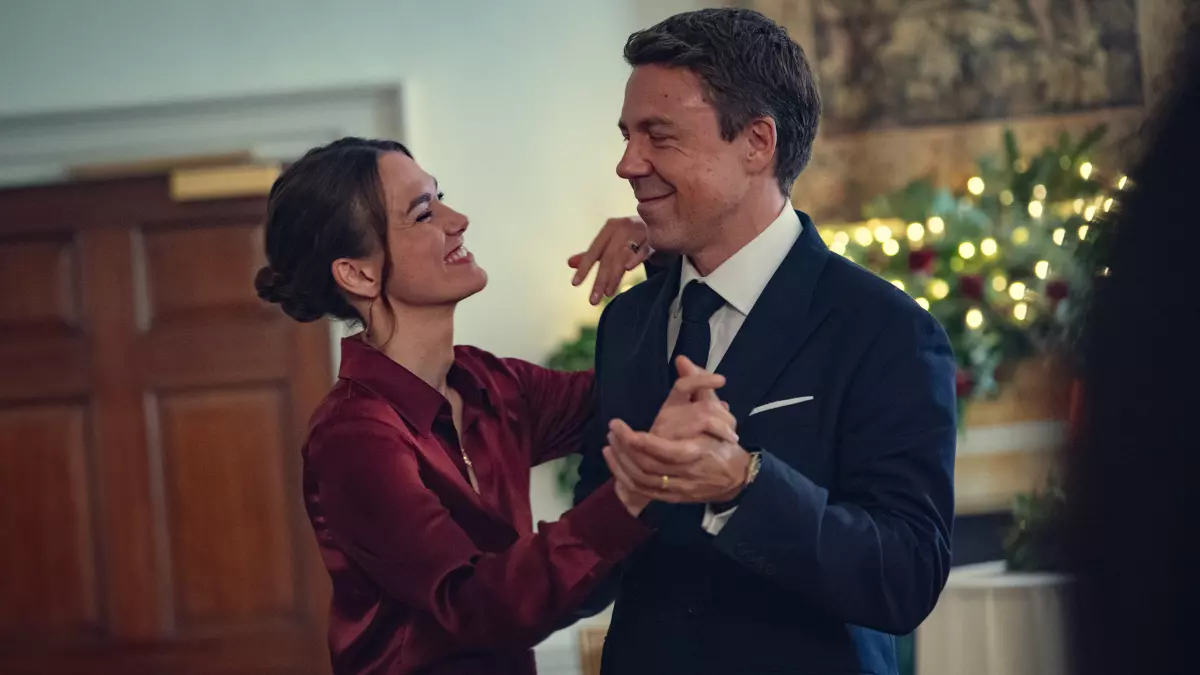
STREAMING NOW ON NETFLIX: KEIRA KNIGHTLEY AND ANDREW BUCHAN IN A MASTERCLASS PERFORMANCE
He thought she was his biggest supporter. The devoted high-society wife who smiled through political dinners, raised their children, and stood loyally at his side as his career climbed toward the highest levels of British power. He had no idea she was his most dangerous handler.
On Netflix, Black Doves delivers one of the most gripping dual performances in recent streaming memory. Keira Knightley, in a career-shifting turn, plays Helen Webb — the picture-perfect politician’s wife who has spent a decade living a meticulously constructed lie. Andrew Buchan, as her husband Wallace, the rising Defence Secretary, brings a quiet intensity that makes the domestic facade feel chillingly real. Together they create a portrait of marriage built on secrets so deep that even the person sharing the bed cannot see them.
The series opens in the festive glow of a London Christmas and immediately undercuts it. Helen moves through charity galas, school runs, and intimate family moments with the polished ease of someone who has rehearsed every gesture. Yet something is off. In one of the show’s most unsettling images — the exact shot referenced in the promotional campaign — a tiny micro-camera is pinned discreetly to her elegant dress. It is not decoration. It is evidence. A silent witness to a life that is never quite what it appears.
That single detail captures the entire premise. Helen is not simply a wife supporting her ambitious husband. She is a professional operative for a shadowy organisation known as the Black Doves — a network of spies-for-hire who trade secrets to the highest bidder, unbound by national loyalty. For ten years she has used her proximity to power to gather and sell information. The marriage is both cover and weapon. The home is both sanctuary and surveillance post. The children she genuinely loves are also the ultimate insurance that no one will look too closely at the woman who never quite leaves the room at the right moment.
Knightley’s performance is a masterclass in controlled duality. She can switch, in the space of a single scene, from the warm, slightly harried mother organising Christmas to a cold, lethal professional who calculates exits, assesses threats, and carries the weight of a second life that must never surface. There is no theatrical villainy here. The terror comes from how ordinary she makes the extraordinary look. The way she pours wine at a dinner party while processing operational information. The flicker of calculation behind a loving smile. The private moments when the mask slips just enough for the audience to see the cost.
Buchan matches her with a performance that is almost more unsettling because it is quieter. Wallace is not a fool. He is intelligent, ambitious, and under pressure. He senses that something in his marriage is carefully managed, that his wife occasionally disappears into spaces he cannot follow. Yet he chooses, repeatedly, to believe the version of her that serves both their lives. The scenes between them — ordinary conversations about children, politics, and the future — carry an undercurrent of dread. Every affectionate gesture becomes a potential lie. Every shared look raises the question of how much one person can truly know another when one of them is trained never to be known.
The writing, by Joe Barton, understands that the most effective spy stories are not about gadgets or car chases alone. They are about the psychological price of living two lives at once. Helen’s affair, her friendships within the organisation, and the sudden violent disruption that forces her carefully balanced world to fracture all serve the same purpose: to test how long a person can remain both protector and predator under the same roof.
What elevates Black Doves above standard thriller fare is the refusal to treat Helen as a fantasy figure. She is competent, sometimes ruthless, and frequently exhausted. She is a mother who worries about bedtime routines in the same breath as she considers operational fallout. Knightley plays the contradictions without apology. There is humour, often dark. There is genuine tenderness. And there is a mounting sense that the walls are closing in — that the micro-camera on the dress is only the visible tip of a much larger apparatus of secrets that someone, somewhere, is about to expose.
The supporting cast deepens the unease. Ben Whishaw, as the old friend pulled back into the game to protect her, brings a weary, understated intensity that suggests years of similar compromises. Sarah Lancashire’s handler is a study in controlled menace — the kind of woman who can discuss Christmas plans and contract killings in the same conversation without changing tone. The London setting, filmed with a cold festive beauty, becomes another character: glittering, crowded, and full of places where a person can disappear in plain sight.
Viewers expecting pure action will find it, but the series is more interested in the quieter violence of deception. The most disturbing moments are not the physical confrontations. They are the domestic ones — the family meals, the political receptions, the late-night conversations in which every word is weighed for what it might reveal. The question that hangs over the entire series is simple and terrifying: if the person you trust most is living a second life, how much of your own life was ever real?
Black Doves does not rush to answer that question. It lets the tension accumulate. It allows Knightley the space to show a woman who is both perpetrator and prisoner of her own design. It allows Buchan to portray a man who may be more aware than he admits, or more willingly blind than is safe. Their scenes together crackle with the specific unease of a long marriage in which one partner holds all the hidden cards.
The series arrived with quiet confidence and quickly climbed the charts, earning Knightley awards attention for a performance that feels both glamorous and deeply unglamorous at once. She is beautiful in the way high-society wives are expected to be, and then, without warning, she is something far more dangerous. The micro-camera on the dress is the perfect emblem. It is small. It is almost invisible. And it sees everything.
For anyone who has ever wondered what happens when the most polished surface begins to crack, Black Doves is essential viewing. It is a spy thriller that understands the real battlefield is not the street or the back alley. It is the dinner table. It is the shared bed. It is the moment when the person who was supposed to be your greatest supporter turns out to have been watching you the entire time — and reporting back.
Streaming now on Netflix.