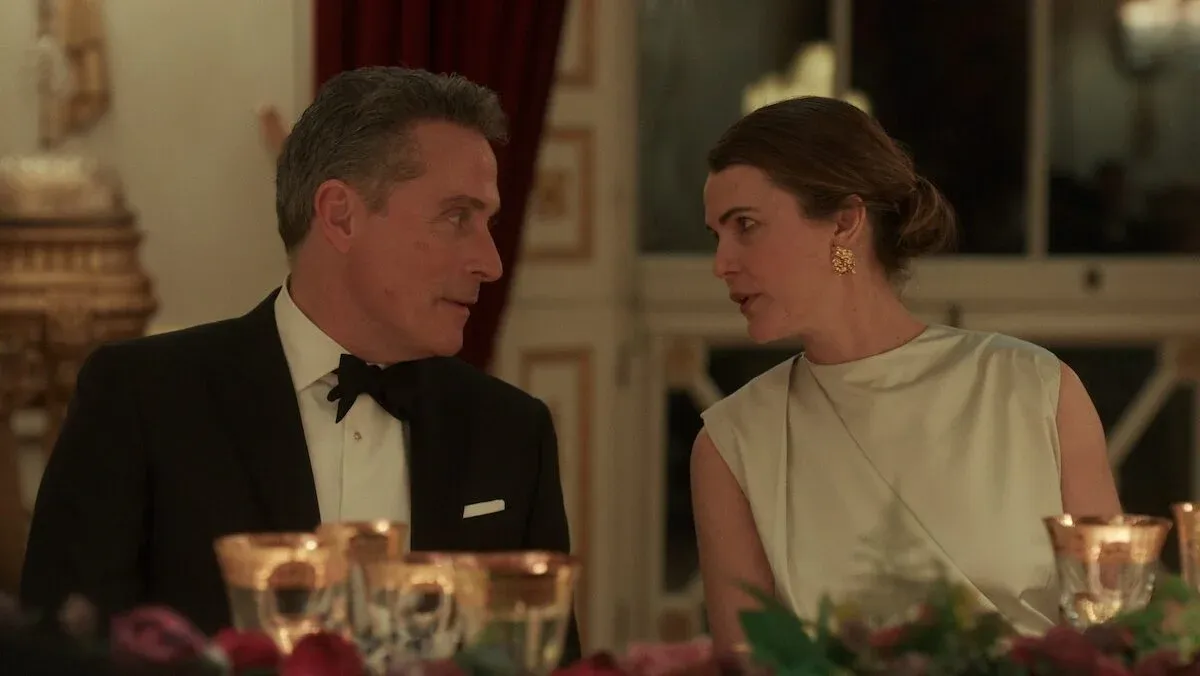
STREAMING NOW ON NETFLIX: KERI RUSSELL AND RUFUS SEWELL IN A MASTERCLASS PERFORMANCE
Keeping your enemies close and your husband closer. On Netflix, Keri Russell and Rufus Sewell deliver intense performances as political titans walking a dangerous tightrope. The urgent warning Kate whispers across the dinner table proves that in the highest corridors of power, the real threat is rarely the one sitting across the border. It is the one sitting across the table.
*The Diplomat* has never been content to treat diplomacy as a clean exchange of memos and handshakes. From its first season it has insisted that the personal is the political, and that the most consequential negotiations often happen in the quiet moments after the official meetings end. In the current run of the series, that thesis reaches a new intensity. Kate Wyler, the American ambassador whose competence has always been both her greatest asset and her deepest vulnerability, and her husband Hal, the charismatic former ambassador whose ambition never quite learned how to stay in the passenger seat, find themselves navigating a landscape in which every private conversation carries the weight of international consequence.
Russell and Sewell have always been the show’s secret weapon. Their chemistry is not the soft, romantic kind that television usually sells. It is the chemistry of two people who know each other’s weaknesses with surgical precision and who still, against every rational calculation, keep choosing to stay in the same room. Russell plays Kate with a restless, almost physical intelligence: the way she absorbs information, the way she recalculates mid-sentence, the way her face hardens when she realizes someone has already outmaneuvered her. Sewell’s Hal is all charm and calculation layered over something darker and more wounded. Together they create the rare television couple whose arguments feel less like scripted conflict and more like the continuation of a long, unfinished war.
The dinner-table sequence that the caption teases is the purest distillation of what the series does best. Formal settings have always been dangerous in *The Diplomat*. Crystal and protocol create the illusion of safety while the real business of power moves underneath. Across that table, alliances shift with a glance. Loyalties are tested in the space between courses. And Kate’s urgent whisper is not merely a piece of plot machinery. It is the moment the personal and the geopolitical become indistinguishable. Whatever she says in that low, controlled voice carries the force of a warning that could alter the trajectory of more than one career, more than one government, and more than one marriage.
What makes the performances so compelling is how little either actor overplays the stakes. Russell never lets Kate become a simple heroine of competence. There is always a flicker of self-doubt, a residual anger at the ways the system still underestimates her, a private calculation about how much of herself she is willing to spend. Sewell refuses to make Hal either pure villain or pure romantic obstacle. He remains dangerously attractive precisely because his instincts are often correct even when his methods are not. Their scenes together crackle with the knowledge that these two people have already survived the worst versions of each other and still cannot quite walk away.
The series has always understood that power does not live only in the Situation Room. It lives in the hallway conversations, the late-night strategy sessions that turn into something more intimate, the shared history that makes every professional disagreement feel like a continuation of an old argument. Kate and Hal’s marriage is not background texture. It is the arena in which the show’s largest questions are fought: How much of yourself do you give to the work? How much do you trust the person who knows you best when that person also happens to be the one best positioned to use that knowledge? When does protecting the country require protecting, or sacrificing, the person sitting next to you?
Russell’s performance in particular has grown sharper and more layered with each season. She has always excelled at playing women who are both formidable and visibly exhausted by the cost of being formidable. In the current chapters of the story she deepens that portrait. Kate’s intelligence is never in question. What is constantly in question is whether that intelligence will be enough, and whether the personal price she continues to pay will eventually hollow out the very qualities that made her valuable in the first place. Sewell matches her beat for beat. His Hal is a man who understands the machinery of power intimately and who cannot quite stop himself from reaching for the levers even when the wiser course would be to step back.
The dinner scene crystallizes all of it. The formal setting, the careful choreography of who sits where, the polite conversation that is anything but polite underneath. And then the whisper. In a lesser show the moment would be pure exposition, a convenient way to move information from one character to another. Here it feels like a small detonation. Whatever Kate says in that quiet exchange carries the weight of everything the series has been building: the erosion of trust, the collision of personal loyalty and national interest, the realization that the person who knows you best may also be the person most capable of destroying what you have built.
*The Diplomat* continues to distinguish itself by refusing easy answers. It does not pretend that competence always wins, or that good intentions protect anyone from consequence. It understands that the people who rise to these levels of power are rarely pure, and that the pure ones rarely last. Russell and Sewell embody that complexity with a precision that elevates every scene they share. Their performances make the political feel personal and the personal feel terrifyingly consequential.
Streaming now on Netflix, the series offers something rarer than another polished political thriller. It offers two of the strongest lead performances on television locked in a relationship that is simultaneously a love story, a power struggle, and a high-stakes negotiation with no clear endgame. The urgent warning across the dinner table is only the latest reminder that in this world the most dangerous conversations are the ones that look, from a distance, like ordinary domestic life.
Keep your enemies close. Keep your husband closer. And never assume you know which is which until the whisper has already been spoken.