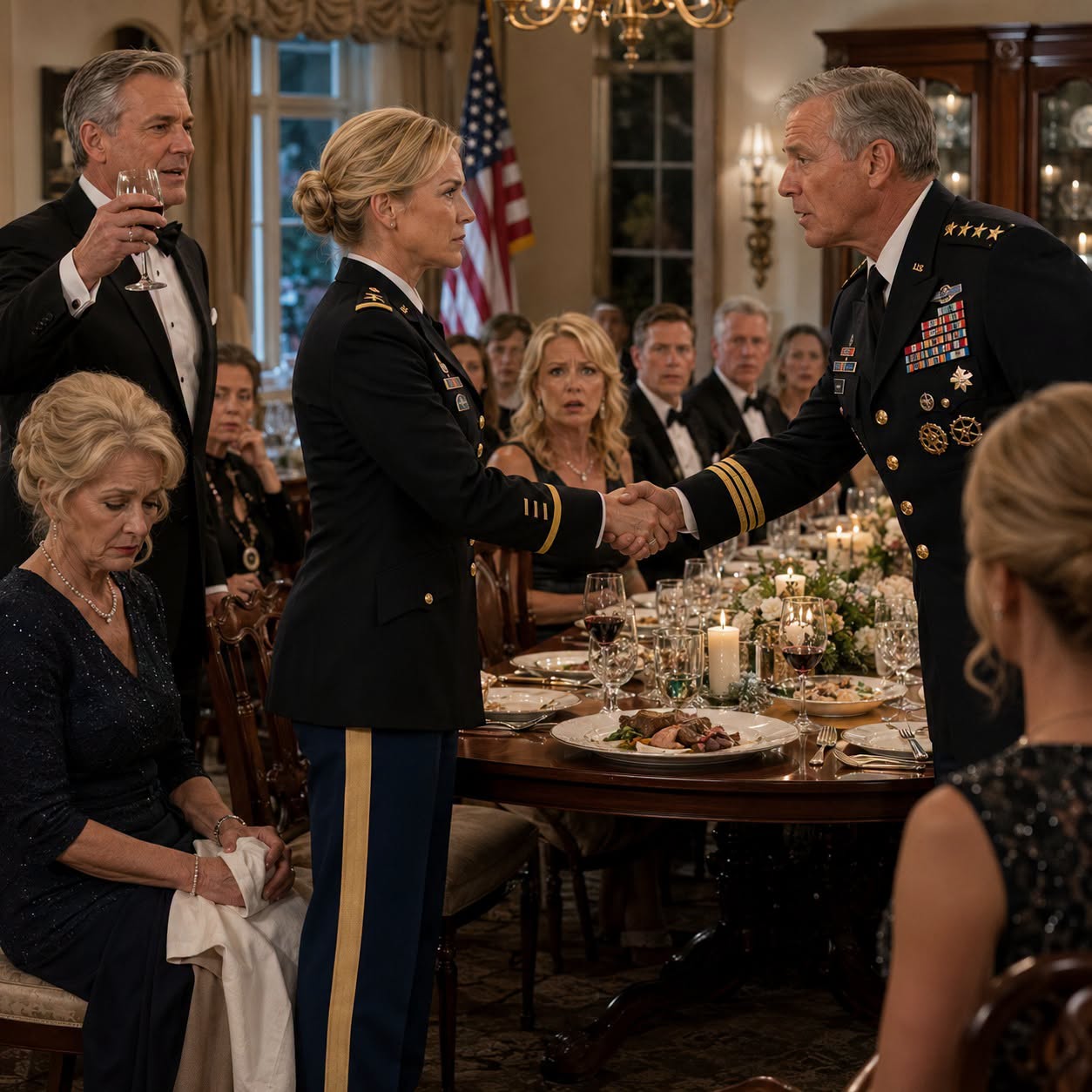
She Was Introduced as the Family Failure at Dinner — Until the Four-Star General Stood Up, Shook Her Hand, and Revealed How She Once Overruled Him and Saved Thousands of Lives Right in Front of Her Father
PART 1
The house looked exactly as it always had—red brick, brass porch light humming against the early October dark, the same oil stain on the concrete driveway my father had been complaining about since 2008. An American flag snapped beside a faded University of Kentucky banner. Nothing had changed. That was the problem.
I carried a glass dish of pecan pie, foil stretched tight across the top, and tried not to notice how heavy it felt.
My mother opened the door before I reached the porch.
“Oh, good. You’re here.” Her eyes moved over my navy dress the way a woman checks inventory. “At least you dressed up.”
“I had help from civilization,” I said.
She did not smile.
Inside, the air was thick with pot roast, yeast rolls, cinnamon candles, and the scorched coffee my father always left on the warming plate too long. Orange mums sat in the center of the dining table. She had taken out the holiday china—the set she usually saved for Thanksgiving and Christmas—as if this ordinary Tuesday required ceremony.
My father stood at the kitchen island uncorking a bottle of Napa Cabernet.
“Rachel.”
“Dad.”
“You remember what I said?”
“Be polite.”
“Keep your work stories to yourself.”
I set the pie down. “I wasn’t planning a slideshow.”
He frowned as though I had already failed some invisible test.
Then the front door opened and the evening tilted.
Emily came in laughing, blonde hair curled just so, cream coat perfect, a bakery box from Magee’s balanced in both hands. Behind her walked Robert Mason—tall, easy smile, the kind of man who never needed to claim a room because the room simply made space for him.
And behind Robert came his father.
Retired General Samuel Mason. Four stars. Forty years in the Army. The man my father had spoken of for weeks the way other men speak of visiting royalty.
Dad nearly jogged across the foyer.
“General Mason. What an honor.”
“Samuel is fine.”
My father laughed too loudly.
I stayed near the kitchen doorway, holding a bowl of mashed potatoes, and watched the general take in the room with those calm, measuring eyes. He looked older than the last time I had seen him—more gray, a little thinner—but the posture had not changed. Neither had the way he noticed everything.
His gaze found me.
For half a second something shifted in his face. Recognition. Memory.
I gave the smallest shake of my head.
Not now.
He understood. He always had.
Dinner began at six. My father controlled the conversation the way some men control a remote—Kentucky football, property taxes, grocery prices, Robert’s law practice, Emily’s real estate numbers, the wedding venue, the guest list. Every road led back to Emily.
“She’s our ambitious one,” he said, passing the green beans.
Emily smiled the careful smile of a woman who has learned to accept praise without looking too pleased by it. “Dad.”
“It’s true. Top producer two years running.”
Robert squeezed her hand. “I’m the lucky one.”
My mother beamed.
I buttered a roll and kept quiet. Silence had always been my most reliable defense. People cannot twist words you never offer them.
General Mason set down his fork.
“And what does Rachel do?”
My father answered before I could open my mouth.
“Government office work.”
“What agency?”
“Nothing exciting.”
I looked at him. He did not look back.
“FEMA,” I said.
Dad waved his fork as if brushing away an insect. “Paperwork, mostly.”
The general’s eyes stayed on mine.
“Paperwork can move armies,” he said quietly.
My father chuckled. “Well, Rachel isn’t moving any armies.”
Not that week, no.
I drank my water. The glass had a cloudy spot near the rim. My mother would have been horrified if she had noticed.
Conversation drifted on. Dessert arrived. Mom cut Emily’s bakery cake first and my pecan pie second, as though ranking the offerings by worth. Dad poured more wine. Somewhere beyond the neighborhood a police siren rose, faded, and vanished into the cold.
Then he lifted his glass.
“I suppose proper introductions are in order.”
My stomach tightened the way it always did when his voice took on that particular brightness.
He gestured toward Emily.
“Our younger daughter. Smartest one in the family. Successful. Organized. Never afraid of hard work.”
Emily’s smile stiffened at the edges.
Then he turned to me.
“And this is Rachel.”
He paused. Actually smiled.
“Our family failure.”
Nobody laughed.
The refrigerator hummed in the kitchen. A fork touched a plate. Emily whispered, “Dad.”
“Oh, come on,” he said, still smiling. “Rachel knows I’m joking.”
I looked down at the gravy drying along the edge of my plate. I did not cry. I did not argue. I simply memorized the room the way I had memorized every other moment when the air left my lungs.
My mother staring at her napkin.
Emily looking ashamed.
Robert looking quietly furious.
My father enjoying the silence he had made.
And General Samuel Mason slowly pushing his chair back.
The legs scraped across the hardwood.
He stood. Walked around the table. Stopped beside my chair.
Then he held out his hand, voice clear enough for every person at the table to hear.
“Ma’am. It’s good to see you again.”
My father’s face lost color so quickly it almost impressed me.
I stood and took the general’s hand.
“It’s good to see you too, Samuel.”
Dad blinked. “Samuel?”
The general smiled at me first. Then he looked at my father.
“Mr. Carter,” he said, “your daughter once overruled me during a disaster operation. In doing so, she saved a medical supply chain that served thousands of people.”
The wineglass in my father’s hand trembled. A single dark red drop landed on my mother’s white tablecloth. He did not notice. No one did.
Across the table, Emily’s engagement ring flashed under the chandelier. Robert leaned forward. My mother gripped her napkin so tightly her knuckles whitened. My father opened his mouth, closed it, then glanced toward the hallway as though some explanation might walk in and rescue him from the truth now standing in his dining room.
Because for the first time in forty-seven years, my father had absolutely no idea who his oldest daughter was.
And the worst part—the part that settled cold and certain in my chest—was that he was about to learn why.
PART 2
The silence that followed was not empty. It was dense, almost physical, the kind that presses against the ribs and makes every small sound louder than it should be.
The refrigerator hummed. A single drop of wine spread slowly across the white tablecloth, darkening the linen like a bruise. My father’s hand still held the glass, but the glass no longer seemed steady in his grip.
General Mason released my hand and returned to his seat with the unhurried calm of a man who had never needed to raise his voice to be obeyed. He picked up his fork as though the conversation had merely paused for breath.
No one else moved.
Robert was the first to speak. His voice was low, careful. “Sir… what exactly are you talking about?”
The general glanced at him, then at my father, then finally back at me. There was a question in his eyes. Permission.
I gave the smallest nod.
He set the fork down.
“Hurricane season, 2018,” he said. “Category 4 making landfall along the Gulf. The usual chaos—roads gone, hospitals overwhelmed, communications patchy. We had a critical medical convoy staged outside Mobile. Plasma, antibiotics, surgical kits. Everything the field hospitals needed to keep people alive for the next seventy-two hours.”
He paused, letting the details settle.
“The order came down from higher command to redirect that convoy inland. Political pressure. A different region was making more noise on the news. The decision looked clean on paper. On the ground, it would have left three coastal hospitals without resupply for at least two days.”
My father’s mouth had gone thin. “And my daughter… what? She argued with you?”
“She overruled me,” the general said simply. “She was the senior civilian logistics coordinator on the joint task force. She had the authority, and she used it. Quietly. Efficiently. She redirected the convoy back to the coast before the paperwork could catch up. By the time anyone in Washington realized what had happened, the supplies were already being unloaded where they were actually needed.”
He looked at me again, and something almost like respect softened the edges of his face.
“Thousands of people lived because of that decision. I told her afterward that if she ever pulled a stunt like that again without telling me first, I would have her removed from the theater. She told me that if the situation ever required it, she would do the exact same thing.”
A short, dry breath of something that might have been a laugh escaped him.
“I believed her.”
My father stared at the tablecloth as though the wine stain might rearrange itself into an explanation he could accept. When he finally spoke, his voice had lost its earlier brightness.
“You never told us.”
The words were soft. Almost accusing.
I met his eyes for the first time that evening without looking away.
“You never asked.”
The sentence hung between us, simple and final.
My mother made a small sound, half protest, half plea. “Rachel… why would you keep something like that from your own family?”
Because the last time I had tried to tell them anything that mattered, my father had interrupted to ask whether I still planned to “waste another decade pushing paper.” Because every achievement I brought home was measured against Emily’s brighter, more visible success and found wanting. Because silence had become the only language this house understood when it came to me.
I did not say any of that.
Instead I said, “It wasn’t the kind of story that fit the narrative.”
Emily’s engagement ring caught the light again as she twisted it. Robert reached for her hand under the table. My father still had not looked away from me.
“There were other times,” General Mason continued, almost gently, as though he were placing another stone on a scale. “Not all of them public. Not all of them even recorded in the way civilians expect. Your daughter has a habit of being where the worst decisions are about to be made… and correcting them before the cost becomes permanent.”
My father’s face had gone the color of old paper.
He opened his mouth.
Closed it.
Opened it again.
“I don’t understand,” he said at last. “You’re telling me that for years… while we thought…”
He could not finish the sentence.
The general’s voice remained even.
“I’m telling you that the woman you just called a failure once stood in a command tent at three in the morning and told a four-star general he was wrong—and then proved it with results measured in lives, not opinions.”
The air in the room felt thinner.
I watched my father’s hands. They were resting on the table now, fingers slightly curled, the way they used to curl around the steering wheel when he was angry and trying not to show it on long drives home from my school events.
He looked older in that moment than I had ever seen him.
And still, somewhere beneath the shock, I could see the old reflex stirring—the need to reassert control, to find a version of the story that left him standing in the right place.
He drew a slow breath.
“If any of this is true,” he said carefully, “then why are you only hearing about it now? Why from him and not from her?”
The question was directed at the general, but his eyes never left my face.
General Mason did not answer immediately.
He looked at me instead, waiting.
The choice was mine.
I could stop here. I could let the evening end with this single revelation, let my father sit with the discomfort of it, and walk out with whatever small dignity the moment had given me.
Or I could tell him the rest.
The part that still woke me some nights.
The part that had nothing to do with medical convoys or hurricanes.
The part that involved a different kind of order… and a different kind of cost.
I held my father’s gaze and felt the old, familiar weight settle behind my sternum.
Then I spoke.
“Because the first time I tried to tell you who I really was,” I said quietly, “you interrupted me to ask whether I was still planning to embarrass the family.”
The words landed with the soft finality of a door closing.
My father’s face changed.
And somewhere in the space between one heartbeat and the next, I understood that the evening was no longer about a single dinner or a single insult.
It had become something else entirely.
Something that could not be walked back.
PART 3
My father’s face did not collapse so much as it emptied. The expression he had worn for decades—the mild superiority, the practiced disappointment—simply left him, as though someone had reached in and switched it off.
“I never said that,” he managed.
“You did.” My voice remained steady. “I was twenty-nine. I had just come back from a deployment support assignment in the Gulf. I tried to tell you what the work actually cost. You looked at your watch and asked if I planned to keep embarrassing the family by ‘playing soldier with clipboards.’”
The words hung there, exact and unadorned.
Emily made a small sound. Robert’s hand tightened around hers. My mother had gone very still, the napkin twisted beyond recognition in her lap.
General Mason said nothing. He had the rare gift of knowing when presence alone was enough.
My father shook his head once, slowly, as if trying to dislodge a memory that refused to leave. “That isn’t how I remember it.”
“I know.” I met his eyes without heat. “That’s the problem.”
I could have stopped. The silence already contained everything it needed. But something in me—the same quiet insistence that had once redirected a convoy against a four-star order—refused to leave the truth half-told.
“There was another time,” I said. “Two years later. A different storm. A different set of numbers on a screen. An evacuation order that would have left a nursing facility cut off for thirty-six hours because the roads were ‘too compromised for standard assets.’ I countermanded it. I moved the assets anyway. Eleven residents who would not have survived the delay are still alive because of that decision.”
I paused.
“I lost two good people in the process. A driver and a medic. The after-action report called it an acceptable risk. I still see their faces when the house is quiet.”
No one spoke.
“I never told you because the telling would have required you to see me as someone whose choices carried weight. And every time I tried, you reduced those choices to the same small story: the daughter who never quite measured up.”
My father’s mouth opened, then closed. When he finally spoke, the voice that came out was thinner than I had ever heard it.
“I didn’t know.”
“You didn’t want to know.” The words were not cruel. They were simply accurate. “It was easier to keep the roles assigned. Emily was the success. I was the disappointment. The story worked as long as no one examined it too closely.”
Emily’s eyes were bright. “Rachel—”
I shook my head once. Not unkindly. “It’s all right. I’m not asking for anything. Not apologies. Not understanding. Not even a different version of the past.”
I looked at my father again.
“I’m only telling you so that the next time you introduce me, you’ll at least know what the words mean.”
The room felt altered, as though the air itself had changed density. My mother was crying quietly now, the tears sliding down without sound. Robert stared at the table. Emily looked at me the way someone looks at a person they thought they knew and suddenly do not.
My father sat very straight in his chair. For a long moment he seemed to be searching for the familiar ground of authority and finding only empty space.
At last he said, almost to himself, “All these years.”
I did not answer.
General Mason rose then. He folded his napkin with deliberate care and placed it beside his plate.
“I should be going,” he said. “Robert, walk me out.”
Robert stood at once. Emily hesitated, then followed. My mother remained seated, staring at the wine stain as though it might still offer an explanation.
I stayed where I was.
When the front door closed and the house fell quiet again, my father finally looked at me—really looked—without the filter of old assumptions.
Something in his face had shifted. Not fully. Not cleanly. But enough that the old version of him could no longer sit entirely at ease in the same chair.
I stood, collected my pie dish, and walked to the kitchen. The foil was still warm under my fingers. I set it on the counter and turned back once.
“The pie is good,” I said. “You should try some before it goes cold.”
Then I left.
Outside, the October air was sharp and clean. The American flag moved against the dark. Somewhere down the street a dog barked once and fell silent.
I walked to my car without looking back.
For the first time in a very long while, the quiet that followed me did not feel like absence.
It felt like space.
THE END