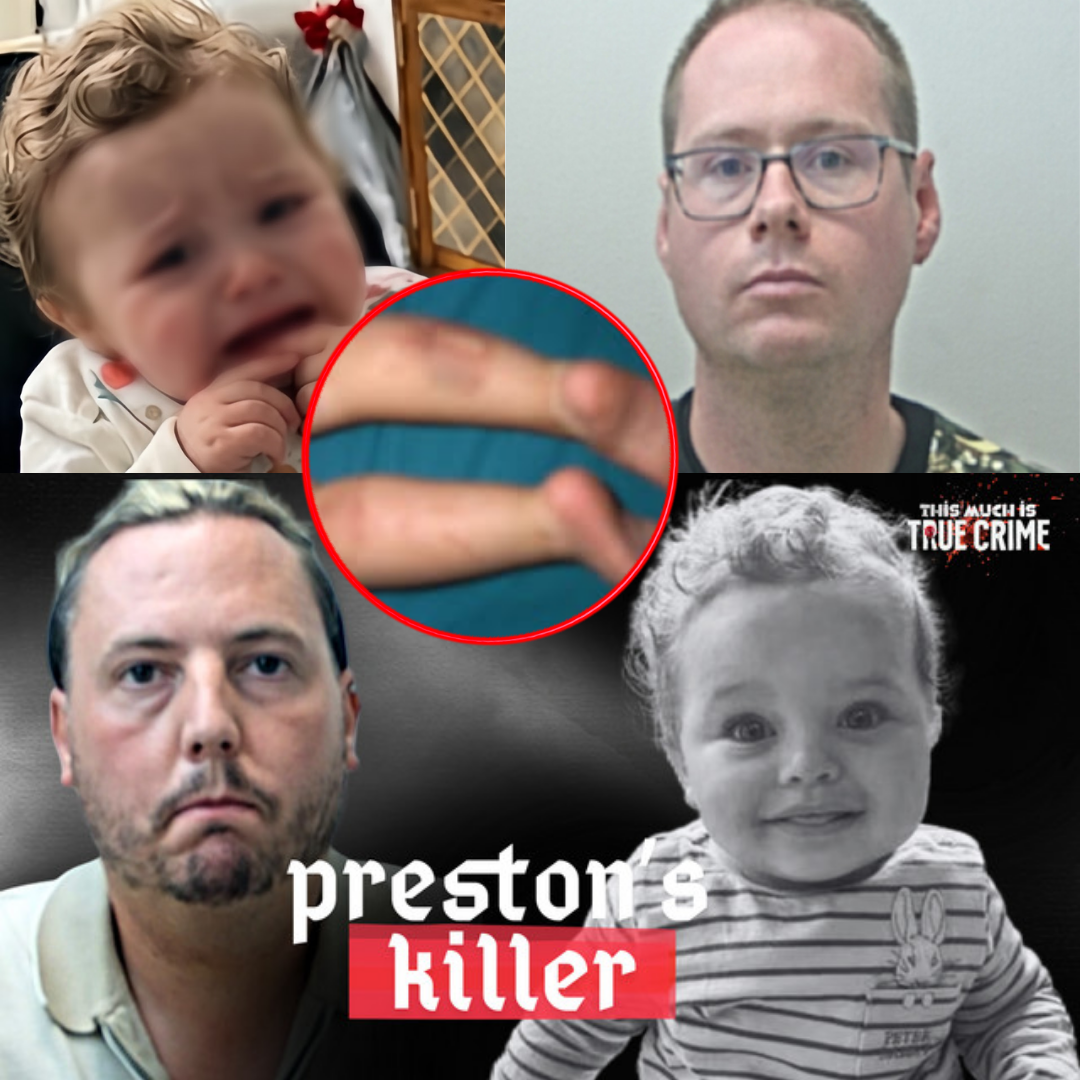
COURTROOM FROZE: NEW EVIDENCE IN PRESTON DAVEY CASE, MEDICAL TIMELINE SHATTERS JAMIE VARLEY’S DEFENSE
New forensic evidence in the Preston Davey case has shocked child welfare advocates after medical experts exposed the true timeline. Digital logs prove the cumulative injuries developed over weeks, completely shattering convicted adoptive father Jamie Varley’s claims. The entire courtroom froze as representatives revealed the precise hour the blockage occurred that ended the 13-month-old’s life.
Preston Davey was just 13 months old when he died on 27 July 2023 at Blackpool Victoria Hospital. He had been placed with Jamie Varley, a secondary school teacher and former head of year, and his partner John McGowan-Fazakerley only four months earlier under an adoptive placement. What began as a hoped-for new start ended in one of the most disturbing cases of prolonged child abuse and murder to come before a British court in recent years.
Varley’s defence centred on a single claim: that on the afternoon of 27 July he had briefly left Preston unattended in the bath, returned to find the child submerged, and that the death was a tragic drowning accident. That account collapsed under the weight of medical science and digital evidence recovered from the couple’s phones.
Home Office pathologist Dr Alison Armour told the jury that drowning was ruled out. There was no water in the lungs consistent with immersion. Instead, the cause of death was acute upper airway obstruction — either smothering or the insertion of an object into the mouth that blocked the child’s breathing. Bruising deep in the throat, described as “most unusual,” had formed while Preston still had circulation. That meant the injury occurred hours before hospital staff began resuscitation efforts, when the child already had no heartbeat and therefore could not bruise from medical intervention.
The timeline proved even more damning. Digital phone data showed Varley recorded a 35-second video at approximately 4:45pm on the day Preston died. In the footage the toddler was in extreme respiratory distress, taking agonal gasps, lips blue, clearly in a pre-terminal state. Experts calculated that significant obstruction of the airway had already occurred by that point. Yet help was not sought until after 6:20pm, when McGowan-Fazakerley returned home and the pair carried the unconscious child into A&E. Preston was pronounced dead at 7:18pm or 7:20pm after nearly an hour of frantic resuscitation.
The courtroom fell silent as medical experts walked the jury through the cumulative pattern of harm. Preston had sustained around 40 traumatic injuries during the four months he lived with the couple. These included more than 30 external bruises, many consistent with fingertip gripping, prodding and pinching; a non-accidental fracture to the left elbow sustained about three weeks before death; linear bruises on the thigh consistent with a slap; internal bruising to the mouth, throat, anus, bowel and bladder; and injuries regarded as clinical signs of forcible penetration and sexual abuse on more than one occasion.
Digital logs and photographs fixed the injuries in time. Phone images from mid-to-late April 2023 already showed bruising to the head. A photograph taken on 12 June captured what experts identified as a human bite mark on the child’s bottom. On 23 July — four days before the fatal incident — Varley recorded a sequence of images lasting more than three minutes in which Preston lay partially suspended over the top bar of his cot, neck resting on the rail, body in a frog-like position, tongue protruding and lips blue. Pathologists described the position as highly unsafe and prolonged.
Earlier hospital attendances had raised red flags that were not fully acted upon. On 25 May 2023 Preston was brought in floppy and unresponsive with unexplained bruising to the forehead. On 30 June he returned with a rash and further head bruises; staff were shown a home video of a toy box falling on the child as an explanation. That video, it later emerged, had been filmed 12 days earlier and could not account for the fresh injuries. On 6 July Varley took Preston to hospital with a fractured elbow and gave inconsistent accounts to different people — an incident in the cot, a fall while being placed in a car seat, catching the child as he fell.
Consultant paediatrician and expert in sexual abuse medicine Dr Joanne Gifford told the court that videos showed Preston in a state of “frozen watchfulness,” a recognised sign in abused infants. She identified at least three earlier “near-miss” episodes of critical respiratory compromise. The pattern was not accidental. It was progressive and deliberate.
Varley’s defence expert, Professor Jack Crane, accepted that many of the injuries were non-accidental, including the elbow fracture and the slap marks. He suggested the cause of death might be “unascertained” and raised the possibility that throat bruising could have occurred during hospital intubation. The jury rejected that interpretation. The medical consensus that the fatal obstruction happened while the child still had a heartbeat, combined with the timestamped video of distress nearly two hours before help was sought, left little room for the drowning narrative.
Child welfare advocates watching the trial described the evidence as both heartbreaking and revelatory. The digital record — photographs, videos, messaging history — had turned the private space of the home into a forensic timeline. What Varley had treated as disposable moments of control and cruelty became permanent exhibits that dismantled every claim of accident or momentary lapse.
In June 2026, after an eight-week trial at Preston Crown Court, Jamie Varley was convicted of murder, two counts of assault by penetration, five counts of cruelty to a child, grievous bodily harm, sexual assault of a child, and multiple counts relating to indecent images and videos. He was sentenced to a whole-life order, meaning he will never be released. McGowan-Fazakerley was convicted of causing or allowing the death of a child, child cruelty and sexual assault, and received a 25-year sentence.
The medical timeline did more than secure convictions. It exposed how a sequence of injuries, each individually minimised or explained away, accumulated into catastrophe. Digital logs fixed those injuries in calendar time. The 4:45pm video fixed the onset of the final airway blockage within a narrow window. Together they left the defence with nowhere to stand.
For those who work to protect children, the case stands as a stark reminder: when the medical evidence and the digital record align, the truth of what happened behind closed doors can no longer be hidden. Preston Davey’s short life ended in silence and obstruction. The evidence that followed spoke with devastating clarity.