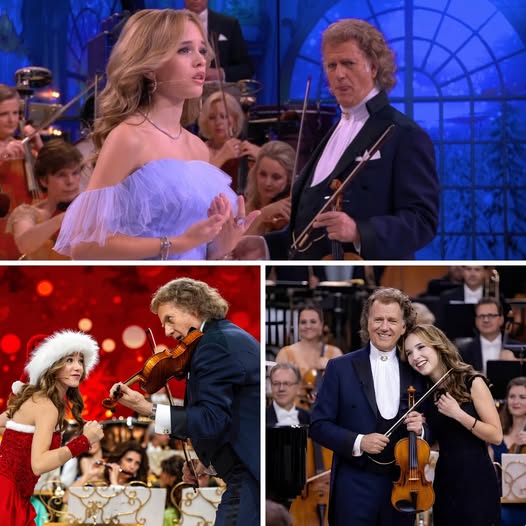
The Tears Behind the Waltz: How Emma Kok’s Unstoppable Voice Unlocked André Rieu’s Deepest Vulnerabilities
On a balmy summer evening in the historic Vrijthof Square of Maastricht, Netherlands, thousands of spectators gathered for what was promised to be another triumphant concert by André Rieu and his world-famous Johann Strauss Orchestra. For decades, the Dutch violinist and conductor—affectionately known across continents as the “King of the Waltz”—had built a global empire on joy, grandeur, and emotional release. His concerts were traditionally a whirlwind of vibrant ball gowns, soaring classical melodies, erupting confetti, and waltzing crowds.
Yet, during one extraordinary performance, the grand spectacle dissolved into a moment of raw, unscripted human emotion that left the audience, the orchestra, and the maestro himself entirely speechless.
When a 15-year-old girl named Emma Kok took center stage in a striking yellow gown, few in the audience could have anticipated the seismic wave of emotion about to sweep through the square. As her soaring, impassioned voice delivered the opening lines of French singer Barbara Pravi’s “Voilà,” something shifted in the open-air arena. Standing just feet away with his violin tucked under his arm, André Rieu began to weep openly.
These were not the practiced tears of a seasoned performer putting on a show. They were the visceral, uncontained tears of a man confronting profound beauty, resilience, and personal memory. The video of that performance would go on to rack up hundreds of millions of views worldwide, but behind the viral phenomenon lies a much deeper, more poignant story—one of hidden physical suffering, financial near-ruin, and the quiet solidarity of two artists who refused to let life break them.
The Girl with the Angelic Voice and the Invisible Battle
To understand why André Rieu broke down on stage, one must first understand the extraordinary life of Emma Kok. Born in Kerkrade, Netherlands, in 2008, Emma displayed a passion for singing almost as soon as she could speak. However, her life has been defined from early infancy by a severe, incurable medical condition: gastroparesis.
Gastroparesis, often referred to as stomach paralysis, is a chronic illness in which the stomach cannot empty food in a normal way due to nerve damage or muscular dysfunction. For Emma, this means her digestive tract is largely non-functional. She cannot consume solid food like a healthy teenager; instead, she relies on a feeding tube connected directly to her intestines, which pumps vital nutrients into her body for up to 22 hours every single day. She carries a heavy medical pump with her wherever she goes, managing constant nausea, abdominal pain, and fatigue.
+-----------------------------------------------------------------------------------+
|                            EMMA KOK: A DUAL REALITY                               |
+------------------------------------+----------------------------------------------+
| Daily Medical Reality              | Artistic & Musical Milestones                |
+------------------------------------+----------------------------------------------+
| • Incurable Severe Gastroparesis   | • Winner of *The Voice Kids* Netherlands     |
| • 22 Hours/Day Feeding Tube        | • Founder of 'Gastrome' Foundation           |
| • Continuous Chronic Pain & Fatigue| • Viral Global Sensation ("Voilà")           |
| • Portable Infusion Pump Lifeline  | • Featured Soloist on Rieu's World Tour      |
+------------------------------------+----------------------------------------------+
Despite these crushing physical limitations, Emma refused to allow her illness to define her identity. Music became her sanctuary, a place where her body was not a source of pain, but an instrument of extraordinary power. In 2021, at just 13 years old, she won The Voice Kids Netherlands, stunning judges and viewers with her vocal control and emotional depth.
When André Rieu, who lives near Maastricht, heard Emma sing, he was instantly spellbound. Recognizing a talent that transcended age, he invited her to perform as a special guest during his 2023 summer concert series in his hometown.
The Anatomy of a Moment: “Voilà” in Vrijthof Square
The choice of song for Emma’s appearance with the Johann Strauss Orchestra was nothing short of prophetic. “Voilà,” originally written by Barbara Pravi for the 2021 Eurovision Song Contest, is a chanson about vulnerability, self-acceptance, and the desperate desire to be heard for who one truly is, without pretense or mask.
The translated lyrics carry an aching intensity:
“Look at me, or at least what’s left of me… Here I am, this is who I am. Here I stand naked, this is my truth.”
When Emma stepped onto the Vrijthof stage, her small frame belied the sheer power of her lungs. Supported by Rieu’s lush, full-orchestral arrangement, she sang not merely with technique, but with every fiber of her soul. Every lyric felt like an authentic declaration of her own struggle—a young girl declaring to the world that despite her fragile body, her pump, and her endless medical treatments, her voice was loud, vibrant, and alive.
As the song reached its dramatic crescendo, the camera panned to André Rieu. The maestro, who spent his career maintaining absolute composure while conducting hundreds of musicians, had lowered his bow. Tears glistened on his cheeks. He dabbed at his eyes with a handkerchief, visibly struggling to maintain his footing as the emotional weight of the performance overwhelmed him. Behind him, members of the Johann Strauss Orchestra—veteran musicians who had played thousands of shows around the globe—were seen wiping away tears of their own.
When the final note echoed through the square, the 12,000 spectators erupted into a prolonged, thunderous standing ovation. Emma stood smiling in her yellow dress, while Rieu embraced her, his face showing a mixture of awe, pride, and deep reverence.
What the Tears Revealed: Rieu’s Private Struggles
Why did Emma’s performance break through the defenses of a man who has performed for royalty, presidents, and millions of fans over four decades? To those close to the maestro, the tears were not just a reaction to Emma’s voice—they were a release of feelings André had carried in silence for years.
While André Rieu is known globally for his cheerful stage persona, his path to international superstardom has been fraught with immense pressure, severe burnout, and catastrophic financial risk.
1. The Shadow of Bankruptcy and the World Arena Tour
In 2008, driven by a dream to create the most grand classical spectacle in history, Rieu commissioned a life-sized replica of Vienna’s Schönbrunn Palace to serve as a mobile stage for a stadium tour. The logistically staggering production required dozens of transport trucks, hundreds of staff, and millions of dollars in daily operating costs.
The economic crash of 2008 hit during the tour, resulting in catastrophic financial losses. Rieu found himself tens of millions of euros in debt, facing the total collapse of his company, the loss of his beloved castle home, and the sudden unemployment of his extended “orchestra family.”
-
The Toll: Rieu worked relentlessly under suffocating pressure to repay creditors, suffering severe physical breakdowns, including severe viral labyrinthitis (an inner ear infection) that left him bedridden for months and forced him to cancel tours.
-
The Lesson: He came face-to-face with total loss, learning what it meant to fight through physical weakness and mental anguish to protect his life’s passion.
2. The Weight of Isolation and Expectations
As the head of an independent musical enterprise employing over 120 people, Rieu bears the sole financial and creative burden of his empire. For decades, he felt compelled to hide his fatigue, anxiety, and pain behind a permanent smile. In Emma Kok, he saw a reflection of his own inner child—someone who had stared into the abyss of suffering, loss, and vulnerability, yet chose to stand up and bring beauty into a cold world.
“When I look at Emma,” Rieu later reflected in interviews, “I don’t just see a great singer. I see a fighter. She reminds me of what it means to give everything you have to the music, no matter how much pain you carry inside.”
The Psychological Power of Shared Vulnerability
The global response to Emma Kok and André Rieu’s joint performance highlighted a profound psychological truth: audiences in the modern world are starving for authentic vulnerability.
In an era dominated by hyper-polished pop music, auto-tuned vocals, and curated social media facades, watching a 15-year-old girl with a feeding tube sing her heart out alongside a weeping 73-year-old classical maestro broke through the digital noise. It wasn’t just entertainment; it was a profound human moment.
+-----------------------------------------------------------------------------------+
|                       THE CHAIN REACTION OF VULNERABILITY                         |
+-----------------------------------------------------------------------------------+
|  1. EMMA'S RAW TRUTH  --> Sings "Voilà" with total honesty, transforming her      |
|                           physical pain into unbridled vocal artistry.            |
|                                     |                                             |
|                                     v                                             |
|  2. MAESTRO'S BREAKDOWN--> Rieu drops his professional defense, crying openly     |
|                           and validating the emotional truth of her struggle.     |
|                                     |                                             |
|                                     v                                             |
|  3. ORCHESTRA & AUDIENCE-> Musicians and 12,000 spectators weep together, breaking|
|                           the traditional barriers of classical performance.      |
|                                     |                                             |
|                                     v                                             |
|  4. GLOBAL CULTURAL WAVE-> Hundreds of millions watch online, inspiring discussions|
|                           around chronic illness, empathy, and artistic beauty.   |
+-----------------------------------------------------------------------------------+
The Catharsis of Classical Music
Classical crossover music, when stripped of elitism, acts as a bridge to universal human emotions. Rieu’s life work has been dedicated to democratizing classical music—rescuing it from stiff, quiet concert halls and giving it back to ordinary people. By showing his own tears on stage, Rieu validated the emotion of every person in the crowd who was battling their own hidden struggles, grief, or physical pain.