NETFLIX PRESENTS A HIGH-STAKES TRUE CRIME THRILLER THAT ELIZABETH OLSEN IN A MASTERCLASS PERFORMANCE
In the quiet, God-fearing suburbs of 1980s Texas, where white picket fences hide more than just well-kept lawns, one woman’s desperate hunger for excitement detonates into an irreversible bloodbath. Love & Death (2023) delivers a suffocating, meticulously crafted portrait of suburban emptiness turning lethal, with Elizabeth Olsen delivering a performance so layered and unsettling that it refuses to let you look away.
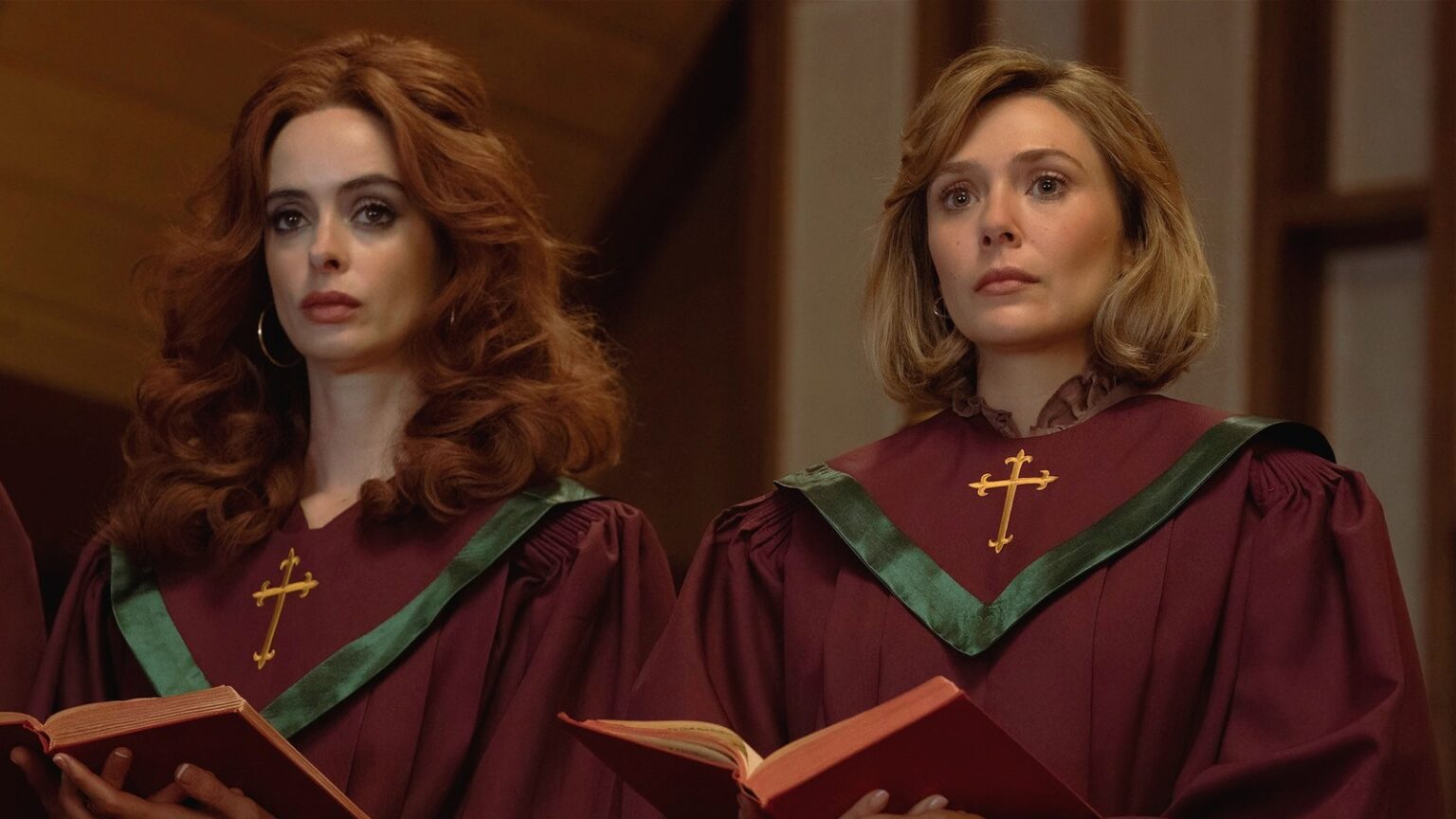
Candy Montgomery appears to have it all. A devoted mother of two, active in her church community, married to a steady engineer, and living the American dream in Wylie, Texas. She stands shoulder-to-shoulder with her neighbors in the pews, hymn books open, voices rising in perfect harmony. On the surface, she is the picture of contentment. But beneath the smiles and the covered-dish suppers, something is rotting. A restless hunger. A craving for risk. A quiet, corrosive boredom that no amount of domestic routine can satisfy.
That hunger finds its target in Allan Gore, the husband of her close friend Betty. What begins as a calculated, almost clinical arrangement between two married people searching for something missing in their own lives quickly spirals into obsession. They set rules. They try to keep it purely physical. They promise themselves they can walk away the moment feelings complicate the arrangement. They are wrong.
Love & Death (2023) does not rush the descent. It lets the tension build like heat in a locked car. Olsen’s Candy is neither monster nor victim in the early episodes. She is a woman who has convinced herself that controlled transgression will fill the emptiness. She plans the meetings with almost military precision. She returns home afterward and folds laundry, packs lunches, and sings in church as if nothing has shifted. The performance is remarkable in its restraint. Olsen never overplays the darkness. Instead, she lets it seep out through small cracks: a lingering glance, a too-bright smile, a moment of stillness when the camera catches her alone.
The series understands that the most terrifying betrayals are the ones that happen in ordinary rooms. Living rooms with matching sofas. Kitchens where coffee is still brewing. Utility rooms where an axe hangs on a pegboard because someone once needed it for firewood. When the confrontation finally arrives, it is not staged as pure horror. It is messy, panicked, and intimately human. Two women who once stood side by side holding hymn books now face each other with everything between them broken.
Standing in that church, voices rising around her, Candy experiences a moment of pure, icy clarity. The realization is not sudden lightning. It is the slow, sickening understanding that the double life she has carefully constructed has a cost she never truly calculated. The face of the woman she called friend. The husband she shared. The children who still believe the adults around them are safe and good. In that exact moment, as the congregation sings of grace and redemption, the weight of what she has set in motion becomes impossible to ignore.
Elizabeth Olsen captures this dread with extraordinary precision. Her Candy is not a cartoon villain. She is a woman who believed she could control the chaos she invited into her life, only to discover that chaos has its own appetite. The performance is a masterclass in controlled intensity. Olsen makes the audience feel the claustrophobia of Candy’s carefully maintained public face while the private one unravels. Every polite conversation, every church social, every moment of domestic normalcy becomes charged with the knowledge of what lies underneath.
The supporting cast matches her intensity. Jesse Plemons brings a quiet, almost passive quality to Allan that makes his role in the affair feel both inevitable and deeply unsettling. Lily Rabe’s Betty is heartbreaking in her vulnerability and her rage. The series refuses to flatten any of these people into simple categories of good or evil. It shows the loneliness that can exist inside marriages that look perfect from the outside. It shows how easily boredom can become a kind of hunger. And it shows how quickly that hunger can turn violent when confronted with the truth.
What makes Love & Death (2023) so gripping is its refusal to sensationalize the blood while still refusing to look away from it. The violence, when it comes, is shocking precisely because the series has spent so much time in the ordinary. The same hands that once held hymn books and passed casserole dishes now grip a weapon. The same suburban quiet that once felt safe becomes the backdrop for something irreversible.
The true story behind the series is almost stranger than the fiction. In June 1980, a real woman named Candy Montgomery stood accused of killing her friend with an axe in a quiet Texas home while a baby slept in another room. The case shocked the community that had known both women as devoted church members and mothers. The trial that followed forced a jury to confront uncomfortable questions about self-defense, rage, and the hidden lives of people who sit next to you every Sunday. The series does not claim to answer every question. Instead, it forces the audience to sit with the same discomfort the town once felt.
David E. Kelley’s writing and Lesli Linka Glatter’s direction create a world that feels both specific to its time and unnervingly familiar. The pastel colors of 1970s and early 1980s suburbia, the careful manners, the church socials, the careful performance of happiness — all of it is rendered with such texture that the eventual rupture feels inevitable. The series understands that the most dangerous double lives are the ones lived in plain sight.
Olsen’s performance is the gravitational center. She never asks for sympathy, but she also refuses to make Candy easy to hate. The result is a character study that lingers long after the final episode. You find yourself replaying moments, wondering at what precise second the ordinary became catastrophic. You remember the hymn books. You remember the congregation singing. And you remember the look on Candy’s face when the realization lands.
Love & Death (2023) is not simply another true-crime retelling. It is a study of what happens when the desperate search for excitement collides with the rigid structures of suburban respectability. It is about the lies people tell themselves to survive ordinary lives, and the moment those lies can no longer be maintained. It is about obsession, betrayal, and the terrifying speed with which a quiet life can turn into a bloodbath.
On Netflix, the series finds a new audience ready to be pulled into its carefully constructed dread. Elizabeth Olsen does not merely play Candy Montgomery. She inhabits the space between the woman everyone thought they knew and the woman who emerged when the mask finally slipped. In that space, between the hymn and the horror, Love & Death (2023) finds its devastating power.
The congregation keeps singing. The hymn books remain open. And somewhere in that moment of collective faith, one woman understands that nothing will ever be the same again.