THE HIGH-STAKES PSYCHOLOGICAL THRILLER ON NETFLIX THAT EMMA THOMPSON IN A MASTERCLASS PERFORMANCE OF LAW AND MORALITY WILL LEAVE YOU ABSOLUTELY SPEECHLESS!
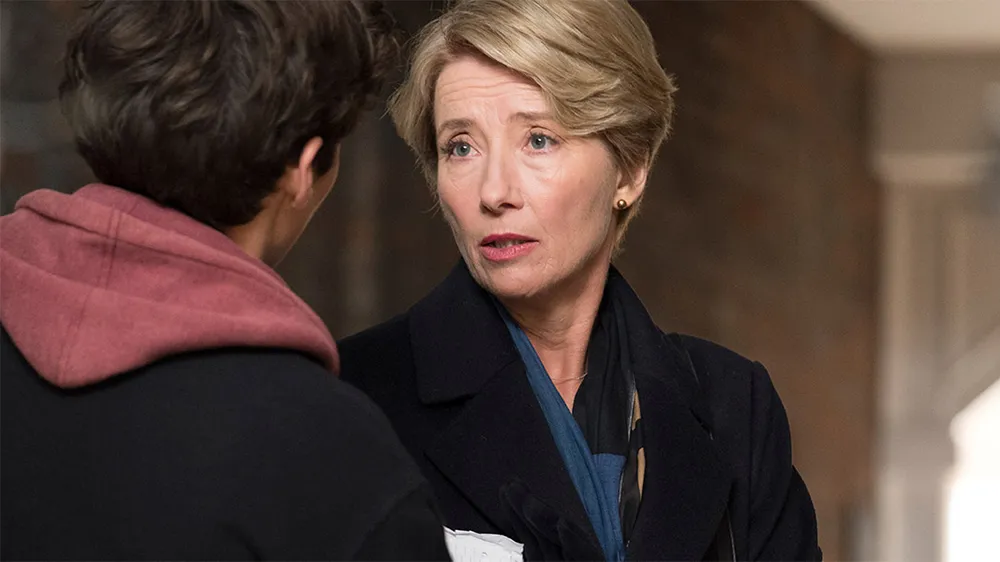
A judge’s forced order, a shattered belief system, and the haunting price of saving a boy against his own will. When strict legal duty collides with a teenager’s fanatical devotion, The Children Act on NETFLIX delivers a devastating clash between law and faith that lingers long after the credits roll. Staring into the eyes of the teenager she legally forced onto a hospital bed, the heartbreaking truth behind Fiona’s decision proves everything about the cost of justice.
This gripping 2018 drama, adapted by Ian McEwan from his own bestselling novel and directed by Richard Eyre, stars Emma Thompson in one of her most layered performances. Thompson plays Fiona Maye, a High Court judge whose cold, rational world is upended by a life-or-death case that forces her to confront not just the boy’s future, but her own. Fionn Whitehead delivers a raw, magnetic turn as Adam Henry, a 17-year-old Jehovah’s Witness with leukaemia whose faith demands he refuse a life-saving blood transfusion. Together, Thompson and Whitehead create a masterclass in moral ambiguity that keeps you on the edge of your seat—especially on Netflix, where the film is currently streaming.
The story opens with a courtroom scene that sets the tone: Fiona issues a Solomon-like ruling on conjoined twins, reminding everyone this is “a court of law, not of morals.” It’s elegant, precise, and utterly detached. But her personal life is already cracking. Her husband, Jack (Stanley Tucci), has grown weary of their emotional distance. “When is the last time we made love?” he asks, voice heavy with exhaustion. Fiona, consumed by work, offers no real answer. Their marriage, once passionate, has become polite goodnights and separate lives.
Then the case arrives: 17-year-old Adam Henry. Diagnosed with leukaemia, he needs a transfusion to survive. His parents, devout Jehovah’s Witnesses, refuse it on religious grounds. Adam is still legally a minor, so the law grants the court power to override their wishes. As the film opens, Fiona visits him in the hospital—her first unorthodox step. What follows is a charged, intimate encounter that no legal brief could ever prepare her for.
Adam is precocious, kind, and fiercely articulate. He plays Yeats’ “Down by the Salley Gardens” on his violin, and Fiona, moved, sings along. In that moment, something shifts. The boy’s intelligence and vulnerability stir long-buried emotions in her. Adam, in turn, becomes obsessed with the “lovely” judge who actually listened. He begs her not to leave. When she returns to court, she rules in favour of the transfusion, declaring Adam’s welfare the “paramount consideration.” The hospital can proceed.
The decision is legally impeccable. But ethically it fractures her. The film never lets us forget that. Thompson’s performance is electric here—every clipped word, every carefully measured gesture reveals a woman who has dedicated her life to protecting children yet never had children of her own. Her marriage is a casualty of her own making. The case she once kept at arm’s length now threatens to consume her.
As Adam’s leukaemia returns and he refuses further treatment, the consequences ripple outward. Fiona rushes to the hospice on the night of a concert, her planned encore replaced by a frantic dash. She finds Adam at death’s door. In his final moments, he tells her it was his choice. The legal victory has become a personal defeat.
Critics praised Thompson’s “masterclass” portrayal, calling it her best since Wit. The Washington Post noted she “bursts with ideas about right and wrong,” while Variety hailed it as elevating a potentially melodramatic story into profound adult drama. Yet some found the narrative contrivances preposterous—Adam’s rapid emotional transformation feels almost too convenient. Still, those flaws are minor compared to the film’s emotional honesty. It never moralises. It simply shows two people, one bound by faith, the other by duty, colliding in a way that changes them forever.
The Children Act is not a straightforward thriller. There are no gunfights or car chases. Instead, it excels at quiet psychological tension. The hospital room becomes a stage for philosophical warfare: blood versus belief, law versus love, autonomy versus protection. Thompson’s Fiona is a woman who excels at dispensing justice to others but struggles to grant it to herself. Her final breakdown in front of Jack, holding his hand as she falls asleep, is devastatingly understated. The film ends not with triumph but with a quiet acceptance of irreversible loss—Adam’s death, Fiona’s shattered certainty, and the realisation that sometimes saving a life means destroying something far more precious: a belief system.
On Netflix, the film has found a new audience hungry for thoughtful British dramas. Its 74% Rotten Tomatoes score reflects praise for Thompson’s performance and McEwan’s sharp writing, even if some viewers wish for more clarity. At just 105 minutes, it packs a lifetime of moral weight into a single case. Whether you’re drawn to the legal realism, the star power of Emma Thompson, or the haunting clash of faith and medicine, The Children Act rewards close attention.
If you haven’t seen it yet, stream it tonight. The title says it all: this is the law governing children, but the real battle is over who gets to decide what they’re willing to sacrifice. When the credits roll, you’ll be left speechless—not because the film is flawless, but because it dares to ask the hardest questions without offering easy answers. In a world full of moral relativism, The Children Act reminds us that even the most rational judge can be shaken to her core by one boy’s unwavering faith.