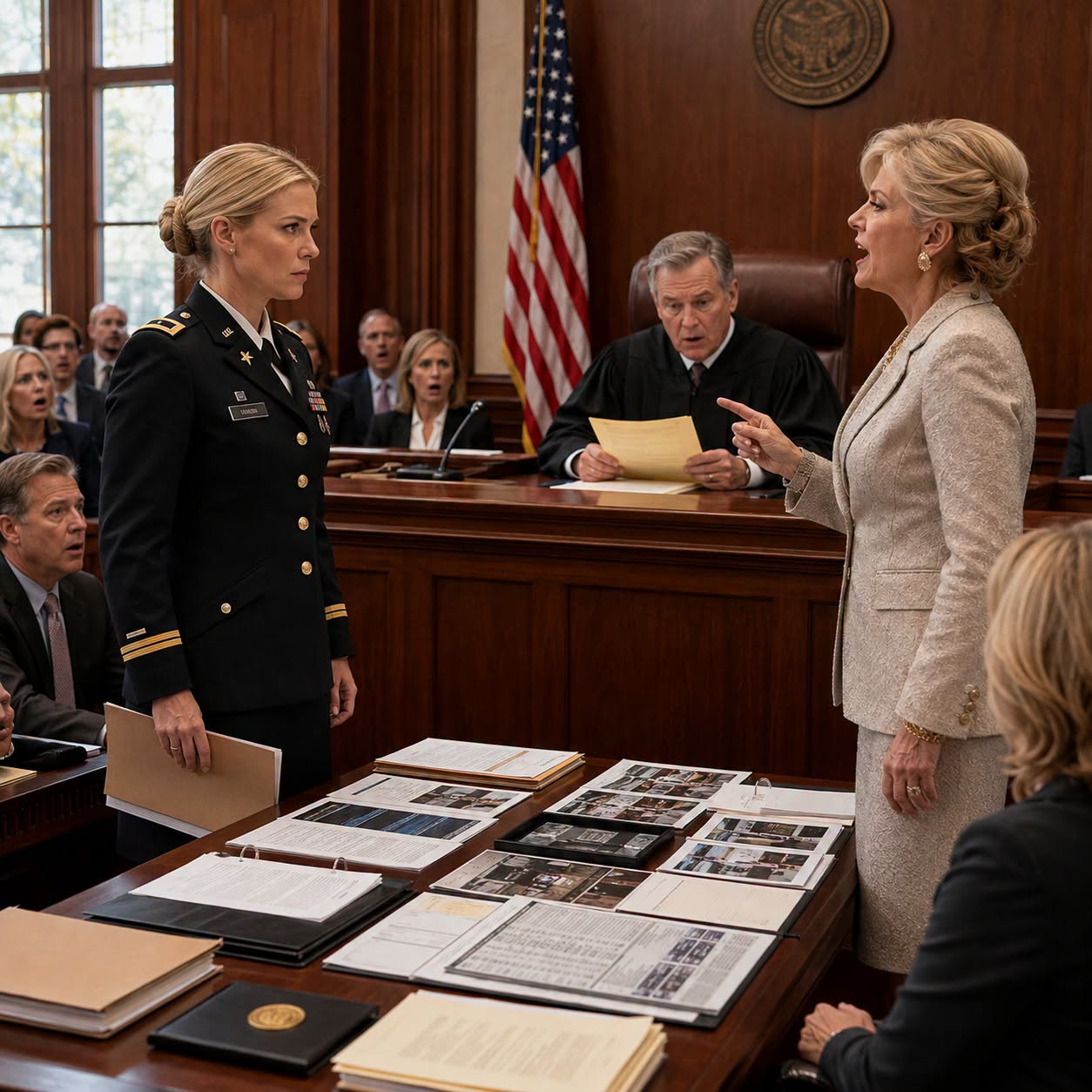
PART 3 – She mocked her stepdaughter in open court and said without the family the Army daughter would sleep in a government barracks with nothing but a duffel bag — then the judge asked why no one mentioned she was the licensed attorney who drafted her father’s trust, and the sealed envelope on the clerk’s desk still had not been opened.
PART 3 – The envelope is read, and the house no longer belongs to the lie
Twenty minutes is a long time in a courthouse hallway when no one is allowed to leave the floor.
Linda stood with Preston near the water fountain, her voice a tight whisper that kept breaking into the same three words.
He would never.
Aunt Carol sat on a bench and stared at her own hands. Cousin Tim checked his phone, put it away, checked it again. Nobody laughed now. The performance had run out of audience.
I stood by the window in dress uniform and watched a delivery truck idle at the curb. Patricia did not speak. She did not need to. The sticky note was already finished with its work.
When we were called back in, the room felt smaller than before.
Judge Whitfield was already seated. The envelope lay open in front of him. The wax was broken cleanly. The pages inside were few.
“Be seated.”
We sat.
He looked at Linda first, then at me, then at the paper.
“This document is dated the same week the trust was executed. It is witnessed. It is notarized. It is addressed to this court in the event of contest. I will read it into the record.”
No one breathed correctly.
The judge’s voice did not rise. He did not need it to.
To the Honorable Court:
If this letter is being opened, then someone has decided my daughter was never really mine, or that my wife’s convenience outranks the promises I made while I could still make them.
Megan drafted this trust because I asked her to. She did it at my desk, in my study, while I could still see the maple tree I planted the year she was born. I did not tell Linda. That was not cruelty. It was caution.
I loved my wife. I also watched her grow frightened of ordinary limits. I watched accounts change names. I watched my first wife’s letters moved from the drawer where they had always lived. I watched my daughter treated as a guest in the house she grew up in.
Therefore:
If Linda contests this trust, isolates Megan, disposes of scheduled property without written consent, or represents to any institution that Megan is unfit, Linda’s authority as trustee terminates immediately. Successor trustee is Megan Elizabeth Sullivan. The Mustang, the study paintings, my journals, and Catherine’s letters are specific gifts to my daughter and are not marital property for purposes of sale.
I am not punishing anyone from the grave. I am finishing a conversation I started too late and meant to finish in person.
David J. Sullivan
The last page made a soft sound as the judge set it down.
For a moment there was nothing.
Then Linda made a noise that was not quite a word.
Preston was already standing.
“Your Honor, we request time to examine authenticity—”
“The signatures match the trust. The notary is known to this court. The date aligns with the emails already marked. You may examine. You will not delay preservation.”
Judge Whitfield turned a page of his own notes.
“Effective immediately, Mrs. Sullivan is suspended as trustee. Major Sullivan is recognized as successor trustee pending formal letters. All estate accounts are frozen except for ordinary household utilities already in place. The Mustang sale, the painting transfers, and the share movement are referred for accounting and, if warranted, to the Commonwealth’s Attorney.”
Linda’s face had the stunned, emptied look of someone who had arrived at the wrong ending of a story she thought she was writing.
“David would never do this to me.”
I looked at her then, fully.
“He didn’t do it to you,” I said. “He did it for the house, and for my mother’s letters, and for the version of himself that still believed people tell the truth when it costs them something.”
Judge Whitfield closed the file.
“There will be a status hearing in fourteen days. Mrs. Sullivan will provide a full inventory by then. Major Sullivan, you will not take possession of the residence until the inventory is filed, but you will have supervised access tomorrow morning for your mother’s papers and your father’s journals. The porch camera footage and the bank recording remain under seal except as needed for the accounting.”
He looked at me over his glasses one last time.
“You may be seated, Major.”
I sat.
The coffee stain was still on Linda’s legal pad. Someone would throw the pad away. The stain would go with it. It had done enough.
Outside, the July heat had not moved.
I walked down the courthouse steps with Patricia. She did not congratulate me. She only said, “He wrote it like a man who knew he was running out of ordinary days.”
“Yes.”
That night I did not go to the house.
I went to the motel on Route 50 where I had been staying since the locks changed. I laid the dress coat over the chair. I set my father’s last email on the table—the one that said, If she ever makes you prove you belonged here, do not argue in the doorway. Bring it to someone who has to listen.
In the morning I would stand on the porch again.
The key would not matter yet.
The camera would.
The letters, if the rain had left any ink, would come home in a box that no longer sat in a driveway.
I was still my father’s difficult daughter.
I was also the person he trusted to finish the sentence he started at his desk, with the maple tree outside the window, while there was still time to write it down.
The barracks Linda had promised me were empty.
The duffel bag could wait.
The house, at last, would have to tell the truth.
THE END