“Take That Jacket Off.” He Said It Like a Joke. Then He Named Restricted Military Routes at the Family Table — and Realized the Woman in the Worn Uniform Was the Officer Who Could End Him.
PART 1
Rain clung to the flag above the porch like it had nowhere else to go.
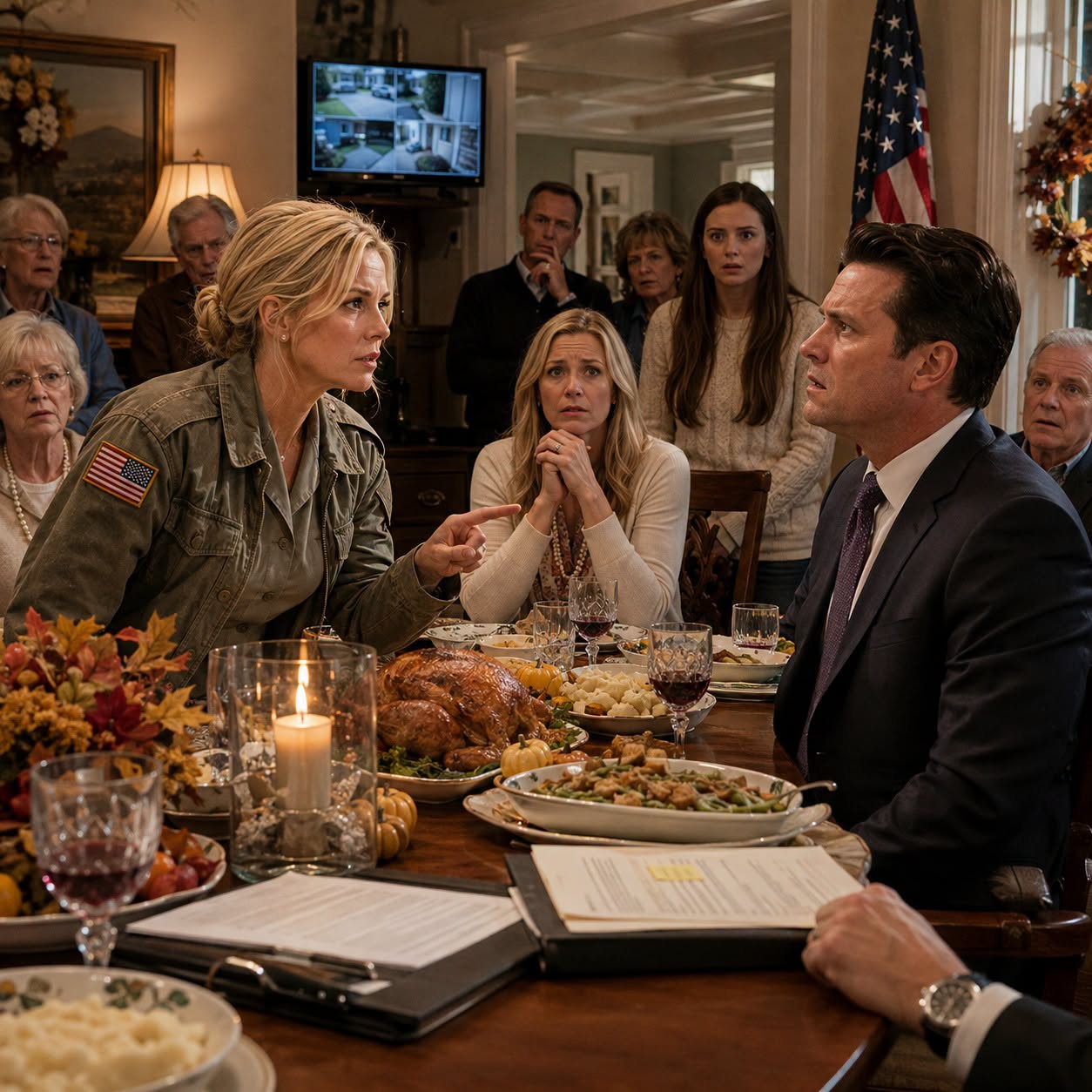
Angela Murphy stood on the brick walk with an apple pie balanced against her hip and the engine of her sedan still ticking in the driveway. Seventy-two hours earlier she had been in a different climate, a different kind of cold. The service dress jacket she wore had not been chosen for the occasion. It had simply never come off.
The cuffs were faded. The elbows had gone smooth. One brass insignia carried a thin scratch from a cargo ramp in Kuwait that no amount of polish had ever fully erased.
Richard saw worn cloth.
She saw years.
“Take that jacket off before you sit down,” he said from the foyer, crystal tumbler already in hand. “We’re serving Thanksgiving dinner, not hiring mall security.”
Nobody laughed.
That was the first thing she noticed.
The second was her sister Clara standing just behind him, dish towel twisted so tightly in her fingers that the knuckles had gone bloodless.
Clara stepped forward and hugged her quickly, too quickly.
“You made it,” she whispered.
The voice was wrong. Not broken. Careful.
Angela handed over the pie and caught the faint purple mark near Clara’s wrist before the sleeve came down.
Richard saw her see it.
Then he smiled.
“Kitchen’s that way. Try not to salute the turkey.”
Uncle Dennis produced a weak cough. Their mother developed a sudden fascination with the wallpaper.
Angela could have answered him there, in the doorway, with rain still darkening the shoulders of her jacket. She did not. In her work the loudest person in a room usually told you exactly where the fracture was. She wiped her shoes, smiled the small professional smile that cost her nothing, and followed Clara toward the kitchen.
The house had changed.
New quartz. Copper pans hung like trophies. Richard’s framed magazine profile sat beside the coffee machine, angled so anyone reaching for cream would have to look at it first.
The old things were disappearing.
Their father’s wooden recipe box was gone. So was the little ceramic church the two sisters had painted one summer when the world still felt simple. A FINAL NOTICE envelope sat half-hidden beneath a grocery circular. Clara slid the pie box over it before Angela could read the sender.
“Everything okay?”
“Perfect,” Richard called from the dining room.
Clara flinched.
Then she manufactured a smile and said, “He’s under pressure. The new contract is huge.”
She did not say we.
They sat at six.
Richard claimed the head of the mahogany table beneath a chandelier bright enough to interrogate someone. The turkey was magazine-perfect. The cranberry sauce was homemade. For ten minutes they passed plates and the room almost remembered how to be a family.
Then Richard began performing.
He spoke of Washington. Of the new SUV. Of the private club and the “serious people” who trusted him with “serious national decisions.” Every sentence ended with a glance in Angela’s direction, as though her presence were the punchline he had been waiting to deliver.
Their mother asked about the base.
“Busy,” Angela said.
Richard laughed into his wine.
“Busy moving boxes?”
“Sometimes.”
He leaned back, expansive.
“That’s the difference between operations and leadership. Angela handles inventory. I shape policy.”
Clara stared at her mashed potatoes. A small smear of lipstick remained on the rim of her water glass where it had been wiped away and reapplied.
Richard pointed his fork at Angela’s sleeve.
“Twenty-two years and that’s the reward? Faded fabric and a government pension?”
“Richard,” Clara said.
“What? I admire service. I do. But let’s not pretend sacrifice automatically equals success.”
He raised his glass.
“To Angela. Proof that loyalty is noble, even when ambition is absent.”
The room went still.
Something tightened in Angela’s chest—not because she believed him, but because their mother lowered her eyes. Because Clara looked ashamed for her instead of angry at him. Because she remembered every missed Christmas and every graduation watched through a phone screen while someone asked when she planned to get a real job.
Pain can make a person loud.
Training had taught her the opposite.
She folded her napkin and set it beside her plate.
Richard mistook the gesture for surrender. His smile widened.
“Don’t take it personally. I’m just excited. My firm received final approval for Project Vanguard. Multi-million-dollar logistics modernization. Top-level access. The kind of work regular service personnel never even hear about.”
Across the table, Paul Whitaker dropped his fork.
Paul was Richard’s corporate attorney. Nine hundred dollars an hour. A man who never wasted movement. He had met Angela once, at a summer barbecue, and had been professionally pleasant.
Now he was staring at Richard as though the man had just opened a vein in public.
Richard kept talking.
“Our clearance came through Monday. I can’t share details, obviously, but the program involves restricted routing architecture, emergency deployment chains, and—”
“Stop,” Paul said.
Too late.
Angela reached inside her jacket.
Richard chuckled.
“What, you brought a coupon for a new uniform?”
She drew out the black leather credential holder and slid it across the table. It stopped beside his wineglass.
He glanced down.
The smile lasted half a second longer than it should have.
Then it died.
The credential identified her as Colonel Angela Murphy, Senior Regional Defense Compliance Director and Chief Logistics Auditor for contracted readiness systems.
Richard read it twice.
Paul read it once and closed his eyes.
Angela leaned forward. Her voice stayed low, almost conversational, the way it did when the room had already become an interview.
“Richard. The contract you just named at an unsecured family dinner is scheduled for compliance review next Tuesday.”
His fingers tightened around the stem of the glass.
She let the silence work.
Then she asked the question that changed the temperature of the entire house.
“If your clearance is real, why did you just disclose a restricted procurement program in front of twelve uncleared civilians—and the officer assigned to audit your company?”
The color left his face.
Even the grandfather clock in the hallway seemed too loud, each tick measuring the exact distance between arrogance and the moment it became evidence.
PART 2
No one moved.
The turkey sat untouched in the center of the table, steam thinning above it as if the room itself had forgotten how to breathe. Crystal caught the chandelier light and threw it back in hard little fragments. Somewhere down the hall the grandfather clock kept counting, indifferent and exact.
Richard’s smile tried to return. It failed halfway.
“This is absurd,” he said. “It’s Thanksgiving.”
Paul Whitaker did not sit back down. He stood with both hands on the edge of the table, fingers spread as though the wood might keep him from falling through it.
“Richard,” he said, very quietly. “Stop talking.”
Richard ignored him.
He looked at Angela the way men look at a problem they believe they can still reframe.
“You came into my house wearing that tired costume and now you want to play inspector? In front of family?” He gave a short laugh that did not reach his eyes. “Clara, tell your sister this is not the time.”
Clara did not tell her sister anything.
She sat with her hands in her lap, one thumb pressing hard into the purple mark she had tried to hide. Her lipstick smear on the glass looked suddenly like evidence of a person trying, again and again, to appear unharmed.
Their mother made a small sound, the beginning of a sentence about gravy, then let it die.
Angela did not raise her voice. She had learned long ago that volume was what people used when they had already lost the room.
“You named a restricted program,” she said. “You described its architecture. You did it in an unsecured residence, in the presence of uncleared civilians, after consuming alcohol, while the officer assigned to your company’s compliance review was seated eight feet away.”
She paused, not for effect, but because precision deserved space.
“That is not a joke that aged poorly, Richard. That is a disclosure.”
Richard’s jaw tightened.
“My clearance—”
“Your clearance,” Angela said, “is not a personality. It is a condition. Conditions can be suspended.”
Paul closed his eyes again, briefly, like a man watching a car leave the road and knowing there is nothing left to grab.
Uncle Dennis stared at his plate. Someone’s child in the next room laughed at a cartoon, the sound thin and far away, belonging to a different holiday.
Richard leaned forward.
“You think you can walk in here after twenty-two years of being the family disappointment and lecture me about national decisions? I built this. I earned this access. You file reports. I move the country.”
Angela looked at him for a long moment.
She saw the new counters. The magazine profile. The missing recipe box. The envelope Clara had hidden. The way her sister’s shoulders had learned to occupy less space in her own dining room.
She saw a man who needed an audience more than he needed judgment.
“You didn’t move the country tonight,” she said. “You described how it would be moved. To people who were never supposed to hear it.”
Richard’s hand went to the credential holder as if he might push it back, make the last two minutes unhappen.
Angela did not stop him. She didn’t need to. The leather case stayed where it was, black and ordinary and heavier than any speech he had given all evening.
“Paul,” she said, still watching Richard, “did you advise your client against discussing Project Vanguard outside approved channels?”
Paul’s throat worked.
“Yes.”
The single word landed like a dropped plate.
Richard turned on him.
“Don’t you dare—”
“I told you Monday,” Paul said, and now the lawyer’s voice had the thinness of a man choosing between loyalty and license. “I told you the language was restricted. I told you the routing architecture was not dinner conversation. I told you the audit window was live.”
Live.
The word changed the air.
Angela felt it settle in her chest with the particular calm that comes after a long approach. She had not come only because it was Thanksgiving. She had come because the file on her desk had begun to smell like haste and debt and a man who talked too much when he felt small.
Richard’s face flushed, then drained again.
“You knew,” he said to Angela. “You sat there and let me talk.”
“I sat there,” she said, “and let you choose.”
Clara made a sound then. Not quite a sob. Something smaller, the noise a person makes when a door they have been holding shut for months finally gives a fraction of an inch.
Richard heard it and turned on her instead.
“This is your family,” he said. “This is what they do. They arrive late and they leave wreckage and they call it duty.”
Angela’s gaze moved, at last, from Richard to her sister.
Clara’s eyes were bright and terrified and, beneath that, something else. A question she had not been allowed to ask out loud for a very long time.
Angela did not reach across the table. She did not perform comfort. Comfort, offered too soon, can become another kind of control.
She only said, quietly, as if the rest of the room had already become official record:
“Clara. After dinner, you don’t have to ride home with him.”
Richard stood so fast his chair struck the wall.
The chandelier trembled.
Paul took one step sideways, already reaching for his phone, already calculating which call would have to be made first.
And in the hallway the clock struck the quarter hour, each note clean and merciless, as if time itself had decided the holiday was over.
PART 3
Richard’s chair left a dark scuff on the cream wall.
“You don’t give orders in my house,” he said.
The words came out too loud, as if volume might restore the ranking he had spent the evening inventing. The chandelier shivered. A drop of wine trembled at the rim of his glass and held.
Angela stood.
She did not square off. She did not raise her hands. She simply rose the way she had risen in rooms where the air had already decided who would leave standing. The faded jacket settled across her shoulders with the same indifferent weight it had carried through deserts, hangars, and years no one at this table had asked about.
“This stopped being your house the moment you turned it into an unsecured briefing,” she said. “Right now it is a location. Locations get recorded.”
Paul already had the phone to his ear. He turned toward the hallway, voice low and stripped of every dinner-party courtesy he had ever practiced.
Richard took one step toward Clara.
Only one.
Clara flinched so small a stranger might have missed it. Angela did not. Neither did their mother, who made a broken little gesture toward the cranberry dish and then let her hands fall useless in her lap.
“Clara,” Richard said, softer now, the tone men use when softness is still a form of ownership. “Tell her you’re fine. Tell her this is a misunderstanding.”
Clara looked at the turkey, at the hidden envelope beneath the pie box in the kitchen of her mind, at the ceramic church that no longer lived on any shelf. She looked at the purple mark her sleeve could no longer negotiate away.
Then she looked at her sister.
Twenty-two years of missed holidays sat between them, and still Angela did not fill the silence for her. Some doors have to be opened from the inside.
Clara stood.
The dish towel she had been twisting earlier was gone. Her hands were empty and shaking and, for the first time that night, her own.
“I’m not riding with him,” she said.
It was not loud. It did not need to be. The sentence did the work the rest of the evening had been circling.
Richard laughed once, ugly and thin.
“You’ll come back. You always do. She’ll put you in some grim little apartment and call it rescue, and in a month you’ll remember who paid for this table.”
Angela picked up the credential holder, closed it, and slid it back inside her jacket. The gesture was almost gentle. That made it worse.
“Tuesday,” she said. “Your offices. Counsel present. Document retention in place from this hour. Paul will confirm the hold.”
Paul, from the hallway, did not argue. He only said, into the phone, “Yes. Family residence. Verbal disclosure. I was present.”
Richard’s face changed then—not to remorse, but to the first clean understanding that the audience had left the room and taken the script with it.
Angela walked around the table. She did not look at the magazine profile. She did not look at the copper pans. She stopped beside Clara long enough to take her sister’s coat from the back of the chair and hold it open.
Clara put her arms through the sleeves as if learning the motion again.
Their mother whispered Angela’s name, a plea for the evening to become food and weather and nothing else.
Angela met her eyes.
“I’ll call you tomorrow,” she said. “Not to explain him. To ask if you’re all right.”
Then she guided Clara toward the foyer.
Rain was still falling on the brick walk. The flag above the porch hung heavy, darkened, stubborn. Angela’s sedan ticked once as if it had been waiting the entire meal.
Clara paused on the threshold and looked back at the dining room—the perfect turkey, the bright chandelier, the man standing in the ruin of his own performance.
She did not apologize.
Angela opened the passenger door.
Clara sat. The belt clicked. For a moment neither woman spoke. The house behind them held twelve people and one unfolding official consequence. Ahead of them there was only wet asphalt and the long, unglamorous work of the days after a truth has been said out loud.
Angela started the engine.
In the rearview mirror the porch light made a small gold wound in the rain.
She did not take the jacket off.
It had never been the costume Richard wanted it to be. It was only the thing that had kept her standing long enough to walk her sister out of a beautiful room that had stopped being safe.
The wipers began their steady argument with the glass.
Neither of them looked back again.
THE END