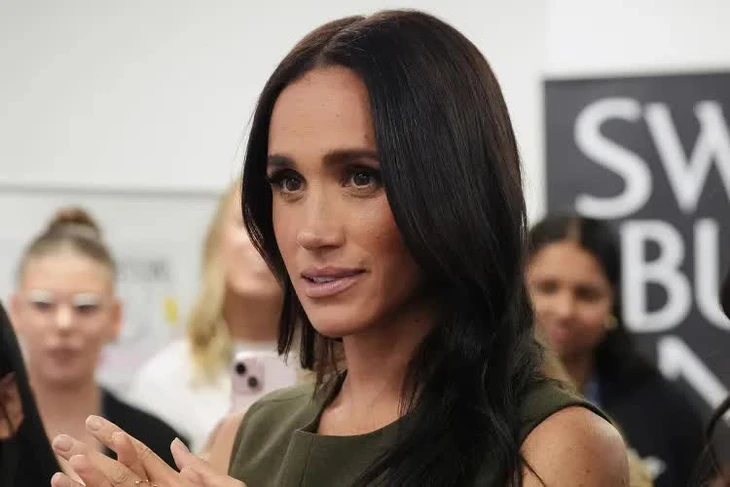
FABRICATED PALACE DRAMA: DECONSTRUCTING THE VIRAL HOAXES AND LIP-READING CLAIMS SURROUNDING MEGHAN MARKLE AND PRINCESS KATE
Deconstructing the Sensational Clickbait Teaser
A dramatic social media teaser published in Vietnamese recently went viral across online forums, proclaiming “💥 IT’S REALLY OVER!” with an array of eye-catching emojis. The post claimed that a secret confrontation at Buckingham Palace ended in shock after Meghan Markle was abruptly “asked to leave after just 30 minutes.” According to the story, King Charles III had prepared a formal reconciliation agreement, but the entire peace summit collapsed when professional “lip-reading experts” allegedly decoded a sarcastic remark made by Meghan toward Catherine, Princess of Wales. The post concluded with a classic engagement hook—a downward-pointing hand emoji instructing readers to click a link to reveal the decoded insult.
A thorough cross-referencing of official Buckingham Palace communications, royal pool reporting, and verified media archives confirms that this story is entirely fabricated. No such private confrontation occurred, no reconciliation contract was drafted, and no lip-reading revelation took place inside Buckingham Palace.
This viral post is a prime example of international clickbait generation. By weaving together high-drama tropes—abrupt palace ejections, secret reconciliation contracts, lip-reading discoveries, and interpersonal feuds between royal figures—content mills craft irresistible narrative hooks designed to manipulate recommendation algorithms, farm social media engagements, and drive web traffic to ad-monetized landing pages.
The Physical Reality: Geography, Security, and Royal Protocol
To recognize the absurdity of these viral allegations, one must evaluate the claim against basic logistical and security realities surrounding the British Royal Family.
The scenario described—where a high-profile member of the royal family arrives unannounced, enters a private summit with the Monarch and the Princess of Wales, engages in a heated dispute, and is escorted out 30 minutes later—ignores every protocol governing royal movements:
-
Geographic and Travel Realities: The Duchess of Sussex resides permanently in Montecito, California, with Prince Harry and their two children. Transatlantic travel by high-profile figures involves extensive advance planning, commercial or private aviation logs, and international security clearance. Any travel by Meghan Markle to the United Kingdom is intensely tracked by international photojournalists; an undetected arrival at Buckingham Palace for a secret 30-minute meeting is logistically impossible.
-
Strict Security Clearances: Access to Buckingham Palace and royal private residences is strictly controlled by the Metropolitan Police’s Protection Command and palace security directors. Entry schedules, security screenings, and private audiences with King Charles III are planned months or weeks in advance. The idea of an impulsive, unvetted confrontation inside palace walls belongs to scripted television drama rather than monarchical reality.
-
Official Royal Agendas: The daily schedules of King Charles III, Queen Camilla, and the Prince and Princess of Wales are published in the official Court Circular. While private family gatherings do occur outside official duties, any formal meeting intended to negotiate royal status or family reconciliations involves senior staff, legal advisors, and formal diplomatic channels.
The “Lip-Reading Expert” Trope in Tabloid Sensationalism
The inclusion of “lip-reading experts” in the viral narrative is a deliberate psychological tactic frequently employed by clickbait creators to lend false credibility to invented stories.
In celebrity gossip media, citing an unnamed “lip-reader” allows content farms to attach malicious or dramatic dialogue to silent video clips or static paparazzi photographs:
-
The Illusion of Technical Proof: By invoking “expert decoding,” creators attempt to transform mundane visual cues—such as a tilt of the head, a brief smirk, or a momentary glance—into definitive proof of an insult or argument.
-
Exploiting Contextless Footage: Tabloids regularly publish silent footage of royal events, such as state funerals or official walkabouts, accompanied by claims that lip-readers caught figures exchanging harsh words. In reality, certified forensic lip-readers consistently emphasize that deciphering conversational speech from partial camera angles, low resolution, or fleeting movements is imprecise and frequently inconclusive.
-
Manufacturing Narrative Hooks: In this specific Vietnamese teaser, the “lip-reader” claim serves as an artificial information gap. By promising that a sarcastic comment was “decoded” without providing the text in the teaser itself, the author forces curious readers to click external links.
The Economics of Transnational Royal Disinformation
The popularity of fabricated royal drama in foreign-language markets, such as Vietnam, highlights the global financial model powering digital disinformation networks.
The British Royal Family functions as a high-value content subject across worldwide media markets. Content creators in various countries exploit this global interest using a predictable production pipeline:
-
Archetypal Character Casting: Stories are built around simplified archetypes: the stern patriarch (King Charles), the graceful traditionalist (Princess Kate), and the rebellious outsider (Meghan Markle). Casting these real people into exaggerated dramatic roles makes the narrative instantly understandable to global audiences regardless of cultural context.
-
Automated Translation and Local Adaptation: Content mills translate trending tabloid rumors from English into local languages, adding heightened emotional phrasing (“Màn thương lượng bí mật,” “Xuống nước cầu xin,” “Kết thúc thật rồi”) to maximize local engagement.
-
Monetized Destination Links: The links appended to these teasers rarely contain legitimate journalism. Instead, they redirect users through ad-tracking networks to low-quality blogs, crypto-scams, or ad-heavy content farms that generate revenue per impression.
Promoting Critical Media Literacy in Modern News Consumption
The viral hoax claiming Meghan Markle was thrown out of Buckingham Palace over a decoded insult demonstrates how readily internet platforms can transform global public figures into fodder for fictional melodrama.
In an era where algorithmic feeds prioritize shock value over factual accuracy, readers must cultivate critical media literacy skills. Distinguishing authentic journalism from engineered clickbait requires looking past sensational headlines and verifying claims against official statements from Buckingham Palace, accredited royal pool reports, and established international news outlets. Rejecting manufactured outrage remains the most effective defense against the proliferation of digital disinformation.