The week my brother Logan was born and my duffel bag already waited by the front door like an uninvited guest
October 2000. Briar Hollow, Pennsylvania, clung to the damp chill of early winter. Our narrow clapboard house smelled of scorched coffee, sweet baby powder, and the faint acrid burn of beef stew forgotten on the stove. My mother, Patrice, sat at the scarred kitchen table with the newborn tucked against her chest, her face softened in a way I had never seen directed at me. Behind her, my father, Dean Ellison, rested his heavy hands on her shoulders, gazing down at his son as though the universe had finally delivered the one thing it owed him.
I was eighteen, standing in the doorway with a university bus ticket clutched in one hand and the fragile weight of Logan’s blanket in the other. His tiny fingers—impossibly small, impossibly red—curled around mine with surprising strength.
“Look at those hands,” my father said, his voice thick with pride. “He’ll build something real with those one day.”
I studied the baby’s grip, wondering what invisible blueprint he already carried. My father never asked what I planned to build. He never had.
At 11:45, I handed Logan back. My mother kissed the air near my cheek without lifting her eyes from her son. “Call when you get settled, Mara.”
My father didn’t walk me to the door. As I stepped onto the sagging porch, cold rain needling the back of my neck, I heard him telling an uncle in the next room that the Ellison name would finally mean something—carried forward by a boy who understood real work.
I paused for one heartbeat, letting the rain soak through my jacket. Then I left.
Briar Hollow had been dying for years. The mills had shuttered one by one, storefronts gaped like missing teeth, and the only diner still open survived on the grievances of old men nursing black coffee before noon. But the town’s creed endured: real work left grease under your fingernails. Real work built fences, rebuilt engines, poured foundations, and produced paychecks you could wave like battle flags at the neighbors. Anything else—especially anything done by a quiet daughter—was theater.
Dean Ellison had spent thirty-two years maintaining massive industrial pumps, his knuckles permanently etched with oil and calluses. Patrice served school lunches and measured every family choice by how it would echo in the supermarket checkout line. A daughter enlisting in the Army on scholarship did not fit their ledger.
I joined because the tuition was free, because I excelled at solving problems others ignored, and because the recruiting sergeant was the first adult who looked at my silence and saw potential rather than absence. Four years later, I commissioned as a second lieutenant in the Army Corps of Engineers.
My parents attended the ceremony like polite spectators at someone else’s play. My mother snapped photos. My father shook my hand and said, “At least it’s steady government work.”
I laughed because laughter was safer than the alternative.
Only my grandmother June had ever truly seen me. She had buried a husband young and raised four children on night-shift office cleaning wages. When I was fifteen and came to her in tears after a classmate claimed credit for my project, she wiped my face with a worn dish towel and said, “Applause finds the loudest voice, Mara. The real work finds the quiet one. Be the work.”
She died six weeks before my commission. I carried her words like a hidden compass through every deployment, every bridge built under fire, every night when exhaustion threatened to swallow me whole.
By the time Logan was old enough to form memories of me, I was already a captain stationed in places my parents couldn’t pronounce. I came home when leave allowed, sent birthday cards from foreign airports, and called on Sundays when the signal held. I also sent money—quietly, relentlessly.
When the furnace died during an ice storm, an anonymous home-repair grant appeared in their account. When Logan needed braces, my mother marveled at the clinic’s “miracle discount.” When he totaled his truck at nineteen and faced a debt that would break the family, the balance vanished before my father could consider remortgaging the house.
Every dollar came from me. Every sacrifice was invisible.
Years passed. Logan grew into the son my parents had always wanted—broad-shouldered, loud with easy charm, quick to laugh and quicker to be forgiven. I watched from afar as he enlisted, following a path that somehow made sense to them because it was his. I felt no bitterness, only a weary kind of love. The kind that had learned long ago to expect nothing in return.
Until that afternoon outside his company office.
I had driven three hours on a surprise visit, hoping to catch him during a training break. The sun hung low, casting long shadows across the motor pool. I spotted him immediately—my little brother, now a private in uniform, laughing with his squad. Something in me lifted. I called his name.
He turned. The laughter died.
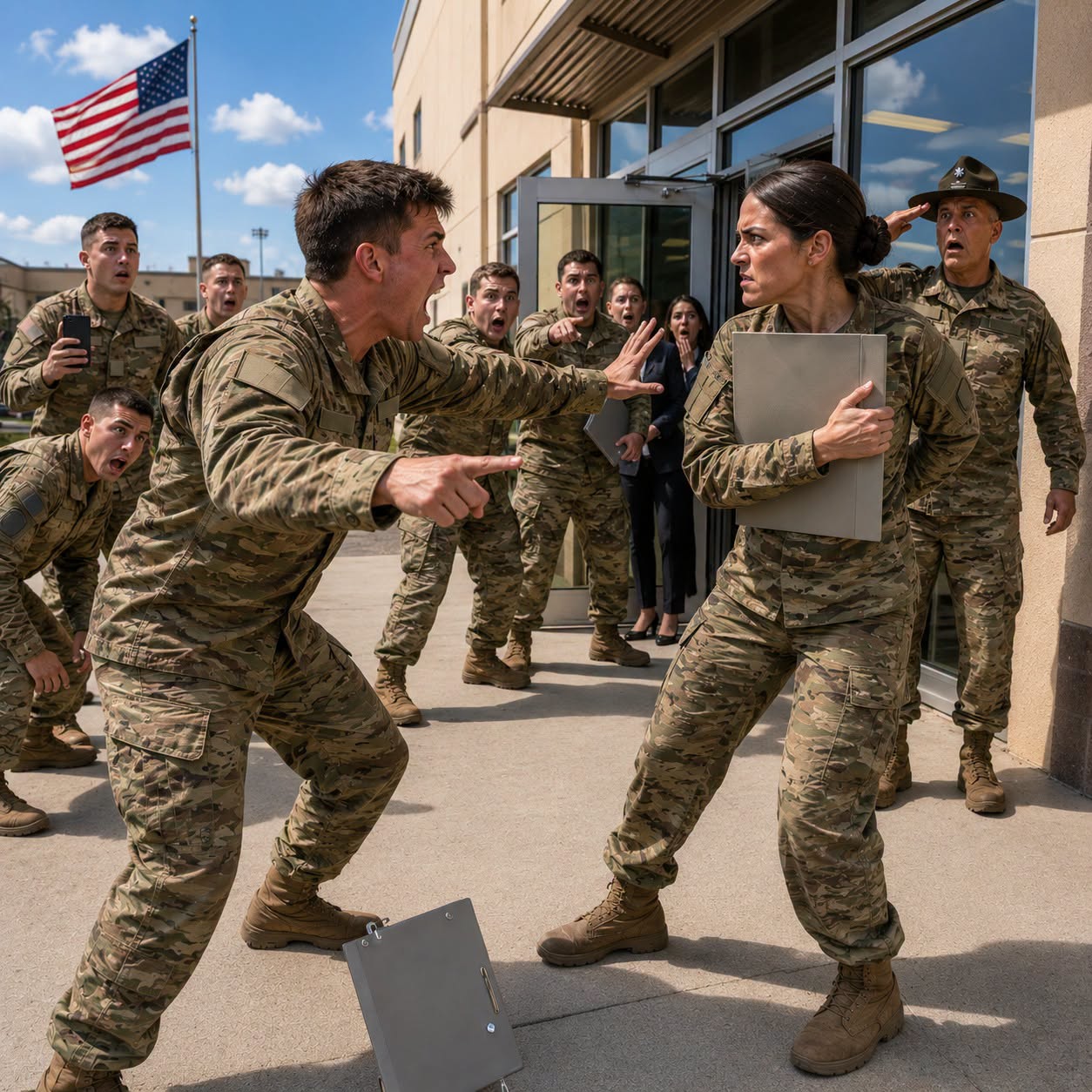
Before I could speak, Logan grabbed my arm and shoved me backward, hard. My shoulders slammed into the cold concrete wall behind me. His face was flushed with something sharper than embarrassment—rage, perhaps, or terror at being seen.
“You need to leave. Now,” he hissed, voice low and venomous. “You’re humiliating me in front of my squad.”
The words landed like a slap. I searched his eyes for the boy who once begged me for stories over the phone, for the brother I had quietly carried on my shoulders for years.
Before I could respond, heavy footsteps rounded the corner. Logan’s platoon sergeant stopped abruptly, his posture snapping into rigid attention. His eyes widened slightly as they locked on me—the bars on my shoulders, the quiet authority I wore like a second skin.
“Private,” the sergeant said, voice steady but edged with surprise, “do you know her?”
The air thickened. Logan’s grip on my arm tightened, then faltered. I stood there against the wall, heart pounding, the weight of two decades pressing down. Everything I had built, everything I had given, hung suspended in that single, frozen moment—waiting for him to answer.
TO BE CONTINUE…