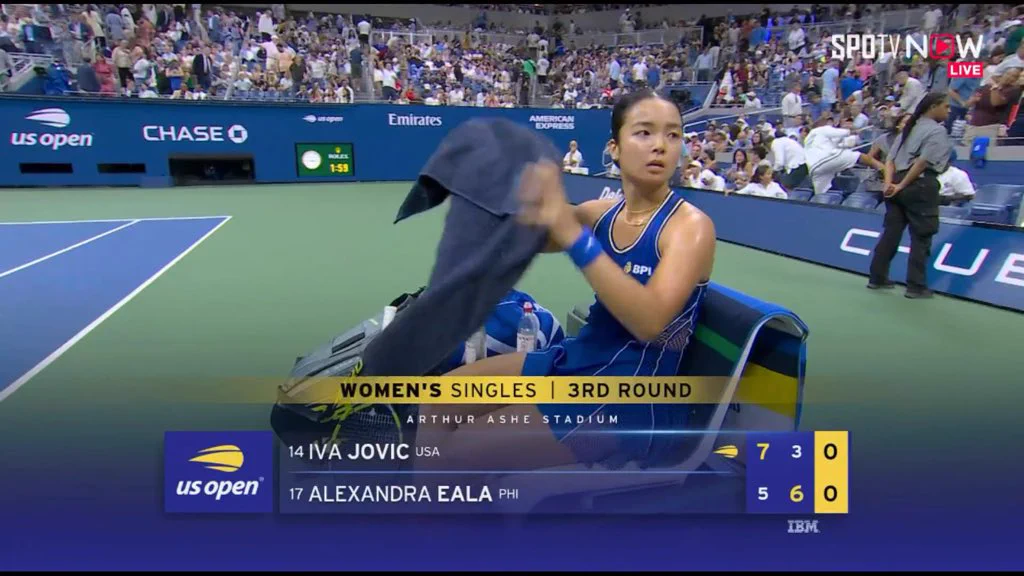
Tears Beyond the Scoreboard: The Emotional Truth Behind Alex Eala’s Post-Match Breakdown
In professional sports, tears are far from unusual. They fall in moments of bitter defeat, in flashes of sudden physical pain, and in the euphoria of championship glory. Yet, following a fiercely contested match against American prodigy Iva Jovic, rising Filipina tennis star Alex Eala sat on her courtside bench, buried her face in her towel, and wept with an intensity that stunned the surrounding arena.
As the umpire called the match and the applause faded, thousands of spectators looked on in hushed, heartbreaking silence. To the casual observer tracking the live score, it appeared to be the natural reaction of an elite athlete devastated by a close loss. But as members of Eala’s team moved quickly to surround her, and details emerged during post-match briefings, the truth became clear: the flood of emotion on the court had very little to do with the numbers on the scoreboard.
A Fierce Clash of Next-Gen Talent
The match itself had been a spectacle of grit and baseline power. Facing Iva Jovic—a familiar rival and close friend from their junior tour days—Eala poured every ounce of energy onto the hardcourt. For over two hours, the two young stars engaged in grueling physical exchanges, trading forehand winners, sliding across the court, and pushing each other to physical limits.
Eala’s signature fight was on full display. Down a break in the final set, she clawed her way back with blistering cross-court returns and relentless vocal encouragement. Every point was contested as if it were a Grand Slam final. When Jovic finally secured the decisive match point with a delicate volley, the crowd erupted in appreciation for the sheer quality of tennis produced by both competitors.
Yet, while Jovic celebrated her hard-fought victory, Eala walked slowly back to her chair, packed away her racquets, and suddenly collapsed into her seat, completely overcome by tears.
A Silence That Washed Over the Arena
It was not the quiet, polite disappointment typical of post-match handshakes. It was a raw, visceral release of emotion that caused the entire stadium to pause. Fans who had been cheering moments earlier quieted down, sensing that something far heavier than a sporting loss was unfolding on the sidelines.
Eala’s team, including her coaches and family members in the player’s box, stepped down to offer comfort, wrapping their arms around her as she struggled to compose herself. Jovic herself paused her celebrations, looking back toward Eala’s bench with visible empathy before quietly exiting the court to allow her opponent space.
Online commentators and social media feeds immediately lit up with concern. Speculation ran rife regarding a potential hidden injury, physical exhaustion, or career frustration. But when Eala later addressed the press, her voice steadying as she spoke, the heartbreaking truth behind her tears was revealed.
Carrying the Weight of Family and Heritage
The emotional dam broke not because of a dropped serve or a missed forehand, but because of a deeply personal milestone coinciding with her grueling global tour schedule.
Eala revealed that the match marked a poignant anniversary—the passing of her grandfather, the man who had first placed a tennis racquet in her small hands on the public courts of Manila and who had remained her guiding light throughout her childhood. Due to the relentless demands of the international tennis circuit, Eala had been thousands of miles away competing during his final days, sacrificing family moments to pursue her dream of bringing honor to Philippine sports.
Furthermore, her family back in the Philippines had been navigating a serious, private health challenge involving an immediate family member in the weeks leading up to the tournament. Eala had chosen to keep the personal crisis strictly private, refusing to withdraw from her scheduled events or make excuses for her performances.
“When the match ended, it was like five months of holding my breath suddenly came out all at once,” Eala admitted softly during her post-match conference. “I spent weeks trying to stay strong for my family, playing every point for my grandfather, and pretending that everything was fine outside the court. When the final ball was hit, I just couldn’t hold the wall up anymore.”
The Unique Burden of National Expectations
Eala’s tearful breakdown also touched upon a broader reality faced by pioneering athletes from non-traditional tennis nations. As the first Filipina to win a Grand Slam junior singles title and the most successful female tennis player in her country’s history, Eala carries an extraordinary weight on her young shoulders.
Unlike players from nations with deeply established tennis infrastructure and dozens of top-100 stars, Eala stands as a lone beacon for millions of fans back home. Every match she plays is broadcast live across the Philippines, where young boys and girls wake up at all hours of the night to watch her compete. Every win is celebrated as a national triumph, while every loss brings an outpouring of public scrutiny.
Living in exile at training academies in Europe for years, far from her home, her culture, and her loved ones, the physical and emotional isolation of the professional tour can be overwhelming. The tears on the court were the physical release of an athlete who had been carrying the hopes of an entire nation alongside a profound personal grief.
A Moment of Humanity That Won Hearts Worldwide
While the match result will be recorded as a loss in the official WTA statistics, Eala’s raw vulnerability earned her something far more enduring than ranking points: the unconditional respect and admiration of the global sports community.
Messages of support poured in from fellow tennis professionals, legendary athletes, and millions of fans across the globe, praising her courage, her dedication, and her authenticity. Many highlighted that seeing a top-tier athlete express such genuine, unvarnished emotion serves as a powerful reminder of the human beings behind the sports spectacles.
As Alex Eala prepares for the next chapter of her career, her post-match tears stand not as a sign of weakness, but as a badge of honor. They reflect a young woman who plays with her whole heart, who honors her roots, and who possesses the courage to feel deeply. The scoreboard may show a defeat, but in her vulnerability and resilience, Alex Eala proved once again why she is a true champion.