The Architecture of Loss and Memory: Examining Post-War Grief and Class in Eva Husson’s ‘Mothering Sunday’
In her haunting, sensory period drama Mothering Sunday, director Eva Husson offers a profound meditation on the psychological aftermath of the First World War, the rigidities of the British class system, and the enigmatic origins of artistic creation. Adapted by screenwriter Alice Birch (Normal People, Succession) from Graham Swift’s acclaimed 2016 novella, the film departs from the polite conventions of traditional British heritage cinema. Instead, it presents a non-linear, emotionally fractured exploration of how personal tragedy and secret intimacy intersect to shape a writer’s creative awakening.
Set primarily on a warm spring day in March 1924, the narrative contrasts the oppressive, silent grief of the English aristocracy against the vivid, sensory liberation of the working class. Through deliberate pacing, exquisite cinematography, and deeply internalized performances—led by Odessa Young and Josh O’Connor alongside Academy Award winners Olivia Colman and Colin Firth—the film examines how a single catastrophic moment can redefine a lifetime of memory.
The Silent Desolation of the Post-War Landed Gentry
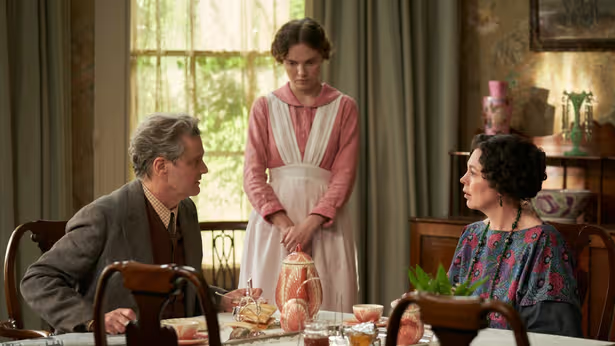
The emotional backdrop of Mothering Sunday is defined by the overwhelming absence of an entire generation of young men lost in the trenches of the Great War. This pervasive grief is most acutely embodied by Mr. and Mrs. Niven, played with heartbreaking restraint by Colin Firth and Olivia Colman. The Nivens are wealthy landowners living on a sprawling country estate, but their grand home is effectively a mausoleum; both of their sons were killed during the war, leaving their lineage extinguished and their daily lives hollowed out by unspoken sorrow.
Colin Firth renders Mr. Niven as a man desperately maintaining the stiff-upper-lip decorum required of his social standing. He fills the void with polite pleasantries, formal luncheons, and hollow routines, attempting to perform normalcy in a world that has been permanently shattered.
Opposite Firth, Olivia Colman delivers a devastating, almost spectral performance as Mrs. Niven. Dressed in muted tones and moving through her home like a ghost, Colman captures a woman past the point of conventional mourning. Her grief has hardened into a cold, detached resignation. In a society that demands propriety above all else, her rare, biting remarks expose the absurdity of maintaining aristocratic rituals when the future of those families has already been destroyed. Colman’s portrayal highlights the quiet horror of a ruling class forced to carry on while surrounded by the physical reminders of their lost children.
Secret Intimacy and Class Boundaries in 1924
While the estate owners drown in suppressed grief, the film’s narrative heart resides with Jane Fairchild (Odessa Young), an orphaned young woman employed as a housemaid by the Nivens. On Mothering Sunday—the traditional holiday when domestic servants were granted leave to visit their families—Jane is left with nowhere to go. She uses her freedom to maintain a long-standing, clandestine sexual liaison with Paul Sheringham (Josh O’Connor), the last surviving son of a neighboring aristocratic family.
Paul is trapped in his own version of post-war obligation. Burdened by the weight of being his family’s sole remaining heir, he is engaged to marry Emma Hobday, a wealthy woman from another local family that also lost its sons in the war. The pending marriage is less a romantic union than a transactional merger designed to consolidate grief and preserve dynastic wealth.
In contrast to the rigid expectations awaiting him at home, Paul’s secret afternoon encounters with Jane offer a rare sanctuary of genuine intimacy and physical vulnerability. Director Eva Husson films these private hours with an unhurried, tactile focus. Unencumbered by clothing or social titles within the sunlit bedrooms of the empty Sheringham estate, Jane and Paul exist outside the suffocating hierarchy of the British class structure. These scenes portray physical passion not merely as romance, but as a vital, restorative assertion of life in a culture consumed by death.
The Catalyst of Sudden Tragedy
The delicate balance of secret affection and social obligation collapses during the afternoon of that fateful March day. After Paul reluctantly departs the estate to join his family and fiancée for a formal celebration lunch, Jane is left alone in the vacant mansion. In an extraordinary sequence of liberation and curiosity, she wanders nude through the grand hallways, examining the vast library, the polished furniture, and the private artifacts of a world to which she has always been denied full access.
This quiet exploration is abruptly shattered by devastating news: on his way to the luncheon, Paul’s automobile veers off the road in a fatal collision. The suddenness of Paul’s death sends shockwaves through the neighboring estates, dismantling the fragile illusion of stability that the families had fought so hard to maintain since the end of the war.
For the Nivens and Sheringhams, Paul’s death represents the final, absolute destruction of their future. For Jane, however, the tragedy marks a traumatic threshold. Forced to mourn her lover in complete secrecy—unable to reveal the nature of her presence at the Sheringham estate or publicly express her heartbreak—she internalizes the grief, transforming the sensory details of that final afternoon into the foundational bedrock of her internal life.
Memory, Non-Linear Editing, and the Birth of an Artist
Rather than restricting the narrative to the events of 1924, Alice Birch’s sophisticated screenplay fractures the timeline, leaping forward to trace Jane’s evolution across the decades. The film depicts Jane in mid-century London as an emerging literary figure working in a bookstore and sharing a life with a thoughtful philosopher named Donald (Sope Dirisu), before eventually transitioning into her late years as a celebrated, award-winning novelist (played in a poignant cameo by Glenda Jackson).
This non-linear structure mirrors the erratic mechanics of human memory. The narrative demonstrates how creative expression often springs from unhealed wounds. Jane’s journey as a writer is driven by her need to decipher the events of Mothering Sunday—a day defined by love, social division, sudden death, and profound silence.
Through impressionistic edits, recurring visual motifs, and shifting time periods, the film illustrates that an artist’s voice is forged not merely by imagination, but by the physical and emotional marks left by lived experience. The tragic loss of Paul, combined with her early life as an observer within the Niven household, provides Jane with a rare, unflinching perspective on human fragility and class performance.
A Nuanced Re-examination of Post-War Trauma
Mothering Sunday stands as an intellectually rigorous and visually stunning contribution to modern historical cinema. By refusing to deliver easy comfort or artificial resolution, Eva Husson’s film honors the complexity of post-war grief while celebrating the resilience of the human spirit.
Anchored by the extraordinary vulnerability of Odessa Young, the tragic chemistry between Young and Josh O’Connor, and the heartbreaking supporting turns from Olivia Colman and Colin Firth, the production transforms a quiet story of secret love into a sweeping meditation on art, loss, and memory. The film ultimately reminds us that while tragedy can dismantle entire lives, the act of remembering—and transforming that memory into art—remains one of humanity’s most powerful acts of survival.