THE HIGH-STAKES PSYCHOLOGICAL CRIME THRILLER ON NETFLIX EXPOSING A HAUNTING SERIAL KILLER LEGACY!
In a small New Jersey town shrouded in autumn mist, a grieving father steps into the nightmare he once only wrote about. The Whisper Man, the 2026 Netflix psychological crime thriller directed by James Ashcroft and starring Robert De Niro, Michelle Monaghan, and Adam Scott, plunges audiences into a labyrinth of obsession, family trauma, and the long shadow of a legendary serial killer. Adapted from Alex North’s bestselling 2019 novel, the film delivers bone-chilling tension, visceral performances, and a finale that reframes every family secret. At roughly 114 minutes, it races against the clock as one man fights to save his abducted son while confronting the ghosts—and a killer’s legacy—that refuse to stay buried.
The story opens with the discovery of a boy’s body in the woods, staged exactly like the work of the infamous “Whisper Man,” a nickname born from the whispered taunts and recorded messages the killer once used to torment grieving families. Detective Amanda Beck (Michelle Monaghan) knows the pattern too well. Twenty-five years earlier, retired Detective Peter Willis (Robert De Niro) captured the original Whisper Man, Frank Carter (Michael Keaton), after burying a fifth victim’s remains somewhere the public never knew. But Carter is still alive in prison, still taunting Willis from behind bars.
Meanwhile, novelist Tom Kennedy (Adam Scott) has just moved his young son Jake into the house where Tom’s late wife grew up. Tom’s grief—cancer took his wife—makes him a distracted father. Jake, eight years old and fiercely imaginative, has a mysterious imaginary friend: a girl in a blue sweater who whispers warnings and fears “the boy in the floor.” One night Tom catches Jake reciting a chilling rhyme at the front door while a hand reaches through the mailbox. No one is there. Tom dismisses it. He has enough to worry about without believing in ghosts.
The nightmare begins when Jake disappears.
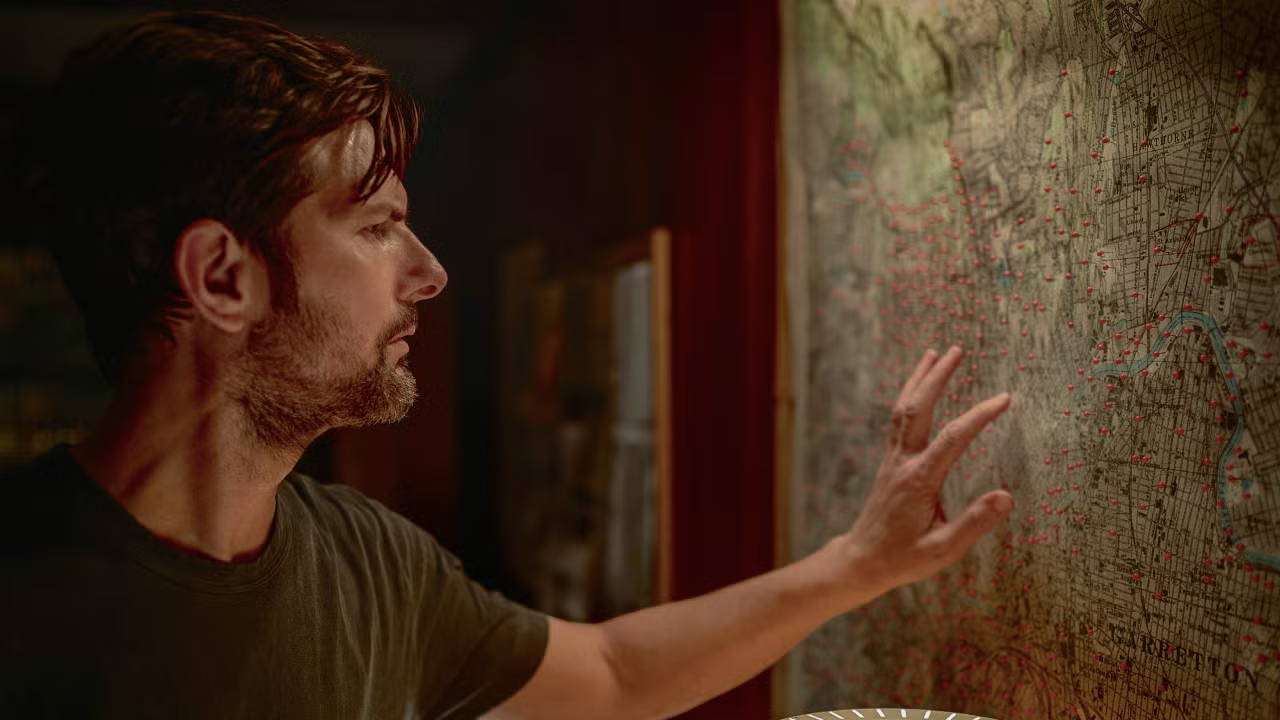
Desperate, Tom reaches out to the estranged father he hasn’t spoken to in years. Peter Willis arrives like a storm, raw and reluctant, yet determined. What follows is a high-stakes manhunt that feels like it could collapse at any second. The film builds dread methodically: red pins on a regional map, matching crime-scene details, prison visitors, and a basement that Tom now suspects holds more than dust. The house itself becomes a character—leaky ceilings, creaky stairs, and a hidden sub-level that seems to swallow secrets.
Scott delivers a raw, exhausted performance that anchors the entire film. His Tom is not a flawless hero; he’s a man cracking under guilt, alcohol-fueled rage, and the terrifying thought that his son might be next. De Niro, in what could be one of his finest dramatic turns in years, channels quiet fury and reluctant paternal love. Their father-son reunion is electric, laced with decades of misunderstanding and the kind of love that refuses to die. Monaghan carries the investigation with steely resolve, but the emotional core belongs to Tom and Jake’s bond.
As the pieces lock together, the film reveals its deepest connection: the new abductions aren’t random. They’re a deliberate emulation of Carter’s crimes, down to details only the original killer (or someone who lived with him) would know. A murderabilia collector named Norman Collins surfaces as a prime suspect—too many alibis, too many strange phone calls. Tom recognizes him as the man who once hid in the basement. But Collins isn’t the killer. He’s a collector who helped introduce a disturbed young man to Carter’s legend.
That young man is Francis Carter Jr. (Owen Teague), Frank’s son. Raised in the shadow of his father’s infamy, Francis has spent years mythologizing the man who abandoned him. The film’s most unsettling revelation is how deeply the cycle of abuse and imitation runs. Carter covered his victims’ faces with shirts so he could imagine strangling his own son. His son has taken the same impulse and turned it outward, choosing lonely, grieving children like Jake. The Whisper Man rhyme—“If you’re lonely, sad or blue, the Whisper Man will come for you”—is no longer folklore. It’s a predator’s playbook.
The climax unfolds in the very house Tom just moved into—the site of the fifth original victim’s hidden remains. Tom’s basement, once a place of adolescent rebellion, now holds skeletal evidence that ties every thread together. Francis Jr. has been there before. The structural decay that once seemed ominous becomes deadly when Francis Jr. crashes through a weakened floorboard in the final confrontation. Pete, mortally wounded, makes one last sacrifice: “Run, Jake.” Tom and Pete reconcile in blood and tears, forging something neither of them believed possible in their lifetimes.
In the epilogue, Frank Carter is shown strangling his own son in prison—the ultimate, poetic justice for a man who could never escape his own demons. Amanda Beck receives a letter from the prison: “Thank you for everything you and Pete have done for me—your friend, Frank.” The killer’s game isn’t over. It’s only paused.
Yet the film leaves one final, haunting question unanswered: Who—or what—is the girl in the blue sweater? Jake sees her consistently, and after his rescue she tells Tom she saved him. The last image is Tom looking at an old photograph of his late wife as a child, wearing the exact blue sweater Jake’s imaginary friend always wore. Is it grief given form? A ghost? Or something deeper? The film deliberately refuses to explain, turning the supernatural into a mirror for the characters’ unresolved pain. It’s a choice that elevates The Whisper Man above pure genre thrills and into the realm of emotional resonance.
Production details add to the film’s weight. The Russo brothers (via their AGBO banner) optioned Alex North’s novel years before it became a bestseller. Netflix joined early, and director James Ashcroft (known for his work on British thrillers) brings a steady hand that keeps the pace relentless without sacrificing atmosphere. Cinematographer Peter Deming captures the small-town New Jersey setting in muted tones—gray skies, damp leaves, flickering streetlights—heightening the sense of isolation. Colin Stetson’s score swells at the right moments, turning ordinary rooms into corridors of dread.
Critics have been split: some praise the performances and emotional core, others note the plot occasionally strains credibility and that Monaghan’s detective feels underutilized. Rotten Tomatoes sits at 46%, Metacritic at 52. But the film’s strengths are undeniable. It doesn’t just deliver jump scares; it examines how trauma travels across generations and how love can be both the greatest motivator and the cruelest weapon. The Whisper Man isn’t just a killer with a nickname—he’s a metaphor for the silence that follows unresolved pain.
The Whisper Man succeeds precisely because it refuses to let the audience look away. Tom Kennedy isn’t saving his son from a monster alone. He’s saving the fragile future of a family that has already lost so much. In the end, the repaired crack in Pete’s ceiling—visible in the final shot—symbolizes the hope that some legacies can be broken. Not every family curse ends with a prison cell and a letter from the killer. Some, like Tom and Pete’s, end with a father and son finally choosing each other.
Whether you’re a fan of classic psychological thrillers or simply someone who appreciates a father-son story wrapped in nightmare fuel, The Whisper Man on Netflix is a must-watch. It’s the kind of film that lingers long after the credits roll—making you reconsider every creak in the dark, every rhyme you hear in childhood, and every promise you never kept to the people you love most.