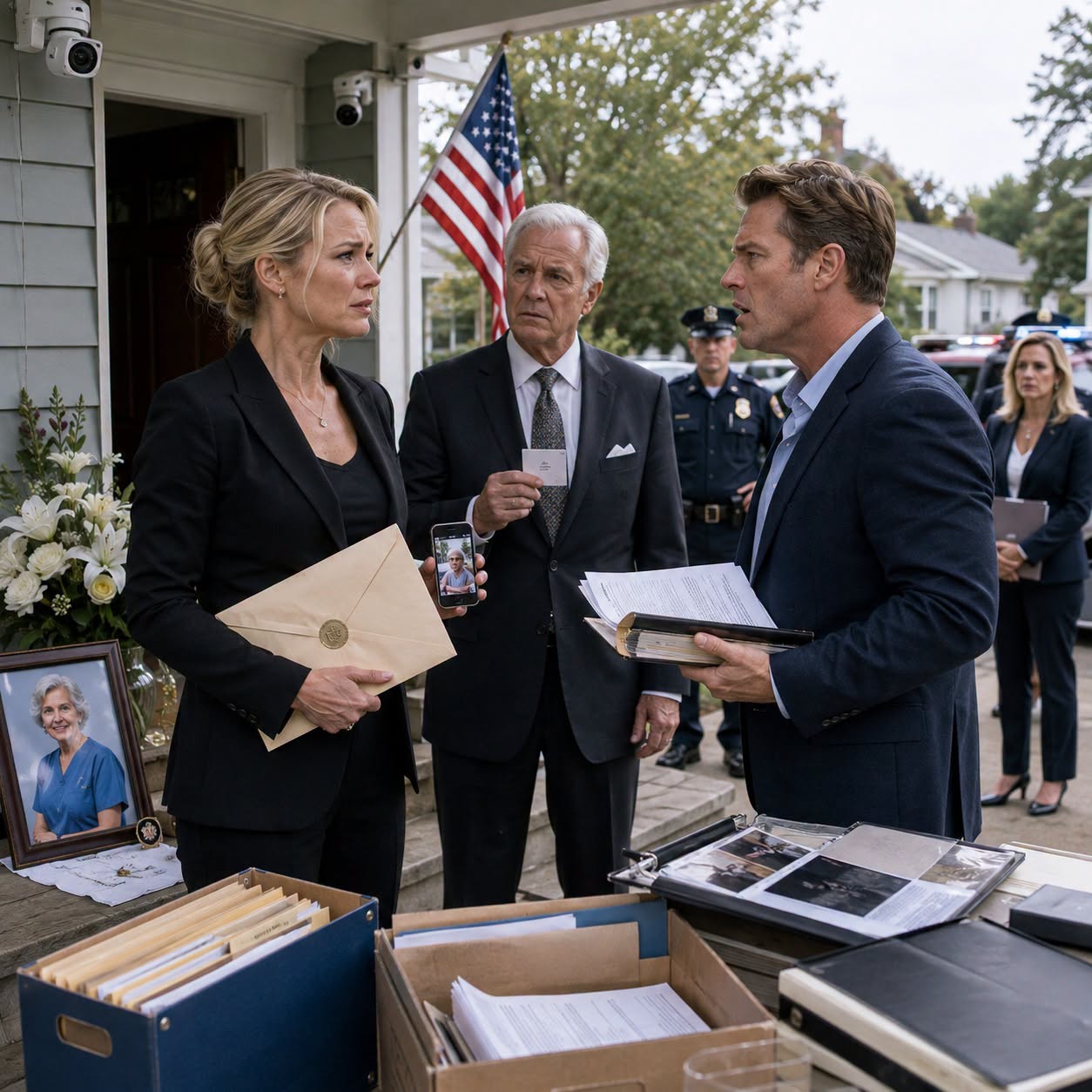
PART 3 – “Nine Million Dollars? Then You Owe Me Four and a Half.” He Said It Six Days After the Funeral—Before He Asked If I Had Eaten. Behind Him, Mom’s Porch Camera Blinked.
The three hundred thousand had a name.
It was not a secret account. It was not a whisper in a daughter’s ear. It was a grant Mom had signed while she could still hold a pen, earmarked for three nursing cohorts and one mortgage fund she had already chosen from letters that arrived at the house in envelopes she opened with a butter knife. Dr. Holt had the minutes. The bank had the memo line in her square handwriting. Claire had the date, two weeks before the stroke, because Margaret Chen had not trusted time and had not trusted delay.
Eric had a screenshot and a talent for implication.
By morning he had sent the implication farther than the porch. A cousin. A man who had once fixed the Subaru. A voice in Sacramento that asked, carefully, whether I needed leave to “handle a family financial matter.” Mud does not have to be true. It only has to travel.
I sat at her table with Holt on speaker and Claire across from the reading glasses that had not moved.
“We do not chase him through group texts,” Claire said. “We put the paper where paper lives. Then we let him explain, in a room with a record, why he parked across a dead woman’s walk and called her life a teardown.”
I slept in her guest room because sleeping in her bed still felt like theft. At nine on Sunday the phone did not ring. That silence was a hole in the week I would spend years learning to walk around.
Eric came back on Thursday with a different suit and the same folder, thinner now, as if hunger had edited it. He brought a woman who used the word fiduciary the way he used harmony. They sat in the living room under the painting Mom had bought at a hospital raffle.
I set the grant file on the coffee table.
Not a speech. Dates. Signatures. The three schools. The mortgage names blacked to initials because dignity was the point of the money.
“She moved it because the spring cycle would have missed her if she waited,” I said. “She moved it because she knew what you would do with a number. She moved it because responsibility does not survive probate as well as greed does.”
Eric’s attorney looked at the memo line and became professionally less certain.
He tried the last knife anyway.
“You’ll run this into the ground. You’re a project manager. You’re not her.”
“I am not her,” I said. “I am the person she trusted to know the difference between wealth and work. You may have the Subaru appraised. You may argue the house in the proper room. You may not have the foundation because it was never on the kitchen counter for you to split.”
Claire added the porch file without theater. His voice, six days after the grave, measuring curtains. The sentence about a shrine. The threat dressed as adulthood.
The attorney closed her laptop a fraction sooner than courtesy required.
Eric sat very still. For a second the popsicle boy was on the step again, astonished that fairness would not inflate to the size of his want.
“She loved me,” he said, smaller.
“She did. She also saw you. Those are not the same gift.”
They left without signatures. The Range Rover did not lay rubber this time. Retreat can be quiet when it has met a filing cabinet.
What followed was not a triumph parade. It was months. An estate for the house and the glasses and the pots. A foundation that kept paying tuition while two siblings learned a colder civility. Eric received what the will actually left him, which was not nothing and was not half of a world he had never asked to understand. He sent one email that almost contained an apology and then buried it under a market update. I did not collect him. I was finished being the loyal audience for men who confuse a sister with a teller window.
I kept the Sunday hour.
I call no one. I sit under the yellow pendant when I am in Portland, or under whatever light Sacramento will give me, and I read the letters the foundation receives: a student who finished, a family that kept a house, a bill that did not finish what a hospital began. Results, not appearances.
The porch camera still blinks.
I leave it on.
Not because I am afraid of my brother.
Because my mother understood that some people arrive with paperwork before they arrive with grief, and that a small blue light, like a nurse’s watch, is there to tell the truth when a voice will not.
Nine million was never the point.
The point was a woman who bought generic cereal and built a table that would outlast the children arguing over who deserved a plate.
I still know the difference.
THE END