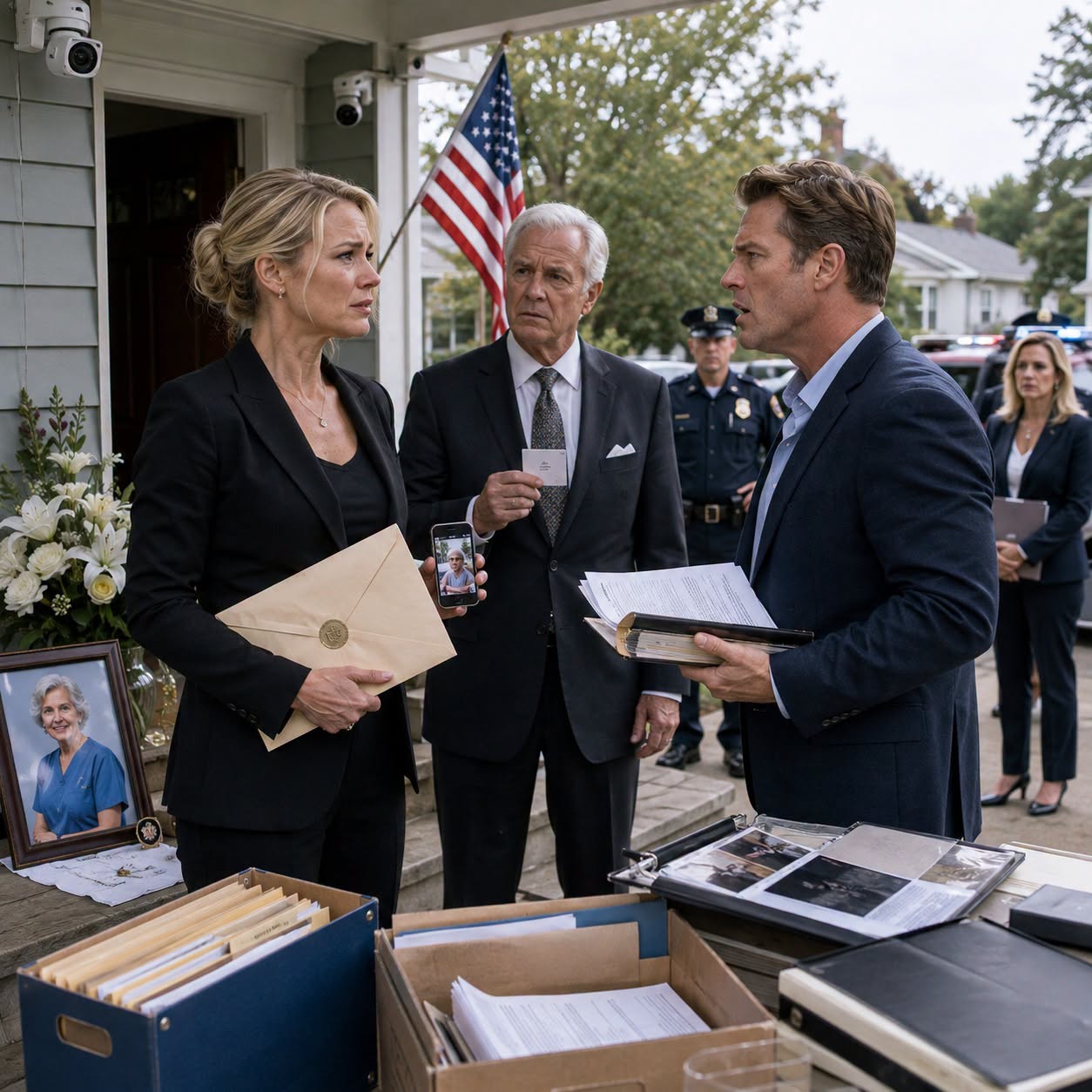
PART 2 – “Nine Million Dollars? Then You Owe Me Four and a Half.” He Said It Six Days After the Funeral—Before He Asked If I Had Eaten. Behind Him, Mom’s Porch Camera Blinked.
He opened the folder as if the porch were a closing table.
Papers with tabs. Language that dressed hunger as efficiency. Dissolution. Distribution. A paragraph about “family harmony” that had never attended a Sunday call at nine. Rain ticked off the gutter Mom had refused to replace because the money had somewhere better to go.
“I’m not signing that.”
Eric’s smile did not fall. It adjusted.
“You will. You work in Sacramento on a salary. You cannot run a nine-million-dollar anything. I’ll take the administration. You’ll get a check. We both walk away looking like her children.”
“I am her child. That is not a look.”
He tapped the page.
“If you refuse, I contest. I tell a judge she was isolated. That you managed her last years. That nurses don’t quietly become foundations unless someone is whispering in their ear.”
The accusation landed in the wet air and waited to see if I would pick it up. I thought of her coupons. Her cracked dash. The way she had said responsibility in ink that did not tremble.
“She isolated herself from people who asked what the house was worth before they asked how she died.”
Color found his throat.
“Don’t play saint on her porch, Anna. You got the calls. You got the holidays. You got the death. Now you want the account.”
“I want the work to continue. That is what she wrote. Not what you drafted on a train of thought between a client and a listing.”
A car slowed on the street. Neighbors had learned the shape of a Range Rover that did not belong. Eric glanced at it and lowered his voice, which was not kindness. It was branding.
“Sign tonight. Tomorrow I bring a broker. This place is worth more as a teardown than as a shrine to her cheap cereal.”
I looked past him at the blue light.
“Say that again,” I said. “About the shrine.”
He frowned, impatient.
“You heard me. Sentiment doesn’t pay assessments. I’m being the adult.”
“Then be the adult on camera.”
His gaze flicked up at last. Found the lens. Found, too late, that our mother had not been as quaint as her Subaru.
“That’s not legal.”
“It’s her porch. It’s her house. It’s her daughter standing where you parked across the walk. You can leave the folder. You cannot leave the sentence.”
He stood. The rail remembered his weight. For a moment I saw the boy who had once split a popsicle fairly on this same step, before fairness became a word he used only when he was shorted.
“You think a blinking light saves you? I have friends in probate. I have a valuation team. I have time you don’t, because you’ll be back at your desk playing dutiful while I stay and empty this place.”
From the street, a second car door. Not a broker.
Claire Bennett, wool coat, no umbrella, as if Portland weather were a rumor she had already ruled on. She took in the folder, the Rover, my un-signed hands.
“Mr. Chen,” she said. “You are on property belonging to an estate whose trustee I have already spoken with. You are also on the threshold of a private foundation whose assets are not sitting in that kitchen. If your paperwork claims otherwise, I suggest you fold it before it learns to perjure itself.”
Eric laughed, shorter this time.
“And you are?”
“The woman who sat with your mother while she designed the part of her life you never asked about. The part that does not halve.”
He looked at me.
“You called a judge on your own brother.”
“I called the number she put in my hand,” I said. “You called a price.”
The porch camera blinked again, patient as a pulse.
Eric closed the folder with care that was not respect.
“This isn’t over. Foundations have weak boards. Trustees have pasts. Nine million makes people remember things.”
Claire’s voice did not rise.
“Then I hope your memory is better than your arithmetic. Half of a thing you do not own is still nothing. And a porch recording of a man threatening a trustee six days after a burial is not nothing.”
He went down the steps.
At the Rover he turned, buyer smile gone, something older showing through.
“She loved me too, Anna.”
“I know,” I said. “That was never the question. The question is whether you loved anything of hers that could not be sold.”
He left rubber on the wet street.
Claire did not watch him go. She watched me.
“He will not come next with a folder,” she said. “He will come with a story about you. When he does, you will need more than a blinking light.”
Inside, the yellow pendant still burned over an empty table.
My phone lit.
A name I did not keep in favorites.
A photo of a document I had not yet shown him.
And under it, from Eric:
If the foundation is so clean, why did Mom move three hundred thousand two weeks before she died?
The coffee I had never drunk went through me like cold.
Claire saw my face.
“That,” she said quietly, “is the sentence he has been waiting to use.”
Behind us the camera kept its small blue watch.
And I realized my mother had planned for grief, for greed, even for the porch.
She may not have planned for the way a brother can turn a dying woman’s last kindness into a smear that looks, to a stranger, like evidence.
TO BE CONTINUE…