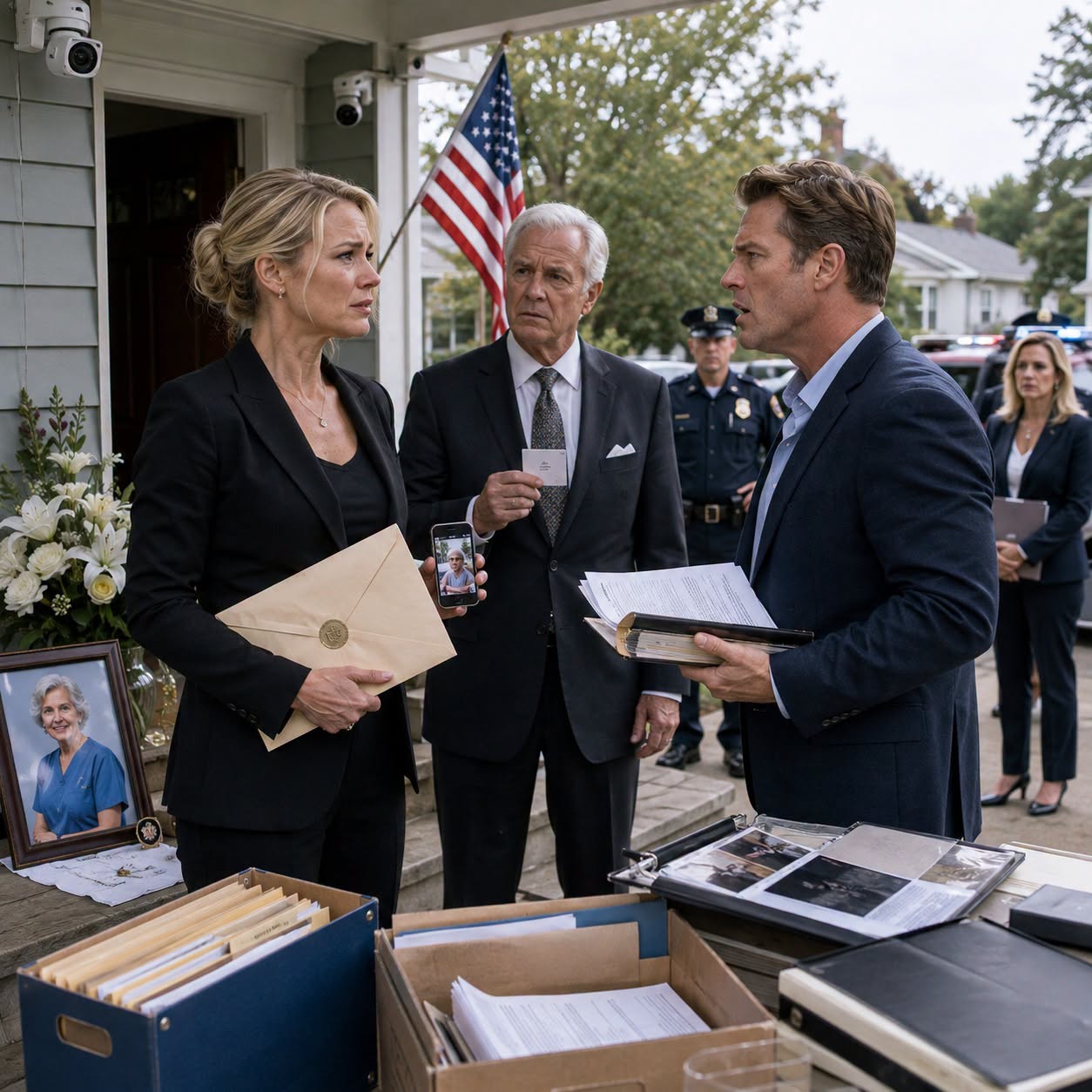
“Nine Million Dollars? Then You Owe Me Four and a Half.” He Said It Six Days After the Funeral—Before He Asked If I Had Eaten. Behind Him, Mom’s Porch Camera Blinked.
The first thing my brother said after the number was not her name.
“Nine million dollars? Then you owe me four and a half.”
Our mother had been dead six days. I was in her Portland kitchen with one palm on the chipped blue counter and the other around coffee that had gone cold without my permission. The refrigerator still hummed as if a carton of eggs might need it. Eric did not ask whether I had slept. He did not ask whether I had eaten. He did not ask why a silver-haired woman at the grave had put a card in my hand and said, Tell them Margaret’s daughter is ready.
He heard nine million and began measuring a house that was still warm with her absence.
“It isn’t an inheritance.”
He laughed once. Dry as a receipt.
“Everything is an inheritance when the owner dies.”
That sentence was a weather forecast.
Margaret Chen had spent thirty-two years in an ICU at Providence, talking strangers through ventilators and the kind of goodbyes that do not come with language. She drove a Subaru with a cracked dash. She clipped coupons under the yellow pendant light. She called me every Sunday at nine as if punctuality were a form of love. She died on a Tuesday with eggs in her hand. A neighbor found her. I was in Sacramento under a flickering fluorescent, learning from a stranger’s voice that the woman who had midwifed other families through impossibility had not been given an ambulance’s worth of time.
Eric flew in from San Francisco the morning before we buried her. His first question was square footage.
Not where she fell.
Not whether she was afraid.
The house.
Eleven of us stood in wet grass while the pastor spoke of humility. Eric checked his watch during the prayer. Then Claire Bennett, dark coat, no umbrella, pressed a white card into my palm.
“Call. Ask for Dr. Holt. Your mother planned for this. Do not tell your brother until you understand what she protected.”
The name meant nothing. Later it would mean twenty-three years on a federal bench. At the cemetery it was only a warning dressed as courtesy.
That night her reading glasses kept watch on the Sunday paper. Copper pots. A lean of paper towels. I sat under her light and did not drink. In the morning I called Seattle.
Three seconds of quiet after her name.
“We’ve been expecting you.”
The train north ran through rain and fir. Eric texted probate, the house, the Subaru’s possible eight thousand if the mileage was honest. I turned the phone over as if its face could be ashamed.
Dr. Holt’s office had no marble and no performance. Elliott Bay in the window. Black coffee. A folder.
THE STEADY WORK FOUNDATION.
Born in 2004 from pieces of a nurse’s paycheck and the kind of investing that looks like boredom until it does not. Tuition for students who would stand where she had stood. Mortgages held up when a hospital shift ended a life. Bills that arrive after a body has already been saved. Current value: a number so large it made generic cereal look like a philosophy.
“She preferred results to appearances,” Holt said, and gave me her letter.
Square handwriting.
I am not leaving you wealth, Anna. I am leaving you responsibility. You know the difference.
The second reading was worse because it was accurate.
Successor trustee. Separate from the estate. Audits. Filings. Counsel. Twenty years of paper that did not care about a son’s arithmetic. It could not be halved like a sofa. It could not be listed with the bungalow. It did not belong to Eric.
I still told him.
I told him because I had not yet learned that some men hear a boundary as an opening bid.
Silence. Then the sentence about four and a half. Then the older knives: loyal daughter, performance, the career that had excused the retirement dinner, the Thanksgivings, the funeral exit toward a developer and a glass.
“Dissolve it. Split it. Nobody has to fight.”
“I’m not dissolving her work so you can feel even.”
“Sentimental.”
“Literate,” I said. “I read the documents.”
He hung up.
The Range Rover was already across her driveway when I returned, as if grief were a parking problem he had solved. Eric sat on the porch rail with a leather folder and a smile I had seen on men who walk through other people’s rooms deciding what will sell.
“I brought paperwork. You’ll sign before dinner.”
Behind his shoulder, above the door she had painted herself, the porch camera’s blue light blinked once.
He never looked up.
I did.
And in that small, steady blink I understood that my mother had not only left me a foundation.
She had left me a witness.
TO BE CONTINUE…