🔥 My Parents Called My Wedding An Embarrassment — But What They Didn’t Expect…
My name is Sergeant Amelia Vance, and at 29, I thought I’d already been through hell and back. I was wrong. My father, Senator Richard Vance, is one of the most powerful men in Washington, DC. He taught me one rule for survival. Image is everything. And a military daughter at an age when she was supposed to be marrying some prestigious lawyer choosing a mechanic in a dusty army town.
That was an image he would never accept. On the day I married Leo, my parents didn’t show up. Instead, I got a phone call. My mother’s voice was as cold as steel. Amelia, your father is busy. He said he will not sacrifice his entire political career over one of your impulsive decisions. They thought they could just cut me off, treat me like some embarrassment to be hidden away.
But they didn’t know who was sitting in the front row of my little chapel that day. The photograph I sent them afterward made them call me back. frantically non-stop.
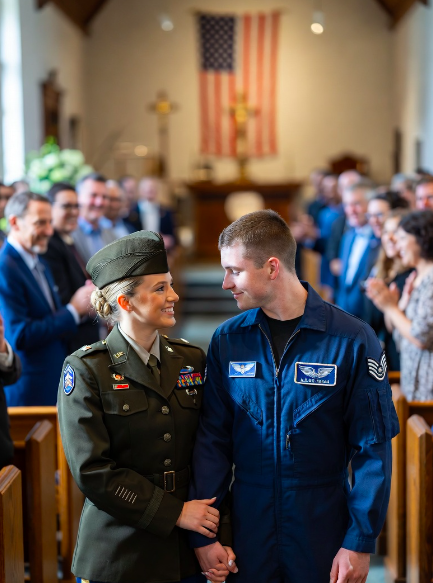
The air inside the small post chapel in Fagetville, North Carolina, smelled of old pine and quiet promises. Sunlight stained amber and blew by the glass windows cut through the gentle haze of dust moes dancing in the air. It was a humble place, a world away from the marble cathedrals of Washington DC, where my family conducted their lives like state dinners, formal, cold, and for public consumption only. But here it was warm.
Here I was home. The pews weren’t filled with politicians and their smiling, calculating wives. They were filled with my family, my real family. The men and women of the 82nd Airborne, their shoulders broad and proud in their dress uniforms. They were loud and unapologetically alive, their laughter echoing off the wooden rafters before the ceremony began.
They were the ones who’d had my back in places that would make my father’s fundraisers faint. They had earned their seats here. My parents’ seats in the front row were empty, but that row wasn’t entirely vacant. Next to the space reserved for my mother and father sat a man who at first glance seemed entirely out of place.
He was older, perhaps in his early 60s, dressed in a simple tweed jacket and worn corduroy pants that spoke more of a university library than a military wedding. He was quiet, his hands resting on his lap, but he had an air of intelligence that was impossible to ignore. And then there were his eyes. When he looked up and caught my gaze, a gentle smile touching his lips, it sent a shiver down my spine.
They were my father’s eyes, the same sharp, intelligent blue. But where my father’s held the cold glint of ambition, this man’s held a deep, settled kindness. He was my guest of honor. He was the reason for everything that was about to happen. Just before the music started, my maid of honor, Lieutenant Davies, handed me my phone.
It’s your mom,” she whispered, her brow furrowed with concern. I nodded, my face a calm mask I’d perfected over 29 years. I stepped into the small, quiet vest, the heavy oak door closing behind me, shutting out the warmth of the chapel. I answered, “Amelia.” Her voice wasn’t warm. It was never warm. It was steel. The kind of polished cold steel you see in a surgeon’s tray.
There was no, “How are you?” No. Are you happy? No. Congratulations on your wedding day. Mother, I replied. My own voice. Even a soldier’s voice. I’m calling to let you know that your father and I won’t be able to make it. She said it wasn’t an apology. It was a statement of fact delivered with the same emotional investment as a weather report. He’s incredibly busy.
There’s a vote on the transportation bill and he can’t afford to be seen out of town. I remained silent. I knew what was coming next. He said, she continued, a slight edge to her voice now that he will not sacrifice his entire political career over one impulsive decision you’ve made. Impulsive. The word hung in the air between us, a carefully chosen weapon.
At 29 years old, a sergeant in the US Army who had led soldiers in combat, who had made life and death decisions under fire, I was still just a child making an impulsive choice in their eyes. Marrying Leo, a man with grease under his fingernails and more integrity in his little finger than my father had in his entire body, was not a strategic alliance.
It was an embarrassment, a stain on the perfect family portrait. The writer Maya Angelo once said, “When someone shows you who they are, believe them the first time. I had given my parents hundreds of first times. This was simply the last.” “I understand,” I said, and the two words were a blade, severing the final thread that connected us. I didn’t wait for her reply.
I ended the call. The party afterward was perfect. Not perfect in my parents’ world. There were no string quartets or champagne fountains. It was perfect in my world. We held it in the backyard of our captain’s house under strings of fairy lights as the North Carolina sun began to set.
The air was thick with the smoky sweet smell of slowcooked BBQ ribs. Kegs of local craft beer were sweating in ice filled tubs. Leo, my husband, had his arm wrapped around my waist, his laughter the best music I’d ever heard. For a moment, I just soaked it in. This was real. This was mine. Then I moved. “Captain Miller,” I called out.
My company commander, a good man with a booming laugh, came over. I pulled Leo close. Then I walked over to my guest of honor. “Sir,” I said softly. “Would you mind taking a picture with us?” His kind eyes twinkled. “It would be my honor, Amelia. We stood there, the four of us, Leo and I in the middle beaming. On one side, Captain Miller representing the life of service and honor I had chosen.
On the other, the quiet, scholarly man in the tweed jacket representing a truth my parents had buried for decades. I held up my phone, snapped the picture, and looked at the image. It was a portrait of my happiness. It was also a perfectly crafted weapon. I opened my family’s group chat, a digital space usually filled with my sister’s brunch photos and my father’s press releases.
I attached the photo. I typed no words. I just hit send. For 3 minutes, there was silence. Then my phone began to vibrate against the wooden picnic table. The screen lit up. Elellanar Vance. I ignored it. It stopped then immediately started again. Senator Richard Vance. A beat of silence, then another buzz. Claire Vance.
One after another, the calls came. Frantic, desperate. A cascade of panic from their pristine world in DC. They had seen the man in the photo, and they knew exactly what he represented. They knew the story he could tell. I looked at the screen at my father’s name flashing with an urgency he had never once shown for me. A slow smile spread across my face.
I picked up the phone, not to answer, but to hand it to Leo. He looked at me, saw the victory in my eyes, and took it without a word. With a simple press of his thumb, he powered it off. The frantic buzzing stopped. All that was left was the sound of our friend’s laughter and the soft evening breeze.
The game had completely changed. My gaze drifted from my husband’s loving face to the man sitting quietly at a nearby table. He has my father’s eyes, the same eyes that had looked at me with such disappointment for years. But his, his were kind. I remember the first time I saw that kindness on a rainy day when I thought I had nowhere else to go.
The invisible scars are always the ones that hurt the most. They don’t bleed, they don’t bruise, but they ache with the memory of every silent judgment, every dismissive glance. My childhood was a collection of such scars, a carefully mapped atlas of my own inadequacy. I remember when I was 16, I’d spent months on my project for the state science fair, a study on bio- remediation of contaminated soil.
It was complex, it was important, and I won first place. I came home clutching a blue ribbon and a small trophy, my heart pounding with a fragile, hopeful pride. I found my father in his study reading the Wall Street Journal. He glanced up when I came in, his eyes scanning the ribbon in my hand.
He gave a single curt nod. “Good,” he said, his attention already returning to the stock market report. “But Clare was just made captain of the cheerleading squad. Now that’s how you build relationships.” And just like that, my months of intellectual labor, my passion, my achievement, it all evaporated. It was rendered worthless next to my younger sister’s social victory.
In the Vance family, intelligence was a commodity, but popularity. Popularity was currency, and I was always bankrupt. My father’s cruelty was a sharp, quick blade. But my mother’s was a slow acting poison. She was the architect of our family’s piece, a piece built on the foundation of my silence. Some of my most vivid memories are of dinners at the Chevy Chase Club in Maryland.
It was my father’s preferred stage. Surrounded by manicured lawns and the hushed clinking of silverware on fine China, he would put me on trial. He’d grill me on current events, on foreign policy, on economic theory. It wasn’t a discussion. It was an interrogation. The other families at nearby tables would smile politely, oblivious to the public execution taking place.
If I answered correctly, he’d simply move on. But if I faltered, if I offered a differing opinion, he wouldn’t raise his voice. He would just look at me. A cold, heavy stare of disappointment that pinned me to my chair that made the lobster bisque taste like ash in my mouth. It was a public humiliation designed to remind me of my place.
One night, after a particularly brutal dinner, I followed my mother to her bedroom. I was 14 and tears were streaming down my face. “Why don’t you ever say anything?” I choked out, the words raw with a pain I couldn’t hold in any longer. “Why don’t you ever defend me?” She was sitting at her vanity, removing her pearl necklace.
She didn’t look at me in the mirror. She just watched her own hands as they methodically unclasped the pearls. She sighed, a sound of profound weariness. Amelia, don’t make things more difficult than they need to be, she said, her voice soft but firm. This family needs peace. Her peace. A piece I had to pay for with pieces of myself.
I realized then that my mother wasn’t a passive observer. She was a willing accomplice. Her silence wasn’t weakness. It was a choice. She had chosen the pearls. She had chosen the status. She had chosen peace over her own daughter. the man from the wedding, the one with my father’s eyes. I’d seen him once before in a ghost of a memory.
I was maybe 10 years old, exploring the dusty attic, and I’d found an old leatherbound photo album. Tucked in the back was a picture I’d never seen. It showed my father, much younger, with his arms slung around another young man who looked so much like him, they could have been twins. They were both grinning, leaning against an old Ford Mustang, the very picture of youthful joy.
A joy I had never once seen on my father’s face. I brought the album downstairs. Mom, I asked, pointing to the photo. Who is this? The change in her was immediate and terrifying. Her pleasant smile vanished, replaced by a tight, angry mask. She snatched the album from my hands. Her fingers, usually so graceful, were like claws as she tore the photograph from its paper corners.
She ripped it in half, then in half again, and dropped the pieces into the waste basket. “We do not speak of this person,” she said, her voice, a low, dangerous hiss. “Ever.” I never asked again. But the image of that smiling man was burned into my memory. The day I finally met him, I was 18.
It had been another terrible fight with my father. I don’t even remember about what. Something about my college applications. He had called my ambitions unrealistic and unbecoming. I had finally screamed back and the shock on his face was followed by a rage so cold it froze the air in the room. I ran. I ran out of the house out into a torrential downpour that soaked me to the bone in seconds.
I just walked aimlessly, tears mixing with the rain on my face, until I found myself standing under the dripping awning of a small, quiet bookstore. Vances, tomes, and tails. The sign read in faded gold letters. The door opened and a man stood there. He was older with streaks of gray in his dark hair and the saddest, kindest eyes I had ever seen.
The eyes from the photograph. You’re going to catch your death out there, he said, his voice gentle. Come in. Let me make you some hot chocolate. I was so tired, so beaten down that I didn’t even hesitate. I stepped inside into a sanctuary that smelled of old paper, leather, and brewing coffee. He didn’t ask my name.
He didn’t ask why I was crying. He just handed me a warm mug, wrapped a thick wool blanket around my shoulders, and sat in an old armchair across from me. He just listened as the entire story of my lonely gilded childhood poured out of me. He was Daniel Vance, my father’s younger brother, my uncle, the man my family had tried to erase.
He never once told me what to do. He just listened. Sitting there in that haven smelling of old paper and rain, I realized I had a choice. I didn’t have to live in their cold, perfect house forever. But what would a life of my own even look like? And where would I even begin? Family isn’t always blood. Sometimes it’s a quiet bookstore in a historic Virginia town that smells of aging paper and cedar.
Sometimes it’s the person who sees the exhaustion in your eyes and doesn’t try to fix you. For me, it was both. And it began with my uncle, Daniel Vance. After that first rainy night, his bookstore became my secret sanctuary. Whenever I could get away from the suffocating perfection of my life in DC, I would drive the two hours to his small town.
I’d spend afternoons tucked away in a worn leather armchair reading poetry while he worked. He never pushed me to talk about my father. In fact, he rarely mentioned his brother’s name. Instead, he taught me things my father never did. He taught me how to listen, not just to wait for my turn to speak, but to truly hear.
He taught me how to debate an idea with respect, how to disagree without being disagreeable. My father saw differing opinions as a threat. Daniel saw them as an opportunity to learn. We’d argue about everything from fiscal policy to the novels of Faulner. And at the end of it, he would always smile and say, “You have a remarkable mind, Amelia.
” No one had ever said that to me before. In my father’s house, my mind was a tool for performance. here. It was something to be valued for its own sake. Sometimes for lunch, he would walk to the deli next door and bring back two pot roast sandwiches overflowing with tender beef and caramelized onions on thick crusty bread.
We’d eat them right there amongst the stacks of books. A simple meal that felt more like home than any of the catered dinners of my childhood. That bookstore wasn’t just a place of refuge. It was where I began to rebuild myself. It was also where I met Leo. My beat up 10-year-old Honda finally gave out one summer afternoon, rattling to a stop just a block from Daniel’s store.
I called him frustrated and near tears, and he said, “Don’t worry, I know a guy.” 20 minutes later, a tow truck pulled up and Leo stepped out. He wasn’t what I expected. He wasn’t some slick, handsome lawyer my father would have approved of. He was tall and lean with kind eyes and hands stained with the honest grit of his work.
There was a quiet confidence about him, a stillness. He didn’t just fix the car. As he worked, he noticed the dark circles under my eyes, the slight tremor in my hands from the constant stress. He looked up from the engine and said, “You look like you’re carrying the world on your shoulders.” It was such a simple, direct observation.
No judgment, no pity, just a fact. And for some reason, it made me want to cry. He didn’t try to solve my problems. He didn’t offer advice. He just saw me. Our first date wasn’t at a fancy restaurant with a wine list and valet parking. He invited me to his garage. It was a cavernous space that smelled of motor oil, metal, and potential.
In the corner, next to a half-finish engine block, was an old charcoal grill. He handed me a cold beer and we grilled hamburgers while he told me about his passion. He wasn’t just a mechanic who fixed broken things. He was an inventor, an artist who worked in steel. He talked about his dream of building affordable, environmentally friendly engines.
His eyes lighting up with a fire I found captivating. For the first time, I was with a man who wasn’t trying to impress me with his power or his connections. He was impressing me with his purpose. That night, sitting on overturned milk crates in a garage, eating a perfectly charred hamburger, I felt more seen and more valued than I ever had in my father’s marble floored mansion.
This man wasn’t trying to fix me. He was just patiently, quietly being with me. And in his presence, I found I could finally start to heal myself. One evening, a few years later, after Leo and I had become serious, I was at the bookstore with Daniel. It was late and a soft rain was tapping against the windows. I finally asked him the question I had held back for so long.
Why did they cut you out, Daniel? Why did dad erase you? He was quiet for a long time, staring out at the rain sllicked street. He looked older in that moment, the sadness in his eyes more pronounced. Your father and I started a real estate development company together a long, long time ago, he began his voice low. We were young, ambitious.
Richard was the face of the operation, charming, ruthless. I was the numbers guy, the strategist. We were a good team. He paused, taking a slow sip of his tea. Then an opportunity came up, a big one. A zoning deal that would make us rich beyond our wildest dreams. But it was dirty. It involved pressuring a lot of small land owners using political leverage that was unethical to say the least.
It required us to become the kind of men we’d always sworn we wouldn’t be. He looked at me then, his gaze steady and clear. I said no. I told him I couldn’t do it, that it wasn’t right. I tried to convince him to walk away. But Richard, he saw it as his one shot. He told me I was weak, sentimental. He said I was holding him back.
The story came out in a quiet measured tone free of bitterness full of a deep ancient sorrow. So he made a choice. He restructured the company, used a legal loophole to push me out with a pittence and took the deal himself. He became Senator Richard Vance and I became the jealous failed brother. A convenient story, one that everyone in DC was happy to believe.
He reached across the table and placed his hand over mine. His hand was warm, steady. I tell you this not to make you hate your father, Amelia. I tell you this so you understand what he values most. He didn’t just push me out. He built his entire empire on that one decision, and he will do anything to protect it. His words hung in the quiet air of the bookstore, heavy with unspoken warning.
It was no longer just a story about the past. It was a map of the future. a future I now knew I was walking straight into. The peace we’d found in Fagetville was a quiet, sturdy thing built of shared meals and silent understanding. But the warning in my uncle Daniel’s voice lingered in the back of my mind. He will do anything to protect it.
I just never imagined anything would look like a brand new obsidian black Mercedes rolling up to Leo’s dusty garage. And I certainly never imagined my sister Clare stepping out of it. She looked like a creature from another planet. Dressed in a silk blouse and tailored trousers that probably cost more than my first car, she navigated the gravel driveway in her heels as if it were a minefield.
Her presence was so utterly out of place, it was almost comical. The sleek, silent luxury of her car against the backdrop of welding tools and engine hoists was a perfect metaphor for our two worlds. She was carrying a large wicker basket, the kind you see in glossy magazines, cellophane glistening over a carefully arranged assortment of cheeses, crackers, and wine.
The logo was unmistakable. Dean and Duca, a piece offering from the high temple of overpriced groceries. Amelia, she chirped, her smile as bright and fake as a department store Christmas tree. I was in the area and thought I’d stop by. in the area. Fagetville, North Carolina, was a 6-hour drive from DC. I leaned against the garage door frame, crossing my arms.
Leo came to stand beside me, wiping his hands on a rag, his presence a silent solid wall at my back. “Hello, Clare,” I said, my voice flat. Her eyes did a quick, dismissive sweep of the garage, a flicker of distaste crossing her features before being replaced by that relentless smile. And you must be Leo,” she said, extending a perfectly manicured hand.
“It’s so wonderful to finally meet you.” Leo shook her hand, his grip firm. He didn’t say anything. He didn’t have to. Clare launched into her performance. “Mom and dad feel just terrible about the wedding,” she said, her voice dripping with manufactured sincerity. “Things have just been so hectic, but they want to make it up to you, to all of you.
” She placed the basket on a workbench, pushing aside a set of spark plugs. They want to host a dinner party. At the house in DC, a proper celebration to welcome you and Uncle Daniel back into the family. She painted a beautiful picture of reconciliation, of a warm family reunion. But her words were laced with a language I knew all too well.
She kept using phrases like mutual interests and combining our strengths. It wasn’t an invitation. It was a business proposal. This wasn’t about family. It was about assets. I just stared at her, my silence making her visibly uncomfortable. She started to fidget with the cuff of her blouse. “Look, Amy,” she said, dropping the pretense slightly.
“It would just be better for everyone if we could present a united front. You know how dad is. He can’t stand the idea of an outsider to the Vance family running something so important.” And there it was, the slip. The single careless sentence that exposed the entire sham. An outsider running something so important. My blood ran cold.
What did she mean? After a few more minutes of awkward pleasantries, Clare finally retreated to her pristine German car and sped away, leaving a cloud of dust and the cloying scent of expensive perfume in her wake. The garage was silent for a long moment. The Dean and Duca basket sat on the workbench like a bomb. I turned to Leo. What was that about? What is she talking about? An outsider running.
What? He looked at me, his kind eyes serious. He took my hands in his. Amelia, he began, his voice steady. There’s something I should have told you sooner. I just I love that you fell in love with me when I was just a mechanic. He led me to the back of the garage to a door I’d always assumed was a storage closet.
He unlocked it and flicked on a light. My jaw dropped. It wasn’t a closet. It was a lab. Clean white walls were lined with computer servers, diagnostic equipment, and complex schematics. In the center of the room, on a pristine workbench, was a sleek, compact battery array glowing with a soft blue light. This garage isn’t just a garage, he said quietly. It’s my headquarters.
My name is Leo Miller and my company is LM Technologies. The name hit me like a physical blow. LM Technologies was the ghost in the machine of the DC Defense World, a mysterious, brilliant startup that had just come out of nowhere and won a massive Pentagon contract for next generation battery technology for military vehicles.
a contract that a major defense contractor, one that my father had been lobbying for heavily, was expected to win. Leo had beaten my father. The photo, the phone calls, Clare’s sudden appearance, it all clicked into place with sickening clarity. They didn’t care about Daniel. They didn’t care about me. They wanted him.
My father couldn’t beat Leo, so he was trying to absorb him, to control him. I wasn’t shocked that Leo was successful. I always knew he was brilliant. What overwhelmed me, what brought tears to my eyes was the profound realization that this incredible man had loved me, had chosen me when he had nothing to gain. He had let me believe he was just a simple mechanic, and he had valued me for who I was, not for what my name could do for him.
He had given me the one thing my own family never had, unconditional love. The dinner invitation wasn’t an olive branch. It was a trap. It was a hostile takeover bid and I was supposed to be the leverage. I looked at Leo, at this good, strong man who was my husband, my partner, my true family. I saw the quiet strength in his eyes and I felt my own resolve harden into something unbreakable.
The fear and hurt I had carried for so long finally burned away, leaving behind a cold, clear certainty. If you’ve ever felt like your worth to your family was tied to what you could do for them, please hit that like button to show your support. And in the comments below, just type the words, “I understand, because I need to know I’m not alone in this fight.
” I took a deep breath, the smell of oil and steel filling my lungs. It was the smell of my real life, my real home. I’m going, I said, my voice quiet but firm, but not to reconcile. I looked him straight in the eyes. I’m going to end it. Walking into my childhood home in Georgetown was like stepping onto a perfectly preserved movie set. Everything was exactly as I remembered.
The gleaming hardwood floors, the impossibly high ceilings, the suffocating silence that clung to the air like dust. Every surface was polished to a mirror shine. Every flower arrangement was flawless. Every object was placed with architectural precision. It was a beautiful house. It had never been a home.
My father, Senator Richard Vance, greeted us at the door, his face arranged into a mask of paternal warmth that didn’t quite reach his eyes. My mother, Elellanar, stood beside him, a perfect hostess in a cashmere dress, her signature pearls gleaming at her throat. “Amelia, darling,” she exclaimed, air kissing the space beside my cheek.
“The performance began immediately. My father clapped Leo on the shoulder with a familiarity that was nauseating. Leo, my boy, it’s a pleasure. I’ve been hearing great things about your hidden talents. The word hidden was laced with a subtle condescension, as if Leo had been a clever trick he’d only just discovered.
Then he turned to Daniel, the brother he had financially ruined and socially exiled for over 30 years. He smiled, a wide politician smile. Daniel, it’s been too long. Welcome home. He said it as if they had simply lost touch, as if Daniel had been on a long vacation instead of living in forced obscurity.
I watched my uncle’s face remain perfectly neutral. His quiet dignity a shield against the staggering hypocrisy of the moment. I felt a wave of nausea. This wasn’t a family reunion. It was a strategic negotiation, and we were the opposing council. Dinner was served in the formal dining room under a crystal chandelier that dripped light onto the polished mahogany table.
The meal was an elaborate multi-course affair catered by one of DC’s finest chefs. The wine was a vintage Bordeaux that cost more per bottle than my monthly rent. Everything was designed to impress, to intimidate, to remind us of the power we were up against. Throughout the meal, my father held court, directing a series of thinly veiled insults disguised as casual conversation.
Each one was a carefully aimed dart. “It’s a relief Amelia found a man who can provide for her,” he said to the table at large, swirling the red wine in his glass. “That military career, well, it’s noble, of course, but it doesn’t exactly lead anywhere, does it?” He was dismissing my service, my rank, my entire identity, reducing it to a quaint but unprofitable hobby.
He turned his attention to Leo. So, a mechanic from a small town. Quite the Cinderella story. It’s amazing what a bit of luck in the right connections can do for a man. He was painting Leo’s genius as a fluke while subtly positioning himself as the right connection Leo now needed. Leo just smiled politely, taking a sip of water.
Daniel remained silent, observing. I ate my seared scallops, each bite tasting of ash. I didn’t say a word. I just watched my father, my eyes narrowed, cataloging every lie, every manipulation. I was a soldier on reconnaissance, mapping the enemy’s position before the battle began. After dinner, my father led the men into his study.
“Let’s talk business,” he said with a booming false cheer. My mother tried to steer me toward the living room for coffee, but I just shook my head. No, I’ll be joining them. The study. It was the same room where he had bered me, belittled me, and broken my spirit more times than I could count. The same mahogany desk, the same leather chairs, the same suffocating smell of old books and power.
My father sat behind his desk, the chairman of the board of our dysfunctional family. He gestured for Leo and Daniel to sit. I remained standing by the door. He wasted no time. He leaned forward, a predator closing in on his prey. Leo, your technology is revolutionary. Truly, but technology alone isn’t enough to operate at the level you’re capable of.
You need political protection. You need access. You need a brand. He stapled his fingers. I have a proposal. merge LM Technologies with a subsidiary of a much larger defense contractor that I have a significant stake in. You’ll maintain creative control, of course, but you’ll have the full weight of our political capital behind you.
You have the tech, I have the power. Together, we’d be an unbeatable team. There it was. The entire reason for this elaborate charade, the acquisition, the hostile takeover. I watched Leo. He didn’t look intimidated. He looked calm, centered. He listened patiently until my father was finished. “Senator,” Leo said, his voice respectful but firm.
“I appreciate the offer, but my company’s core values are independence and innovation. I built it to challenge the very kind of corporate bloat you’re describing. I’m afraid I’m going to have to decline.” The silence in the room was absolute. My father’s smile froze, then slowly dissolved. His eyes, which had been figning warmth all evening, turned to chips of ice.
He stared at Leo for a long moment, as if he couldn’t comprehend what he had just heard. Rejection was not a language my father understood. Then his head snapped toward me. The fury that had been simmering beneath the surface all night finally erupted. His face twisted into a mask of pure rage, the same rage I’d seen a hundred times before.
He pointed a finger at me, his hand trembling. “You,” he roared, his voice bouncing off the panled walls. “It’s always you, the defiant one, the one who has to ruin every good thing.” He slammed his fist on the desk, the sound like a gunshot in the silent room. “I should have known,” he bellowed, his eyes burning into me. “I should have known you’d infect him with those foolish ideas.
” And that was it. the final crack in the dam. The one accusation that connected every scar, every humiliation, every moment of worthlessness he had ever inflicted on me. The sound of my own breaking point was a deafening silence. In the deafening silence that followed my father’s roar, something inside me shifted.
It wasn’t a loud violent snap, but a quiet final click, like a lock settling into place. The fear that had lived in the marrow of my bones for 29 years simply vanished. It evaporated, leaving behind a calm so profound it felt like ice water in my veins. I lifted my head and looked directly at him, not as a daughter, not as a disappointment, but as an equal.
My voice, when it came out, was not a shout. It was low, steady, and dangerously calm. No, Senator, I said, the formal title, a deliberate, calculated strike. I don’t ruin everything. You’re the one who ruined things. You ruined my childhood with the beatings you gave me in this very room. The words hung in the air, heavy and poisonous.
My father’s face, which had been contorted with rage, slackened into stunned disbelief. My mother let out a tiny gasp. Clare, who had crept into the room at the sound of the shouting, froze in the doorway. Don’t you dare say things that aren’t true, Amelia. My mother whispered, her voice trembling. Your father was just strict. Strict? The word was so pathetic, so inadequate. It was almost laughable.
It was the lie she had told herself for decades. The flimsy curtain she had used to hide from the ugliness. I turned my cold gaze on her. Strict? I repeated, my voice devoid of emotion. Is that what you call it? I remember the sting of his leather belt on the back of my legs when I was 12 because I got a B+ in history.
I remember being locked in here in the dark, crying so hard I couldn’t breathe while the rest of you ate dinner downstairs as if nothing was wrong. I remember every single scar you chose not to see. I took a step toward her. She shrank back in her chair. “And you,” I said, my voice dropping even lower.
“You were there. You saw all of it. You heard the crying, but you chose your pearls and your reputation over your own daughter. You chose this house over a home. I let the accusation settle, then delivered the final fatal blow. Your silence hurt more than his leather belt ever did.
My mother made a small wounded sound like an animal in pain. She clutched her pearl necklace as if it were a life raft, her knuckles white. She finally looked broken. I turned my back on them and walked to Leo’s side. I took his hand, our fingers lacing together, a silent declaration of allegiance. I looked back at my father, whose face was now a pasty, slackjawed mask of impotence.
“This man,” I said, my voice ringing with a clarity I had never felt before. “The man you call a mechanic, taught me what kindness and respect feel like. He gave me the safety you never did. He sees a value in me that you were never capable of understanding. A value that has nothing to do with your name, your money, or your power.
I felt Leo squeeze my hand, his strength flowing into me. I felt Daniel<unk>’s presence behind me, a quiet pillar of support. I was no longer a girl standing alone in a tyrant’s study. I was a woman flanked by her family. “I didn’t come here tonight to ask for your approval,” I stated, my eyes locked on my father’s. I didn’t come here to negotiate.
I came here to inform you. I took a final steadying breath. As of this moment, you no longer hold any power over my life. You are not my commander. You are not my father. You are just a politician in a room full of expensive furniture. And we are leaving. The finality in my voice was absolute. It was not a plea. It was a verdict.
Without another word, I turned. Leo and Daniel turned with me. We walked three a breast toward the door. We didn’t look back. I could feel the chaos erupting in the silence behind us. I could sense Clare frozen in the doorway, her perfect world crumbling around her. I could hear the faint sound of my mother beginning to sob, a hollow, empty sound.
I could feel the crushing weight of my father’s impotent rage as he watched his power, his control, his entire narrative walk out of his life forever. For the first time, Senator Richard Vance was utterly, completely powerless. We walked through the grand foyer, past the flawless flower arrangements, and the polished mirrors reflecting our unified retreat.
Leo opened the heavy front door, and a gust of cool night air washed over us, cleansing It felt like my first breath of free air. We didn’t run. We walked with a calm, deliberate pace down the stone steps and onto the quiet Georgetown Street. We didn’t say a word until we reached our car. Behind us, the heavy oak door of the Vance house slammed shut.
The sound echoed in the night, sharp and final. It wasn’t just the closing of a door. It was the closing of a tomb. the end of a dark, suffocating chapter of my life. The soldier was finally, truly on her way home. The drive back to Fagetville from DC was the quietest 6 hours of my life. I didn’t feel triumphant.
I didn’t feel angry anymore. I just felt empty. It was the hollow, aching emptiness of a battlefield after the war is over. The fight for my own soul had been won, but the cost was the final complete amputation of my own family. It was a necessary surgery, but it still left a phantom limb that achd. When we got home, the first thing I did was take out my phone.
I scrolled to my mother’s contact. Her picture, a professionally taken photo of her and my father smiling at a charity gala, stared back at me. I pressed block number. I did the same for my father. It wasn’t an act of anger. It was an act of sanitation, of cleaning a wound to prevent infection. It was the building of a wall, a high steel wall.
My silence was the mortar holding it together. I was no longer a player in their game. We fell back into our life in Fagatville. The quiet rhythm of it was a balm to my raw nerves. Early morning runs, the smell of coffee brewing, the familiar hum and clank from Leo’s garage. This was real. The life we were building, brick by brick, was founded on respect and honesty, not on image and power.
For the first time, I felt a sense of peace that was real, not one that had been purchased with my silence, but the aftershocks of the explosion in DC were beginning to ripple outward. A few weeks later, I was scrolling through the news on my laptop and saw a headline in Politico. Senator Vance’s influence waines as Pentagon favors tech upstart.
The article detailed how my father had failed to secure the lucrative battery contract for his preferred defense giant. It mentioned in passing that the contract had gone to a small agile firm called LM Technologies. The political analysts were buzzing, questioning if the senator was losing his touch.
His donors were getting nervous. I felt a grim satisfaction. I hadn’t fired a shot. My father’s empire was beginning to crack under the weight of its own arrogance. He had tried to acquire the future, and when he failed, the future simply passed him by. The consequences weren’t just political. They hit closer to home in a way I hadn’t anticipated.
One afternoon, my phone rang. It was a number I didn’t recognize, so I let it go to voicemail. A few seconds later, a text popped up. Amy, please pick up. It’s me, Claire. With a heavy sigh, I called her back. The voice on the other end was not the chirpy, condescending tone of my sister.
It was the ragged, desperate sob of a girl whose entire world had just been shattered. He called it off. She wailed without any preamble. Jonathan’s family. They called off the engagement. Jonathan was Clare’s fiance, the heir to a hotel fortune. Their wedding was supposed to be the social event of the season, the ultimate merger of two powerful DC dynasties.
His father said that that our family’s long-term stability was in question. She cried. It’s because of dad losing that contract. I know it is. and it’s all your fault. You ruined everything. There it was, the blame. Even in her despair, her first instinct was to make me the villain.
The old Amelia would have absorbed that guilt. The old Amelia would have apologized. The new Amelia just listened. I let her cry it out. I let her vent all her anger and fear and frustration. I didn’t defend myself. I didn’t argue. I just stayed on the line, a silent, steady presence. There was no joy in her suffering.
I wasn’t reing in her pain. Seeing my sister, the golden child who had always floated through life on a cloud of privilege, so utterly broken, it just made me sad. Sad for the hollow life she had been raised to value. When her sobs finally subsided into shuddering breaths, I spoke. My voice was gentle but firm. Clare, I said. I’m sorry you’re hurting.
She was quiet for a moment, probably shocked that I wasn’t yelling back. I can’t fix this for you, I continued. I can’t talk to Jonathan’s family, and I won’t talk to mom and dad to try and smooth things over. That life, that world, it’s not mine anymore. So, you’re just going to do nothing?” she asked, her voice thick with disbelief.
“No, I’m not going to do nothing. If you want to build a life of your own, a real one, I’ll help you. I’ll help you write a resume. I can make some calls, help you find a real job, a place of your own. I can help you learn how to stand on your own two feet. I paused, letting the offer sink in.
Then I drew the line, the boundary that I knew was essential for my own survival. But I will not come back to that house, and I will not engage with mom and dad. That is my boundary, non-negotiable. Have you ever had to set a difficult boundary with a family member to protect your own peace? It’s one of the hardest and most important things we can do.
If you get it, if you support this decision, please give this a like and in the comments, just write two simple words. Good for her. I’d love to see that wave of support. Clare was silent on the other end of the line. I could almost hear the gears turning in her head as she tried to process an offer that wasn’t based on manipulation or mutual gain, but on genuine conditional support.
I have to go, Clare, I said finally. The offer stands. You know how to reach me. I hung up the phone. I hadn’t punished her. I hadn’t gloated. I had used my power not as a weapon, but as a tool to build a bridge, a bridge she could choose to cross, but one that stopped firmly at the edge of my own hard one piece.
I had drawn my line in the sand. But as I sat there, I started to realize that the consequences of that night were bigger than just our family. The cracks were starting to show on the outside for the whole world to see. They say that a house built on a rotten foundation will eventually collapse under its own weight.
I didn’t have to push it. I didn’t have to light a match. I just had to step away and wait for the laws of physics to do their work. The first tremor came about a month after the dinner party. It arrived not as a dramatic confrontation, but as a headline on the front page of the Washington Post website. I was drinking my morning coffee when Leo slid his laptop across our small kitchen table.
You should see this,” he said quietly. The headline was stark. The senator’s original sin. How Richard Vance built an empire on a foundation of betrayal. It was a meticulously researched piece of investigative journalism, the kind that wins Puliter prizes. A reporter had spent months digging into my father’s early business dealings.
The article laid out in excruciating detail the story of the unethical zoning deal. It had names, dates, and copies of old legal documents. It told the story of how a brilliant, ruthless young developer named Richard Vance had used illicit political pressure and a series of shell corporations to force his own younger brother, Daniel Vance, out of their shared company, leaving him with virtually nothing.
The story was all there. My uncle Daniel’s story, the one he had told me on that rainy night in his bookstore. The article never mentioned my name. It never mentioned our family dinner. It didn’t have to. It was simply the truth. Finally brought into the light. And the truth was a wrecking ball. My phone started ringing almost immediately.
It wasn’t my family this time. It was reporters, the New York Times, CNN, Politico. They all wanted a comment. They wanted the aranged military daughter’s take on her father’s political scandal. They wanted the inside story. They wanted me to pour gasoline on the fire. I didn’t answer a single call. Leo and I unplugged our landline.
We put our cell phones on silent. Our silence was more powerful than any statement we could have made. It was a tacic confirmation. We didn’t need to join the chorus of condemnation. My father’s enemies, the ones he had made over a lifetime of ruthless ambition, were more than happy to do that for us. His empire was burning and he had lit the match himself 30 years ago.
The fallout was swift and brutal. Within a week, my father’s key donors began to pull their funding. An ethics committee was formed in the Senate to launch a formal investigation. The story dominated the 24-hour news cycle. He was no longer Senator Vance, the powerful dealmaker. He was Richard Vance, the corrupt politician who had betrayed his own brother.
His image, the one thing he had woripped above all else, was shattered. Two weeks after the article was published, he held a press conference. I watched it on a small TV in the corner of Leo’s garage. He stood at a podium, looking older and smaller than I had ever seen him. He announced he was resigning from the Senate, effective immediately, citing the need to focus on his family and personal matters.
It was a lie, of course. One last piece of political theater, but no one was buying it anymore. The political empire was gone. The financial one soon followed. The real estate company at the heart of the scandal was hit with a barrage of lawsuits from the families of the land owners he had cheated decades ago.
The Vance family fortune, built on a single act of betrayal, began to hemorrhage money. The perfect family portrait had been torn to shreds. The pieces scattered in the wind. They had lost everything they valued, the power, the money, the reputation. Amidst the storm, a single quiet piece of correspondence arrived in our mailbox.
It was a simple cream colored envelope addressed to me in a familiar, elegant script. But the return address wasn’t the Grand House in Georgetown. It was a small P.O. box in a little town in rural Virginia I had never heard of. I opened it. The letter inside was a single sheet of matching stationery. It was from my mother.
She didn’t offer excuses. She didn’t ask for pity. She didn’t even apologize. Not in the traditional sense. Her words were simple, stark, and stripped of all pretense. She wrote, “Amelia, I was wrong. I spent my entire life helping your father build a house and I forgot to build a family. I have left him. I don’t know where I am going, but I know I cannot stay there.
I understand if you never want to see me again.” Elellaner, I read the letter three times. My father’s downfall had brought me a cold, grim sense of justice. But this this was different. This was just sad. It was the wreckage of a life laid bare in three short sentences. It was the confession of a woman who had woken up at the end of her life to find herself living in the beautiful empty museum she had helped create.
She wasn’t asking for forgiveness. She was just stating a fact. A fact as cold and hard as the truth that had just torn our family apart. Forgiveness wasn’t on the table. But for the first time, I wondered what was. My mother’s letter sat on my kitchen counter for 3 weeks. I’d walk by it, see her elegant looping handwriting on the envelope, and feel a complicated knot tighten in my stomach.
It wasn’t anger anymore. It was something quieter, more confusing. Leo never pressured me. He’d just see me looking at it and say, “Whatever you decide, I’m with you.” His support was the solid ground beneath my feet, giving me the courage to finally make a choice. It wasn’t about her. I realized it was about me.
I wrote back a short, simple note with a time and the address of a small coffee shop halfway between her new town and Fagatville. The woman who sat across from me in that brightly lit cafe was someone I barely recognized. The impeccable blonde koif was gone, replaced by soft, unstyled hair with visible gray roots. The designer clothes were gone, swapped for a simple sweater and jeans.
For the first time in my life, I saw my mother without her armor. No makeup masked the tired lines around her eyes. No pearls gleamed at her throat. She looked older. She looked exhausted. And she looked more real than she ever had before. The conversation started awkwardly. We talked about the weather, about the coffee.
The small talk felt like a fragile bridge over a vast canyon of unspoken words. Then she started to talk. She told me about her new life. She had a small apartment. She was working part-time at a local library. She was taking a pottery class. It was a small, quiet life, the kind she had been raised to look down upon. I was a coward, Amelia, she said, her eyes fixed on the ceramic mug in her hands.
She wasn’t making excuses. She was stating a fact. I was so terrified of your father, of losing the life he gave me, that I I stopped being a mother. I just played the part he wrote for me. She finally looked up and her eyes were filled with a profound, bottomless shame. There is no excuse for what I allowed to happen to you. I know that. I listened.
I didn’t interrupt. I just let her truth, her broken, ugly truth, fill the space between us. And as I listened, I felt the last of the hardened anger inside me begin to soften, not into forgiveness, but into a kind of sad understanding. We sat in silence for a long moment. The only sounds were the hiss of the espresso machine and the quiet chatter from other tables.
I forgive you, I said, and the words felt strange and new on my tongue. She looked up startled, tears welling in her eyes. Amelia, you don’t have to. I know, I interrupted gently. I’m not doing it for you. I’m doing it for me. I leaned forward, my voice quiet but clear. I forgive you because I deserve to have peace. I forgive you because I cannot carry this anger around for the rest of my life.
It’s too heavy. I saw a flicker of hope in her eyes and I knew I had to draw the line immediately before that hope could grow into a dangerous expectation. But that doesn’t mean things go back to the way they were. I continued, my voice steady. There is no going back. We can’t erase the scars.
I laid out the new terms of our engagement, the non-negotiable boundaries. We can start over, but it will be slow. There will be no more fake family dinners, no more performances. There will only be honesty, and you have to respect that. You have to respect my life, my husband, and my home. You have to respect my peace.
” She just nodded, tears streaming silently down her cheeks. It wasn’t the cathartic movie scene reconciliation. It was something much more real. It was the beginning of a fragile, tentative truce built not on sentiment, but on brutal honesty, a new foundation on cleared ground. After another moment of silence, she asked the question I knew was coming. Her voice was barely a whisper.
And your father? I didn’t have to think about the answer. The decision had already been made long ago in the cold silence of his study. I shook my head slowly. I have nothing to say to him, I said. The words were not born of hatred, but of a quiet final acceptance. I hope he finds some kind of peace for himself one day.
But I will not be the one to bring it to him. That door was closed, locked. The key melted down. It was the healthiest, most necessary decision of my life. I was no longer waiting for the father I wished I had. I was accepting the one I got and choosing to walk away. Driving away from the coffee shop, I didn’t feel sadness or anger, just quiet.
I had closed a door on my father and opened a new fragile one with my mother. But the most important door was the one in front of me, the one leading back to Leo, to the life we were building. A life not based on the past I had survived, but on the future I was choosing to create. The sunrises in Fagetville are different from the ones in DC.
In Washington, the sun seems to fight its way through a haze of ambition and concrete. Here, it just arrives. It spills golden and warm over the pine trees, promising nothing more than a new day. And for the first time in my life, that’s all I need. It’s been 5 years since that dinner. 5 years of quiet, steady, beautiful life. I’m still a sergeant in the army, but something has changed.
I no longer wear the uniform as armor to hide myself from the world. I wear it with a simple, quiet pride. It’s a part of who I am, not an escape from who I was. Our house isn’t a mansion. It’s a modest rambling ranch with a big backyard, usually littered with Leo’s half-finish projects and our son’s toys.
Our son, his name is Sam. He has Leo’s kind eyes and my stubborn chin. Our home is loud. It’s filled with the sound of a four-year-old’s questions with the banging of pots and pans with open debate and easy laughter. It is perfectly imperfect. It is safe. Just last week, I was helping Sam build a complex Lego spaceship.
He was getting frustrated, trying to force a piece where it didn’t belong. The plastic brick wouldn’t click into place, and he let out an angry little growl, his small face clouding over. He balled his fist and was about to smash the whole thing to pieces. “It’s stupid,” he yelled. In that moment, a ghost of a memory flickered through me.
the memory of a cold stare, of a father’s heavy sigh of disappointment, of the feeling of being fundamentally wrong. The old programming, the cycle of impatience and punishment, was right there waiting. But a cycle is only a cycle until someone is brave enough to break it. I knelt down on the carpet, getting on his level.
I didn’t grab the toy. I didn’t tell him to stop being difficult. I just looked him in the eyes. It’s not stupid, buddy, I said, my voice soft. It’s just tricky. It’s okay to get frustrated. Let’s take a look together. We can figure it out. Mom and dad are right here to help. He looked at me, his little brow still furrowed, and his fist slowly unccurled.
We worked on it together, and when the piece finally snapped into place, his face lit up with a triumphant grin that was pure sunshine. In that small ordinary moment, sitting on the floor of my living room, I knew I had won the most important war of my life. I was not my father’s daughter anymore. I was Sam’s mother.
Today is a sunny Saturday, and the backyard is full. Uncle Daniel is here, his kind eyes crinkling as he watches Sam chase a butterfly. My mother, Elellanar, is here, too. Our relationship is a quiet, careful thing. We talk on the phone once a week. She comes to visit every couple of months.
There’s still a space between us, a canyon of unspoken history, but we are learning to build a new, more honest bridge across it. She sits in a lawn chair, a small, peaceful smile on her face, just watching. My sister Claire is here. She’s different now. After her engagement fell apart, she took my offer. She got a job. She has her own small apartment in Charlotte.
She’s still finding her way, but she’s doing it on her own terms. The brittle, entitled girl is gone, replaced by a woman who’s a little lost, but a lot more real. And Leo, he’s at the grill flipping burgers, laughing at something Daniel said. He’s the steady, unwavering heart of this world we’ve built. LM Technologies is a huge success, but you’d never know it.
He’s still the same man who won my heart in a dusty garage. Last year, Leo and I used some of the company’s profits to start a small foundation. We call it the Daniel Vance Scholarship Fund. It provides full scholarships for promising engineering students from low-income backgrounds. It’s our way of taking a legacy of betrayal and bitterness and turning it into a legacy of opportunity and hope.
I look around at this chaotic, beautiful, real collection of people in my backyard. This is my family. Not the one I was born into, but the one I chose, the one I built. My father taught me that image is everything. He was wrong. Love is everything. Safety is everything. Honesty, patience, kindness, these are the things that build a life.
And the freedom to be your own flawed authentic self. That is the only real power in this world. I am a soldier. For years, I was fighting a war on the wrong front. But now, finally, I have found my way home. My journey home is complete. But I know that for many of you, it might just be beginning.