CRITICS SPOTTED A DISTRACTING DETAIL: ROBERT DE NIRO TAKES ON A DARING DUAL ROLE — BUT ONE UNCANNY VISUAL CHOICE CLEARS UP EXACTLY WHY THE FILM FAILS TO DELIVER…
In The Alto Knights, director Barry Levinson attempts something unusually ambitious: casting De Niro as both Frank Costello and Vito Genovese, two powerful Mafia figures whose bitter rivalry helped shape the American underworld during the 1950s.
On paper, the concept sounds irresistible. Two ruthless personalities, one extraordinary actor, and a historical conflict filled with betrayal, ambition, and violence.
Yet the execution has proved far less convincing.
And according to one particularly cutting review, the film’s problems can almost be summed up by a single distracting detail: the visible edge of De Niro’s prosthetic nose.
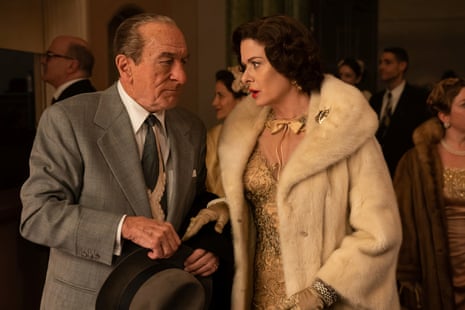
TWO GANGSTERS, ONE FACE — AND A QUESTIONABLE GAMBLE
The film follows the deteriorating relationship between Costello and Genovese as their competing ambitions threaten to destabilize New York’s criminal hierarchy.
Costello, portrayed as the more measured and calculating figure, represents a quieter approach to maintaining power. Genovese, meanwhile, embodies a more aggressive hunger for control.
Their differences should provide the foundation for an electrifying confrontation.
Instead, the decision to have De Niro portray both men introduces an unexpected obstacle.
Rather than becoming absorbed in the rivalry, viewers may find themselves concentrating on the actor’s makeup, altered facial features, and attempts to distinguish one character from the other.
What should feel like a collision between two formidable personalities occasionally resembles an elaborate acting experiment.
THE PROSTHETIC NOSE THAT BECAME A SYMBOL OF THE FILM’S PROBLEMS
Writing in The Guardian on March 23, 2025, critic Wendy Ide singled out the dual casting as one of the film’s most unfortunate creative choices.
Her criticism was not simply that De Niro plays two characters. It was that the performances fail to establish enough meaningful separation between them.
Ide described both portrayals as only marginally different and excessively theatrical.
She also pointed to the artificial nose used for De Niro’s portrayal of Costello, suggesting viewers could entertain themselves by identifying where the prosthetic had been attached.
It was a devastating observation.
A detail intended to help distinguish two historical figures instead became an illustration of the film’s larger weakness: its determination to make the dual-role concept work visually without making it equally compelling dramatically.
A GANGSTER STORY TRAPPED IN THE SHADOW OF CLASSICS
Levinson faces another considerable challenge.
His own acclaimed 1991 crime drama Bugsy explored a similar criminal world, with Costello and Genovese appearing as supporting figures.
More broadly, The Alto Knights inevitably invites comparisons with the gangster masterpieces that established De Niro’s reputation.
Unfortunately, those comparisons expose the film’s limitations.
Its wandering narration, delivered by Costello directly to the camera, recalls the storytelling techniques of Goodfellas without consistently reproducing that film’s urgency or momentum.
Rather than intensifying the historical conflict, the narration sometimes contributes to an already sluggish atmosphere.
The result is a crime drama that possesses fascinating material but struggles to transform it into gripping entertainment.
THE VERDICT: AN AMBITIOUS IDEA THAT OVERSHADOWS THE STORY
There is something undeniably intriguing about watching De Niro tackle two notorious figures within the same film.
But ambition alone cannot guarantee cinematic success.
The central rivalry contains enough historical intrigue to sustain a compelling gangster epic. Unfortunately, Levinson’s decision to place one actor on both sides of the conflict becomes more memorable than the conflict itself.
Ultimately, The Alto Knights demonstrates the danger of confusing an unusual casting experiment with genuine dramatic innovation.
And perhaps that is why the prosthetic nose attracted such pointed criticism.
When audiences begin noticing the makeup more than the characters, the illusion has already started to collapse.