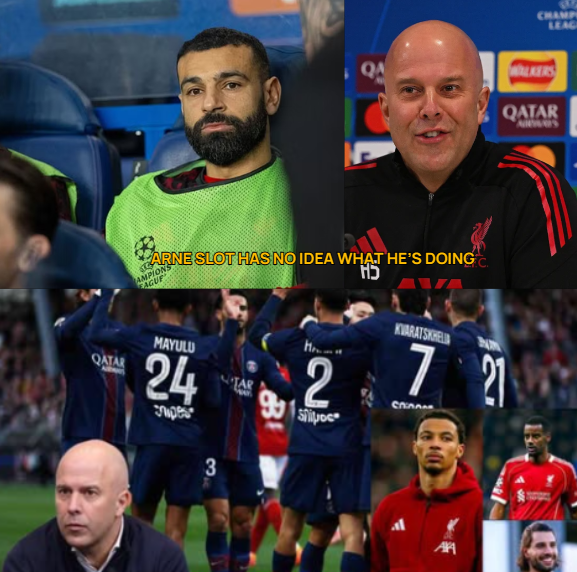
LIVERPOOL LEGEND BENCHED IN SHOCK CALL — ARNE SLOT’S DECISION SPARKS FURY 😳🔥
The Champions League quarter-final first leg between Paris Saint-Germain (PSG) and Liverpool was billed as a clash of philosophies—a meeting between Luis Enrique’s refined possession game and Arne Slot’s evolving, disciplined Liverpool. Yet, when the final whistle blew at the Parc des Princes, the 2-0 scoreline in favor of the Parisians was secondary to a single, baffling question that echoed from the terraces to the press rooms: Why did Mohamed Salah spend all 90 minutes on the bench?
For a club like Liverpool, whose identity is inextricably linked to the goal-scoring prowess of their Egyptian talisman, his absence during a crucial European knockout tie felt like a tactical heresy. However, as Arne Slot later revealed, the decision was not a lapse in judgment but a cold, calculated move into “survival mode.”
I. The Context: A Night of Parisian Dominance
Paris Saint-Germain entered the tie with a point to prove. Under Luis Enrique, they have shed the individualistic “Galactico” skin of the past in favor of a high-octane, team-oriented machine. On this particular night, the pace and width provided by Desire Doue and Khvicha Kvaratskhelia proved to be an insoluble puzzle for the Liverpool backline.
Doue’s opening goal was a testament to PSG’s transition speed, while Kvaratskhelia’s strike underscored the sheer technical quality currently residing in Paris. Liverpool, usually the aggressors in these scenarios, found themselves pinned back. The “Anfield roar” was miles away, replaced by the relentless chanting of the Collectif Ultras Paris.
In the face of this onslaught, Arne Slot made a decision that will likely define the early stages of his tenure. He abandoned the traditional Liverpool 4-3-3 for a pragmatic five-at-the-back system. This was a clear signal: Liverpool were not there to win the battle; they were there to survive the war.
II. The “Survival Mode” Rationale
In the post-match press conference, Slot was characteristically blunt. He didn’t offer excuses; he offered a philosophy of risk management. According to the Dutch manager, the decision to keep Salah on the bench was driven by three primary factors:
1. Tactical Balance and Defensive Integrity
Slot admitted that PSG’s ability to cover every blade of grass with speed forced his hand. By deploying five defenders and utilizing high-energy wing-backs like Jeremie Frimpong and Milos Kerkez, Slot hoped to stifle the spaces that PSG thrives in.
“We had to limit what they do best, even though it was extremely difficult,” Slot noted. Inserting Salah—a player who, while brilliant, is naturally exempt from the heaviest defensive duties—might have compromised the rigid defensive block Slot felt was necessary to prevent a 4-0 or 5-0 blowout.
2. Preservation for the Second Leg
Modern football is often described as a game of chess played over 180 minutes. Slot’s comments suggested he viewed the first leg as a damage-limitation exercise. At 2-0 down, the temptation to throw Salah on for the final 15 minutes was immense. Yet, Slot resisted.
“The important thing was maintaining the score,” he confessed. By keeping Salah fresh and away from the physical toll of a high-intensity chase in Paris, Slot is gambling on a “fresh-legged” talisman turning the tide at Anfield. It was a concession of the battle to maintain hope for the campaign.
3. The Failure of the High Press
Liverpool attempted to press high early on, but PSG’s technical proficiency allowed them to bypass the first line of engagement with ease. When the press failed, Liverpool was left exposed. Slot realized that continuing to play an expansive game would be “suicidal.” Consequently, the game plan shifted to a deep block—a tactical environment where Salah’s greatest strengths (running into space behind a high line) are neutralized.
III. The Counter-Argument: Can You Win by Not Trying to Lose?
While Slot’s logic is grounded in pragmatism, it has drawn fierce criticism from fans and pundits alike. The core of the dissent lies in the “Liverpool Identity.” Historically, Liverpool is a team that defies the odds through audacity, not caution.
By leaving Salah on the bench, Slot effectively told his players—and the opposition—that Liverpool did not believe they could score at the Parc des Princes. This psychological concession can be dangerous. It invites pressure and saps the confidence of the midfielders who are looking for an outlet.
Furthermore, the “survival” strategy only works if you actually survive. A 2-0 deficit is manageable, but it remains a mountain to climb. Had Liverpool managed an away goal through a moment of Salah magic, the complexion of the second leg would be entirely different.
IV. The Shadow of Anfield 2019
Every discussion about a Liverpool comeback is haunted by the ghost of the 2019 “Anfield Miracle” against Barcelona. On that night, Liverpool overturned a 3-0 deficit without Salah (who was injured). Perhaps this historical precedent influenced Slot’s thinking. If Liverpool could beat Messi’s Barcelona 4-0 without their star man, surely they can overturn a 2-0 lead with a rested Salah at home?
Slot alluded to this in his closing remarks: “On our home turf, Liverpool will be a different team. PSG is very strong, but this confrontation is not over.” He is banking on the intangible power of Anfield to bridge the gap that tactical pragmatism couldn’t close in Paris.
V. Comparing the “New” PSG and the “Pragmatic” Liverpool
The article from An Ninh Thủ Đô highlights a fascinating role reversal. Traditionally, PSG was the team of stars that crumbled under tactical discipline, and Liverpool was the cohesive unit that overwhelmed individuals.
In this quarter-final, the roles were flipped. PSG looked like the cohesive unit with a clear plan, while Liverpool looked like a team struggling to find a balance between their attacking DNA and the defensive requirements of the elite European stage.
The use of Jeremie Frimpong and Milos Kerkez as high-pressing tools showed that Slot is trying to modernize the Liverpool press, but his admission that it “hardly brought any results” against PSG is a sobering reality check for the Premier League leaders.
VI. The Statistical Reality
While we don’t have the live tracking data, the eye test suggested that Liverpool’s Expected Goals (xG) in the second half was negligible. Without Salah, the threat of the counter-attack lacked its usual “bite.” The PSG defenders were able to push higher and squeeze the game because they didn’t fear the long ball over the top.
In contrast, PSG’s xG was fueled by consistent entries into the Liverpool box. The five-at-the-back system “held,” but it did not “thrive.” It was a shield that was slowly being chipped away.
VII. Looking Ahead: The Anfield Gauntlet
The second leg now becomes one of the most anticipated matches of the season. Arne Slot has placed his reputation on the line. If Liverpool fails to overturn the lead, the decision to bench Salah will be remembered as the moment the tie was lost. If they succeed, it will be hailed as a masterstroke of load management and tactical foresight.
For Salah, the benching might serve as a powerful motivator. A player of his stature does not take kindly to being a spectator during a loss. Expect a “scorched earth” performance from the Egyptian King when the Parisians arrive on Merseyside.
VIII. Conclusion: A High-Stakes Gamble
Arne Slot’s decision to bench Mohamed Salah was a departure from the “heavy metal football” that fans have grown to love. It was a move into the realm of “survivalist” football—a cold, calculated acceptance of temporary defeat to ensure future survival.
In the high-stakes world of the UEFA Champions League, fortune usually favors the brave. Slot, however, is betting that fortune favors the prepared. By sacrificing the first leg to the Parisian fire, he hopes to bring a cold, rested, and lethal Liverpool back to life at Anfield.
Whether this was a moment of genius or a catastrophic error remains to be seen. But one thing is certain: on the night of April 8th, 2026, the silence of Mohamed Salah’s boots was the loudest sound in Paris.