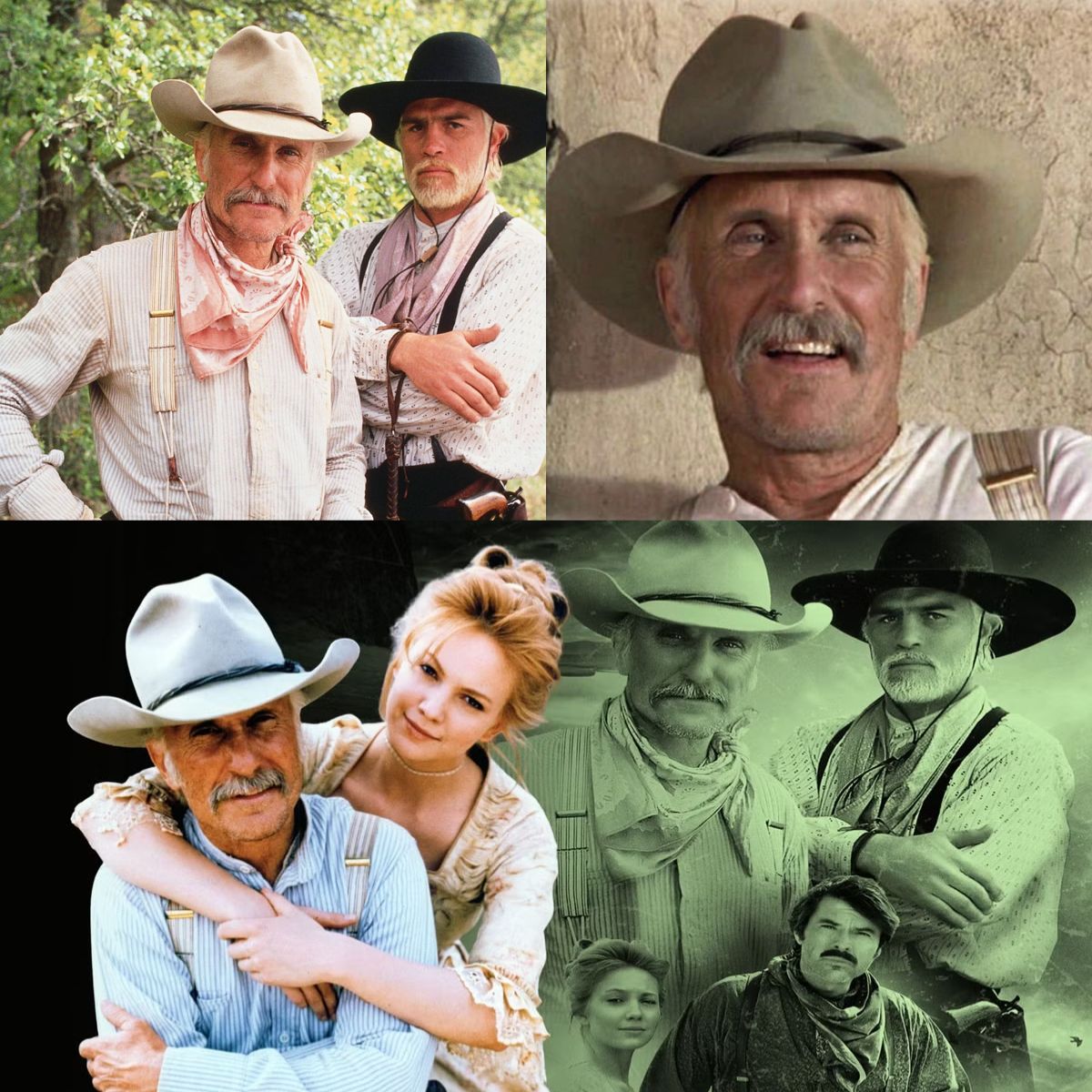
“40 YEARS LATER… HE RIDES AGAIN.” — After Robert Duvall’s passing, Lonesome Dove storms back to #1, reminding the world why Augustus McCrae became a legend.
In the wake of Robert Duvall’s passing at the age of 95 on February 15, 2026, fans have flocked back to the dusty trails of one of television’s most enduring masterpieces. The 1989 CBS miniseries Lonesome Dove, where Duvall delivered a career-defining performance as the irrepressible Augustus ‘Gus’ McCrae, has surged to the top of streaming charts across platforms like iTunes, Apple TV, and beyond.
It’s a remarkable resurrection for a six-and-a-half-hour epic that first captivated audiences nearly four decades ago. No flashy CGI, no gratuitous violence for shock value, no celebrity cameos designed to trend on social media. Just raw, heartfelt storytelling about friendship, loss, adventure, and the fading American West – anchored by Duvall’s magnetic turn as a whiskey-drinking, womanizing, larger-than-life former Texas Ranger who quotes Shakespeare one minute and robs a bank the next.
As tributes poured in from Hollywood and fans alike following the news of Duvall’s peaceful death at his Virginia horse farm, streaming data showed Lonesome Dove rocketing up the charts. On February 17, it topped domestic iTunes rankings, outpacing everything from modern prestige dramas to rewatches of beloved comedies. In the US and Canada, it climbed as high as No. 2 overall on certain platforms. Nearly 40 years on, Gus McCrae is riding high once more – proving that legends don’t fade; they simply saddle up and keep going.
The Man Who Made Gus McCrae Immortal
Robert Duvall wasn’t just acting in Lonesome Dove. He was living it. Born in 1931, the Oscar-winner (for Tender Mercies in 1983) had already etched his name into cinema history with powerhouse roles in The Godfather (as the loyal consigliere Tom Hagen), Apocalypse Now (the surfing-obsessed Lt. Col. Kilgore, famously declaring ‘I love the smell of napalm in the morning’), Network, True Grit alongside John Wayne, and countless others. But many who knew him – and Duvall himself – considered Gus McCrae his crowning achievement.
He once compared the role to Hamlet, telling interviewers that while the English could keep their Shakespearean princes, he’d take the roguish, silver-haired (well, in the book at least – Duvall was famously bald) Texas Ranger. ‘The western is ours,’ Duvall famously said. ‘The English have Shakespeare, the French have Molière, the Russians have Chekhov. The western is ours.’ And in Lonesome Dove, he made it his kingdom.
Adapted from Larry McMurtry’s Pulitzer Prize-winning 1985 novel, the miniseries follows two retired Texas Rangers – Gus (Duvall) and his stoic partner Woodrow F. Call (Tommy Lee Jones) – as they embark on an epic cattle drive from the Rio Grande in Texas all the way to the wilds of Montana in the 1870s. What begins as a simple adventure to escape boredom and claim new land turns into a harrowing odyssey filled with bandits, Comanche warriors, treacherous rivers, blizzards, romance, betrayal, and profound loss.
Duvall’s Gus is the beating heart of it all: a charming rascal with a philosopher’s soul, quick with a witty one-liner or a heartfelt reflection on life and death. He’s the life of the campfire, the man who’ll risk everything for a woman he loves (or even one he barely knows), and the reluctant hero who faces mortality with a mix of defiance and grace. His chemistry with Jones – whose Call is the perfect foil, all duty and repressed emotion – crackles with decades of unspoken brotherhood. It’s bromance before the term existed, but deeper, more authentic, more masculine in the truest sense.
The supporting cast was equally stellar: Diane Lane as the tragic prostitute Lorena Wood, whose journey with Gus becomes one of the miniseries’ most poignant threads; Anjelica Huston as the strong-willed Clara Allen; Robert Urich as the charming but doomed Jake Spoon; Danny Glover as the loyal Joshua Deets; and Frederic Forrest as the terrifying half-Comanche outlaw Blue Duck. Directed by Simon Wincer with sweeping cinematography that captured the vast, unforgiving beauty of the American frontier, Lonesome Dove felt less like TV and more like a grand cinematic event.
When it aired over four nights in February 1989, it drew an astonishing 26 million viewers per episode at its peak – a staggering number in the pre-streaming, three-network era. It earned 18 Emmy nominations and won seven, including Outstanding Directing for a Miniseries and technical awards for its sound and editing. Duvall took home the Golden Globe for Best Actor in a Miniseries or Motion Picture Made for Television, though notably, he was snubbed for the Emmy in the lead actor category (a decision that still rankles fans to this day). The series also snagged a Peabody Award for its outstanding dramatic achievement.
Critics raved. Rotten Tomatoes still gives it a near-perfect 98% from critics, with audiences loving it just as fiercely. One reviewer called Duvall’s performance ‘sublimely rowdy,’ capturing how he brought McMurtry’s pages roaring to life with humor, vulnerability, and quiet strength. It wasn’t just a western; it was a meditation on manhood, aging, loyalty, and the inevitable passage of time.
Why It Still Hits Harder Than Anything Today
In an age of endless franchises, quick-cut action, and stories engineered for maximum algorithmic engagement, Lonesome Dove stands apart because it dares to take its time. Clocking in at over six hours, it lets characters breathe. Conversations unfold naturally. Landscapes aren’t just backdrops – they’re characters themselves, indifferent and majestic.
There’s the infamous river crossing scene, where the herd faces deadly currents and hidden dangers. The brutal encounters with Blue Duck that leave viewers shaken. The quiet moments around the campfire where Gus spins yarns or philosophizes about ‘the hell of it’ – life, love, and everything in between. And, of course, the gut-wrenching finale that has reduced grown men to tears for generations.
Duvall’s Gus doesn’t grandstand. He doesn’t deliver monologues with swelling orchestral scores. His strength is in the subtlety: a twinkle in the eye during a card game, the way he tips his hat to a lady, the gravelly voice cracking just slightly when confronting loss. It’s the kind of performance that feels lived-in, not performed. No wonder Duvall reportedly told the crew they were making ‘the Godfather of westerns.’ He knew.
Fans have long hailed it as the greatest western ever put on screen – miniseries or otherwise. It revived interest in the genre at a time when Hollywood had largely abandoned it post-Unforgiven and Dances with Wolves. It inspired sequels (the 1993 Return to Lonesome Dove, though without Duvall or Jones in their original roles) and a short-lived TV series, but none captured the magic quite like the original.
And now, in 2026, with Duvall gone, that magic is drawing new eyes – and old ones revisiting with fresh emotion. Social media is flooded with clips: Gus chasing buffalo only to end up on the run himself, his farewell scenes with Call, the tender moments with Lorena. One viral post simply read: ‘This one hurt. Augustus “Gus” McCrae. My favorite character of all time. Period.’
Tributes from co-stars and admirers highlight not just Duvall’s talent but his humanity. His wife Luciana shared a touching statement: ‘Yesterday we said goodbye to my beloved husband, cherished friend, and one of the greatest actors of our time. Bob passed away peacefully at home, surrounded by love and comfort.’ Hollywood mourned a chameleon who disappeared into every role, from Mafia lawyers to country singers to this quintessential cowboy.
Even McMurtry, the author, who reportedly never watched the full series, couldn’t diminish its impact. The book is a masterpiece of American literature, but Duvall and company made it visual poetry.
The Broader Legacy: A Generation Defined by Quiet Strength
Lonesome Dove arrived at a cultural crossroads. The 1980s were winding down, the Reagan era giving way to new uncertainties. Westerns had been declared dead multiple times, yet here was a story that celebrated the rugged individualism, the code of honor, the messy friendships that built the West – and by extension, America.
It spoke to baby boomers who grew up on John Wayne and Clint Eastwood, but offered something richer: flawed, aging heroes confronting their legacies. Gus isn’t invincible. He’s vain, impulsive, romantic to a fault. But his loyalty and wit make him unforgettable. Call, meanwhile, embodies the repression and duty that defined so many men of that era – and perhaps still do.
For younger viewers discovering it now via streaming, it’s a revelation. In a world of irony-soaked anti-heroes and spectacle-driven blockbusters, Lonesome Dove offers sincerity. Real stakes. Characters who feel the weight of their choices. No shortcuts, as the viral caption put it. Just sharp dialogue, breathtaking vistas (filmed across Texas, New Mexico, and Montana), and performances that hit like a cattle stampede to the heart.
Its resurgence isn’t surprising. With Duvall’s death, fans aren’t just mourning an actor – they’re reconnecting with the values his Gus represented: resilience, humor in the face of adversity, the importance of chosen family. In polarized times, there’s comfort in a story where good men (flawed as they are) ride for something bigger than themselves.
Duvall’s own life echoed some of that cowboy ethos. He lived on a sprawling Virginia farm, raising horses, staying grounded despite decades in the spotlight. He directed films, wrote, and never chased trends. His career spanned from To Kill a Mockingbird (as the mysterious Boo Radley) in 1962 to roles into his 80s and beyond. Over 90 films. Countless awards. But Lonesome Dove remained his favorite.
‘This character is like Shakespeare,’ he said. And in many ways, the miniseries is America’s epic – a Iliad or Odyssey on horseback, complete with gods (or at least larger-than-life men), monsters (Blue Duck), and tragic homecomings.
Scenes That Still Define a Generation
Ask any fan for their standout moment, and you’ll get a dozen answers.
For many, it’s Gus’s deathbed scene – not spoiling details, but it’s the kind of raw, dignified farewell that modern TV rarely dares. The bond between Gus and Call, forged in Ranger days and tested across a thousand miles, culminates in exchanges that reveal decades of unspoken respect and regret.
Then there’s the romance with Lorena: Duvall and Lane’s chemistry turns what could have been a stereotypical ‘hooker with a heart of gold’ into a profound story of redemption and unexpected tenderness. Gus sees her not as fallen, but as worthy of protection and affection.
The action sequences – Indian attacks, river fords, outlaw pursuits – are gritty and realistic, never glamorized. Horses tire. Men bleed. Nature doesn’t care about your plans.
And the humor! Gus’s one-liners, his love of whiskey and women, his habit of ‘visiting’ with the dead or philosophizing mid-adventure. Duvall infuses him with such joie de vivre that even in sorrow, there’s light.
These elements combined to make Lonesome Dove a cultural touchstone. It influenced everything from subsequent western revivals to how male friendships are portrayed on screen. It’s often called the best miniseries ever made, and for good reason.
In a World of Noise, Real Storytelling Endures
As Lonesome Dove climbs the charts again, it’s a timely reminder: quality endures. No amount of reboots, remakes, or AI-generated content can replace authentic performances and thoughtful narratives.
Duvall’s passing at 95 closes a chapter on a golden era of acting – the Method-influenced generation that included peers like Gene Hackman, Dustin Hoffman, and others he came up with. But his Gus lives on, riding those endless trails in the imaginations of millions.
Fans are sharing stories: grandfathers introducing it to grandsons, families gathering for annual viewings, couples bonding over its emotional depth. One commenter noted watching it every summer ‘in this damned Texas heat,’ a ritual that now feels even more sacred.
There’s talk of future adaptations – rights have changed hands, with new versions in development – but none will likely eclipse the 1989 original. How do you top Duvall as Gus? You don’t.
Instead, we revisit. We stream. We laugh, cry, and reflect on what it means to live fully, love deeply, and face the end with the same quiet strength Gus showed.
Nearly 40 years later, Lonesome Dove isn’t just topping charts. It’s reminding us why stories like this matter. No spectacle needed. Just horses, heart, and a man named Robert Duvall who made a bald, crotchety Ranger into an eternal legend.
Legends don’t fade… they ride on. And right now, Augustus McCrae is leading the herd once more – straight to the top.