They Threw Her To The K9s. THE GATE SLAMMED SHUT BEHIND ME—FOUR MILITARY DOGS, TRAINED TO KI*L, EYES LOCKED ON MY THR0AT. BUT I CAME HERE TO FIND MY FATHER’S MURD*RER, AND I WON’T LEAVE UNTIL I BURY THE DOCTRINE THAT BROKE US BOTH. WILL I SURVIVE THE PEN? WHO IS REALLY BEHIND THIS CRUELTY?
The K9 Doctrine
The chain-link rattled with a sound like loose bones.
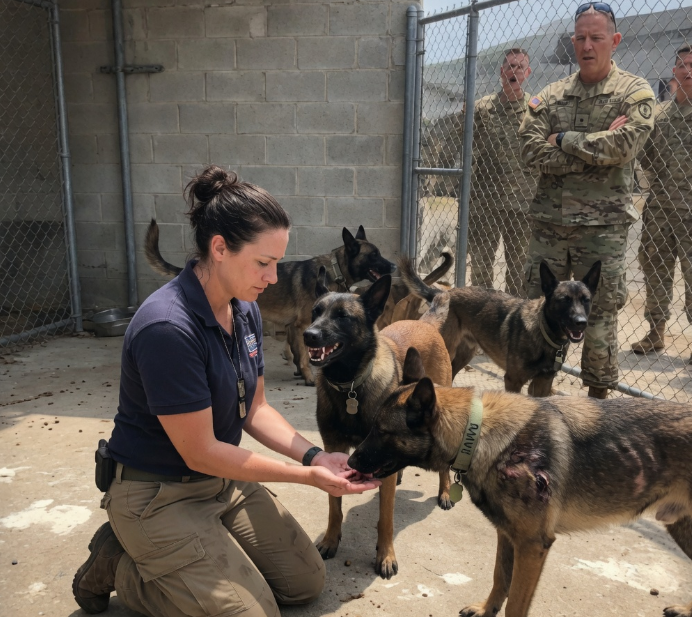
I could smell the dogs before I saw them properly—that hot, sour musk of adrenaline, old bleach, and the metallic tang of stress so thick it coated the back of my throat. Four of them. Malinois and one limping Shepherd, spread across the sun-bleached concrete like a net being drawn tight. The afternoon heat pushed down hard enough to make the air wobble.
My name is Kira Brennan. I was twenty-seven, a naval officer undercover, and I had just been thrown into a pen with four attack dogs by a man who thought he was proving a point.
Outside the fence, Lieutenant Colonel Dominic Kesler crossed his arms. His face was flat. Expectant.
“You wanted a demonstration,” he said. His voice carried over the yard like he was announcing a weather report. “Let her prove it.”
The lead dog lunged first.
Not at me. At the space between us. Testing. His paws scraped concrete and his lips pulled back just enough to show the dark line of gum above his canines. The sound that came out of him wasn’t a bark. It was a low, continuous rumble that vibrated right through the soles of my boots.
I kept my hands open at my sides.
“She’s gonna get shredded,” someone muttered behind the fence. I heard Maddox, my contact on the inside, suck in a breath so sharp it sounded like a cut.
My heart was a fist inside my ribs. But I had spent thirteen years preparing for this moment without ever knowing it would look like a concrete pen in North Carolina. I had spent my whole life chasing the ghost of a German Shepherd named Havoc—the dog that killed my father in a Kuwaiti desert six weeks before I was born. Redirected aggression. Handler-directed attack. The words from the classified report were burned into my memory like a brand.
And now, standing in front of me, was a new Havoc. A Shepherd with an infected shoulder and eleven electrical burn sites on his body. A dog Kesler had named deliberately, as if he were daring the past to repeat itself.
I softened my knees. The lead Malinois surged forward another step. His breath was hot and fast.
I knelt.
The yard went dead silent. Predators expect prey to run or fight. Pack expects signals. I lowered my chin, exposed my neck, and let my hands rest palms-up on my thighs. My breath slowed until I could feel my pulse in my lower back instead of my throat.
The Malinois stopped eighteen inches from my face. His growl wavered. Confusion.
Havoc, the limping Shepherd, moved forward through the others. He was reading me. Not hunting. Reading. His eyes, dark and exhausted, held mine for one unbearable second. Then, with a movement so slow it hurt to watch, he pressed his nose into the center of my palm.
“Hey,” I whispered. My voice cracked on the single syllable.
He didn’t bite. He didn’t growl. He just held his nose there, breathing me in. Behind me, I heard Kesler’s breath catch. When I stood up, all four dogs rose with me. They flanked me to the gate like I had been theirs for years.
I pulled my real credentials from my jacket and held them up so the light caught the shield.
“My name is Lieutenant Kira Brennan,” I said, looking straight at Kesler’s gray face. “Federal investigator. And your program is over.”
Part II: The Shadow of the Doctrine
The arrest of Dominic Kesler was supposed to be the end, but as I sat in the dim light of the holding room three hours later, I knew I had only pulled a single loose thread.
Kesler was a symptom. The “K9 Doctrine” was the disease. For decades, a whispers-only protocol had existed within the specialized canine units—a training method designed to create “living landmines.” It wasn’t about partnership; it was about breaking the animal’s spirit until only a hair-trigger remained.
My father, Sergeant Elias Brennan, had been a handler. He was one of the good ones. But according to the redacted files I’d spent a decade stealing, he had been on the verge of whistleblowing. He had seen what the Doctrine did to the dogs, and what it did to the men who used them.
“You think you’re a hero, Kira?” Kesler sneered from across the table. He was handcuffed, but he still wore his arrogance like a uniform. “I didn’t kill your father. A dog did. A beast that couldn’t tell the difference between a target and its master.”
“You named that dog in the pen Havoc,” I said, my voice steady. “Why?”
Kesler laughed, a dry, rattling sound. “To remind everyone of the stakes. Your father thought he could ‘rehabilitate’ the Doctrine assets. He thought he could love the war out of them. Havoc showed him the truth.”
“No,” I said, leaning in. “Havoc was triggered. I found the forensic reports, Kesler. The ones your predecessors tried to burn. The dog didn’t just snap. He was hit with a high-frequency pulse—a prototype of the same ‘behavioral correction’ tools I found in your office today. My father didn’t die because of an animal. He died because someone pushed a button.”
Kesler’s eyes flickered. For the first time, the arrogance cracked.
Part III: The True Architect
The “high-frequency pulse” was the key. It was a tool developed by a private defense contractor, Aegis-K9, which had been supplying the military with “enhanced” training equipment for thirty years.
I left the base as the sun was setting, Havoc—the real, breathing dog—sitting in the back of my SUV. I had pulled rank to keep him from the vet-techs until my own specialist arrived. He was quiet, watching the world through the glass with a weary intelligence.
My investigation led me to a name I hadn’t expected: General Arthur Vance (Ret.).
Vance was a legend. A hero of the Gulf War. He was also the majority shareholder of Aegis-K9. And he was currently hosting a “Charity Gala for Fallen Handlers” at his estate, only twenty miles from the base.
I didn’t change out of my tactical gear. I didn’t wash the dog-musk off my skin. I simply drove.
The estate was a fortress of glass and steel. Valets looked at my muddy SUV with disdain, but the federal plates on the bumper kept them silent. I walked through the front doors with Havoc at my side. The dog was limping, but his head was high. He sensed the tension in my grip on the leash.
The ballroom was filled with the clink of crystal and the hum of polite conversation. When I entered, the noise died down in a wave of curiosity and then shock.
General Vance stood at the far end of the room, a glass of scotch in his hand. He looked exactly like the photos—a grandfatherly figure with silver hair and eyes as cold as a winter sea.
“Lieutenant Brennan,” he said, his voice a rich baritone. “I heard there was a disturbance at the pens today. I didn’t realize you’d bring the evidence to my party.”
“He’s not evidence, General,” I said, walking toward him. The crowd parted. “He’s a survivor. Which is more than I can say for the men who died testing your ‘Doctrine’.”
Vance smiled thinly. “Progress requires sacrifice, Kira. Your father understood that. He just didn’t have the stomach for the final step.”
“The final step being murder?” I reached into my pocket and pulled out a small, black device I’d recovered from Kesler’s safe. It was the original trigger from 1996. “I had the serial number tracked. This wasn’t a military prototype. It was a private asset from Aegis. Registered to you.”
The room went cold. The donors and officers looked between us, the air suddenly thick with the scent of a scandal that could topple empires.
“You think a piece of plastic proves anything?” Vance asked.
“I think the logs on the Aegis servers—the ones my team is currently downloading—will prove that this device was active on the morning of June 14th, 1996, in the exact GPS coordinates of my father’s patrol,” I said.
Vance’s hand tightened on his glass. “Your father was going to ruin everything. He was going to pull the funding for a program that has saved thousands of lives by creating the perfect, obedient soldier. I couldn’t let one man’s sentimentality destroy the future of warfare.”
“He wasn’t sentimental,” I snapped. “He was right. You didn’t create soldiers. You created trauma. You broke the bond that makes us human.”
Vance looked at Havoc. A cruel light sparked in his eyes. He reached into his own pocket and pulled out a modern version of the remote.
“Let’s see if your bond is as strong as you think,” Vance whispered.
He pressed the button.
A high-pitched whine, nearly silent to human ears, pierced the room. Havoc’s body went rigid. His fur stood on end, and a guttural, terrifying sound ripped from his chest. His eyes rolled back, showing the whites.
The crowd screamed, backing away. Vance laughed. “He’s a landmine, Kira! And you’re standing right on top of him!”
Havoc lunged.
But he didn’t lunge at me.
In the weeks I had spent undercover, I hadn’t just watched the dogs. I had worked with them. I had smelled like them. And most importantly, I had taught Havoc a different signal.
I had grabbed Vance’s sleeve the moment I saw him reach for his pocket. I was the source of the scent, the “handler” in the dog’s fractured mind, but I was pointing. My body was angled. My hand was clamped on Vance’s arm.
Havoc hit the General like a freight train.
He didn’t go for the throat. He went for the arm—the one holding the remote. The glass of scotch shattered. The remote skittered across the floor. Havoc pinned the man to the marble, a wall of snarling, vengeful fur.
“Call him off!” Vance shrieked, his face turning purple as the weight of the dog crushed the air from his lungs. “Call him off!”
I stepped over the broken glass and picked up the remote. I turned it off.
Havoc didn’t let go immediately. He waited, his growl vibrating against Vance’s chest, until I placed my hand on his head.
“Easy,” I whispered. “It’s over.”
Part IV: The Burial
The aftermath was a whirlwind. Vance’s confession, captured by the dozens of high-profile witnesses in the room, was the final nail in the coffin for Aegis-K9 and the Doctrine. The program was dismantled. The “landmine” dogs were moved to a specialized sanctuary I helped fund with the settlement from my father’s wrongful death suit.
Six months later, I stood on a cliffside in Maine.
The wind was cold, smelling of salt and pine. Beside me, Havoc—now just ‘Buddy’ to the world—sat patiently. His limp was better, his eyes clear.
In my hand, I held a small urn. My mother had kept my father’s ashes for twenty-seven years, waiting for the day the truth could be buried with him.
“He would have liked you,” I told the dog.
I scattered the ashes into the Atlantic. I didn’t feel the weight of the past anymore. The Doctrine was broken. The man who pushed the button was behind bars. And the dog who was supposed to be my father’s killer was the one who had finally brought him peace.
I turned away from the edge, my hand resting on Buddy’s head. We walked back to the car together, two survivors of a war that was finally over.
As the gate to the trail slammed shut behind us, I didn’t flinch at the sound. It wasn’t the sound of a cage. It was the sound of a door finally being locked on the darkness.