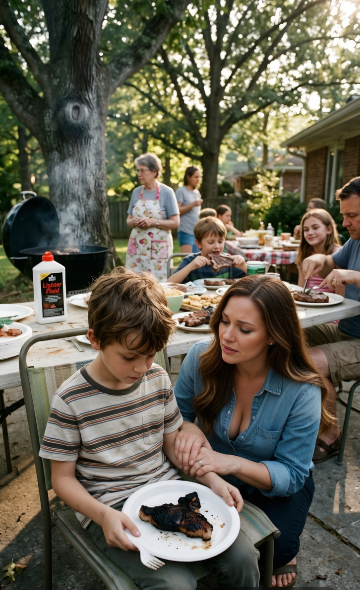
During a family cookout, my mom only let my son eat a burnt slab of fat while the other kids got T-bone steaks. She laughed, “That’s more than enough for a child like him.” My sister smirked, “Even a dog eats better.” When I was about to speak up, my son whispered, “Mom, I’m happy with this meat.” An hour later, when I realized what he meant… my hands started shaking.
My name is Andrea Collins, and the most horrifying sentence my son ever spoke to me was so quiet, so polite, that no one else at the cookout even noticed it.
At first, the afternoon looked ordinary.
My mother, Eleanor, had invited the family over for a Sunday cookout in her backyard in the suburbs of Virginia. It was a sprawling, manicured space, the kind of lawn that looked like it was maintained with a ruler and a pair of scissors. My sister Melissa was there with her husband, Dave, and their son, Tyler. Tyler was the same age as my boy, Evan—both eight, both skinny, both still young enough to think adults meant what they said.
The grill smoked under the ancient oak tree, the patio table was covered in bowls of potato salad and grilled corn, and my mother moved around in one of her crisp floral aprons. To any passerby, she was the picture of the doting grandmother, the matriarch gathering her brood for a celebration of summer.
But my family had never been equal with love. It was a currency Eleanor dealt in, and she was a stingy banker.
Melissa had always been the golden child. She was the one who married the “right” man, the one who stayed in town, the one who mirrored our mother’s sharp-tongued elegance. Her son, Tyler, was treated like a little prince. He got the first slice of every cake, the most expensive Christmas gifts, and the warmest, most genuine smiles.
My Evan, however, was the outlier. He was quiet, sensitive, and—in my mother’s eyes—the product of my “failed” life in the city. To Eleanor, Evan wasn’t a grandson; he was a chore. At best, he was tolerated with a thin, brittle politeness. At worst, he was the target of the kind of “jokes” adults make when they want to wound a child and call it humor if anyone dares to protest.
I had fought with them over it a hundred times. Every time I stood up for him, my mother would wave a hand dismissively and say I was “raising him too soft,” or that I was “projecting my own insecurities” onto her.
That afternoon, however, the hierarchy of the family was made impossible to ignore. It was written in the meat.
The Meal
The smell of searing beef filled the air. Dave and Tyler were throwing a football near the rosebushes, their laughter ringing out in the humid air. Melissa sat on a lounge chair, nursing a glass of expensive Chardonnay, looking like a queen surveying her domain.
When the steaks finally came off the grill, the distribution began.
Eleanor moved with purposeful grace. First, she handed a plate to Melissa. It held a thick, juicy T-bone, perfectly seared with cross-hatched grill marks, resting beside a heap of buttered corn. Dave got the same. Then came the children.
“Here you go, Tyler,” Eleanor cooed, ruffling his hair. She handed him a plate with another T-bone, smaller than the adults’ but still a premium cut of meat, tender and pink in the middle.
Then, she turned to Evan.
She didn’t coo. She didn’t ruffle his hair. She reached for a small paper plate at the end of the counter and dropped something onto it with a wet thud.
It barely qualified as food. It was a burnt strip of gristle and yellowed fat, blackened to a bitter crisp at the edges and limp in the middle. There was no meat on it—only the discarded trimmings of a larger cut.
I stared at the plate. My stomach did a slow, sick roll.
“Mom,” I said, my voice tight and careful, “where’s Evan’s steak?”
My mother chuckled, a dry, papery sound, and didn’t even look at him. “Oh, Andrea. That’s plenty for a child like him. He’s always been such a picky eater, haven’t you, Evan? No sense wasting good beef on someone who won’t appreciate it.”
Melissa laughed from her lawn chair, her eyes sparkling with a cruel sort of glee. “Honestly, Andrea, look at that thing. Even a dog would eat better than that. Maybe he can beg for scraps under Tyler’s chair.”
A few other relatives—cousins and uncles—smiled awkwardly. They shifted in their seats, looking at their own plates, unwilling to break the social contract of the “happy family” by pointing out the blatant cruelty.
My whole body went hot with a familiar, searing anger. I felt the words rising in my throat, a scream of defense for my son, but before I could speak, Evan lowered his eyes to his plate. His voice was small, steady, and hauntingly calm.
“Mom, I’m happy with this meat.”
I looked at him, my heart breaking. He didn’t look up. He didn’t defend himself or look for my help. He just stared at the burnt slab of fat, his fork motionless in his hand. It wasn’t the voice of a child who was satisfied; it was the voice of a child who had accepted his place at the bottom of the world.
I pushed my chair back, the legs screeching against the patio stones. “No. No, you’re not eating that, Evan. Mom, give him a piece of one of the other steaks. There’s plenty left on the tray.”
But as I reached for his plate, Evan caught my wrist. His grip was surprisingly urgent.
“Please,” he whispered, his eyes wide and dark. “It’s okay. Really. I like it this way.”
That stopped me more than the insult had.
Evan was a gentle child, but he was also honest. If he was hungry, he told me. If a movie scared him, he hid behind the couch. If something was unfair, his face usually crumpled into a pout. But now, there was something else in his expression. It wasn’t embarrassment or sadness.
It was fear. Real, cold, paralyzing fear.
I took the plate from him anyway and marched to the grill. I looked at the trays. They were empty. Only grease-streaked foil and a few charred onions remained.
“Mom,” I said, turning back to her. “You cooked six steaks. There were only five people eating meat besides Evan. Where is the last one?”
My mother shrugged, her expression one of bored innocence. “I suppose I overcooked one and tossed it. Or perhaps Dave had seconds. Really, Andrea, you’re making a scene over a piece of protein. It’s embarrassing.”
“For God’s sake, Andrea,” Melissa rolled her eyes, taking a large bite of her steak. “It’s meat. Stop being so dramatic. You’re ruining the vibe.”
I wanted to grab Evan and leave right then. I should have. I should have followed my gut. But Evan touched my arm again. His fingers were unnaturally cold for such a warm day.
“Mom,” he said softly, leaning in so only I could hear. “Please don’t make them mad. Just let me eat this.”
I crouched beside him, my voice a whisper. “Evan, why would I make them mad? It’s just dinner.”
He didn’t look at the table. He didn’t look at Melissa or my mother. He looked at the house—the big, white colonial house that always felt more like a museum than a home.
Then he leaned in closer, his breath warm against my ear, and said the sentence that would haunt the rest of my life.
“Because,” he whispered, his eyes darting to the paper plate, “I’m glad she didn’t put the blue salt on mine.”
The Confusion
I frowned, my anger cooling into a confused, uneasy chill. “Blue salt? What are you talking about, Ev?”
“The kind from the shiny bottle under the sink,” he said, his voice barely a breath. “I saw her when I went to get a juice box earlier. She was in the kitchen, and she thought I was already outside. She rubbed a whole bunch of it into the big steaks. The ones for Aunt Melissa and Tyler. But she said my meat wasn’t worth wasting it on. She said I was lucky to get anything at all.”
I stared at him, my mind racing. Blue salt? My mother was an old-school cook. She used Kosher salt, black pepper, and maybe some garlic powder. She was a purist.
I thought of the “gourmet” salts that had become trendy—blue Persian salt, perhaps? It seemed like exactly the kind of pretentious thing Melissa would love. Maybe Mom was just trying to impress her favorite daughter with some expensive, colorful seasoning.
But the way Evan said it—the shiny bottle under the sink—didn’t sit right.
I looked over at my mother. She was sitting perfectly still, watching us. She wasn’t eating. Her plate held only a small mountain of potato salad, which she was moving around with her fork but never actually lifting to her mouth.
“Mom, you’re not having a steak?” I asked, my voice sounding strange to my own ears.
“Oh, you know me,” she said with a thin smile. “I filled up on the appetizers. And that potato salad is so heavy. I’ll have some later, dear.”
Melissa was halfway through her T-bone, laughing at something Dave said. Tyler was sawing away at his own steak with a plastic knife, his face smeared with juice.
I looked back at Evan. He was slowly, dutifully chewing on the burnt fat. He looked relieved. He looked safe.
I felt the exhaustion of years of fighting with my family. I told myself I was overreacting. Evan was eight; he probably saw a bottle of dish soap or a canister of Comet and his imagination did the rest. Children misinterpret things all the time.
If I started screaming about “blue salt” now, I would be the “crazy sister” for the rest of eternity. They would use it as ammunition to keep Evan and me at arm’s length.
So, I sat back down. I pulled a napkin from the pile and quietly wiped the worst of the bitter char off Evan’s pathetic strip of fat. We ate in silence. I didn’t speak to the others, and they didn’t speak to us. I just watched the clock, waiting for enough time to pass so that leaving wouldn’t seem like a “retreat.”
The Silence Breaks
About forty minutes later, the air in the backyard changed.
It happened so subtly at first that I didn’t notice. The laughter didn’t stop; it just… wilted.
Melissa set her wine glass down on the patio table. It wasn’t a gentle placement; it was a hard, erratic clink that sent a splash of Chardonnay over the rim. She was massaging her temples, her eyes squeezed shut. Her skin, which had been sun-kissed and glowing an hour ago, was suddenly glistening with a sickly, oily sheen of sweat.
“God, it’s hot out here,” she muttered.
“You okay, Mel?” Dave asked. He started to stand up, but his legs seemed to give way beneath him. He slumped back into his chair, his face turning an ashen, dusty gray. He didn’t say a word. He just stared at the oak tree with a look of profound confusion.
Then, he doubled over. A low, guttural groan escaped him, and he stumbled blindly toward the downstairs bathroom, his shoulder hitting the doorframe with a dull thud.
“Must be a nasty stomach bug going around,” my mother said.
Her voice was the most terrifying thing I had ever heard. It was hollow. Empty. There was no concern in it, no maternal panic. It was the voice of someone reading a weather report.
She was still sitting in her lawn chair, her hands folded neatly in her lap. She looked like a statue.
“Mom?” Tyler whimpered.
I turned. Melissa’s son was curled on the grass near the oak tree where he had been playing just minutes before. He was clutching his stomach, his small body shaking. His breathing was fast and shallow—a terrifying, wheezing sound—and his eyes were rolling back in his head, showing only the whites.
“Melissa, what’s wrong with him?” I yelled, my pulse spiking as I stood up.
Melissa didn’t answer. She couldn’t. She leaned forward, a terrible, wet, choking sound tearing from her throat. Her body stiffened, her back arching in a violent spasm, and then she collapsed heavily onto the patio stones. She began to convulse, her heels drumming a rhythmic, sickening beat against the concrete.
Chaos erupted. My aunt and uncle began screaming, hovering over Melissa, trying to hold her tongue, trying to stop the shaking.
“Call 911!” I screamed, realizing my phone was still in my purse on the kitchen island.
I sprinted toward the house, my heart hammering against my ribs like a trapped bird. I burst through the sliding glass doors, the air-conditioned silence of the kitchen feeling like a slap in the face.
I tore through my bag, my thumbs trembling so hard I could barely unlock the screen. As the emergency operator’s voice crackled to life in my ear—911, what is your emergency?—my eyes drifted over the kitchen counter.
There, sitting next to the empty styrofoam meat trays and the cutting board, was the bottle Evan had mentioned.
It was a shiny, professional-grade plastic bottle. It had been pulled out from the heavy-duty cleaning caddy under the sink, the one Eleanor kept locked so the “help” wouldn’t misuse the chemicals.
It wasn’t salt. It wasn’t a gourmet seasoning.
It was an industrial-grade rodenticide used for clearing out farmhouse infestations. The label featured a stark black skull and crossbones. Below it, in bold red letters, were the warnings: EXTREMELY NEUROTOXIC. FATAL IF INGESTED. CAUSES RAPID RESPIRATORY FAILURE AND INTERNAL HEMORRHAGING.
The “salt” was actually bright blue crystals, designed to look like food to grain-eating pests. They were scattered thickly across the cutting board, pressed deep into the leftover bloody juices where the T-bone steaks had been rested and sliced.
She said my meat wasn’t worth wasting it on.
The realization hit me with the force of a physical blow. My hands started shaking so violently that the phone slipped from my grip, clattering against the hardwood floor. The operator was still talking, a tiny, tinny voice asking for my location, but I couldn’t move.
I looked through the kitchen window.
The scene outside was a nightmare. Dave had collapsed in the doorway of the bathroom. Tyler was still on the grass, his movements slowing into a terrifying stillness. My relatives were in a blind panic, performing frantic, useless CPR on Melissa, whose face was turning a bruised, mottled purple.
And in the center of it all sat my mother.
She hadn’t moved to help. She hadn’t screamed. She just slowly turned her head, looking through the glass of the sliding door, right at me.
She didn’t look like a grandmother. She didn’t even look like a human being. She looked like someone who had finally finished a long, tedious, and necessary chore. There was a faint, satisfied twitch at the corner of her mouth.
In her sick, twisted mind, Eleanor hadn’t given Evan that burnt scrap of fat to humiliate him. She had given it to him because he and I were never “the favorites.” We were never her golden children. We were the “flawed” ones, the ones she couldn’t control, the ones who didn’t fit into her perfect gallery of a life.
And because we weren’t perfect, we weren’t chosen.
She had decided to preserve her “perfect” family forever—to take them with her, or perhaps just to stop the clock while they were still hers. She had poisoned the ones she claimed to love most, and she had spared the ones she despised simply because she didn’t want to “waste” the means of their destruction on us.
Her hatred was the only thing that had saved my son’s life.
I didn’t pick the phone back up. I knew it was too late for Melissa. I knew it was too late for Dave and Tyler. The “blue salt” was designed to work fast and leave nothing behind.
I turned and ran. I didn’t go to help the others. I didn’t confront the monster in the floral apron. I ran back out into the screaming yard, ignored the dying and the dead, and scooped my beautiful, terrified, living boy into my arms.
Evan clung to my neck, his small heart beating against my chest.
“We’re going, Ev,” I sobbed, stumbling toward the gate. “We’re going home.”
I didn’t look back. I didn’t need to. I could feel my mother’s eyes on my back, watching us leave, perhaps already regretting that she had been so thrifty with her “salt.”
We reached the car, and I drove. I drove until the suburbs vanished, until the sun began to set, until the only thing I could hear was the sound of my son’s breathing.
It was the most beautiful sound in the world.