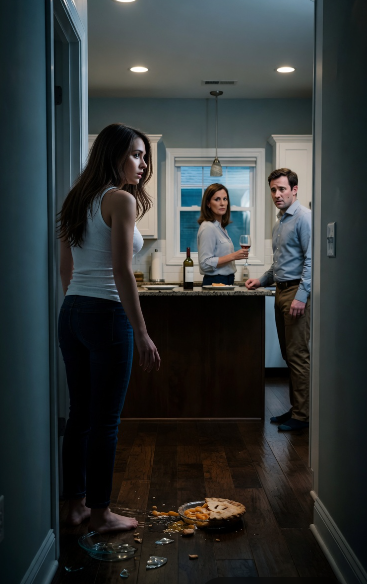
I was supposed to be planning my wedding, not walking into a nightmare. “She trusts you,” my mother laughed softly. My fiancé replied, “That’s why this works.” Then I stepped inside. The pie fell. The room froze. I waited for denial, panic—anything. Instead, my mother met my eyes and said, “You should’ve stayed out longer.” That’s when I knew… I hadn’t just lost a fiancé. I had been set up.
I thought I was walking into the beginning of my forever. My name is Natalie Brooks, and that evening, I stood outside my own front door with a warm peach pie in my hands. The crust was still flaky, the scent of cinnamon and caramelized fruit wafting up to meet the cool autumn air. I was smiling to myself, mentally drafting the guest list for an early Thanksgiving dinner. I wanted to merge our families—the Brookses and the Miller—into one seamless tapestry of love.
Then, I heard it. A laugh.
It was a melodic, practiced sound that I knew better than my own heartbeat. My mother, Susan Brooks. But Susan wasn’t supposed to be here; she was meant to be at a charity gala in the city. And she certainly didn’t have a key.
Then came Jason’s voice, low and urgent. “She trusts you,” my mother laughed softly, the sound clinking like ice in a crystal glass. My fiancé replied, his tone smooth as velvet, “That’s why this works.”
The silence that followed was heavy, a physical weight pressing against the door. I pushed it open.
The pie didn’t just fall; it surrendered. It slipped from my numb fingers and disintegrated against the dark hardwood of the foyer, a sticky, golden carnage of fruit and ceramic. The room froze. I waited for the predictable choreography of guilt—the frantic pulling apart, the stammered excuses, the wide-eyed denial.
Instead, my mother didn’t even move her hand from where it rested, dangerously close to Jason’s shoulder. She met my eyes with a chilling, clinical calmness. She took a slow, deliberate sip of her Sauvignon Blanc and said, “You should’ve stayed out longer, Natalie.”
In that moment, the world didn’t tilt; it leveled. The fog of the last year—the perfect dates, the expensive ring, the way my mother had suddenly become my “best friend” during the wedding planning—evaporated. I hadn’t just lost a fiancé. I had been the target of a long game.
“How long?” I asked. My voice was a ghost of itself.
“Long enough that you should have noticed,” my mother replied.
I didn’t scream. I didn’t cry. I simply looked at the man I was supposed to marry in three months. Jason looked away, his jaw tight, but I saw no remorse, only the annoyance of a hunter whose prey had tripped the trap too early.
“I see,” I whispered. I turned on my heel, stepping over the ruins of the pie, and walked out into the night.
Part 2: The Audit of Betrayal
I didn’t go to a hotel to weep. Tears are for those who are surprised by a loss; I was busy realizing I had been robbed. I drove to a 24-hour diner on the outskirts of town, the kind of place where the fluorescent lights hum with a depressing frequency. I ordered a black coffee and opened my laptop.
My father, David Brooks, had been a titan of industry—and a man who knew his wife’s soul better than anyone. When he died five years ago, he left a complex web of trusts. I began to dig through the digital archives of his estate, bypasses and firewalls I hadn’t touched in years.
Around 3:00 AM, I found it. The “Stability Clause.”
Upon my thirtieth birthday—which was only two months away—or upon my marriage, I would inherit the controlling interest in Brooks International. Until then, Susan was the executor. However, there was a sinister sub-clause: if I were declared “mentally or emotionally incapacitated,” the executorship would remain with Susan indefinitely.
The pieces clicked together with a sickening metallic snap. Jason wasn’t a lover; he was an operative. He was a professional charmer hired to lead me to a breaking point. My mother didn’t want a son-in-law; she wanted a reason to keep the keys to the kingdom. If they could orchestrate a betrayal so devastating right before the wedding, they could argue I was too fragile to handle the family’s billions.
I stared at my reflection in the dark window of the diner. My mother thought I was the “soft” one, the daughter who took after David’s kindness. She forgot that my father didn’t build an empire on kindness alone. He built it on foresight.
“If this is your game, Mother,” I whispered to the steam rising from my coffee, “let’s play by your rules.”
Part 3: The Trojan Bride
I returned home the next morning at 9:00 AM. I had applied just enough makeup to look like I’d spent the night crying, but not enough to look like a mess.
Jason was on the sofa, a script of apologies ready on his lips. He stood up, his face contorted into a mask of “anguished regret.”
“Natalie, please. It was a moment of weakness. She—she manipulated me.”
I let a single tear roll down my cheek. I let my shoulders slump. “I can’t lose you, Jason. Not now. Not with the wedding so close.”
I saw the flicker of triumph in his eyes. It was a fleeting thing, but I caught it. He thought I was weak. He thought the “sunk cost fallacy” had me by the throat.
“We need to fix this,” I sobbed into his chest, feeling the cold fabric of his designer shirt. “But I need time. Let’s just… let’s keep things quiet for a few weeks. I’ll go to the retreat in the Hamptons. I need to clear my head.”
For the next month, I played the part of the crumbling heiress. I skipped work. I “accidentally” left burner phones with half-written, desperate texts lying around for Susan to find. I made sure she saw me taking “sedatives”—which were actually Vitamin B12 supplements.
My mother swooped in, her eyes gleaming with predatory pity. “Oh, my sweet girl. You’re just not yourself. Here, sign these papers. It’s just to ensure the business runs smoothly while you… recover.”
I signed the Power of Attorney documents she slid across the table. I did it with a trembling hand and a vacant stare.
What she didn’t know was that I had spent my “healing time” in the Hamptons meeting with Vance Sterling, my father’s old legal shark and the one man who hated Susan more than I currently did. Together, we had redirected the flow of the Brooks Trust. The papers I signed for her were for a shell company—a beautiful, gilded cage containing nothing but debt and legal liabilities.
Part 4: The Grand Finale
The rehearsal dinner was held at the Pierre Hotel. It was an affair of obscene elegance. My mother wore a dress that cost more than a mid-sized sedan, looking every bit the victorious queen regent. Jason stood by my side, his hand on the small of my back, a gesture that felt like a brand.
Eighty of the most influential people in the country were there. The air was thick with the scent of lilies and expensive perfume.
As the dessert course was served—a delicate peach tartlet, a nod to her “victory” over me—I stood up to give a toast.
“Friends, family,” I began, raising a glass of vintage Bollinger. “Most of you know that the Brooks family has always valued two things: legacy and loyalty.”
I turned to my mother. “My mother has taught me so much about legacy. She taught me that sometimes, you have to be willing to do anything to keep what you think is yours.”
I nodded to the AV technician. The large screen behind us, intended for a montage of my “happy” childhood, flickered to life.
But there were no baby photos.
Instead, a crisp audio recording filled the room. It was the conversation from the kitchen a month ago.
“She trusts you,” my mother’s recorded voice purred. “That’s why this works,” Jason’s voice replied.
The room went tomb-quiet. The clinking of silverware stopped. My mother’s face turned a shade of grey I didn’t know human skin could achieve.
I clicked a remote in my hand. The screen changed to show bank transfers. Five hundred thousand dollars from Susan Brooks’s private account to an offshore entity owned by Jason Miller. The memo line? “Final Phase: Engagement.”
“You see,” I said, my voice now cold and razor-sharp, cutting through the silence of the ballroom. “My mother didn’t want a wedding. She wanted a lobotomy. She wanted to prove I was unfit to lead my father’s company.”
Jason tried to stand, but two men in suits—Vance’s security—stepped behind his chair.
“Natalie, stop this!” Susan hissed, her voice cracking.
“Stop what, Mother? The truth?” I smiled, and for the first time in years, I felt like David Brooks’s daughter. “As of midnight, I turned thirty. The trust has automatically transferred to my sole control. The Power of Attorney you had me sign? It gave you control over ‘Brooks Holdings LLC.’ You should check the filings. That company just declared bankruptcy due to three hundred million dollars in bad debt I acquired from a failing textile firm this afternoon. You’re personally liable for the signatures on those loans.”
I leaned in, my face inches from hers. “You wanted the business, Mom. Now you own the debt. All of it.”
I turned to Jason. “And you. You’re not a fiancé. You’re a line item. And I’ve just deleted you.”
I drained my glass and set it on the table with a firm clink.
“The dinner is paid for,” I addressed the stunned crowd. “Enjoy the tartlets. They’re made with real peaches. Not the bitter kind.”
I walked out of the Pierre, the heavy gold doors swinging shut behind me. The New York City air was crisp and biting, but I didn’t feel the cold. I felt the weight of the world lifting, replaced by the solid, unshakeable foundation of my own strength.
The nightmare was over. I was finally the architect of my own life.