Colin Jost just dropped his most polarizing moment yet on Saturday Night Live — and the internet is at war. What started as a routine cold open has spiraled into one of the year’s most divisive TV scenes, with both sides furious and no one backing down. This isn’t just comedy anymore… it’s a full-blown controversy—and the moment that triggered it is even more shocking than you think
It was meant to be Saturday night comedy as usual. Lights down, audience cheering, the familiar Saturday Night Live band kicking in. But within minutes of the cold open airing, social media wasn’t laughing — it was on fire.
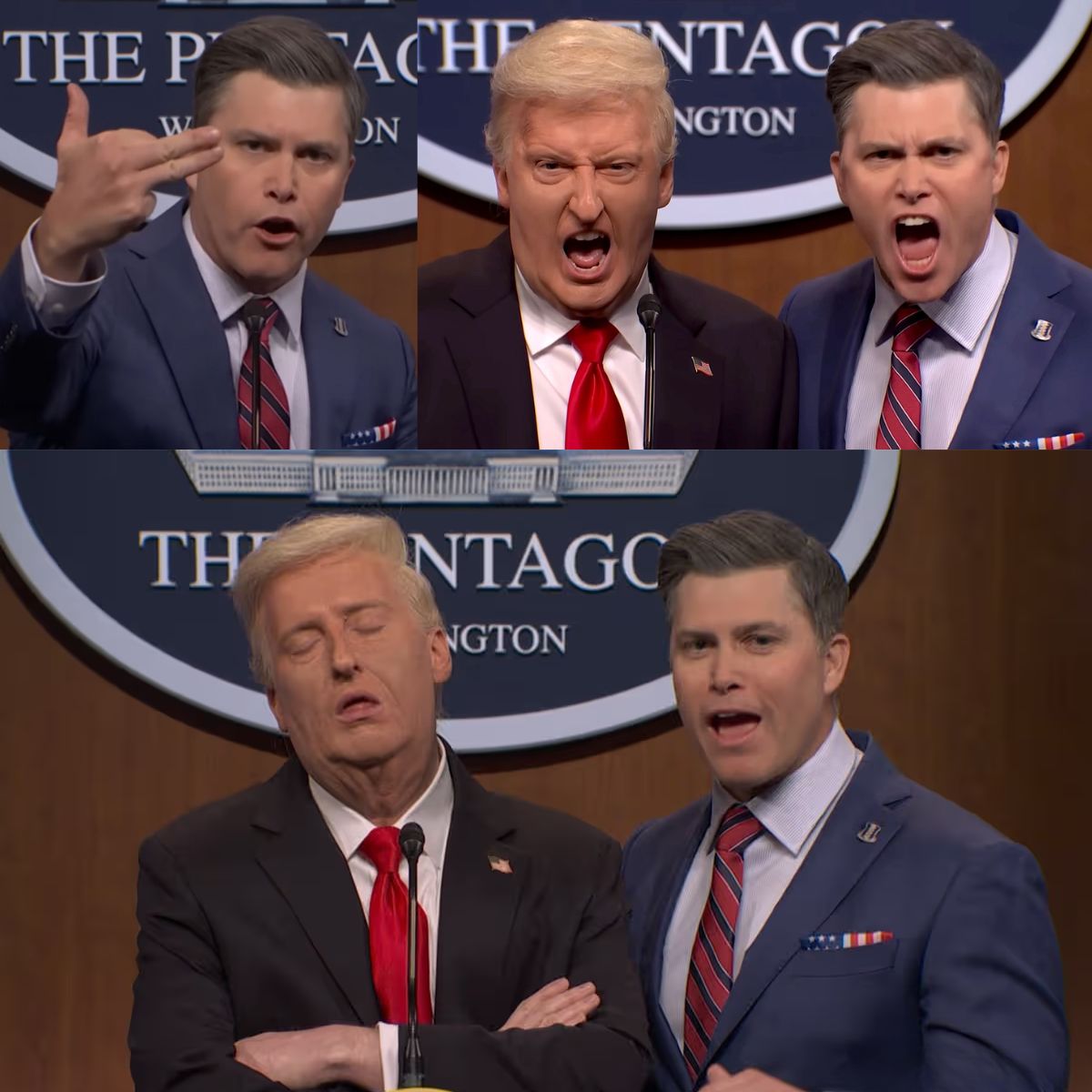
Colin Jost, the boyish, quick-witted co-anchor of Weekend Update who has spent over a decade delivering deadpan jokes from behind a desk, stepped boldly out of his comfort zone. This time he wasn’t reading headlines with Michael Che. He was front and centre as Pete Hegseth, Donald Trump’s controversial Secretary of Defense, in a blistering press conference sketch that didn’t hold back, didn’t soften the edges, and absolutely refused to play it safe.
The result? One of the most talked-about — and fought-over — cold opens in recent SNL history. Conservative viewers branded it “cringe,” “lazy liberal propaganda,” and “proof that SNL has completely lost the plot.” Others cheered it as “fearless,” “brutal,” and “exactly what political satire should be in 2026.” The internet, as always, split neatly into two furious Americas — with hashtags trending, clips going viral, and endless heated threads arguing whether the sketch was genius or a tone-deaf embarrassment.
So what exactly happened in those five chaotic minutes? And why has Colin Jost’s latest turn as Hegseth sparked such a ferocious backlash — and equally passionate defence?
Let’s rewind to the sketch itself. Jost strode onto the stage with full WWE-style bravado — chest puffed, American flag pocket square flapping, energy drink in hand. He slammed it down like a frat boy at a tailgate before launching into a hyper-aggressive press conference defending U.S. military actions in Iran. The portrayal was unapologetically over-the-top: Hegseth barking at reporters, dodging serious questions about escalation, rhyming like a “white Hamilton,” and even breaking into parody rap and rock lyrics (including a memorable Papa Roach “Last Resort” riff about turning Iran into a “Trump resort”).
Lines like “We’re treating Iran like the breathalyzer in my car — we’re blowing it the hell up” landed with the subtlety of a sledgehammer. Jost’s Hegseth came across as a red-faced, chest-thumping former Fox News host turned Pentagon chief — all machismo, zero filter, and plenty of frat-boy swagger mixed with defensive bluster when pressed on the human cost or legal questions.
Supporting players joined the fray, including Ashley Padilla as a fired Kristi Noem making a bizarre cameo, adding layers of absurdity to the administration satire. The whole thing unfolded against a backdrop of real-world tensions: U.S. strikes, rising gas prices, and heated debates over military policy that have dominated headlines for months.
For fans of sharp political comedy, it was peak SNL — the kind of bold, no-holds-barred takedown that the show built its reputation on in decades past. “Colin Jost absolutely nailed the Hegseth energy,” one viewer posted. “That grown-up middle-school bully vibe is perfect. He’s not even exaggerating at this point.” Others praised the writing for exposing what they see as the administration’s bluster and contradictions through exaggerated humour. Clips racked up millions of views within hours, with comments like “This is why we still watch SNL” and “Jost killing it outside of Update as usual.”
But the backlash was swift, loud, and unyielding. Conservative commentators and everyday viewers flooded X, Facebook, and Reddit with accusations that the sketch crossed the line from satire into outright hostility. “This wasn’t comedy — it was propaganda,” one popular post read. “SNL has become unwatchable. Same tired Trump-era jokes, just with new cabinet names.” Others called Jost’s performance “cringe-worthy,” accusing the writers of lazy stereotyping and deliberately baiting outrage for clicks and relevance in a post-2024 election landscape.
Some went further, arguing the cold open was tone-deaf given ongoing international tensions. “While real people worry about war and gas prices, SNL is turning it into a frat-boy rap battle,” one critic wrote. “Completely disrespectful.” There were even claims that the sketch proved SNL’s long-standing liberal bias has only gotten worse — a complaint as old as the show itself, but one that gains fresh traction every time a Republican administration is in the crosshairs.
The divide spilled far beyond politics. Even some longtime SNL fans who lean left questioned whether Jost’s extended time away from Weekend Update was the best use of airtime. Reddit threads debated if the 12-year veteran (and longtime writer) was “overstaying his welcome” in these recurring impressions, with some suggesting younger cast members deserved the spotlight. Others simply found the humour too mean-spirited or repetitive compared to classic political sketches.
Yet here’s the twist that makes this moment so fascinating: the outrage itself became fuel for the defenders. Many on the pro-sketch side argued that the furious reaction was proof the joke had landed perfectly. “If it didn’t sting, it wouldn’t be satire,” one fan fired back. “The fact that certain people are melting down shows SNL still knows how to hold a mirror up to power.” Clips were shared with captions like “Conservatives mad because it’s too accurate” and “This is what fearless comedy looks like.”
Colin Jost himself has become an unlikely lightning rod in all this. The 43-year-old comedian, married to Scarlett Johansson and father to two young children, has long been seen as the more polished, straight-man half of the Update desk alongside the edgier Michael Che. His Weekend Update segments often deliver clever, biting one-liners with a charming, almost apologetic delivery that softens the sting.
Stepping into full sketch mode as Hegseth requires a different energy — louder, more physical, more confrontational. Jost has leaned into it with surprising commitment: the puffed-up posture, the aggressive cadence, the way he channels what critics call Hegseth’s real-life “Fox News alpha” persona into something almost cartoonish yet uncomfortably recognisable. Fans of the impression say he captures the essence without needing to do a cheap vocal mimic — it’s more about the vibe, the bravado, the unshakeable confidence even when cornered.
This isn’t Jost’s first rodeo with the character. He has returned to Hegseth multiple times across different episodes, evolving the portrayal as real-world events unfolded — from early confirmation hearings to military briefings and now high-stakes international pressers. Each time, the sketch seems to push a little further, testing how far SNL can go in the current cultural climate.
The show’s producers and writers have always defended their approach as equal-opportunity satire, pointing to past jabs at Democratic figures. But in practice, the sharpest, most viral cold opens often target the party in power — and right now, that power sits with Trump and his cabinet, including the teetotaling, tattooed, veteran-turned-TV-host Hegseth, whose real-life persona (military background, outspoken views, and sometimes colourful personal history) provides rich material for exaggeration.
For SNL, these moments are high-stakes. Cold opens set the tone for the entire episode. A strong one can drive ratings, social buzz, and cultural relevance in an era where traditional late-night comedy struggles against fragmented audiences and algorithm-driven outrage. A polarising one, like this, guarantees conversation — even if half of it is negative.
The internet war played out predictably but intensely. On one side, clips were celebrated in liberal circles as “brutal takedowns” and “much-needed laughs in dark times.” On the other, they were dissected as evidence of Hollywood elitism and a refusal to adapt to shifting political realities after the 2024 election. Some conservative voices called for boycotts or joked that “SNL writers are still stuck in 2016.”
Meanwhile, neutral observers noted the familiar pattern: political satire rarely changes minds. It mostly entertains the already convinced and infuriates the other side — which, in today’s hyper-partisan environment, can feel more like performance art than comedy.
What makes Jost’s performance stand out is the contrast with his usual persona. The clean-cut, Harvard-educated funny man isn’t naturally the “angry bro” type. Watching him transform into this pumped-up, rhyme-spitting version of Hegseth creates a layer of absurdity that some find hilarious and others find forced. It’s the same reason impressions work when they toe the line between exaggeration and recognition — get it too wrong and it falls flat; get it too right and it risks feeling mean.
Behind the scenes, SNL has navigated these waters for nearly 50 years. From Chevy Chase’s Gerald Ford to Alec Baldwin’s Trump to a rotating cast of political figures, the show has thrived on controversy. But in 2026, with streaming clips spreading instantly and audiences more fragmented than ever, every sketch carries extra weight. One misstep can alienate viewers; one bullseye can dominate the Monday morning news cycle.
Jost’s colleagues have rallied around the moment in subtle ways. Michael Che, his Update partner, has a reputation for sharper, more provocative humour himself. The broader cast, including breakout talents like Ashley Padilla, continues to bring fresh energy to political material. Even host Ryan Gosling’s episode (in one notable airing) added star power that amplified the sketch’s reach.
As the dust settles — or rather, keeps swirling — the bigger question lingers: Can Saturday Night Live still do political satire in a way that feels fresh, fair, and funny to a divided nation? Or has the show become so predictable in its targets that it risks becoming background noise for one side and red meat for the other?
Colin Jost’s Hegseth impression sits right at the centre of that debate. For some, it’s a reminder of the show’s glory days — fearless, timely, and willing to punch up (or at least at the powerful). For others, it’s Exhibit A in why they’ve stopped watching: same old tired tropes dressed up with current events.
One thing is undeniable: the sketch succeeded in doing what great (or at least provocative) comedy often does — it started a conversation. Before the first commercial break, America was already arguing about it. Clips were dissected frame by frame. Think pieces were drafted. Family group chats lit up with “Did you see that SNL thing?”
In an age of short attention spans and endless content, that kind of cultural impact is increasingly rare. Whether you loved it, hated it, or found yourself somewhere in the exhausted middle, Colin Jost stepping out from behind the Update desk and charging into politically explosive territory ensured that this Saturday night felt anything but ordinary.
The internet remains at war. Memes are flying. Opposing camps are digging in. And somewhere in a writers’ room in New York, the SNL team is probably already brainstorming the next one — knowing full well that the outrage machine is always ready to rev up again.
Because in 2026, nothing unites (or divides) quite like a cold open that refuses to play nice.
Was it a swing and a miss? A bold home run? Or simply more evidence that political satire in America has become its own kind of performance — where the real show happens not on stage, but in the furious reactions that follow?
One sketch. Two very different Americas. And, as always, endless takes.