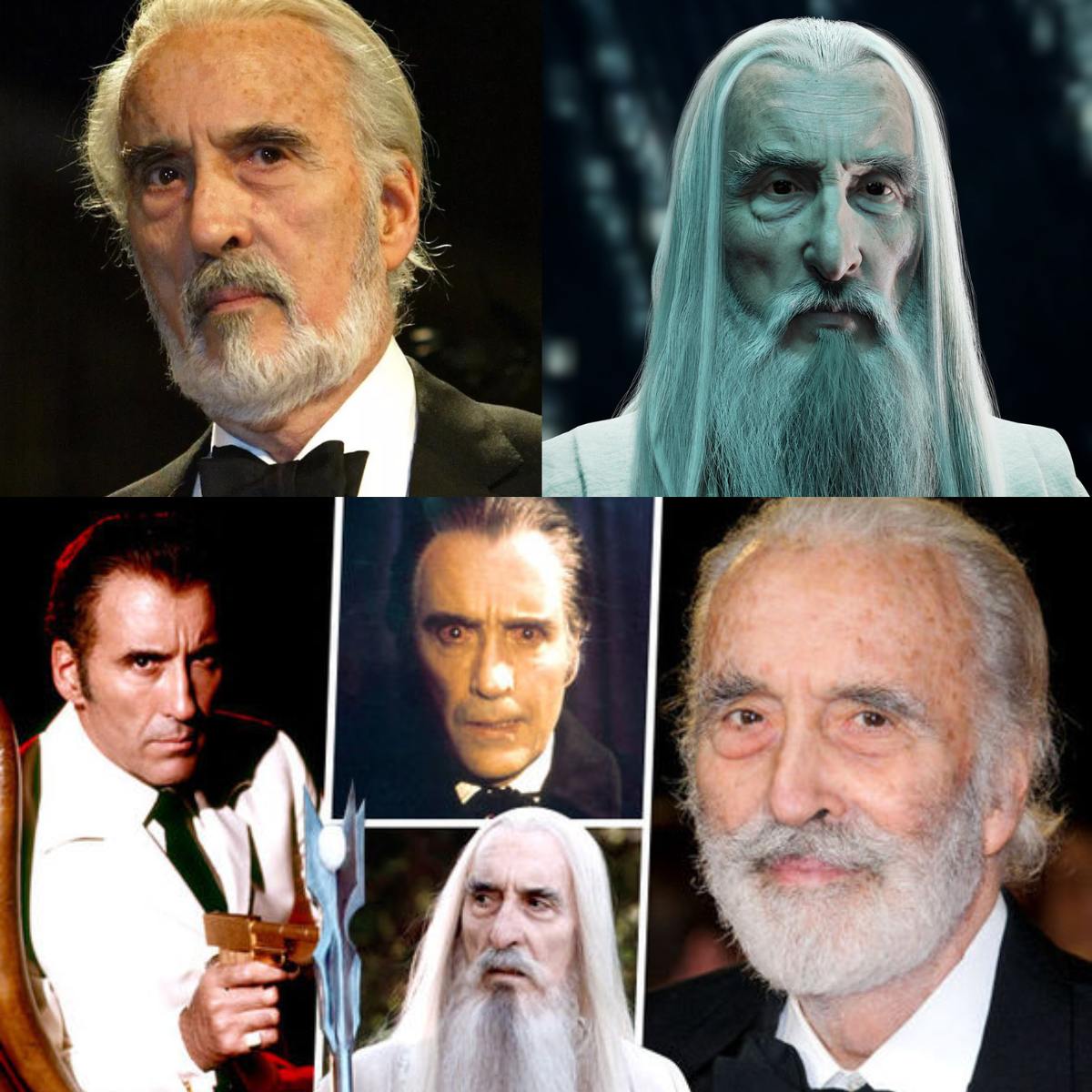
On his final night at age 93, legendary actor Christopher Lee reportedly asked the nurses in his hospital room to play the entire The Lord of the Rings film trilogy — the same epic saga where he immortalized the wizard Saruman.
The world of cinema lost one of its most towering figures on June 7, 2015, when Sir Christopher Lee passed away peacefully at the age of 93 in London’s Chelsea and Westminster Hospital. But in the quiet hours before his death from heart failure, the legendary actor spent his final night doing something profoundly fitting: rewatching one of the films from The Lord of the Rings trilogy alongside the nurses who were caring for him.
According to heartfelt recollections shared by his son-in-law, Juan Aneiros, in the Sky Arts documentary The Life and Deaths of Christopher Lee (which aired in late 2024 and reignited the touching story across social media), the evening unfolded with gentle normalcy amid the beeps of hospital monitors. One of the films in Peter Jackson’s epic saga was airing on television in his room. Rather than letting it play in the background, Lee—ever the passionate storyteller—suggested they all watch together. “The Lord of the Rings is on TV so we’ll watch it with the nurses,” he reportedly said. “I’ll explain how the movie was made.” Because, as Aneiros simply put it, “he loved that movie.”
What followed was a private, intimate screening where the man who brought the sinister wizard Saruman to life became an enthusiastic commentator for an audience of healthcare workers. As scenes unfolded on the small hospital TV—perhaps the sweeping landscapes of New Zealand, the siege of Helm’s Deep, or Saruman’s dramatic fall from Orthanc—Lee shared behind-the-scenes anecdotes: tales of Peter Jackson’s meticulous direction, the challenges of green-screen work in his later Hobbit appearances, the camaraderie on set with Ian McKellen, Viggo Mortensen, and the rest of the fellowship. The nurses, likely accustomed to long shifts and weary patients, got a front-row seat to Hollywood history from one of its last living legends.
His family had every reason to believe this was just another bump in the road. Lee had dealt with respiratory issues before, and at 93, hospital stays weren’t uncommon. “We went home and we were already thinking, ‘OK, he’s coming back,'” Aneiros recalled. But later that night, the call came: Lee had slipped away peacefully in his sleep, without suffering. No dramatic farewell, no fanfare—just a quiet exit after one last immersion in the world of Middle-earth that had meant so much to him.
The moment feels like perfect poetic closure for an actor whose career was defined by larger-than-life roles and an almost supernatural longevity. Born Christopher Frank Carandini Lee on May 27, 1922, in Belgravia, London, to an Italian contessa mother and a British father in the military, Lee’s life read like one of the adventure tales he so loved. He served in the Royal Air Force during World War II, flying missions and working in intelligence—experiences that later informed his authoritative screen presence. After the war, he transitioned to acting, landing bit parts before exploding onto the scene as Hammer Horror’s definitive Dracula in a string of gothic classics starting with Dracula (1958). His towering 6ft 5in frame, piercing eyes, and velvety voice made him the perfect villain: menacing yet magnetic.
Over six decades, Lee amassed more than 200 film credits, embodying everyone from the villainous Francisco Scaramanga in the James Bond film The Man with the Golden Gun (1974) to the evil Count Dooku in Star Wars: Episode II – Attack of the Clones (2002) and its sequel. He played Sherlock Holmes, Fu Manchu, Rasputin, and even found time for heavy metal albums in his 90s, releasing symphonic metal tracks that stunned fans half his age.
But nothing quite matched his connection to J.R.R. Tolkien’s legendarium. Lee was a lifelong devotee of The Lord of the Rings books, having read them soon after their publication in the 1950s. Uniquely among the cast, he met Tolkien himself in the 1950s at a lunch arranged by a mutual friend. The author autographed Lee’s copy of the trilogy, and the two discussed the works at length—Lee later said the encounter was one of the highlights of his life. When Peter Jackson cast him as Saruman in 2001, it wasn’t just a job; it was a dream realized. Lee had originally hoped for Gandalf (a role that went to Ian McKellen), but he embraced Saruman with fierce intelligence and gravitas, delivering lines like “Together, my lord Sauron, we shall rule this Middle-earth” with chilling conviction.
Lee’s performance elevated the character from a scheming wizard to a tragic figure of corrupted ambition. He returned for the extended editions, providing additional voice work, and reprised the role in The Hobbit trilogy (2012–2014), filming his scenes via motion-capture at an advanced age. Jackson once recounted how Lee corrected him on the sound a stabbing victim makes—drawing from his WWII experiences—leading to a more authentic death scene for Saruman.
In those final hospital hours, as he narrated the film to his nurses, Lee wasn’t just reliving a movie; he was sharing a piece of his soul. The nurses likely had no idea they were in the presence of a man who had met Tolkien, fought in a world war, terrified generations as Dracula, dueled with lightsabers, and headlined one of the biggest fantasy epics ever made. Yet there he was, in a hospital gown, pointing at the screen and saying, “See that? That’s how we did it.”
The story resurfaced powerfully in recent years thanks to viral posts on Instagram, TikTok, Reddit, and Facebook, where fans shared screenshots from the documentary and wept over the tenderness of it all. “I’m not crying, you are,” became a common caption. Comments poured in: “A cinematic legend, right to the end.” “He wasn’t just Saruman—he lived the legend.” “What a beautiful way to go—surrounded by stories he helped create.”
Lee’s death in 2015 prompted an outpouring from the film world. Peter Jackson called him “a giant of a man” whose “towering presence” would be missed. Ian McKellen paid tribute to his “old friend,” noting their shared love of the books. Fans worldwide mourned the end of an era—one where actors like Lee bridged classic horror, blockbuster fantasy, and even modern music.
Yet amid the grief, this final anecdote stands out as a quiet triumph. In an industry obsessed with spectacle, Lee’s last act was intimate: education, connection, joy. He didn’t die alone in silence; he died mid-story, mid-laughter, mid-wonder, passing the torch of Middle-earth to strangers who became, for one night, his fellowship.
Sir Christopher Lee once said of Saruman: “He is the most brilliant, the most powerful, with the greatest intellect and the greatest knowledge.” In his own way, Lee embodied those qualities too—brilliant, powerful, endlessly knowledgeable, and deeply human. His final night rewatching The Lord of the Rings wasn’t just a coincidence; it was a full-circle tribute to the fantasy world he adored long before cameras rolled, and to the real-world kindness he showed in his closing moments.
Rest in peace, Sir Christopher. May the Valar guide you home to the Undying Lands. Your voice still echoes through the halls of Isengard, the corridors of Minas Tirith, and now, in the memories of those nurses who got to hear the greatest storyteller of them all one last time.