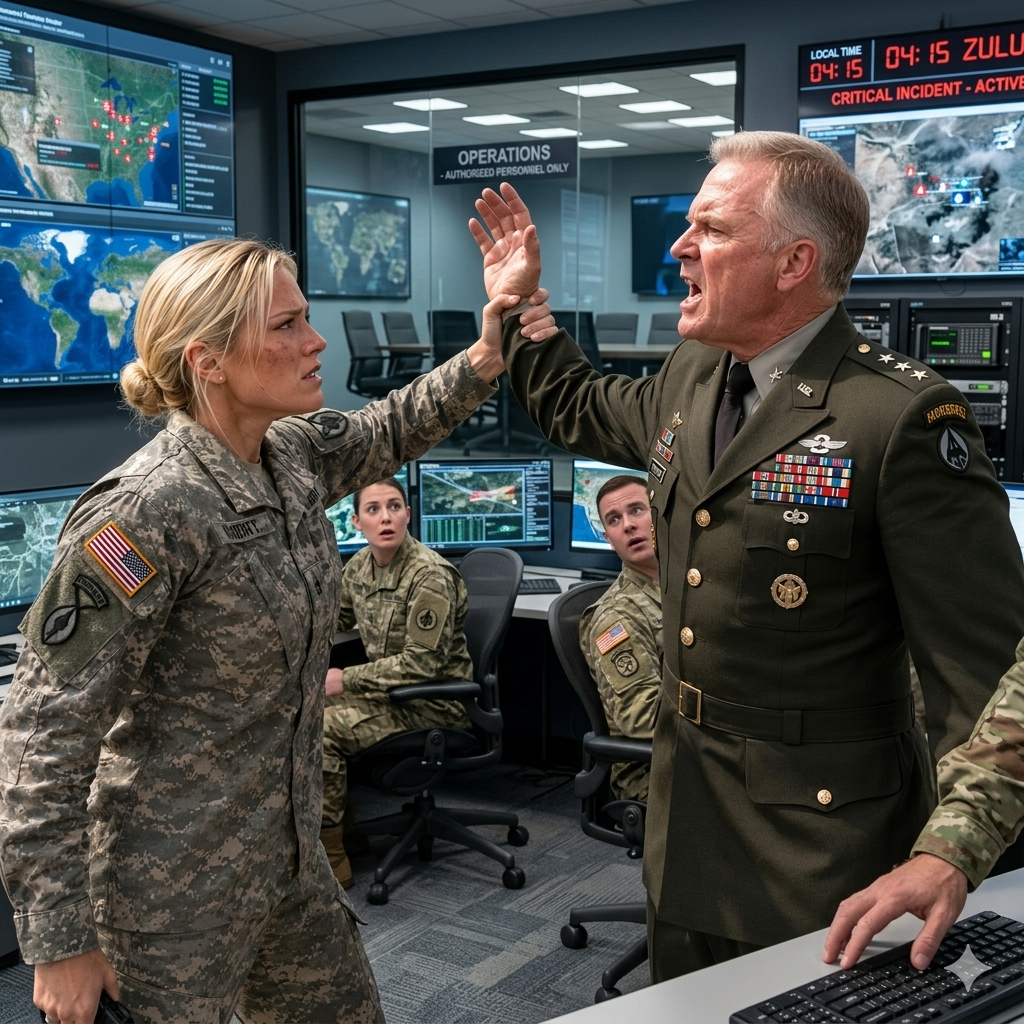
The Colonel Raised His Hand at Me in Front of 282 Soldiers—Two Seconds Later, Everything Changed.
Nobody laughed.
That was the worst part.
Laughter would have made it obvious. Laughter would have given me permission to look around the room and say, “Anyone else want to embarrass themselves before 0900?”
But silence was more useful to men like Briggs.
I was thirty-two years old when I arrived at Fort Braddock, a dry, sprawling Army installation in Georgia where the humidity glued your uniform to your back before breakfast and the flags snapped hard enough in the wind to sound like warning shots.
Fort Braddock had a reputation.
Old command.
Old habits.
I had served two tours in Afghanistan and one in Iraq. I had pulled a nineteen-year-old corporal out of a burning transport outside Kandahar. I had earned a Purple Heart, three commendations, and one thin scar under my ribs that still hated cold weather.
But at Fort Braddock, none of that mattered as much as one fact.
I was a woman who did not lower her eyes when men like Briggs entered the room.
He loved phrases like “command climate” and “discipline culture.”
Everyone else called it fear.
He made young officers stand outside his office for forty minutes just to remind them he could. He reassigned people who corrected him. He destroyed careers with phrases like “not a team fit” and “emotional judgment concerns.”
On paper, he was decorated.
In person, he was poison with rank.
The morning I met him, I was standing in the briefing room with a black coffee from the PX, a tablet under my arm, and a training schedule I had rewritten after finding three safety violations nobody wanted to mention.
Briggs walked in, scanned the room, and stopped on me.
“Captain Torres,” he said.
“Sir.”
He looked at my file, then back at my face.
“San Antonio girl. Combat arms. Impressive little résumé.”
“Thank you, sir.”
His mouth twitched.
“Let’s see if it translates outside paperwork.”
A major beside him shifted in his chair.
Nobody looked at me.
I smiled just enough to be irritating.
“I’ve found paperwork usually becomes important after someone screws up the fieldwork.”
That got one cough from the back row.
Briggs looked at me like he had just found gum on the bottom of his boot.
And that was the beginning.
Not loud.
Not dramatic.
Just a tiny crack in the floor before the whole building learns it was built wrong.
For the next six weeks, Briggs made me his hobby.
In briefings, he cut me off mid-sentence.
“That sounds like a civilian solution, Captain.”
When I submitted reports, he sent them back with red ink across entire paragraphs.
Overcomplicated.
Too cautious.
Needs stronger command tone.
When my unit finished first in a navigation drill, he said the course must have been too easy.
When we finished first again, he said I was training them to perform, not endure.
When I requested two promotions for soldiers who had earned them, the paperwork disappeared.
A week later, I found one of the forms folded under my door with no note.
Just a black line through my signature.
That was Briggs.
He didn’t attack first.
He erased.
He took your authority one corner at a time until people started questioning whether you had ever had it.
But he made one mistake.
He thought I was alone.
My soldiers saw everything.
Staff Sergeant Reeves saw it first.
Reeves was forty-one, built like a refrigerator, with a shaved head and the calm expression of a man who had watched too many lieutenants make bad decisions near live equipment.
He had fifteen years in.
He didn’t talk unless the sentence had a job.
One night, after a twelve-hour field exercise, I found him sitting on an ammo crate outside the motor pool, eating gas station beef jerky and pretending not to wait for me.
“You got a second, Captain?”
“Do I need coffee first?”
“You need a lawyer first.”
I stopped.
He didn’t smile.
“Briggs is leaning on your people.”
“My people?”
“Your unit. He’s been pulling them aside. Asking whether you’re too aggressive. Whether they feel pressured. Whether you’ve made the environment uncomfortable.”
I looked across the lot.
A Humvee idled under floodlights. Somewhere nearby, somebody dropped a wrench and cursed like they were trying to summon a demon.
“What did they say?” I asked.
Reeves tore the jerky in half.
“They said you run harder than they do and still finish paperwork before dinner.”
I almost laughed.
Almost.
Then he added, “But that’s not the point.”
No, it wasn’t.
Because Briggs wasn’t investigating me.
He was building a file.
The next morning, I walked into his office.
He didn’t invite me to sit.
Fine.
I preferred standing.
His office looked exactly like him. Dark wood. Framed medals. A photograph of him shaking hands with a senator. A silver pen set that probably cost more than Private Morales’s entire paycheck.
He leaned back in his chair.
“Something on your mind, Captain?”
“Yes, sir. I’d like to know why you’re questioning my soldiers outside my chain of command.”
His eyebrows lifted.
“My base. My soldiers.”
“My unit, sir.”
His smile flattened.
“There it is.”
“There what is?”
“That tone.”
I stayed still.
He stood and walked around the desk slowly, like bad theater.
“You walk around here like you’re auditioning for a recruiting commercial. Strong. Controlled. Inspirational.”
He stopped too close.
“Men don’t respond to that forever.”
I looked at the space between his boots and mine.
Not enough.
“Then it’s lucky I’m here to lead soldiers,” I said, “not babysit men.”
His face changed.
Tiny shift.
Useful information.
Briggs liked obedience.
He liked fear more.
But what he could not tolerate was being answered.
He stepped closer.
“You should be careful.”
“I am careful.”
“No,” he said. “You’re bold.”
He leaned in, his breath smelling like burnt coffee and wintergreen.
“Bold for a woman.”
I let the sentence sit there.
Let it expose him.
Then I said, “Permission to leave, sir.”
He waited for me to blink.
I didn’t.
Finally, he stepped back.
“Dismissed.”
I turned and walked out without giving him the satisfaction of seeing my hands close into fists.
Outside, the Georgia sun hit me in the face.
Across the parade field, 282 soldiers were running drills in clean lines under a huge American flag.
The flag cracked once in the wind.
Hard.
Like it knew something I didn’t.
Three days later, someone slid a note under my barracks door.
No signature.
Just six words.
He doesn’t lose quietly. Watch yourself.
I read it twice.
Then I folded it, placed it inside my field notebook, and wrote the date beneath it.
Because my father, a Marine drill instructor from San Antonio who believed pancakes were “civilian weakness,” had taught me one thing before he taught me how to throw a punch.
Document everything.
My mother had taught me the second thing.
When a man tries to make you smaller, don’t argue.
Make him adjust his eyes.
So I kept working.
I trained my unit harder.
I checked gear twice.
I rewrote drills, corrected supply gaps, pushed my soldiers until they hated me at 0600 and thanked me by lunch.
Private Morales, nineteen, skinny, from Detroit, with a mouth faster than his feet, called me “Mom” exactly once.
I made him run two extra laps.
He never called me Mom again.
He did call me “ma’am” with a grin.
That was acceptable.
Then Briggs ordered the stress test.
No warning.
Full gear.
Noon sun.
Eight-mile run, sandbag carries, casualty drags, weapons breakdown, wall climb, and final formation.
He announced it in front of three units and looked straight at me.
“Let’s see if Captain Torres’s people are as sharp when the day gets ugly.”
I heard the trap close.
He wanted collapse.
He wanted one soldier vomiting behind a truck.
One sprained ankle.
One sloppy finish.
One picture he could frame as failure.
Instead, I put my helmet on.
Reeves walked over.
“You’re running with us?”
“Unless my boots filed retirement papers without me.”
He grunted.
That was Reeves laughing.
We ran.
The heat came off the asphalt in waves. Sweat stung my eyes. My shoulders burned under the pack. Morales cursed in Spanish, English, and something he claimed was “Detroit Latin.”
At mile six, Briggs stood on the observation platform with a clipboard.
I looked up once.
He wasn’t watching the unit.
He was watching me.
So I smiled.
Not wide.
Just enough.
We finished first.
Every soldier.
Every station.
Every time mark cleared.
When Morales crossed the line, he bent over, hands on knees, gasping.
“Respectfully, ma’am,” he said, “you are insane.”
“Hydrate before I make that official.”
He laughed.
The unit laughed.
Briggs did not.
From the platform, he looked like a man watching his own reflection insult him.
That evening, a second note appeared in my locker.
He lost face today. That makes him dangerous.
I didn’t sleep much that night.
Not because I was afraid.
Fear is loud. Fear runs around knocking things over.
This was different.
This was calculation.
By morning, I knew Briggs would not use paperwork anymore.
Paperwork had failed.
He needed an audience.
He needed a stage.
And Fort Braddock had one waiting.
PART 2
Colonel Briggs chose the parade field because humiliation always needs witnesses.
The live maneuver began at 1100.
Two hundred eighty-two soldiers in formation. Three observation towers. Field cameras recording for training review. Dust rising under boots. A flag hanging bright and hard against a white Georgia sky.
My unit had the left flank.
The scenario was simple: simulated breach, rapid reposition, defensive reset.
Then I saw it.
A gap.
Small, but enough.
If this had been real, an enemy team would have walked through it like a front door at Walmart.
I gave the order.
“Second squad, shift left. Close the lane. Move now.”
They moved.
Clean.
Fast.
Correct.
Briggs saw it from the center line.
His voice cracked across the field.
“Captain Torres!”
Every head turned.
I faced him.
“Sir.”
He started walking toward me.
Not fast.
Worse.
Controlled.
The kind of walk a man uses when he wants everyone to know he owns the ground.
“Who gave you authority to override my formation?”
I kept my voice level.
“Field protocol allows immediate correction of exposed vulnerability during active maneuver.”
“Don’t quote protocol to me.”
“I didn’t write it, sir.”
A few soldiers looked down.
Bad idea.
Briggs caught it.
His face darkened.
He stepped closer.
“You think you’re clever?”
“No, sir.”
“Good. Because what you are is insubordinate.”
The cameras kept recording.
The soldiers kept watching.
The flag snapped once overhead.
I could feel Reeves somewhere behind me, still as stone.
Briggs came within inches of my face.
Too close for rank.
Too close for professionalism.
Too close for anything except intimidation.
“You embarrassed me in front of my men,” he said.
I looked past him at the formation.
“They’re not your men.”
His mouth opened slightly.
I had said it softly.
Everyone heard it anyway.
His hand rose.
Not a point.
Not a gesture.
A strike.
And in that half second, Fort Braddock stopped breathing.

PART 3
He swung at me like rank was body armor.
People always imagine moments like that in slow motion.
They’re not.
They’re fast.
Ugly.
Practical.
His shoulder shifted first. Then his elbow. Then the flat of his hand came toward my face with enough force to leave a mark he could later call “unfortunate contact.”
I didn’t think.
Thinking is for after.
My left hand caught his wrist before impact.
My right hand locked above his elbow.
I stepped in, turned my hips, and used his momentum against him exactly the way I had been trained in close-quarters defense.
One controlled rotation.
One hard stop.
One crack across the parade field.
Briggs dropped to one knee.
The sound that came out of him was not command presence.
It was pain.
Two hundred eighty-two soldiers watched their colonel fold in the dirt.
I released him immediately and stepped back.
My breathing was steady.
My voice carried.
“You will never raise your hand to me again, sir.”
Nobody moved.
Not the medics.
Not the officers.
Not even the birds on the fence line seemed interested in making the first sound.
Then Reeves barked, “Medic!”
That broke the spell.
A medical team ran in.
Briggs clutched his arm, face gray, eyes wide with a kind of disbelief I almost understood.
Men like him believed violence was a privilege attached to authority.
He had never considered what might happen if the person in front of him refused the arrangement.
Major Glassman came down from the observation tower looking like someone had deleted his entire career plan.
“Captain Torres,” he said, voice tight. “Stand down.”
“I am standing down.”
“Report to administrative command immediately.”
“Yes, sir.”
I turned to my unit.
Every soldier watched me.
Some looked shocked.
Some looked ready to cheer but smart enough not to.
Morales looked like he had just seen gravity lose a fight.
I gave one order.
“Maintain formation.”
They snapped back into place.
Not because I scared them.
Because they trusted me.
That mattered more.
In the admin wing, they put me in a white-walled office with no windows and a vending machine outside that hummed like it had classified information.
I sat alone for twenty-seven minutes.
My knuckles were not bruised.
My uniform was not torn.
My career, however, was probably standing on a trapdoor.
Finally, a colonel from regional command walked in.
Felix Meyer.
Pentagon type. Neat hair. Careful eyes. A pen clipped perfectly to his folder.
He sat across from me and opened a laptop.
The video played without sound first.
Briggs stepping close.
Briggs raising his hand.
Me intercepting.
Briggs dropping.
Meyer watched it twice.
Then he looked up.
“Captain Torres, Colonel Briggs claims you attacked him during a training exercise.”
“He attempted to strike me.”
“So the footage shows.”
“Then why are we using his sentence?”
Meyer almost smiled.
Almost.
He played the video again, this time with audio.
My voice filled the tiny room.
They’re not your men.
Then the strike.
Then the snap.
Meyer paused the video.
“You understand the seriousness of physically engaging a superior officer.”
“I understand the seriousness of assaulting a subordinate in front of 282 witnesses.”
“That is not in dispute.”
“Good.”
He leaned back.
“You’re very calm.”
“I’ve had practice being blamed for men’s decisions.”
That got the almost-smile again.
He closed the laptop.
“There will be an inquiry. You’ll be placed on administrative reassignment pending review.”
“Am I under arrest?”
“No.”
“Am I being charged?”
“Not at this time.”
“Is Colonel Briggs?”
His pen stopped.
“That is being evaluated.”
I nodded.
There it was.
The system’s favorite dance.
Step one: admit something happened.
Step two: remove sharp edges from the language.
Step three: hope everyone gets tired before accountability arrives.
But Fort Braddock was not tired.
By dinner, the base was on fire.
Not literally.
Worse for command.
Socially.
The story moved through barracks, group chats, spouses’ Facebook pages, veteran forums, text chains, encrypted chats, and probably three retired sergeants drinking Coors Light in somebody’s garage.
He tried to hit her.
She caught him.
In front of everyone.
They have video.
That night, Reeves came to my temporary office carrying a paper cup of coffee from the gas station outside the main gate.
It tasted like burnt asphalt.
I drank it anyway.
“You okay?” he asked.
“I’m suspended.”
“Reassigned.”
“That’s Army for suspended with better spelling.”
He sat down without permission.
I allowed it.
“They’re taking statements,” he said.
“From who?”
“Everybody.”
“That sounds inefficient.”
“Not when everybody saw it.”
I looked at him.
He lowered his voice.
“And not when everybody has something else to say.”
I understood then.
This wasn’t about the slap anymore.
It had never been about the slap.
The slap was just the moment Briggs got careless enough to do publicly what he had always done privately.
By midnight, twenty-three soldiers had submitted statements.
By morning, the number was forty-one.
By the next afternoon, former soldiers began calling.
A female lieutenant who had transferred out two years earlier.
A medic Briggs had cornered after a promotion ceremony.
A chaplain who had reported “command cruelty” and been told to choose softer language.
A sergeant major who had retired early rather than sign off on a false reprimand.
The file grew.
So did the panic.
Command called it “a climate review.”
The soldiers called it “finally.”
Briggs’s lawyer called it “a coordinated character attack.”
That statement leaked by lunchtime and became the dumbest thing anyone could have said.
Because if there is one group of people you should not accuse of coordination, it is angry soldiers with screenshots.
By evening, someone had compiled dates, messages, memos, complaint numbers, transfer orders, denied promotions, medical notes, and witness names into a document so clean it looked like a law firm had done it.
The title page had only four words.
This Did Not Start Today.
I didn’t write it.
I didn’t ask for it.
But when Meyer showed it to me in a second interview, I recognized half the patterns.
Delayed paperwork.
Private meetings.
Career threats.
Public insults.
Reputation sabotage.
The kind of abuse that never hits hard enough in one place to photograph but leaves bruises all over a person’s life.
Meyer flipped through the pages.
“You knew about some of this?”
“I suspected.”
“Why didn’t you report it earlier?”
I stared at him.
He had the decency to look uncomfortable.
Then I said, “To whom?”
That was the question nobody liked.
Because for years, Briggs had been the answer to that question.
If he was the problem, and he controlled the door, where exactly was everyone supposed to go?
Three days after the parade field incident, General Marlene Huxley arrived.
Huxley was sixty, sharp-eyed, and carried herself like someone who had won every room by refusing to ask permission to enter it.
She called me into a conference room with Meyer, two legal advisers, and a brigadier general named Curtis Latham who looked expensive in a way uniforms should not allow.
Huxley studied me.
“Captain Torres.”
“General.”
“You’ve caused a national headache.”
“I didn’t swing first.”
“No,” she said. “You did not.”
Latham exhaled through his nose.
“That’s not the point.”
I turned to him.
“It is exactly the point.”
His eyes hardened.
“Careful, Captain.”
I almost laughed.
Men like Latham always said “careful” when what they meant was “smaller.”
Huxley held up one hand.
“Enough.”
The room went quiet.
She opened a folder.
“The footage supports self-defense. The response appears controlled and proportionate. Colonel Briggs’s conduct before and during the incident is under formal investigation. Additional complaints are being reviewed.”
I waited.
There is always a “but” in rooms like that.
Huxley delivered it clean.
“But this base is unstable right now. Reporters are calling. A senator’s office has requested information. Veteran organizations are already making noise.”
Latham leaned forward.
“You’ve become the face of a movement, Captain. Movements are bad for discipline.”
I looked at him.
“So is protecting abusers.”
Meyer looked down at his notes.
Huxley didn’t.
Latham’s jaw worked once.
“You are walking a very thin line.”
“So was Colonel Briggs,” I said. “I just didn’t let him cross it.”
The room went very still.
For a second, I thought that was it.
Court-martial. Career over. Pack your bags.
Then Huxley closed the folder.
“You’ll be transferred to Westfield Command Center effective immediately.”
Latham added, “Strategic operations liaison. Temporary rotation.”
I knew the language.
It was a velvet box with a lock on it.
“You’re removing me from Fort Braddock.”
“We’re promoting your visibility,” Latham said.
“That is a beautiful sentence for a bad decision.”
Meyer looked like he wanted to cough himself into another building.
Huxley’s mouth moved slightly.
Not a smile.
But close enough.
“You leave tonight,” she said.
I stood.
“Understood.”
When I stepped outside, Reeves waited by the hallway vending machine with two Snickers bars.
One was already open.
“Bad?” he asked.
“Containment disguised as opportunity.”
He handed me the unopened candy bar.
“Still better than burial.”
“That your professional legal analysis?”
“That’s my gas station analysis.”
I took it.
Outside, the sun was dropping behind the barracks.
Soldiers moved across the base in small groups. They looked different now. Not happier. Not relaxed.
Awake.
Morales found me near the motor pool before I left.
He stood stiffly, like he had rehearsed the moment and hated every version of it.
“Ma’am.”
“Private.”
“I just wanted to say… what you did—”
“What I did was defend myself.”
“Yes, ma’am. But what you showed us was bigger.”
I didn’t answer.
He swallowed.
“My sister’s joining next year. She watched the clip. My mom too. My mom said you looked like somebody who already knew the truth before everybody else caught up.”
That landed harder than Briggs ever could have.
I adjusted the strap on my duffel.
“Tell your sister to keep records. Trust her instincts. And never confuse rank with character.”
Morales nodded.
“Yes, ma’am.”
Then he saluted.
Not because he had to.
Because he meant it.
I returned it.
That night, I left Fort Braddock in a government SUV with tinted windows, a packed duffel, one gas station Snickers, and a file of notes hidden inside my bag.
Behind me, the base lights shrank.
Ahead of me, Westfield waited.
Command thought distance would cool the story down.
They were wrong.
Distance gave it oxygen.
PART 4
By the time I reached Virginia, Colonel Briggs had already lost control of his own lies.
Westfield Command Center sat on a low ridge outside Richmond, all concrete, glass, security gates, and people who used the phrase “operational alignment” without shame.
My new office had no personality.
Gray desk.
Two monitors.
One government phone.
One chair that hated the human spine.
A welcome packet sat in the center like a bad joke.
Strategic Operations Liaison.
Translation: keep her busy, keep her visible, keep her away from reporters.
I put my duffel down and opened the blinds.
Fog covered the parking lot.
Some captain from admin handed me a temporary badge and whispered, “For what it’s worth, my wife saw the video. She said, ‘Good.’”
Then he walked away like he had committed treason.
By noon, I had thirteen emails.
By 1600, I had forty-seven.
Some were official.
Most were not.
A captain at Fort Drum wrote that her complaint against a battalion commander had been “lost” twice.
A staff sergeant at Fort Cavazos sent a timeline of retaliation after he reported harassment against a junior soldier.
A retired major from Colorado attached a scanned memo from six years earlier with Briggs’s name on it.
One message came from a woman named Dana Price.
Former lieutenant.
Subject line: He did it to me too.
I stared at it for a full minute before opening.
Her email was short.
No drama.
No polished language.
Just facts.
Date.
Room number.
Witness.
Transfer order.
Medical leave.
Career over.
At the bottom, she wrote:
I used to think leaving meant I lost. Watching him on the ground was the first time I wondered if maybe I survived.
I read that sentence three times.
Then I printed the email, logged it, and walked it to Major Leila Daniels.
Daniels ran internal review at Westfield.
Early forties. Black coffee. No patience. Combat patch on her right sleeve. Voice like she charged by the syllable.
She read the email once.
Then she opened a drawer, pulled out a folder, and dropped it on her desk.
Inside were six more.
“All Briggs?” I asked.
“All command climate suppression. Briggs is just the loudest idiot in the room right now.”
She leaned back.
“General Huxley authorized a task force.”
“Official?”
“Official enough to exist. Unofficial enough to make people nervous.”
“What’s the objective?”
“Find patterns before Congress finds them for us.”
I looked at the folder.
Fort Braddock was listed first.
Then five other installations.
Two names I recognized.
One made my jaw tighten.
Camp Redstone.
My first assignment.
The place where I learned that silence could be issued like equipment.
Daniels noticed.
“You have history there?”
“Everyone has history somewhere.”
“That’s not an answer.”
“It’s the one I’m giving until coffee improves.”
She smiled.
Barely.
“You’re on the team.”
“I thought I was here to be contained.”
“You are. We’re just putting wheels on the container.”
For the next two weeks, I worked sixteen-hour days.
Complaint records.
Transfer patterns.
Promotion denials.
Medical leave spikes.
Anonymous reports that had gone nowhere.
Career-ending evaluations written suspiciously close to misconduct complaints.
It was all there.
Not one dramatic villain speech.
Not one obvious memo saying, Please destroy this person for telling the truth.
That would have been too easy.
Abuse in uniform had a different handwriting.
Administrative delay.
Leadership concern.
Performance instability.
Failure to adapt.
Not a team player.
Every phrase clean enough for a file.
Dirty enough to ruin a life.
Daniels and I built a pattern map across installations.
The map looked like a spiderweb.
Briggs sat near the center.
Not because he controlled everything.
Because men like him recognized each other.
They recommended each other.
Protected each other.
Promoted each other.
Meanwhile, Fort Braddock kept boiling.
The video had not been publicly released, but enough people had seen it for the internet to build religion around it.
Veteran forums called it The Snap Heard Round the Base.
A cable news anchor asked whether the Army had “a leadership abuse crisis.”
A senator from Arizona demanded a briefing.
Briggs’s attorney went on TV and called me “emotionally volatile.”
That was his first mistake.
His second was calling the investigation “a feminist witch hunt.”
His third was forgetting that half the military wives in America have Facebook, screenshots, and zero fear of retired colonels with podcast microphones.
By sunrise, his comments had been clipped, captioned, stitched, mocked, and sent into every corner of the internet.
One military spouse posted:
If your leadership style ends with a woman breaking your arm in self-defense on camera, maybe the woman isn’t your biggest problem.
Three million views.
Briggs disappeared from television after that.
Then came the hearing notice.
Formal Article 32.
Public due to national interest.
Colonel Everett Briggs would answer for abusive authority, conduct unbecoming, assault, obstruction of complaints, and retaliation.
I was ordered to testify.
Daniels found me in the file room holding the envelope.
“You good?”
“No.”
“Want coffee?”
“Yes.”
“Want advice?”
“No.”
“Great. I only had coffee.”
She gave me a paper cup from the cafeteria.
It was terrible.
Westfield was consistent.
The hearing took place at Fort Myer, outside Washington, D.C.
Oak walls.
Dress uniforms.
Reporters outside the gates.
Sketch artists inside.
No cameras in the room, but everyone behaved like history had brought a notebook.
Briggs sat at the defense table in dress blues.
His right wrist was still braced.
His medals sat on his chest like props from a life he no longer controlled.
When I entered, the room quieted.
I hated that.
Not because I feared attention.
Because symbols are heavy, and nobody asks whether your shoulders are free.
I took the stand.
The oath was administered.
The prosecutor began with the parade field.
I answered cleanly.
Yes, Briggs confronted me.
Yes, he stepped inside professional distance.
Yes, he raised his hand.
Yes, I believed he intended to strike me.
Yes, I used a trained defensive technique.
No, I did not continue force after the threat stopped.
Then the prosecutor asked, “Captain Torres, why did you respond physically instead of taking the strike and reporting it later?”
I looked at Briggs.
He stared back with the same cold contempt he had worn in every briefing, every hallway, every stolen moment of power.
But this time, he was seated.
I was not.
I turned back to the panel.
“Because 282 soldiers were watching,” I said. “And every one of them would have learned something from whatever I allowed next.”
The room went still.
I continued.
“If I had taken the slap, they would have learned that abuse is acceptable when it comes from high enough rank. If I had backed away, they would have learned that intimidation works. If I had escalated, they would have learned that rage is leadership.”
I paused.
“So I did what I was trained to do. I stopped the threat with the least force available.”
The prosecutor nodded.
“And what did you believe the threat was?”
I looked at Briggs again.
“Not just his hand.”
The defense objected.
The judge advocate overruled.
“Answer may continue.”
I kept my voice flat.
“The threat was a command culture that taught people to survive abuse quietly because reporting it would cost them more than enduring it.”
Someone in the back row inhaled sharply.
Good.
Let them breathe the truth for once.
Briggs’s lawyer stood for cross-examination.
He wore a suit that probably had its own mortgage.
“Captain Torres,” he began, “isn’t it true you have a history of challenging authority?”
“Yes.”
That threw him off.
He blinked.
“You admit that?”
“I challenge unlawful, unsafe, or incompetent authority. I have no issue with legitimate command.”
A few pens stopped moving.
He tried again.
“You embarrassed Colonel Briggs in front of his soldiers.”
“Colonel Briggs embarrassed himself. I happened to be nearby.”
A tiny sound moved through the room.
Not laughter.
Containment failure.
His lawyer’s face tightened.
“You made a sarcastic remark moments before the altercation.”
“I made an accurate correction.”
“You said, ‘They’re not your men.’”
“Yes.”
“Was that meant to provoke him?”
“No. It was meant to remind him that soldiers are not property.”
The judge looked down at his notes.
Briggs looked at the table.
For the first time since I had known him, he had no room to perform.
Over the next four days, the hearing became less about me and more about everyone he had counted on staying quiet.
Dana Price testified.
Her voice shook once.
Then never again.
A former sergeant major testified that Briggs ordered him to “make a problem disappear” after a female NCO filed a complaint.
A chaplain testified that he had escalated concerns and was told to avoid “career-sensitive language.”
A medic testified about being cornered after a promotion ceremony.
Each witness took a piece of Briggs’s reputation and placed it on the table like evidence from a crime scene.
By day five, his medals looked smaller.
By day six, his supporters stopped making eye contact in the hallway.
By day seven, the panel had enough.
Briggs was referred to court-martial.
The Army announced immediate removal from command.
Pending trial, he would be stripped of authority, barred from contact with witnesses, and placed under restriction.
But the real ending came later.
Three months later, after the court-martial, Everett Briggs was dismissed from service, forfeited retirement benefits, and was referred for civilian prosecution connected to assault and harassment allegations.
The man who once treated Fort Braddock like his personal kingdom left the Army with no command, no pension, no polished legacy, and no room full of silent men to protect him.
His wife filed for separation two weeks after the verdict.
His daughter, a first-year law student, released one public sentence through her attorney:
I believe the women who testified.
That sentence did more damage to him than any headline.
Because disgrace is not losing when strangers judge you.
Disgrace is when your own family reads the evidence and steps away.
As for Fort Braddock, General Huxley took temporary command and cleaned house with the efficiency of a woman who had waited years for the right excuse.
Three senior officers were reassigned pending review.
Two resigned.
One tried to retire quietly and discovered quietly had been canceled.
The complaint system was moved outside local command.
Anonymous reporting got real oversight.
Promotion denials tied to misconduct reports were reviewed.
And every unit on base received new training that did not begin with a slogan.
It began with the video.
Not the snap.
Not the humiliation.
The raised hand.
The moment before impact.
The moment everyone had been trained to ignore.
PART 5
When I returned to Fort Braddock, nobody called me “little lady.”
They called me Major Torres.
General Huxley met me at the gate in dress uniform, her expression unreadable.
Behind her, nearly three hundred soldiers stood in formation on the same parade field where Briggs had fallen.
Same dirt.
Same flag.
Different air.
Reeves stood in the front row, trying and failing not to grin.
Morales stood beside him, shoulders squared, eyes forward.
Huxley handed me a citation signed by the Secretary of the Army.
Moral courage.
Physical restraint.
Leadership under unlawful threat.
Words polished enough for the frame they would probably end up in.
Then she pinned the oak leaf cluster to my uniform.
The formation erupted.
Not polite clapping.
Real noise.
Boots, hands, voices, relief.
I stood there and took it because running from respect is just another kind of fear.
Afterward, Morales found me near the flagpole.
“My sister enlisted,” he said.
“Smart or terrible decision?”
“Yes, ma’am.”
I nodded.
“Tell her to keep her boots clean and her standards inconvenient.”
He smiled.
“Yes, ma’am.”
That night, I walked across the empty parade field alone.
The lights were bright.
The flag moved above me.
I stopped where Briggs had raised his hand.
There was no marker.
No plaque.
No dramatic scar in the dirt.
Just ground.
That felt right.
Justice doesn’t always need a monument.
Sometimes it needs a witness who refuses to look away.
I opened my field notebook and turned to a blank page.
At the top, I wrote two words.
Never again.
Then I closed it, walked to my truck, and drove out through the gate without looking back.
Because Briggs had tried to make an example out of me.
He did.
Just not the one he wanted.
THE END.