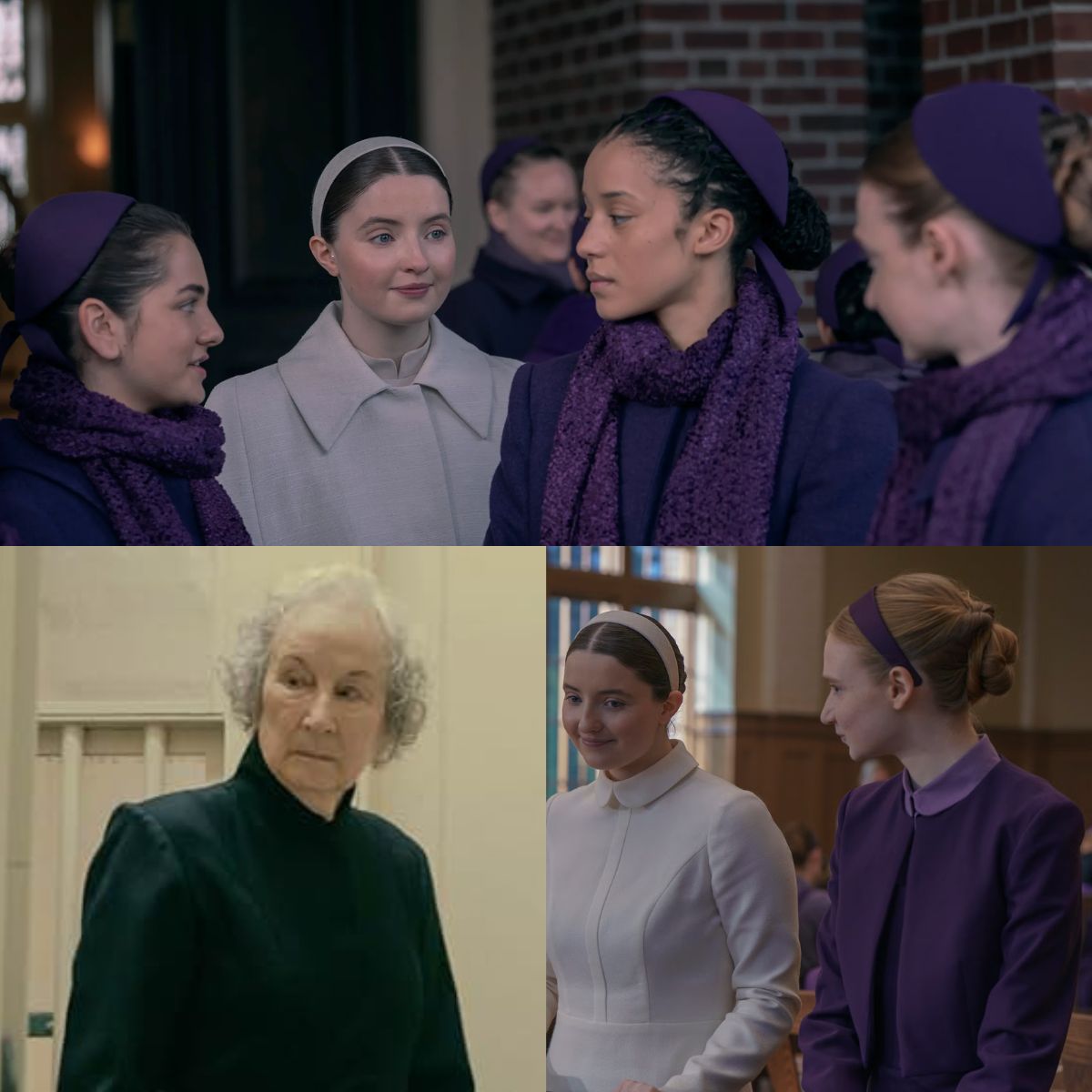
SHE APPEARED FOR ONLY A FEW SECONDS… but The Testaments fans are convinced it changed everything. Viewers have discovered Margaret Atwood’s hidden cameo in the finale, and many believe it was a deliberate clue about Gilead’s future.
In the dystopian shadows of Gilead, where every glance carries weight and every silence screams rebellion, a fleeting moment in the Season 1 finale of Hulu’s The Testaments has ignited a firestorm of fan theories. For just a few electrifying seconds, the legendary Margaret Atwood — the visionary mind who created this chilling universe — stepped into the frame as a stern prison matron. What seemed like a charming Easter egg has exploded into something far more significant, with devoted viewers convinced the author’s strategic placement holds the key to Gilead’s unraveling future.
The episode, titled “Secateurs,” delivered heartbreak, defiance, and a revolutionary kiss between Becka and Agnes that has already become legendary. But it’s Atwood’s blink-and-you’ll-miss-it appearance — dressed in the severe black robes of a Gilead prison matron, white hair pulled back tightly, gloves on her hands — that has sent the internet into overdrive.
The Cameo That Stopped Fans in Their Tracks
The scene unfolds early in the finale. Aunt Lydia (the incomparable Ann Dowd), one of the most complex and terrifying figures in the entire saga, is being led through a dimly lit detention center to visit the imprisoned Becka. The woman guiding her? None other than Margaret Atwood herself.
“Don’t agitate her,” the author warns in a stern, authoritative tone before stepping back into the shadows. The moment is brief — mere seconds — yet its impact has been seismic.
Fans paused, rewound, and screamed in recognition. Social media erupted with screenshots, slow-motion breakdowns, and wild speculation. This marks Atwood’s second on-screen appearance in the Handmaid’s Tale universe (she previously cameo’d as an Aunt in the original series premiere), but her role in The Testaments feels far more loaded with meaning.
“This wasn’t random,” one popular fan theorist posted. “Atwood doesn’t do anything by accident. Her standing directly behind that character right before the betrayal hint? She’s telling us who holds the real power — or who’s about to lose it.”
The Biggest Theory: A Deliberate Clue About Betrayal and Collapse
The dominant fan theory centers on the precise framing of the shot. As Aunt Lydia approaches Becka’s cell, Atwood’s matron figure lingers in the background, her stern gaze fixed forward. Moments later, subtle hints of an impending betrayal within Gilead’s upper ranks begin to surface.
Viewers believe Atwood’s positioning — literally standing as a silent witness behind key players — symbolizes the author’s (and by extension, the audience’s) watchful eye over the regime’s impending downfall. Some go further, suggesting it foreshadows a major internal collapse triggered by the younger generation (Agnes, Becka, and Daisy) and disillusioned figures like Aunt Lydia.
One viral Reddit breakdown claims: “Atwood is placed symbolically behind the old guard. She’s the creator watching her creation begin to crumble. The ‘betrayal’ hinted at isn’t just personal — it’s the beginning of the end for Gilead’s entire system.”
Others interpret it more literally. Could the prison matron represent hidden resistance within Gilead’s institutions? Or is Atwood signaling that the true architects of change are the overlooked women in positions of quiet authority?
Inside the Emotional Season 1 Finale
For those who haven’t yet watched (major spoilers ahead), the Season 1 finale of The Testaments — set 15 years after the events of The Handmaid’s Tale — delivers on every promise of Robyn Carr-level emotion mixed with Atwood’s signature sharp social commentary.
The episode centers on Becka’s imprisonment after she murders her abusive father to protect her friends. Her tender, defiant kiss with Agnes (revealed to be June Osborne’s daughter Hannah) has been hailed as one of the most powerful queer moments in dystopian television. The scene of solidarity between the young women has fans calling it revolutionary in a regime that suppresses all forms of love and autonomy.
Aunt Lydia’s visit to Becka forms the emotional core. Their conversation crackles with tension, regret, and the first glimmers of something resembling redemption for the fearsome Aunt. It is during this sequence that Atwood appears, adding a meta-layer that feels almost sacred to longtime fans of the books.
Margaret Atwood: Creator, Cameo Queen, and Cultural Icon
At 86 years young, Margaret Atwood remains one of the most vital voices in literature. Her decision to appear in both The Handmaid’s Tale and now The Testaments speaks volumes about her investment in these adaptations. Showrunners have described her as deeply involved, offering notes and guidance throughout production.
In interviews, Atwood has spoken warmly about stepping into Gilead once more. “It was scary in the best way,” she reportedly told producers. Her brief but commanding presence as the prison matron feels like the author inserting herself as both observer and participant in the world she built.
Fans have flooded social media with love for the moment. “Margaret Atwood casually running a Gilead prison wing is the crossover we didn’t know we needed,” one viewer wrote. Another added: “She created this nightmare and now she’s walking through it. Icon behavior.”
What This Means for Season 2
The Testaments has already been renewed for Season 2, and the finale’s events — combined with Atwood’s cameo — have set up tantalizing possibilities. Will Aunt Lydia fully turn against Gilead? How will the younger women’s resistance movement grow? And what larger role might the mysterious prison matron (or figures like her) play in the coming collapse?
Insiders hint that Season 2 will dive deeper into the fractures within Gilead’s leadership. The “shocking betrayal” teased in the finale is expected to have far-reaching consequences, potentially involving high-ranking Commanders and Aunts who are beginning to question the regime’s sustainability.
Atwood’s involvement suggests the show will stay true to the spirit of her novels while expanding the universe in bold new directions. Her cameo may be a subtle promise from the creator herself: the story is in safe (if terrifying) hands.
The Cultural Impact of The Testaments
Since its premiere in April 2026, The Testaments has dominated conversations about women’s rights, authoritarianism, and resistance. In a world that feels increasingly unstable, the series resonates perhaps more powerfully than ever.
The inclusion of Atwood in the finale feels like a full-circle moment — a reminder that this dystopia was born from one woman’s pen, and its dismantling may require the same sharp intellect and quiet defiance she embodies.
Fans are already planning re-watches, creating intricate timelines connecting The Handmaid’s Tale to The Testaments, and debating every micro-expression in that prison hallway scene.
A Message From the Creator?
Whether intentional or not, Margaret Atwood’s placement in that final episode feels like more than fan service. It’s a meta-commentary on authorship, legacy, and the power of stories to both create and destroy worlds.
As one literary critic put it: “By stepping into the frame, Atwood reminds us that she is still watching. And if she’s watching, hope is not entirely lost.”
The Testaments Season 1 has left viewers hungry for more — more resistance, more redemption, more of this richly layered world. And with Margaret Atwood’s ghostly presence lingering in the background, the future of Gilead has never felt more uncertain… or more thrilling.
What did you think of the cameo? Do you believe it hints at bigger betrayals ahead? Let us know in the comments.