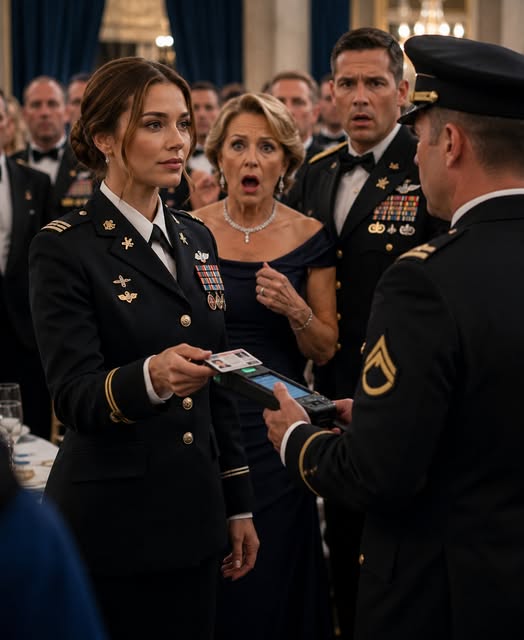
PART 2 – The Credential That Silenced the Ballroom
PART 2
“Sir,” the sergeant said, “Mrs. Parker-Walker is here under official authority.”
A ripple moved through the ballroom, quiet but unmistakable.
Patricia’s smile collapsed.
Ryan took one step toward me, then stopped, as if some invisible line had appeared between us.
General Mitchell’s gaze shifted to my credential holder, then to my face. He was a tall man with silver hair, steady eyes, and the kind of calm that made a room listen without being asked.
“Official authority?” he repeated.
The sergeant nodded. “Yes, sir. Department of Defense civilian investigative liaison. Temporary assignment attached to Inspector General review.”
The words fell into the silence like stones dropped into still water.
I heard someone inhale sharply behind me.
Patricia blinked. “That can’t be right.”
Her voice was smaller now.
Ryan looked at me for the first time all evening. Not through me. Not around me. At me.
And there it was—the fear.
Not fear for me.
Fear of me.
General Mitchell turned toward him. “Captain Walker, did you know your wife held this position?”
Ryan opened his mouth.
Nothing came out.
I slipped the credential back into my clutch with hands that remained steady only because I had practiced steadiness for years.
“No, sir,” I said quietly. “He did not.”
That was not entirely true.
Ryan had known I worked in compliance. He had known I reviewed contracts, records, and procedural reports. He had known my job required discretion.
What he had not known was that my recent assignment involved Fort Belvoir.
What he had not known was that the folder he had tried to take from my suitcase three nights ago had not contained divorce paperwork.
It contained evidence.
General Mitchell studied me. “Mrs. Parker-Walker, perhaps we should step somewhere private.”
“That would be appreciated, sir.”
Patricia suddenly found her voice. “Private? After what she just did?”
I turned toward her.
For years, I had answered Patricia with politeness. I had softened my words, apologized when I owed no apology, smiled when her remarks landed like paper cuts.
Tonight, I did not smile.
“What I did,” I said, “was attend an event I was invited to attend.”
Her face reddened. “You tricked us.”
“No, Patricia. You assumed I was powerless.”
The ballroom remained painfully quiet.
Ryan whispered, “Emily, please.”
That one word—please—almost broke something in me.
Not because it was tender.
Because it was late.
General Mitchell gestured toward a side corridor. “This way.”
The MPs did not touch me. They did not need to.
Instead, they cleared a path.
I walked past Ryan without looking back, though every part of me felt the weight of him watching.
In the corridor beyond the ballroom, the music began again, soft and uncertain.
General Mitchell led us into a small reception room lined with framed photographs of past commanders. The air smelled faintly of furniture polish and winter rain from the coats hanging near the entrance.
Only four people entered with us: the general, the sergeant, a woman in a navy dress named Colonel Reeves, and Ryan.
Patricia tried to follow, but Colonel Reeves stopped her gently.
“Ma’am, this conversation is official.”
Patricia’s eyes narrowed. “I am his mother.”
“And this is not a family matter.”
The door closed.
For the first time that night, Ryan and I stood alone in the same room without his mother between us.
Yet she was everywhere.
In his posture.
In his silence.
In the years he had allowed her voice to become louder than mine.
General Mitchell removed his glasses. “Mrs. Parker-Walker, explain.”
I looked at Ryan.
He looked away.
So I began.
“Six weeks ago, I was asked to review procurement irregularities connected to a veterans’ rehabilitation grant. It began as a paperwork concern. Missing signatures. Repeated vendor names. Budget transfers made just under approval thresholds.”
Colonel Reeves folded her arms. “Which vendor?”
“Walker Family Outreach Foundation.”
Ryan flinched.
The general’s expression did not change, but the room grew colder.
I continued. “The foundation is listed as a charitable organization supporting military families. Patricia Walker is chairwoman. Captain Walker is listed as an unpaid advisory board member.”
“I don’t handle the money,” Ryan said quickly.
His voice sounded too sharp.
General Mitchell looked at him. “No one asked yet.”
Ryan swallowed.
I reached into my clutch and removed a folded sheet. Not the whole file. Never the whole file. I had learned caution the hard way.
“This is a summary of concerns already submitted through proper channels. Tonight I came because I received confirmation that several original donors would be present. I was advised to observe, not confront.”
Ryan stared at the paper as if it were burning.
“That’s why you came?” he asked.
I met his eyes. “I came because it was my job.”
“And you didn’t tell me?”
“No.”
His jaw tightened. “I’m your husband.”
The words landed between us, fragile and hollow.
“You were,” I said softly, “the first person who taught me why I couldn’t.”
For a moment, his face changed.
The polished officer disappeared.
Underneath was the man I had married at twenty-seven, the one who once brought me coffee during late-night storms and left handwritten notes inside my books.
Then the mask returned.
“I didn’t know anything illegal was happening,” he said.
Colonel Reeves tilted her head. “But you knew enough to let your mother accuse your wife of fraud in front of a ballroom full of officers.”
Ryan looked down.
That silence answered more than his words could have.
General Mitchell took the summary from me. “Sergeant, secure the hallway. Colonel, notify legal discreetly. No disruption to the event.”
“Yes, sir.”
When they left, only the general, Ryan, and I remained.
Outside, laughter drifted faintly from the ballroom. Life continuing, as it always did, even when someone’s private world was collapsing.
General Mitchell’s voice lowered. “Mrs. Parker-Walker, are you in immediate danger?”
“No, sir.”
Ryan stared at me. “Danger? From me?”
I almost pitied him then.
He truly believed danger only wore a raised hand.
He did not understand what it meant to live beside someone who dismissed your grief, questioned your memory, and let his mother rewrite your life one dinner at a time.
“No,” I said. “Not physically.”
The general understood the difference.
Ryan did not.
A knock came.
Colonel Reeves opened the door and stepped inside. Her face was controlled, but her eyes carried urgency.
“Sir,” she said, “Mrs. Walker is attempting to leave.”
Ryan moved instantly. “I’ll talk to her.”
General Mitchell held up one hand. “You will remain here.”
“She’s my mother.”
“She is also connected to an active review.”
Ryan’s face hardened. “With respect, sir, this is becoming personal.”
General Mitchell looked at me, then back at him.
“Captain, it became personal when your wife was publicly accused without evidence.”
Ryan had no answer.
Minutes passed. Rain tapped against the window. Somewhere beyond the walls, glasses clinked and people pretended they had not witnessed the unraveling of a family.
I thought of the first Walker family dinner after our wedding.
Patricia had inspected my casserole and said, “How sweet. Ryan always liked simple girls.”
Ryan had laughed, not cruelly, but comfortably.
That had been the beginning.
A thousand small moments followed. My job was too serious. My dresses were too plain. My house was too organized. My grief after losing the pregnancies was too quiet, then too heavy, then inconvenient.
And Ryan, always stationed between us, kept choosing the easier side.
His mother’s.
The door opened again.
This time, Patricia entered with Colonel Reeves behind her.
Patricia had repaired her face. Powder smoothed the redness. Her pearls sat perfectly at her throat. She looked less like a woman exposed and more like a woman preparing for battle with manners.
“General,” she said, “there has been a misunderstanding.”
General Mitchell did not invite her to sit.
Patricia glanced at me. “Emily has always been sensitive. We’ve tried to support her.”
My laugh escaped before I could stop it.
It was quiet, but everyone heard it.
Patricia’s gaze sharpened.
I stepped closer to the table. “No more.”
Ryan whispered my name again.
I ignored him.
“No more stories about my sensitivity. No more concern that sounds like accusation. No more pretending cruelty becomes kindness because you lower your voice.”
Patricia’s lips parted.
Perhaps no one had spoken to her like that in years.
Perhaps ever.
General Mitchell placed the summary on the table. “Mrs. Walker, did you authorize expenditures from the foundation account for personal event costs?”
Her expression flickered.
“Absolutely not.”
Colonel Reeves opened a slim folder. “Including tonight’s floral arrangements, gown alterations, and private catering deposits?”
Patricia went still.
Ryan turned toward her. “Mom?”
She recovered quickly. “Those were temporary allocations. Reimbursements were planned.”
“From which account?” Colonel Reeves asked.
Patricia’s eyes moved to Ryan.
It was brief.
Too brief for anyone else, perhaps.
But I had spent three years learning the Walker family language.
That glance said: help me.
Ryan’s shoulders sagged.
I realized then that he did know.
Not everything.
Maybe not enough to name the crime.
But enough to understand the shape of it.
“Ryan,” I said.
He looked at me with something like desperation.
“I signed two approvals,” he said finally.
Patricia closed her eyes.
The room seemed to lean toward him.
General Mitchell’s voice remained even. “Explain.”
Ryan rubbed both hands over his face. “My mother said the foundation account was delayed. She said vendors needed confirmation for a donor reception. She said it was all internal and would be corrected after pledges came through.”
Colonel Reeves asked, “Did you verify that?”
“No.”
“Did you benefit from those funds?”
“No.”
Patricia snapped, “Ryan.”
The word carried warning.
He looked at her, and for one heartbreaking second, I saw the boy he must have been—trained to obey, rewarded for loyalty, punished by disappointment.
Then he looked at me.
“I didn’t think,” he said.
I believed him.
That was the saddest part.
He had not thought about the money.
He had not thought about the veterans the foundation claimed to serve.
He had not thought about me standing alone beneath chandeliers while his mother tried to erase my dignity.
Ryan had spent years not thinking because thinking would require choosing.
And now choice had arrived anyway.
General Mitchell closed the folder. “This matter will proceed through appropriate channels. Mrs. Walker, you are not to leave the installation until legal counsel speaks with you.”
Patricia’s calm cracked. “You cannot treat me like some criminal.”
“No one has used that word,” he said.
“You’re all listening to her.” She pointed at me again, though less dramatically this time. “You have no idea what she’s like. She sneaks around. She collects things. She ruins families.”
I felt strangely peaceful.
“Families don’t ruin because someone finds the truth,” I said. “They ruin because someone buried it.”
Patricia stared at me as if seeing me for the first time.
Not as Ryan’s wife.
Not as an obstacle.
As a person she had underestimated.
Colonel Reeves escorted her out soon after.
Ryan tried to follow, but General Mitchell stopped him again.
“Captain, you’ll provide a written statement tonight.”
Ryan nodded numbly.
The general turned to me. “Mrs. Parker-Walker, you may return to the ballroom or leave, whichever you prefer.”
Return?
The idea seemed impossible.
My gown suddenly felt heavy. My shoes pinched. My hair, so carefully pinned, tugged at my scalp.
“I’ll leave,” I said.
Ryan stepped forward. “Emily, let me drive you.”
“No.”
“Please. We need to talk.”
“We needed to talk for three years.”
He looked wounded, and once that would have made me soften. I would have rushed to reassure him, to make his discomfort smaller than my own pain.
Not tonight.
Tonight, I let him carry it.
General Mitchell offered to have a car arranged, but I declined. I had driven myself. That had been one of the small rebellions Ryan had mocked earlier.
“You’re being dramatic,” he had said when I refused to ride with him and Patricia.
Now that choice felt like a lifeline.
In the ladies’ room near the entrance, I stood before a gold-framed mirror and finally let my hands shake.
A woman in a green gown emerged from one of the stalls. She was older, with kind eyes and silver earrings shaped like leaves.
She paused when she saw me. “You’re Emily.”
I braced myself.
“Yes.”
She reached into her purse and handed me a tissue. “I’m Nora Bennett. My husband served with General Mitchell years ago.”
I accepted the tissue. “Nice to meet you.”
“I saw what happened.”
Of course she had.
Everyone had.
Nora’s expression softened. “You stood very still. That takes practice.”
The kindness in her voice nearly undid me.
“It does,” I whispered.
She leaned against the counter. “May I tell you something without sounding like a stranger interfering?”
I nodded.
“My first husband was admired by everyone. Charming, capable, generous in public. At home, he made me feel like every feeling I had was inconvenient.” She smiled sadly. “For years, I thought marriage meant becoming easier to love.”
The room blurred.
“What changed?” I asked.
“I found one person who believed me. Then I slowly learned to believe myself.”
I pressed the tissue beneath my eyes, careful not to smear mascara.
Nora opened her purse again and removed a small card. “I run a support network for military spouses navigating separation, grief, career transitions, all the messy crossings people pretend are rare.”
I took the card.
“Thank you.”
She touched my arm gently. “Whatever happens next, do not let tonight become only the night they embarrassed you. Let it become the night you saw yourself clearly.”
After she left, I remained at the mirror.
My reflection looked unfamiliar.
Not triumphant.
Not destroyed.
Awake.
Outside, the rain had softened to mist. The parking lot glistened beneath amber lights. I walked carefully, lifting the hem of my gown away from puddles.
Halfway to my car, I heard footsteps.
“Emily.”
Ryan.
I did not turn immediately.
He stopped several feet behind me. For once, he did not come closer than invited.
“I gave my statement,” he said.
“That was fast.”
“I told them what I knew.”
“And what did you know?”
His breath caught. “Less than I should have. More than I admitted.”
The honesty surprised me.
I turned.
Rain misted his uniform. Without the ballroom lights, he looked tired rather than impressive.
“My mother said you were trying to ruin her,” he continued. “She said you had become unstable after…” He stopped, ashamed.
“After the miscarriages.”
His eyes glistened. “Yes.”
The word hung between us, carrying hospital rooms, silent drives home, flowers that wilted on the kitchen counter, and Ryan sleeping beside me like distance could protect him from grief.
“You let her say that,” I said.
“I know.”
“No, Ryan. You let her use our losses as evidence against me.”
He flinched.
“I don’t know how to fix that,” he whispered.
“You may not be able to.”
He nodded once, as if accepting a sentence.
For a long moment, we stood under the misty light, two people who had once promised forever and had somehow arrived as strangers.
Then he reached into his jacket.
I stepped back instinctively.
Pain crossed his face, but he only removed an envelope.
“I was going to give you this next week,” he said. “Before everything happened.”
I did not take it.
“What is it?”
“A letter.”
“From you?”
He shook his head. “From my father.”
The world seemed to still.
Ryan’s father, Daniel Walker, had died five years before I met Ryan. In the Walker house, he existed only in portraits and carefully polished anecdotes. Patricia described him as devoted, brilliant, loyal.
Ryan rarely spoke of him.
“I found it last month,” Ryan said. “In a locked box in my mother’s attic.”
“Why would your father write to me?”
“He didn’t. He wrote it to whoever married me.”
The mist gathered on the envelope’s edges.
Ryan’s voice broke slightly. “I think he knew.”
“Knew what?”
Ryan looked toward the building, then back at me.
“That my mother was hiding something.”
I stared at the envelope.
Every instinct told me not to take anything from him. Not tonight. Not when my heart was raw and my trust had been worn thin.
But mystery has its own gravity.
I reached out.
The paper was thick, yellowed at the corners, sealed once and opened recently.
My name was not on it.
Instead, written in careful blue ink, were the words:
For Ryan’s wife, when she begins asking questions.
A chill moved through me that had nothing to do with rain.
“Why didn’t you show me before?” I asked.
Ryan looked ashamed. “Because I was afraid it would prove you right.”
I opened the envelope with trembling fingers.
Inside was a single page.
The handwriting was elegant, slanted, deliberate.
To the woman my son chooses,
If this letter has reached you, then you have already seen what most people miss. Patricia builds beautiful rooms around locked doors. She will call your concern disrespect. She will call your questions betrayal. She will make Ryan choose before he understands there was a choice at all.
Please know this: my son is not cruel by nature, but he was raised to fear conflict more than dishonesty. That fear may cost him what he loves.
There is a ledger.
Not the foundation ledger. The first one.
It is not in the house. It is where Patricia believes no one will look because grief keeps people away.
Find the blue chapel book.
D.W.
I read the final line three times.
The blue chapel book.
My pulse quickened.
“Emily?” Ryan asked.
I folded the letter carefully. “Where is your father buried?”
Ryan’s face drained of color.
“Arlington.”
Before I could respond, my phone buzzed inside my clutch.
A blocked number.
I almost ignored it.
Then a message appeared.
No words.
Just a photograph.
A small blue hymnal resting on a stone bench.
Behind it stood a white chapel wall.
And tucked beneath the cover was a corner of paper marked with Patricia Walker’s signature.
A second message arrived immediately after.
You were not the first wife Daniel tried to warn.
END OF PART 2 – LIKE, SHARE AND COMMENT “THE ENTIRE STORY” IF YOU WANT TO READ THE FULL STORY