She Fed a Starving Boy in 2003
PART 2: She Fed a Starving Boy in 2003—Twenty-One Years Later, 97 Bikers Came Back to Repay the Debt
“Ma’am… do you know what those men outside are here to repay?”
For a few seconds, I couldn’t answer.
The envelope in Luke’s hand looked too heavy for paper. Thick, cream-colored, wrapped with a red rubber band, the kind banks used when they counted money they expected you to give back with interest. His fingers trembled around it, though everything else about him looked steady now.
Not like the boy from 2003.
That boy had been all elbows and silence. A haunted thing in an oversized hoodie who ate like someone might snatch the plate away if he blinked.
This man standing in front of me had shoulders broad enough to fill the doorway. His black leather vest was patched with words I didn’t understand, stitched over a faded gray shirt. His beard had silver at the chin. A long scar ran from his left ear down into his collar.
But the eyes were the same.
Hazel.
Watchful.
Wounded.
Alive.
“Luke,” I whispered.
His face broke.
Not into a smile exactly. More like something inside him gave way after holding for twenty-one years.
“You remember.”
My hand went to the counter to keep myself standing. “Of course I remember.”
Behind him, my regulars sat frozen in place. Ed Mullins had one hand halfway around his coffee mug. Rita from the post office held a napkin pressed against her mouth. Two college kids in Booth Three had stopped recording with their phones and stared like the world had tilted.
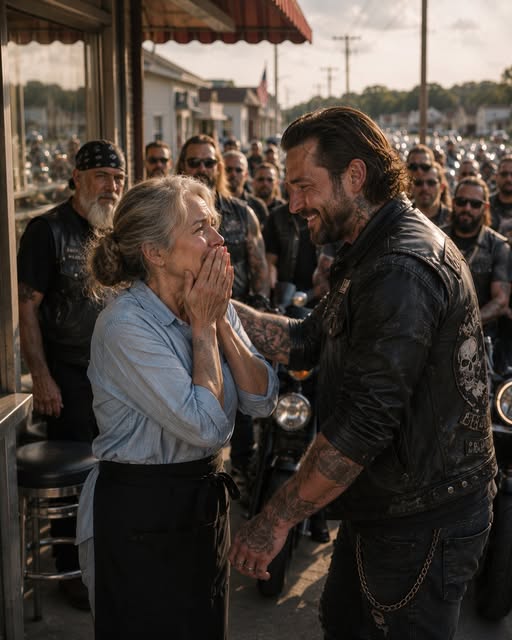
Outside, ninety-seven bikers stood beside ninety-seven motorcycles in a silence so disciplined it scared me more than the noise had.
Luke looked around the diner slowly.
The cracked booths.
The faded photographs.
The old pie case with one lonely apple pie inside.
The neon OPEN sign buzzing in the window.
His gaze softened on Booth Four.
“That still there?” he asked.
I looked toward the booth near the window. “Always has been.”
He swallowed hard.
“That’s where you saved my life.”
Nobody moved.
I wanted to say something gentle. Something ordinary. Something Maggie-like. But my throat had closed.
Luke placed the envelope on the counter between us.
I stared at it.
“What is this?”
“First payment,” he said.
I let out a nervous little laugh because that was what people did when the air got too full. “First payment for what? A grilled cheese?”
His eyes shone.
“No, ma’am. For twenty-one years of living.”
The words landed harder than I expected.
I looked down at the envelope again. “Luke, I can’t take—”
“You can.”
His voice wasn’t loud, but it filled the diner.
Then he turned toward the door and gave a small nod.
One by one, the bikers outside began reaching into saddlebags, jacket pockets, and old leather pouches. They stepped forward in a line, not pushing, not speaking, each carrying something.
At first, I thought it was money.
Some of it was.
But not all.
The first biker through the door was a woman with cropped white hair and a tattoo of angel wings climbing her neck. She placed a folded check on the counter and touched two fingers to her brow.
“Thank you, Miss Maggie,” she said.
“I don’t know you, sweetheart.”
“No,” she replied. “But he fed my son when I couldn’t.”
She stepped aside.
A bald man with arms the size of tree trunks came next. He held a small envelope with both hands like it was fragile.
“Luke got me sober,” he said. “Twelve years now.”
Then another.
“Luke paid for my daughter’s surgery.”
Another.
“He found my brother when nobody else cared.”
Another.
“He stopped me from ending my life in a motel outside Dayton.”
Another.
“He gave me a job when prison was the only thing on my resume.”
Another.
“He sat with my wife while she died because I was too scared to.”
The line kept moving.
Boots against checkered tile.
Leather creaking.
Voices breaking.
People I had never seen in my life stood in my tiny Ohio diner and thanked me for things I hadn’t done.
Except maybe I had.
Maybe every kindness had children.
Maybe mercy didn’t end where you dropped it.
Maybe it went walking through the world in someone else’s hands.
I gripped the counter until my knuckles ached.
“Luke,” I said, “what did you do?”
He looked toward Booth Four again.
“I did what you did.”
The envelope on the counter seemed to grow heavier.
Outside, more bikers waited. Not rowdy. Not dangerous. Just patient.
And suddenly I noticed something else.
Every one of their jackets had the same patch on the back.
A simple design.
A white coffee cup.
Steam rising in the shape of angel wings.
Beneath it, stitched in bold letters, were three words:
NOBODY LEAVES HUNGRY.
My breath left me.
“That’s my saying,” I whispered.
Luke nodded. “It became ours.”
I stared at him. “Ours?”
He took a slow breath.
“We’re not a club the way people think. Not really. Some of us ride. Some of us don’t. Some work construction, some drive trucks, some run shelters, some teach, some fix roofs, some just show up when someone calls. We started with five men in a church basement in Akron. Now there are chapters in six states.”
He gave a small, embarrassed shrug.
“We call ourselves The Booth Four Brotherhood.”
Rita from the post office started crying.
Ed Mullins muttered, “Well, I’ll be damned.”
Luke’s mouth twitched. “That’s usually the reaction.”
I sank onto the stool behind the counter.
The room tilted softly around me.
“The Booth Four Brotherhood,” I repeated.
“That first winter,” Luke said, “you fed me four times.”
“Five,” I corrected automatically.
His eyebrows lifted.
I pointed weakly toward the kitchen. “You came once when I was closing. You didn’t sit down. You said you weren’t hungry, but you kept looking at the soup pot. I gave you chili in a coffee cup.”
He closed his eyes.
A tear slipped through his beard.
“I forgot that.”
“I didn’t.”
For a long moment, he couldn’t speak.
Then he pulled out the stool beside mine and sat, though he looked too large for the little diner furniture.
“I need to tell you what happened after I left.”
The diner stayed silent.
Even the refrigerator in the kitchen seemed to quiet down.
Luke folded his hands on the counter. They were scarred hands, thick at the knuckles, oil deep in the cracks no soap could remove.
“When I disappeared,” he said, “I didn’t run far. I made it to Canton riding in the back of a produce truck. I was fifteen. Maybe sixteen. I didn’t know exactly anymore. My mother was gone by then. My stepfather was… not a man anybody should live with.”
He said it plainly, without decoration.
That made it worse.
“I slept under loading docks. Ate from dumpsters. Got arrested for stealing a pack of crackers from a gas station. The officer who picked me up knew I was a runaway. He had every right to send me back.”
Luke looked down.
“But in my pocket, I had something.”
He reached into his vest and pulled out an old folded piece of paper sealed inside a clear plastic sleeve.
He laid it on the counter.
My handwriting stared back at me.
Curled and faded.
Good for one hot meal. No questions asked. —Maggie
My fingers went numb.
“I gave you that?”
“Last time I came in,” Luke said. “You tucked it in my hoodie pocket when I wasn’t looking. I found it two days later.”
The memory came back in pieces.
A cold afternoon.
A boy too proud to ask.
Me pretending to wipe his booth while slipping the note into his pocket.
“You were so thin,” I whispered.
“The cop read it,” Luke continued. “He asked who Maggie was. I told him you were just a lady with a diner. He drove me there.”
My head snapped up. “No, he didn’t.”
Luke smiled sadly. “He tried. But I got scared when we hit the county line. I thought if you saw police with me, you’d get in trouble for feeding a runaway. So I jumped out at a red light and ran.”
I covered my mouth.
“I never knew.”
“I know.” His voice softened. “That’s why I’m here.”
He touched the plastic-covered note.
“I kept this. For years. When I didn’t have a bed, I had this. When I got beat up behind a warehouse, I had this. When I thought about giving up, I had this. It was stupid maybe, but it made me think there was still one door in the world I could walk through and not be hated.”
His eyes lifted to mine.
“That matters, Maggie.”
The diner blurred.
I reached across the counter and put my hand over his.
His hand swallowed mine.
“You were a child,” I said.
“I was angry.”
“You were hungry.”
“I was both.”
Outside, one of the motorcycles ticked as its engine cooled. The sound was oddly gentle.
Luke went on.
“A man named Earl found me sleeping behind his repair shop. He could’ve called the cops. Instead, he gave me a broom. Then a sandwich. Then a place on the floor in the back room. He rode motorcycles. Vietnam veteran. Meanest-looking man I ever saw.”
Luke gave a low laugh.
“Softest heart.”
“That sounds familiar,” I said.
“Yeah.” He smiled. “He said the world splits people into two kinds. Those who see a hungry kid and ask what he did wrong, and those who see a hungry kid and make soup.”
Rita sobbed out loud.
Luke glanced at her gently, then back at me.
“Earl taught me engines. Taught me how to read better. Taught me not to swing at everybody who stepped close. When I turned eighteen, he helped me get an apartment. When I turned twenty-five, he left me his shop.”
“That’s wonderful.”
“It was,” Luke said. “But I couldn’t stop thinking about you. I looked for Millbrook once, but I only remembered the road and the red sign. Took me years to find the exact town.”
I glanced at the neon sign in the window. It was more pink than red these days.
“I haven’t exactly been hiding.”
“No. But life gets loud.”
He looked toward the bikers still lined outside.
“Then one night, a kid came into my shop. Seventeen. Rain dripping off his sleeves. Said his chain slipped. No money. Bruise under one eye. Same look I had.”
His voice thickened.
“I heard you in my head.”
“Coffee’s terrible,” I whispered.
“But the grilled cheese might save your life,” he finished.
The two of us laughed through tears.
“So I fed him,” Luke said. “Then another. Then Earl’s old riding buddies started helping. Then somebody knew a veteran sleeping in his car. Somebody knew a mother choosing between rent and groceries. Somebody knew an ex-con nobody would hire. We started fixing bikes for free, then cars, then roofs. We built a food pantry in the back of the shop. And every time someone asked why, I showed them that note.”
He tapped the plastic sleeve.
“Good for one hot meal. No questions asked.”
He paused.
“That became the rule.”
I didn’t know what to do with my face. Crying seemed too small. Smiling seemed too weak.
“So they came here,” I said slowly, “because of a piece of paper?”
“No,” Luke said. “Because of you.”
A silence followed that felt almost sacred.
Then the front door opened again.
A young man in a leather jacket stepped in carrying a metal cash box. Behind him came two more bikers with tool belts over their shoulders. Then a woman with a clipboard. Then a gray-haired man in a suit who looked painfully out of place among them.
Luke turned the envelope toward me and slid it closer.
“Maggie, we know about the bank.”
My heart stumbled.
All warmth drained from my body.
“What?”
He held my gaze.
“We know the diner is behind. We know the developers offered to buy the property. We know they’ve been pressuring you.”
My hand pulled away from his.
“Who told you that?”
Luke’s face changed slightly.
Not guilty.
Careful.
“A friend at the county office.”
I stood too quickly. The stool scraped backward.
“This is private.”
“I know.”
“No, you don’t.” My voice cracked sharper than I meant it to. “You come in here with ninety-seven motorcycles and envelopes and stories, and you think you can just—just rescue me?”
He flinched.
For one terrible second, I saw the boy again.
I softened immediately, but the panic had already escaped.
“I’m sorry,” I said.
“No.” Luke stood too. “You’re right.”
The diner seemed to hold its breath.
I looked around at the faces watching me. Kind faces. Worried faces. Strangers who had come to thank me, and somehow that made me feel naked.
“I fed you a meal,” I said quietly. “That doesn’t mean you owe me my life.”
Luke’s eyes filled again.
“Maggie, that’s exactly what I owe you.”
I shook my head.
“No.”
“Yes.”
“No, Luke.”
He leaned forward, voice low and breaking.
“You don’t understand. That night in Canton, after I ran from the cop, I ended up on a bridge.”
The room froze.
My hand pressed to my chest.
Luke looked away, jaw tight.
“I had your note in my pocket. I took it out. Read it under a streetlight. Good for one hot meal. No questions asked.” He swallowed. “And I thought, if one person could write that to me, maybe I wasn’t what he said I was. Maybe I wasn’t trash.”
He looked back at me.
“So I climbed down.”
No one breathed.
“That meal was not just food,” he said. “That note was not just paper. You gave me one reason to stay alive long enough for Earl to find me.”
I sat back down because my knees had forgotten their purpose.
Luke gently pushed the envelope closer.
“This pays the bank. In full.”
I stared at him.
The old man in the suit stepped forward and cleared his throat.
“I’m Howard Bell, ma’am. Attorney. I’ve reviewed the numbers. With penalties, interest, and late fees, the balance is included in that envelope as a cashier’s check.”
My mouth opened, but no sound came out.
“And,” Howard added, “there’s a separate fund established for property taxes, repairs, and operating costs for the next five years.”
The college kids in Booth Three gasped.
Ed Mullins stood up so fast his chair nearly tipped.
“Five years?”
Luke nodded.
“And we brought people to fix what needs fixing.”
One of the tool-belt bikers raised a hand. “Roofing crew.”
Another said, “Electrical.”
The woman with the clipboard added, “Plumbing, flooring, refrigeration, sign restoration, booth upholstery, grease trap, parking lot, and a new coffee maker.”
Rita laughed and cried at the same time.
I looked personally offended. “What’s wrong with my coffee?”
Every biker in the doorway looked somewhere else.
Luke coughed.
The room broke into laughter.
Not polite laughter.
Real laughter.
The kind that rattled dishes and loosened grief from the walls.
For the first time in months, maybe years, Maggie’s Family Diner sounded alive.
Then the back kitchen door swung open.
My cook, Benny, who had worked for me every Saturday since his retirement and complained about everything except being needed, stood there holding a spatula.
“Are they paying for the bacon too?” he asked.
Luke looked at him seriously. “Yes, sir.”
Benny nodded. “Then I like ’em.”
More laughter.
But beneath it, something inside me trembled.
Five years.
The bank paid.
The diner saved.
I had spent so long preparing to lose the place that I didn’t know how to receive the opposite.
I looked at Luke.
“You should have asked me first.”
He nodded. “I should have.”
“You should have called.”
“I was afraid you’d say no.”
“I might’ve.”
“I know.”
We stared at each other, stubbornness meeting stubbornness across the counter.
Then he reached into his jacket again.
“There’s one more thing.”
I groaned. “Luke.”
“It’s not money.”
He placed a photograph on the counter.
It showed a building I didn’t recognize at first. Red brick. Wide windows. A black awning. Under the awning stood a group of people in leather vests, aprons, work shirts, and winter coats.
Above the door was a sign.
MAGGIE’S HOUSE — HOT MEALS, NO QUESTIONS ASKED
My breath caught.
“What is this?”
“Our first shelter kitchen,” Luke said. “Akron. Opened in 2012.”
He placed another photo beside it.
Another building.
Then another.
Columbus.
Toledo.
Fort Wayne.
Louisville.
Pittsburgh.
Each had the same name.
Maggie’s House.
My name.
On walls I had never touched.
In cities I had never visited.
Serving people I had never met.
I pressed a hand over my mouth as the photographs spread across the counter like pieces of another life.
“You named them after me?”
Luke nodded.
“I didn’t know your last name. Just Maggie. So that was enough.”
I stared at the photos until the faces blurred.
A little girl holding soup with both hands.
An old man sleeping in a chair beside a radiator.
A woman laughing while stirring a pot.
A teenage boy in a hoodie sitting near a window.
Booth Four, everywhere.
“You should’ve told me,” I whispered.
“I wanted to come back when I had become someone you wouldn’t worry about.”
That broke me.
I reached for him.
He came around the counter so fast he nearly knocked over the napkin holder. And then this great leather-clad man folded himself into my arms like the starving boy had finally found the place he meant to return to.
He smelled like rain, road dust, engine oil, and peppermint gum.
I held him tightly.
“You were always someone,” I said into his shoulder. “You hear me? Always.”
His breath shook.
“Yes, ma’am.”
Outside, the bikers removed their caps.
Inside, people cried openly.
Even Benny turned toward the grill and pretended onions were involved.
For a little while, nobody talked about banks or developers or overdue bills.
We just stayed there.
A woman who had thought her life was shrinking.
A man who had carried one meal through twenty-one years.
A diner full of witnesses.
And ninety-seven motorcycles waiting outside like guardian beasts.
Then the bell above the door jingled again.
A man stepped in who did not belong.
Not because of his clothes, though his navy suit looked expensive enough to pay my electric bill for a year. Not because of his polished shoes or silver watch or the way his hair sat too perfectly in place.
He didn’t belong because the warmth seemed to retreat from him.
The laughter died.
I knew him immediately.
Grant Voss.
The developer.
He owned half the empty storefronts in Millbrook already. Bought them cheap, boarded them up, then waited until the town got desperate enough to call his projects “revitalization.” He had been trying to buy my diner for eight months.
Behind him came two men in dark coats.
Not bikers.
Not locals.
Grant looked around the room with a thin smile.
“Well,” he said, “isn’t this touching?”
Luke released me slowly and turned.
Every biker in the place shifted.
Not aggressively.
Just enough.
Grant noticed.
His smile tightened.
“Maggie,” he said, ignoring them, “we had an agreement.”
“No,” I said. My voice was rough from crying. “You made an offer. I declined.”
“You delayed.” He brushed invisible lint from his sleeve. “There’s a difference.”
Luke took one step forward.
“Problem?”
Grant looked him up and down.
“I don’t believe we’ve met.”
“No,” Luke said. “You’d remember.”
Something flickered across Grant’s face. Irritation, maybe. Or recognition he refused to admit.
Howard Bell, the attorney, stepped forward. “Mr. Voss, any business you have with Mrs. Maggie can go through me.”
Grant laughed softly. “Mrs. Maggie. Charming.”
“It’s Miss Walker,” I said.
His eyes snapped to mine.
For months, he had called me Maggie like we were friends. Like he had a right.
Today, I didn’t give it to him.
Grant’s smile vanished.
“Miss Walker,” he said, “you are in no position to play sentimental games.”
Luke’s voice turned cold. “She doesn’t owe the bank anymore.”
Grant’s gaze dropped to the envelope.
For the first time, he looked surprised.
Then angry.
“That loan was not yours to interfere with.”
Howard narrowed his eyes. “Interesting choice of words.”
Grant ignored him.
“Maggie, you need to consider carefully what you’re doing. This property is part of a larger plan. A hotel, retail space, apartments. Jobs. Tax revenue. A future.”
“This diner is my future.”
“This diner is a corpse.”
The room went deadly still.
Luke’s jaw flexed.
I touched his arm lightly before he could move.
Grant leaned closer.
“You think these people can save you? Today, maybe. Tomorrow? Next year? Old buildings rot. Towns die. Charity dries up.” His eyes shifted to Luke. “And men playing hero usually have pasts they don’t want examined.”
Luke didn’t blink.
Grant smiled again, sensing something.
“What was your name?”
“Luke.”
“Luke what?”
No answer.
Grant’s smile widened.
“There it is.”
A strange chill moved through me.
I looked at Luke.
His face had gone unreadable.
Grant turned toward the diner like a performer addressing an audience.
“You all see leather jackets and tears, and suddenly nobody asks questions.” He pointed lightly at Luke. “Where did the money come from? Who are these people? Why now?”
One of the bikers growled, “Careful.”
Grant lifted both hands. “Just asking.”
Howard spoke sharply. “The funds are clean. I verified them.”
“I’m sure you verified what you were shown.”
Luke took another step forward.
“Leave.”
Grant’s eyes glinted.
“Or what?”
For a moment, I feared the whole place would explode.
Then the oldest biker in the room, a narrow man with a white beard braided under his chin, stepped between them. His vest had more patches than leather.
“No,” he said calmly.
Luke didn’t look away from Grant. “Silas.”
The old biker’s voice stayed gentle. “Not here.”
Grant chuckled.
“There’s discipline. How sweet.”
I moved from behind the counter.
This was my diner.
My floor.
My trouble.
I walked straight up to Grant Voss, close enough to see the tiny red veins in his eyes.
“You came here to scare me.”
His smile returned. “I came here to help you make a rational decision.”
“No,” I said. “You came because you thought I was alone.”
Behind me, ninety-seven bikers stood silent.
Rita from the post office stood too.
Then Ed.
Then Benny, still holding the spatula.
Then the college kids.
Then everyone else.
I looked Grant in the eye.
“I’m not.”
For the first time, he had no quick answer.
Then his phone buzzed.
He glanced at it.
Whatever he saw made his expression harden.
“This isn’t over,” he said.
Luke smiled without warmth. “Good. I hate boring endings.”
Grant turned to leave.
At the door, he paused and looked back at me.
“Ask your boy what really happened in winter of 2003.”
My heart stopped.
Luke went still.
Grant’s gaze slid to him.
“Ask him why he disappeared.”
Then Grant walked out.
The bell jingled cheerfully behind him, cruel in its innocence.
No one spoke.
Outside, Grant and his two men crossed between the motorcycles. Every biker watched them go. His black SUV pulled away slowly, like a threat taking its time.
I turned to Luke.
“What did he mean?”
Luke’s eyes were fixed on the window.
The softness was gone.
The boy was gone.
In his place stood someone who had survived by locking doors inside himself.
“Luke,” I said.
He looked at me then, and I saw fear.
Not of Grant.
Of me.
“What happened in 2003?”
Silas lowered his head.
Several bikers exchanged glances.
They knew.
The realization hurt more than I expected.
Luke’s voice came quietly.
“I didn’t just disappear, Maggie.”
My fingers curled around the edge of the counter.
“What does that mean?”
He reached into his vest one more time.
This time, what he pulled out was not a note, not a photograph, not a check.
It was a yellowed newspaper clipping.
He unfolded it carefully and placed it beside the old meal voucher.
The headline was faded but readable.
LOCAL TEEN SUSPECTED IN MILLBROOK FIRE VANISHES
Under it was a blurry photograph.
A building burned black against the winter sky.
I knew that building.
Everyone in Millbrook knew that building.
The old county records office.
It had burned down two days after Luke’s last visit.
A night watchman had died inside.
My stomach turned over.
I looked from the clipping to Luke.
“No,” I whispered.
His eyes filled with tears again, but this time they did not fall.
“I didn’t start that fire,” he said.
The diner remained silent.
Then he added, so softly I almost missed it:
“But I know who did.”
Outside, far down Route 62, Grant Voss’s SUV disappeared over the hill.
And for the first time that day, I understood.
The bikers had not come only to save my diner.
They had come because something buried twenty-one years ago had finally followed Luke home.
THE END OF PART 2 – LIKE, SHARE AND COMMENT “FULL STORY” IF YOU WANT TO READ FULL STORY.