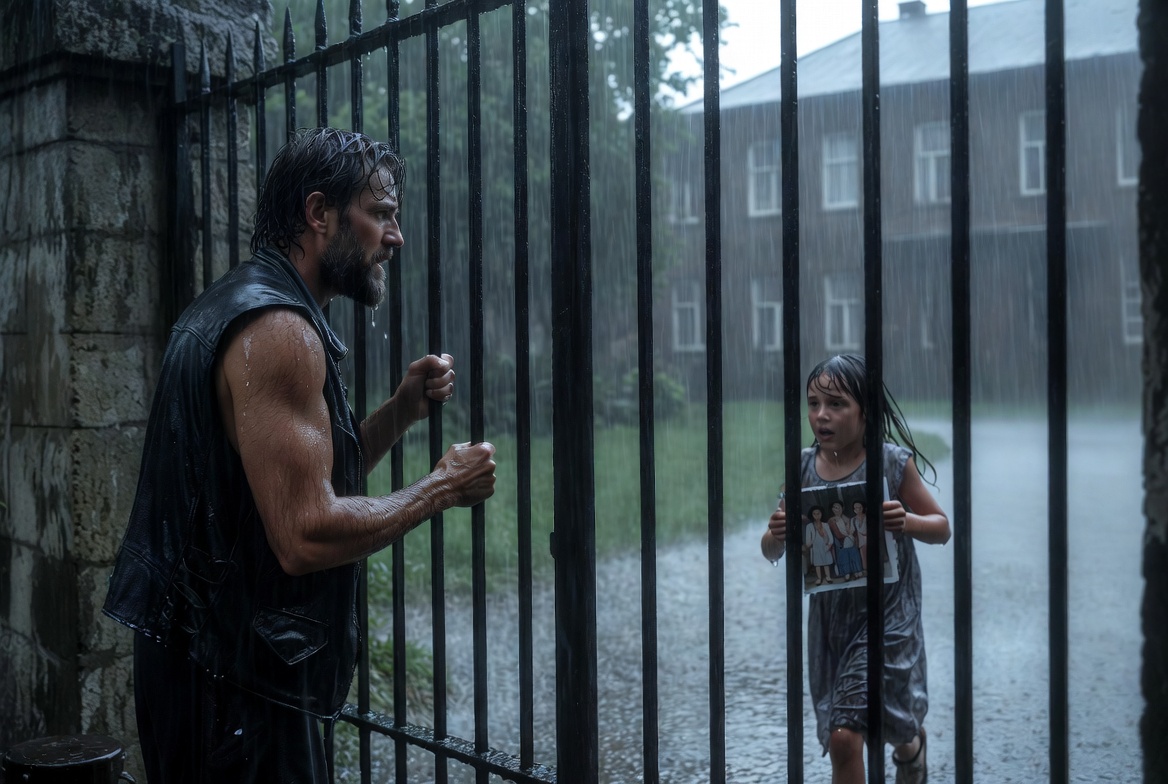
The rain fell in relentless silver sheets, turning the orphanage driveway into a shallow river of mud and regret. Atlas sat astride his Harley like a sentinel carved from storm itself—broad shoulders hunched beneath a sodden leather cut, knuckles white as they gripped the iron bars of the locked gate. Water streamed from the brim of his bandana, but he did not blink. He simply stared through the bars toward the lighted windows of the old Victorian building, as if sheer will could bridge the distance that the law had forced between them.
Emma saw him first.
The seven-year-old orphan sprinted across the lawn in mismatched sneakers, her thin nightgown plastered to her legs, clutching something crumpled and precious against her chest. A torn family portrait—her mother’s smiling face now severed from the rest by a jagged rip. She reached the gate gasping, small fingers threading between the bars to touch his.
“You came,” she whispered, voice cracking like thin ice. “Even though they said you couldn’t.”
Staff silhouettes appeared in the doorway, flashlights cutting through the downpour. Someone was already on the phone with the authorities. Atlas didn’t move. He had been warned, suspended from visits after the last “incident”—the one where he had quietly repaired the orphanage’s broken swing set at midnight and left a new pair of rain boots on Emma’s doorstep with a note that simply read *For puddle jumping*. The administration called it boundary violation. He called it keeping a promise.
He had not crossed the gate line. Not once. Not in all the months he had returned every Saturday at precisely 4:17 p.m., the same hour his sister—Emma’s mother—had died in a crash on the interstate. Emma once told him, in that devastatingly matter-of-fact way only children who have lost everything can manage, that adults always disappeared right after they used words softer than goodbye. So Atlas gave her no soft words. Only presence. Rain or shine. Threat of arrest or not.
The low growl of another motorcycle joined the storm. A second rider, younger, patched in the same club, killed the engine and approached on foot. In his gloved hands he carried three things that would change everything:
Atlas’s spare leather vest, freshly cleaned and folded.
A thick manila envelope stamped with the county’s foster care seal.
And a sealed letter, edges worn from being carried in a saddlebag for weeks—words Atlas had written in the dead of night, never meant for Emma’s eyes.
The younger rider passed them through the bars without a word. Atlas accepted them in silence, rain mixing with something fiercer on his scarred face. Emma’s eyes widened at the sight of the vest. She had once traced the patches with reverent fingers, calling him her “leather dad” in a moment of shy courage that had nearly broken him.
He opened the letter first, hands trembling for the first time in years. The final page contained only six handwritten words, scrawled in the unsteady script of a man more comfortable with wrenches than feelings:
*I started painting your room the day you first called me Dad.*
The admission hung between them like lightning. Months ago—long before any social worker had approved paperwork, before the system had even known his name—he had bought pale yellow paint because Emma once said yellow felt like safety. He had cleared the junk from the spare room above his garage, installed childproof locks, and hung fairy lights along the ceiling so she would never be afraid of the dark again. All while telling himself it was just in case. Just a foolish old biker’s dream.
Emma’s breath hitched. The torn portrait fluttered in her grip as she pressed her forehead against the cold iron, tears cutting clean paths through the rain on her cheeks.
“Atlas…” she began, voice small but fierce.
Sirens wailed in the distance. The staff was closing in. The younger rider shifted uneasily, ready to pull his brother away before cuffs could close.
But Atlas remained rooted, eyes locked on the little girl who had somehow become the center of his broken universe. The foster application felt heavier than any engine block he had ever lifted. The vest smelled of home. And those six words—those impossible, vulnerable six words—had just torn open the last wall he had built around his heart.
This was the moment everything could shatter.
Or finally begin.
PART 2
The sirens grew louder, slicing through the rain like accusations. Atlas didn’t flinch. He dropped to one knee in the mud outside the gate, bringing his scarred face level with Emma’s so the world narrowed to just the two of them. Water streamed between the bars, but her small hand found his anyway—cold, trembling, yet gripping with surprising strength.
“I read the letter,” she whispered. “The one you didn’t want me to see.”
His chest tightened. That letter had been his confession, written in the quiet hours after club runs when the ghosts of his past rode harder than any highway. Pages of apologies for the life he led, promises he had no right to make, and the simple truth that a man who once lived for the open road had found his reason to stay.
“I started painting your room the day you first called me Dad,” he repeated hoarsely, the six words no longer just ink on paper but a vow spoken aloud. “Yellow, like you wanted. With stars on the ceiling so you’d never feel alone at night. There’s a shelf for your books… and a hook for your coat right by the door. I even got that stupid unicorn night-light you pointed out at the store last month.”
Emma’s eyes shimmered, a fragile mix of wonder and fear. Behind her, the orphanage director barked orders. Two staff members were gently but firmly trying to pull her back toward the warm lights of the building. She dug her heels in, refusing to let go of the gate.
“You’re not supposed to be here,” the director called, voice sharp with authority and something like pity. “The court order was clear after the last visit, Mr. Kane. No contact until the investigation is complete.”
Atlas rose slowly, rain dripping from his beard, but his gaze never left Emma. He had lived a life of broken rules and harder consequences—fists, engines, loyalty bought in blood. Yet nothing in that rough existence had prepared him for the terror of losing this one small girl who had seen past the leather and tattoos to the man beneath.
The second rider—Jax, his club brother—stepped forward, holding out the foster application like a shield. “He’s doing it right this time,” Jax said, voice low but steady. “Paperwork filed. Background cleared. Even talked to that social worker who hates bikers. He’s all in.”
Emma looked at the manila envelope, then back at Atlas. “You really want me? Even though I… even though I’m broken?”
The word hit him harder than any punch he’d ever taken. Broken. She had said it once before, after waking from a nightmare about the crash that took her mother. Atlas had sat outside the window that night, telling her stories through the glass until dawn—stories of a little girl who tamed dragons and rebuilt kingdoms from the ashes.
“You’re not broken, kid,” he growled, voice thick with emotion he no longer tried to hide. “You’re the strongest person I know. And if they let me, I’ll spend every damn day proving that home isn’t a place that disappears when the words get hard.”
A police cruiser skidded to a halt at the curb, lights painting the rain in frantic red and blue. Officers stepped out, hands near their belts, assessing the scene. One recognized Atlas—old history from bar fights and bad decisions—but the other noticed the way Emma clung to the bars, the way the big biker kept his hands visible and his voice soft.
Time stretched taut. Emma’s grip tightened. “Don’t go,” she pleaded, the torn portrait now soaked and clinging to her chest like a second skin. “Please don’t use soft words and leave.”
Atlas swallowed hard, every instinct screaming at him to tear the gate from its hinges. Instead, he reached through the bars one last time, brushing a rain-soaked strand of hair from her face.
“I won’t,” he said, the promise raw and unshakable. “Not this time.”
The officers moved closer. The director reached for Emma. Jax muttered a warning under his breath.
And in that suspended heartbeat—between arrest and hope, between the life he knew and the one he desperately wanted—Atlas realized the real battle had only just begun.
The storm raged on, but something deeper was breaking open inside him.
PART 3
The rain eased into a whisper as the officers approached, their boots splashing through puddles that reflected the chaos of flashing lights. Atlas kept his hands open and visible, a lifetime of instinct urging him to fight or flee. But he stood firm, eyes only for the little girl whose fingers still curled desperately around the iron bars.
“Step back, sir,” one officer said, voice cautious but not unkind. The other glanced at the foster application Jax had thrust forward, then at the way Emma refused to budge.
She was crying now—quiet, determined sobs that cut deeper than any accusation. “He’s my dad,” she told them, voice rising with a ferocity that silenced the adults. “He painted my room yellow. He came every Saturday even when they said no. He didn’t leave.”
The director hesitated, the weight of paperwork and protocol warring with the raw scene before her. Atlas met her gaze steadily. “I’m not asking for favors,” he said, low and steady. “I’m asking for a chance to do right by her. The way her mother would’ve wanted.”
In the end, it wasn’t the law or the club or even the storm that decided. It was Emma. She slipped the torn family portrait through the bars into Atlas’s hand, then turned to the director with the quiet dignity of someone who had already survived too much.
“If he goes, I go with him. In my heart. Always.”
Something shifted in the air. The officers exchanged looks. After tense radio calls and a temporary standoff that felt like hours compressed into minutes, a reluctant decision was made: no arrest tonight. A welfare check would follow. The foster application would be expedited under supervision. Boundaries remained, but a door—narrow, guarded, yet real—had cracked open.
Weeks blurred into a careful dance of visits, evaluations, and late-night rides where Atlas would circle the block just to see her window light. He finished the yellow room with his own hands, adding shelves for books about dragons and stars that refused to fall. The unicorn night-light cast gentle shadows across walls that now held promise instead of emptiness.
On the day the judge finally signed the papers, Atlas waited outside the courthouse in clean jeans and his patched vest, heart hammering harder than any engine he’d ever rebuilt. Emma walked out holding a small duffel bag, the repaired family portrait now tucked safely inside.
She didn’t run this time. She walked straight into his arms, burying her face in the familiar leather that smelled of rain, oil, and home.
“No more gates,” she whispered.
“No more gates,” he agreed, voice rough with unshed tears. For the first time in years, Atlas Kane—suspended biker, reformed storm chaser, reluctant father—felt the road ahead wasn’t one he had to ride alone.
They rode off together on the Harley, Emma tucked safely in front, her laughter rising above the engine’s roar. Behind them stretched the past: loss, rain, and locked gates. Ahead lay yellow walls, fairy lights, and the slow, stubborn work of building a family from broken pieces.
Some legends are written in blood and thunder. This one was written in six handwritten words, a child’s trust, and a love stubborn enough to outlast any storm.
And for the first time, Atlas understood: home wasn’t a destination. It was the hand that never let go.
THE END