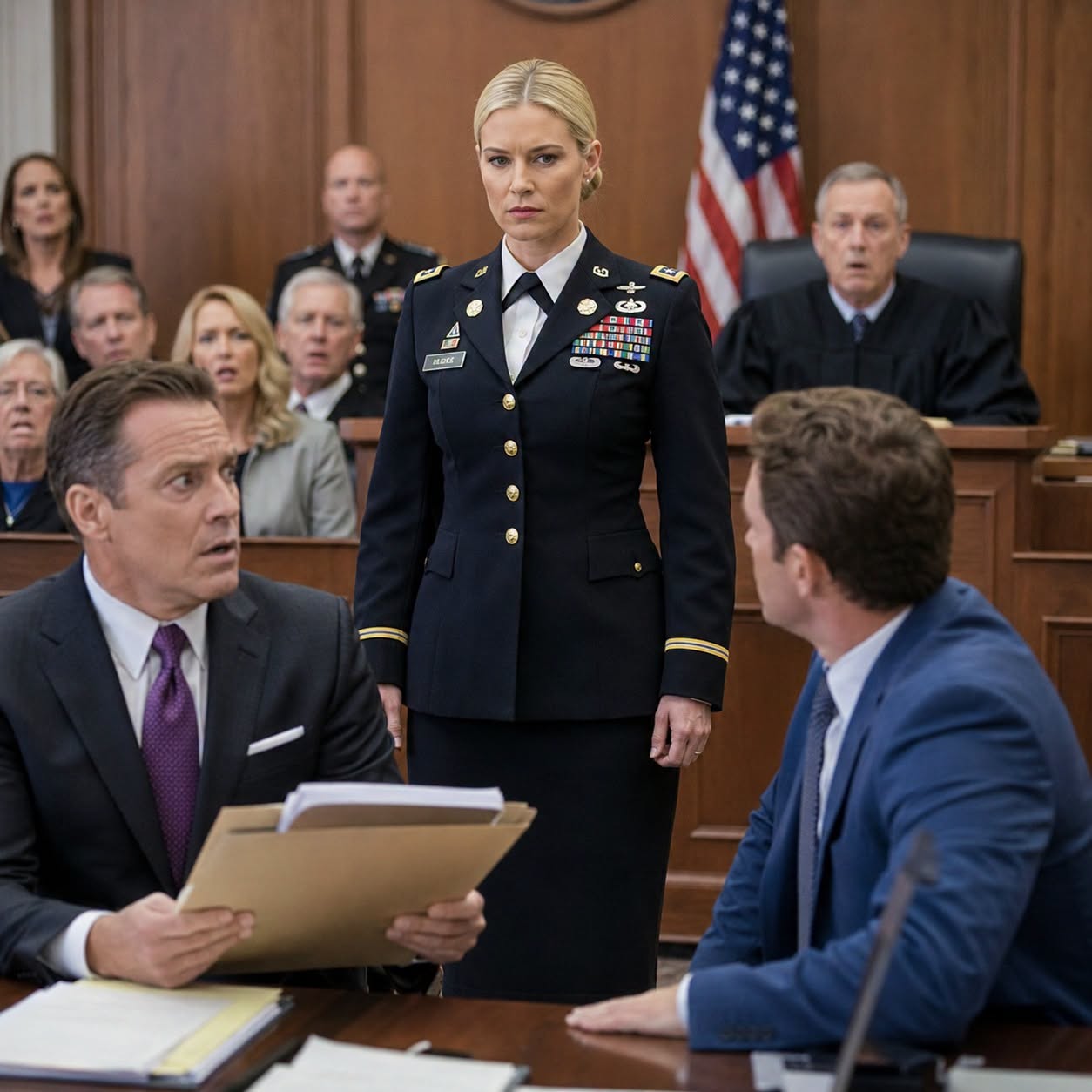
“NICE COSTUME,” my stepbrother sneered the moment I stepped into the courtroom, crisp in my Army dress uniform. Then his lawyer looked up. The man’s face drained to the color of ash. The thick leather folio slipped in his grip. For one impossible second, the air itself seemed to freeze—judges, spectators, even the dust motes in the slanted morning light holding their breath
Ethan’s triumphant smile cracked like cheap porcelain.
Eighteen years earlier, I had dragged that lawyer’s daughter through a storm of bullets while the world burned around us. And now, the man Ethan had paid a fortune to bury me was staring at the one person alive who could destroy everything he had built.
My brother thought he had purchased victory.
He had hired his own reckoning.
PART 1 — THE ENVELOPE
The process server found me in the grocery-store parking lot, mesh bag of oranges cutting into my hip, the North Carolina sun pressing down like an unwelcome hand on my shoulder.
“Your brother says you manipulated a dying man,” he announced, loud enough for the curious strangers drifting past with their carts to hear every word.
I had been home from deployment for six days. Six days of waking at 0300, fingers twitching for a rifle that no longer rested beside my bed, heart still calibrated to the rhythm of distant mortars.
I took the envelope without a word.
ETHAN BAILEY v. PAIGE BAILEY.
The names sat one above the other like a verdict already rendered.
A short, bitter laugh escaped me—not because anything about this was funny, but because screaming in a parking lot would have handed Ethan the satisfaction he craved.
That night, I sat at my kitchen table beneath the single hanging bulb, the complaint spread before me like a battle map. Ice water sweated in the glass beside my hand, slowly warming to room temperature, forgotten.
Ethan’s lawyer had painted me as an uneducated military brute who had preyed on a confused old man, isolating him from his “only devoted son” and stealing the family legacy: the Bailey farm, the town house, the investments, and control of the scholarship trust that bore our father’s name.
The document mentioned my uniform nine times. Nine times my service was twisted into evidence of something predatory.
It did not mention the $198,000 Ethan had borrowed and never repaid.
It did not mention the golf resort in Arizona where he had been vacationing while our father fought pneumonia in the ICU.
It said nothing of the twenty-three-hour flight I had endured from the other side of the world, the vinyl hospital chair where I had slept for weeks, spooning ice chips between Dad’s cracked lips while monitors beeped their fragile hymn.
Paper, I reminded myself, only carries the lies people are willing to pay for.
I folded the complaint with deliberate care and set it beside the salt shaker. Upstairs, in the quiet dark of my childhood bedroom, I lay fully clothed on the bed and stared at the ceiling.
In the Army, you do not plan your next move when your hands are still shaking. You sleep. You breathe. You study the ground you will have to fight across when dawn comes.
Two mornings later, Ethan went on local television.
He sat in a polished blue suit, every hair in place, playing the wounded son with practiced sorrow while the sympathetic host tilted her head like a concerned aunt.
“She spent her life hiding behind that uniform,” he said, voice thick with fabricated grief. “Paige never learned how to live in the real world. So she came home and took what was never hers.”
My coffee stopped halfway to my lips.
He knew the truth. He knew every flight, every vigil, every sacrifice. Yet he smiled at the camera, weaponizing small-town judgment like a marksman.
By lunchtime, the internet had done what it does best. Thousands of comments branded me a gold-digger, a leech, a disgrace to the flag I had sworn to defend. One woman wrote that medals do not make you a good daughter.
She was right.
Showing up does.
I did not answer the posts. I did not call Ethan. I did not demand equal airtime.
Silence is a weapon too, especially against those who need noise to survive.
But silence has teeth.
At a quiet diner outside Fayetteville, two old veterans fell silent when I walked in. Their sudden, careful politeness hurt more than any insult. I ordered black coffee, slid into a corner booth, and opened a yellow legal pad.
At the top of the page I wrote three questions in block letters:
Who benefited? Who had access? What is Ethan terrified the court will find?
My attorney, Lena Ortiz, arrived twenty minutes later in a charcoal suit that looked sharp enough to cut glass. She carried the calm ferocity of someone who had spent her career dismantling bullies.
“He hired Richard Whitmore,” she said without preamble.
Even I knew the name. Whitmore was a legend—the estate litigator who could make corporations and bloodlines disappear with a few measured sentences. Most lawyers settled rather than face him in open court.
“Good,” I replied.
Lena blinked. “Good?”
“The sharper the blade, the quicker it notices when something doesn’t fit.”
I slid the legal pad across the table. We reviewed the facts together: Dad’s old computer left unguarded in the study after the funeral. Ethan and his wife Carol’s two unsupervised hours inside the house before I changed the locks. The hospice files stored in a cabinet Ethan knew intimately. The outdated security system our father had installed years earlier after a break-in scare.
Lena circled the last note. “Cameras?”
“I don’t know if they still work.”
Her pen hovered, then stilled.
For the first time, something like hope—sharp and dangerous—moved between us.
The preliminary hearing arrived on a Monday heavy with humidity.
I stood before my bedroom mirror and dressed with ritual precision: every ribbon aligned, every button gleaming, every insignia placed exactly where it belonged. Eighteen years of service reduced by Ethan to a punchline. I would not walk into that courtroom pretending to be smaller.
The courthouse smelled of old oak, stale coffee, and generations of human fear.
Ethan sat at the plaintiff’s table beside Carol, whose pearl earrings and soft pastel suit gave her the air of graceful widowhood. When she saw me, her mouth pinched into a thin line.
Ethan leaned in as I passed.
“Nice costume,” he whispered, venom wrapped in silk.
I paused, looking down at him.
“Enjoy today,” I said quietly. “It may be the last day anyone still believes you.”
His smile faltered.
Then the side door opened.
Richard Whitmore entered carrying a folio thick enough to bury me. Tall, silver-haired, utterly composed—until his eyes lifted and found mine.
The color fled his face.
His fingers loosened. The folio dipped.
In front of the judge, my brother, and half the county, the most feared lawyer in North Carolina breathed a single, stunned whisper:
“It’s really you?”
He remembered.
Of course he remembered.
And Ethan had just invited the one man who owed me a debt no fortune could repay straight into the heart of his own destruction.
PART 2 — THE RECKONING
The courtroom, which only seconds earlier had hummed with the low murmur of anticipation, now felt like the inside of a pressure chamber. Every eye swung toward Richard Whitmore as if the man had suddenly grown a second head.
He stood frozen in the aisle, silver hair catching the light from the tall windows, the heavy folio trembling in his grasp. For a man renowned for carving up fortunes with surgical calm, the sight of me had undone him completely.
“Mr. Whitmore?” the judge prompted, her voice sharp with irritation. “Are you prepared to proceed?”
Ethan twisted in his seat, confusion flickering across his features. He had hired the best, and now his weapon was staring at the enemy like a man who had seen a ghost rise from the grave. Carol’s hand fluttered to her pearls, sensing the shift without understanding it.
I remained standing, uniform sharp as a blade, ribbons a silent testament to choices Ethan would never comprehend. My pulse was steady—combat steady. I had faced worse than this room full of judgment.
Whitmore cleared his throat, but the sound came out ragged. He forced his gaze away from me and moved to the plaintiff’s table, yet the damage was done. The ghost-white pallor remained. When he finally spoke, his legendary voice—usually velvet over steel—carried a faint tremor.
“Your Honor,” he began, “before we address the motion, there is… a matter of professional ethics I must disclose.”
Ethan’s head snapped toward him. “What are you talking about?”
Whitmore did not look at my stepbrother. He looked at me.
Eighteen years collapsed in that single glance.
I saw it again in my mind’s eye: the narrow street in Kandahar, dust and cordite thick in the air, the ambush erupting like hell itself opening its jaws. Whitmore’s daughter—then a wide-eyed aid worker barely twenty-three—had frozen in the kill zone. I had sprinted through gunfire, grabbed her by the webbing of her vest, and dragged her behind cover while rounds chewed the wall above our heads. She had screamed my name as I shielded her with my own body, blood from a graze on my arm painting her shirt.
Her father had flown halfway around the world afterward. He had found me in a field hospital, eyes hollow with gratitude and something deeper— the unbearable weight of a debt that could never be repaid. “Anything,” he had whispered then. “Name it. Anything.”
I had asked for nothing.
Until now.
Whitmore set the folio on the table with exaggerated care, as though it contained explosives. “Your Honor, I find myself in an irreconcilable conflict of interest. I must withdraw from this case immediately.”
The courtroom erupted.
Ethan shot to his feet. “You can’t be serious! We have an agreement!”
“Sit down, Mr. Bailey,” the judge snapped, but her eyes had narrowed with new interest.
Whitmore continued, each word measured but laced with quiet thunder. “Eighteen years ago, in Afghanistan, Captain Paige Bailey—then First Lieutenant—saved my daughter’s life under enemy fire. She risked everything. I owe her a debt I can never settle. Representing the man attempting to destroy her would be an ethical violation I cannot ignore.”
He turned to Ethan, and for the first time, the predator in Whitmore’s reputation showed—not toward me, but toward the man who had hired him.
“You told me this was a straightforward inheritance dispute,” Whitmore said, voice dropping. “You failed to mention the full context. Or perhaps you didn’t know it yourself.”
Ethan’s face flushed crimson. “This is outrageous! She’s manipulating you just like she manipulated my father!”
But the seed had been planted. Whispers rippled through the gallery. The judge called for order, yet her gaze kept returning to me with fresh appraisal.
Lena Ortiz leaned back in her chair, a small, satisfied smile playing at the corners of her mouth. She caught my eye and gave the faintest nod.
I should have felt triumph. Instead, a deeper ache bloomed behind my ribs.
This wasn’t just about the farm, the money, or even clearing my name. It was about the years I had given—deployments that stole pieces of my soul, nights when the weight of command crushed the breath from my chest, the quiet erosion of self that no medal could restore. Ethan had reduced it all to a “costume.”
And now the lie was cracking open in public.
Whitmore gathered his things with deliberate dignity. As he passed my table, he paused. His voice was low, meant only for me.
“I never forgot, Captain. I still haven’t. Whatever evidence they prepared…” His eyes flicked toward the folio. “I suspect it won’t hold. Not against the truth.”
He left the courtroom without another word.
The judge recessed the hearing for two weeks to allow Ethan time to secure new counsel. As the gavel fell, Ethan whirled on me, eyes wild with fury and something closer to fear.
“You think this changes anything?” he hissed. “I still have the evidence. Dad’s own signature. You’re finished.”
I met his gaze without flinching. “Then bring it, Ethan. Bring everything. Because I’m done carrying the weight of your failures.”
He stormed out, Carol trailing behind like a shadow.
But as the courtroom emptied, Lena slid a single sheet of paper across the table to me. It was a preliminary forensic note she had requested on the security system.
“The cameras,” she whispered. “They were still recording. And there’s footage from the night before Dad’s final amendment to the will.”
My breath caught.
The real battle had only just begun.
And somewhere in that footage lay the truth capable of ending Ethan’s carefully constructed world forever.
PART 3 — THE TRUTH THAT REMAINS
Two weeks later, the courtroom felt smaller, heavier, as though the walls themselves had absorbed the tension and were pressing back. Ethan had hired new counsel—a competent but lesser man named Hargrove, who carried himself with the nervous energy of someone stepping into a minefield.
I sat beside Lena in my dress uniform once more. Not for show this time, but as armor. These ribbons had been earned in silence and fire; they would witness the end of this chapter.
The footage changed everything.
On the grainy security recording from that final night, Ethan could be seen leaning over our father’s bedside, voice low and insistent while Dad—weak from medication and exhaustion—struggled to follow. Carol hovered in the background, printing documents. The camera captured Ethan guiding Dad’s trembling hand across papers that were not the ones later filed with the court. A second set. A forged amendment.
The signature had been traced. The timestamps didn’t match. Even the ink was wrong.
Lena presented it with clinical precision, each piece of evidence another stone in the foundation of Ethan’s ruin. Whitmore, true to his word, had quietly provided an affidavit confirming irregularities he had spotted in the documents Ethan originally gave him—subtle enough to slip past most eyes, but glaring to a man of his caliber.
Hargrove tried valiantly, but the ground had shifted beneath him. The judge’s expression hardened with every new revelation.
When Ethan took the stand, he crumbled.
“I only wanted what was fair,” he insisted, sweat beading at his temples. “She was never there. Not really. Always off playing soldier while I handled everything.”
I rose when it was my turn to speak. The courtroom fell into a profound hush.
“I never wanted to fight you, Ethan,” I said, voice steady but laced with the weight of years. “I wanted our father to die in peace, knowing he was loved. I flew across oceans while you played golf. I held his hand through nights when the pain made him cry out for Mom. I did it not for the farm, not for the money, but because that is what love asks of us—presence, not performance.”
My gaze found his. “You reduced my service to a costume. But these scars, these ribbons—they represent every time I chose duty over comfort. I protected strangers on foreign soil. The least I could do was protect our father in his final days.”
I turned to the judge.
“I don’t ask for vengeance. I ask for truth. The farm, the trust, the house—none of it matters as much as the lie dying here today.”
Ethan’s face twisted with rage and desperation. In a final, desperate outburst, he shouted, “She’s always been the favorite! She stole him from me!”
But the evidence spoke louder. The forgery was undeniable. The financial trail—large withdrawals Ethan had made in the months before Dad’s death—painted a damning picture of motive.
The judge ruled in my favor within the hour. Full dismissal of Ethan’s claims. The estate remained as Dad had intended. Restitution was ordered for the money Ethan had already siphoned.
As the gavel fell, the weight I had carried for months—perhaps years—lifted. Not in triumph, but in quiet exhaustion. Justice, I realized, often tastes less like victory and more like the sorrowful closing of a wound.
Ethan didn’t look at me as he left. Carol followed, her elegant facade finally shattered.
Outside on the courthouse steps, the late afternoon sun bathed the square in golden light. Lena touched my shoulder. “You did it, Paige.”
I shook my head. “We did it. And Dad… he did it long before us by seeing clearly.”
That evening, I returned to the farm. The old house stood quiet, wrapped in the scent of pine and earth. I walked the fields where my father had taught me to trust the land and my own strength.
Service had taken much from me—friends, pieces of my youth, the ease of ordinary life. But it had also forged in me an unshakeable core: the knowledge that some things—loyalty, honor, showing up—are worth every sacrifice.
Ethan had chased shadows of legacy. I had lived it.
And in the end, the truth, like a steady rifle beside you in the dark, had been enough.
THE END