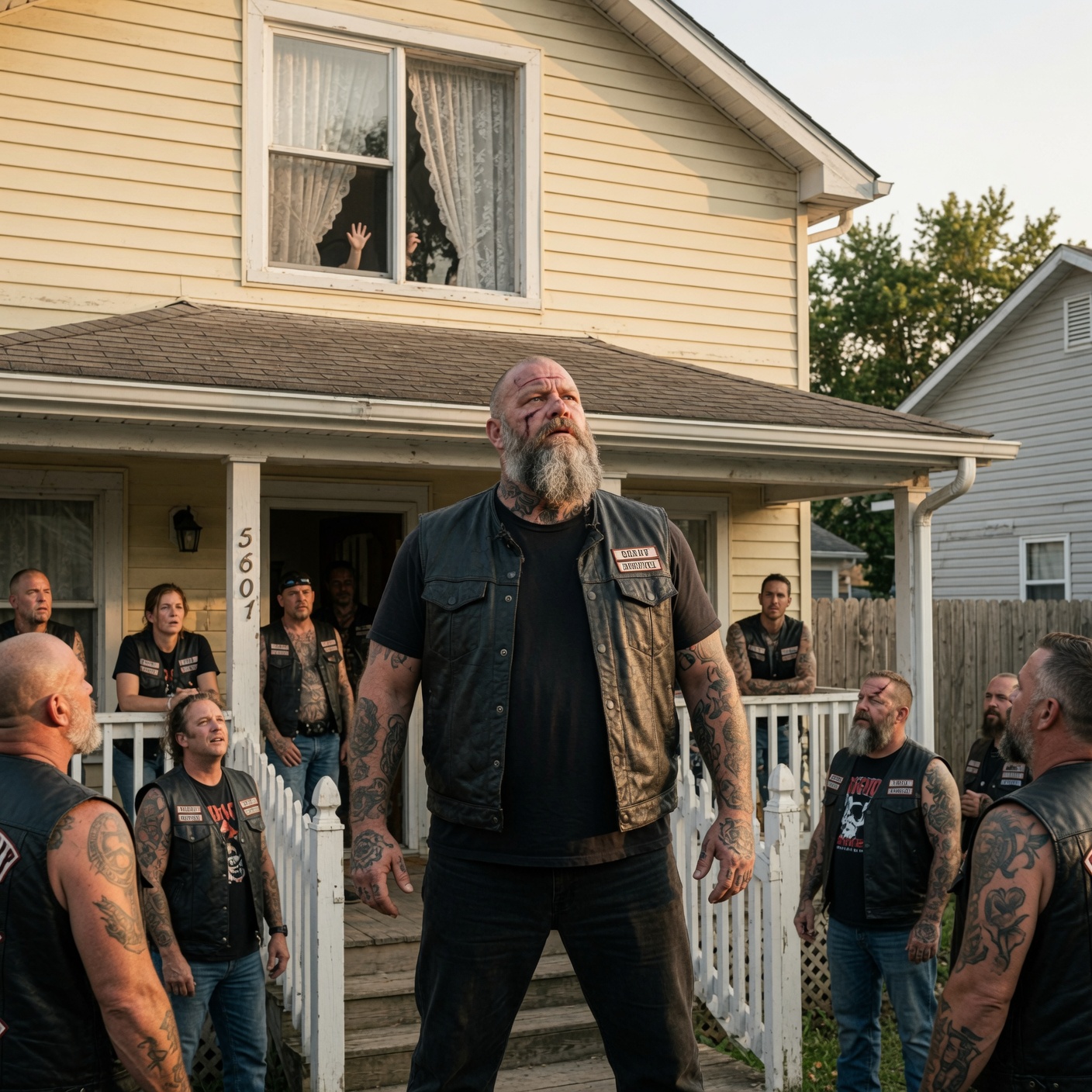
PART 2 — THE ROOM BEHIND THE BOOKCASE
The first time I heard Bear Callahan say the words “Open the sewing room!”, every person on the street froze.
I certainly did.
There was no sewing room.
At least, that was what everyone in Maple Ridge believed.
The blue Victorian house belonged to Harold Bennett, a retired contractor who lived with his wife Linda and her two grandchildren after their daughter died several years earlier. He rarely spoke to neighbors. The children were homeschooled. Curtains stayed closed.
People called them private.
Bear called them trapped.
A second crash echoed upstairs.
This time it sounded like furniture scraping across hardwood floors.
The Latina biker beside Bear—her road name was Vega—held up the cracked phone again.
Another message had appeared.
WE CAN’T OPEN IT.
Bear didn’t waste another second.
He stepped off the porch, grabbed a six-foot steel pry bar from one of the motorcycles, and drove it between the front door and the frame.
Harold Bennett appeared behind the frosted glass.
“Get off my property!” he shouted.
“My grandkids are sleeping!”
Bear’s voice stayed calm.
“No, Harold.”
“They’re asking for help.”
Harold’s face changed.
Just for a heartbeat.
Fear.
Not anger.
Fear.
He slammed both locks.
Bear looked at his riders.
“Windows.”
Within seconds, fifty bikers spread around the house—not to break in randomly, but to cover every possible exit.
Two stood behind the garage.
Three watched the backyard gate.
Others positioned themselves beneath the upstairs windows.
Nobody drew a weapon.
Nobody threatened anyone.
They simply waited.
Then a tiny fist struck the upstairs glass.
Once.
Twice.
A little girl’s face appeared for less than two seconds before someone yanked her backward.
The entire street gasped.
The police finally arrived.
Three patrol cars stopped so abruptly their tires squealed.
Officers rushed toward Bear.
“What the hell is going on?”
Bear immediately laid the pry bar on the ground and stepped back with both hands visible.
“The children are alive.”
“They’re upstairs.”
Officer Melissa Grant frowned.
“You have proof?”
Vega handed over the damaged phone.
The lock screen showed dozens of unanswered emergency messages sent over the previous week.
Every one came from the same hidden number.
The first simply read:
HELP.
The second:
HE TOOK OUR PHONES.
The last one, sent only nine minutes earlier, included a blurry photograph.
It showed a narrow room.
No windows.
A bookshelf.
Pink wallpaper.
And a brass doorknob fitted with a deadbolt…
…on the outside.
Officer Grant stared at the picture.
“How did they contact you?”
Bear answered quietly.
“My granddaughter runs an online art group.”
“One of the girls hid messages inside her drawings.”
Grant looked back at the house.
“So you know the child?”
Bear nodded.
“Emily.”
“She used to post pictures every Friday.”
“Then they suddenly stopped.”
“When my granddaughter asked why…”
“…Emily answered with colors instead of words.”
The officer didn’t understand.
Bear pointed to the phone.
“My granddaughter noticed every drawing suddenly included one blue square.”
“Always the same size.”
“It was Morse code hidden in pixel patterns.”
Grant blinked.
“Who figured that out?”
Bear looked toward Vega.
“She teaches computer security.”
Vega opened another image.
The blue squares translated into one sentence.
LOCKED BEHIND BOOKCASE ROOM.
Officer Grant no longer hesitated.
She ordered officers to enter the house.
Harold Bennett tried blocking the hallway.
He was handcuffed within seconds.
But when officers reached the second floor…
…there was no locked room.
Only bedrooms.
A bathroom.
And an old sewing room exactly where Harold insisted it had always been.
Bear never moved.
He simply stared at one wall.
“The bookshelf,” he whispered.
“Move it.”