My Mother Made Me Work Three Jobs to Pay for My Sister’s “Dream.” Then I Found Out My Sister Was on a Full Scholarship
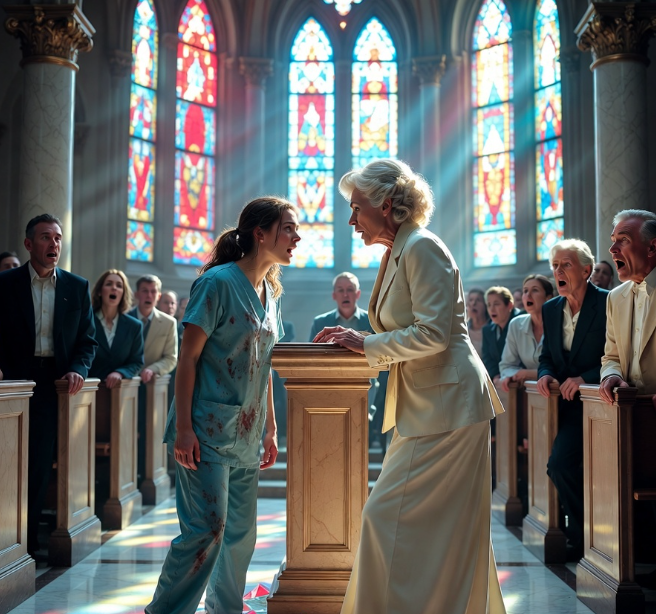
The stained glass of the St. Jude’s sanctuary cast long, fractured ribs of ruby and sapphire across the pews. It was a beautiful afternoon in Connecticut, the kind of day that looked like a postcard for “the American Dream.” My mother, Evelyn, stood at the pulpit, draped in a cream-colored silk suit that cost more than my monthly rent. She looked like an icon of maternal sacrifice.
“Strength isn’t found in the easy years,” Evelyn said, her voice catching with a practiced, melodic tremor. “It’s found when the cupboards are bare, when the patriarch falls, and when a mother has to put her own dreams into a box to ensure her children can fly.”
I stood in the very back, my shadow stretching down the center aisle. I was wearing the same nursing scrubs I’d been wearing for sixteen hours. I smelled of antiseptic and exhaustion. In my hand, I gripped a manila folder—the weight of it felt like a whetstone.
“Ashley,” my mother continued, gesturing to my sister in the front row. Ashley was glowing, her graduation gown draped over the pew beside her. “Through every hardship, through every dark night of my husband’s ‘illness’ and unemployment, we never let the light go out for you.”
The congregation let out a collective, sympathetic sigh. I saw Mrs. Higgins from down the street wipe a tear. They saw a saint.
I saw the woman who, forty-eight hours ago, had watched a glass of expensive Chardonnay slip from her hand and shatter near my boots as she told me my room had been rented out to a “suitable” tenant.
“Your part is finished, Marissa,” she had said, the crystal shards sparkling like diamonds between us. “You were the bridge. Now, Ashley is the destination.”
I looked at the middle of the room. My father, David, was sitting in the fifth row. He wasn’t in a hospital gown. He wasn’t “hollowed out” by the mysterious depression Mom had described to me for three years to justify why I had to work three jobs. He was wearing a sharp charcoal suit. He looked healthy. He looked… terrified.
Our eyes met. For three years, I had been told he was in a private facility, “too fragile” for visitors, his care paid for by my overtime shifts.
“When my husband’s career collapsed and the shadows grew long,” Evelyn whispered into the microphone, “I had to lead.”
I started walking.
The click of my clogs on the marble was a rhythmic intrusion into her sermon. Heads turned. The murmur of the crowd rose like a tide. My mother’s eyes flickered toward me. For a split second, the mask slipped—a flash of pure, predatory panic—before the “Saint Evelyn” smile returned.
“And here is our Marissa,” Mom said, her voice booming through the speakers. “The silent worker. The daughter who helped her mother carry the cross.”
I didn’t stop until I reached the foot of the pulpit. I didn’t look at the congregation. I looked at Ashley, who wouldn’t meet my eyes, and then at my father.
“The cross was heavy, Mom,” I said. My voice wasn’t amplified, but in the sudden hush of the church, it carried to the rafters. “Especially since I was the only one carrying it.”
The Three-Year Ghost
Three years ago, I was a month away from starting my residency. I had the stethoscope my father had bought me, a tiny apartment in Boston, and a life that felt like it was finally beginning.
Then came “The Collapse.”
My mother had called me, hysterical. Dad had lost his executive position at the firm. He’d had a “breakdown.” The house was in foreclosure. Ashley’s Ivy League dreams were about to turn into ash.
“Family helps family, Marissa,” she had whispered over a cold kitchen table.
So, I stayed. I traded the residency for twelve-hour shifts at a private clinic, weekend shifts at a hospice center, and nights doing medical coding until my eyes bled. I lived in my childhood bedroom. I gave Mom my paycheck every Friday. I paid for Ashley’s tuition, her “study abroad” in Florence (which Mom said was vital for her mental health), and the staggering bills for Dad’s “treatment.”
I never saw the bills. “It’s too painful for you, honey,” Mom would say, tucking my $2,000 checks into her designer purse.
I became a ghost in my own life. I wore the same two pairs of scrubs for three years. I stopped seeing friends. I stopped being Marissa; I became a transaction.
Then came last Tuesday. I had finally saved the last $9,000 for Ashley’s final semester. I handed the check to Mom. I felt a sense of pride. I thought, Finally, we’re all going to be okay. Now I can go back to my life.
I had walked into my room to find it stripped. The walls were bare. My books, my medals from med school, my grandmother’s quilt—gone.
“I’ve signed a lease with a young professional from the city,” Mom had said, sipping her wine. “He moves in Monday. Your things are in a storage unit on the edge of town. I paid for the first month. Consider it a parting gift.”
“Parting gift?” I had gasped. “Mom, I just gave you nine thousand dollars. I have nowhere to go.”
“You’re an adult, Marissa. You’ve been so… stagnant lately. It’s time for you to find your own way. Ashley is graduating. Our family’s struggle is over.”
That’s when the glass hit the floor. Crunch. I left with nothing but my car and my purse. I spent the night in the hospital breakroom, crying into a paper towel. At 3:00 AM, my phone started vibrating.
It was a number I didn’t recognize. I answered, expecting a debt collector.
“Marissa?”
The voice was deep, steady, and vibrating with a decade of suppressed grief.
“Dad?”
“I’m in a hotel in Stamford,” he said. “I’ve been trying to find you for eighteen months. Your mother told the court you moved to London. She told the neighbors you wanted nothing to do with us because of the ‘shame’ of my job loss.”
“Job loss? She said you were in a facility, Dad. She said you couldn’t speak.”
“I was in a legal battle, Marissa. I was fired because I blew the whistle on the firm’s embezzlement. I won the wrongful termination suit a year ago. I’ve been sending five thousand dollars a month in alimony and child support to that house. I thought you were back in residency. I thought Ashley was on a scholarship.”
The world didn’t just shift; it shattered.
The Pulpit of Truth
Back in the church, my mother tried to step down from the podium to intercept me, but I stepped up the stairs, meeting her halfway.
“Marissa, dear, you’re exhausted,” she whispered, her hand gripping my arm with bruising force. “Let’s go to the back. You’re making a scene.”
“I’ve spent three years making a life for Ashley,” I said, pulling my arm away. “I think I’m allowed one scene.”
I turned to the congregation. I saw the confused faces. I saw my father stand up, his face set in a mask of grim determination.
“My mother just told you a story about a family that survived on grace,” I said into the microphone. “I want to tell you a story about a family that survived on a lie.”
I opened the folder.
“This is a cashier’s check for nine thousand dollars,” I said, holding up a photocopy. “I gave it to my mother forty-eight hours ago. It was for Ashley’s ‘final semester.’ But Ashley, you’ve been on a full-ride merit scholarship since sophomore year, haven’t you?”
Ashley’s face went a dusty shade of grey. She looked at the floor.
“And Dad,” I said, looking at him. “Mom told me you were in a psychiatric ward for three years. She told me the five thousand dollars I gave her every month was for your ‘specialists.'”
The congregation gasped. The sound was like a collective intake of air before a scream.
“But my father has been working as a consultant in Boston,” I continued, my voice gaining strength. “He’s been sending money. He’s been trying to reach me. But his emails were blocked. His letters were intercepted. My mother told me he was a ghost, and she told him I was a stranger.”
I looked at Evelyn. She was frozen. The “Saint” was gone; in her place was a woman whose entire empire of cards was blowing away in a cold wind.
“Where did the money go, Mom?” I asked. “The hundred and fifty thousand dollars of mine? The hundreds of thousands from Dad? Was it the ‘Study Abroad’ that was actually a vacation in Bali for you and Ashley? Was it the new kitchen you told me was a ‘repair’ for a burst pipe? Or was it the rent you’ve already collected for my room?”
I reached into the folder and pulled out a final set of papers.
“This is a bank statement I found in the trash when I was packing my life into garbage bags,” I said. “It’s an account in Ashley’s name. It has sixty thousand dollars in it. My overtime. My missed sleep. My stolen residency.”
Ashley burst into tears and ran for the side door.
My mother finally found her voice. “I did it for the family! I did it to keep our status! To make sure we weren’t looked down upon!”
“No,” I said, stepping off the pulpit. “You did it for the cream suit. You did it for the glass of wine. You did it because you found a way to turn your eldest daughter into an ATM and your youngest into an accomplice.”
I walked down the aisle. My father met me halfway. He didn’t say anything; he just pulled me into a hug that smelled like the childhood I thought I’d lost. He felt solid. He felt real.
“I have the car packed,” he whispered. “Your residency spot? I called the Dean. I told him the truth. They’re holding a place for you in the fall.”
I looked back one last time. My mother was standing alone at the pulpit. The congregation was getting up, their faces twisted in disgust and hushed gossip. The light through the stained glass didn’t look like ruby and sapphire anymore; it looked like bruises and sirens.
The New Architecture
Six months later, the air in Boston was crisp. I was standing in the lobby of the Mass General, my white coat heavy on my shoulders. It was a weight I actually wanted to carry.
My phone buzzed.
It was a text from Ashley. Mom is selling the house. She says she’s broke. She’s asking for your address. Please, Marissa, she’s still our mother.
I thought about the broken glass on the floor. I thought about the three years of coded charts and “Family helps family” lectures.
I typed back: My part is finished.
I blocked the number.
I checked my stethoscope—the one my father had bought me, which he’d kept in a safe-deposit box for three years because he knew I’d need it again.
I walked into the ER, ready for my shift. There were no ghosts here. Only patients. Only the truth. And for the first time in a very long time, I wasn’t the bridge to someone else’s destination.
I was exactly where I was supposed to be.