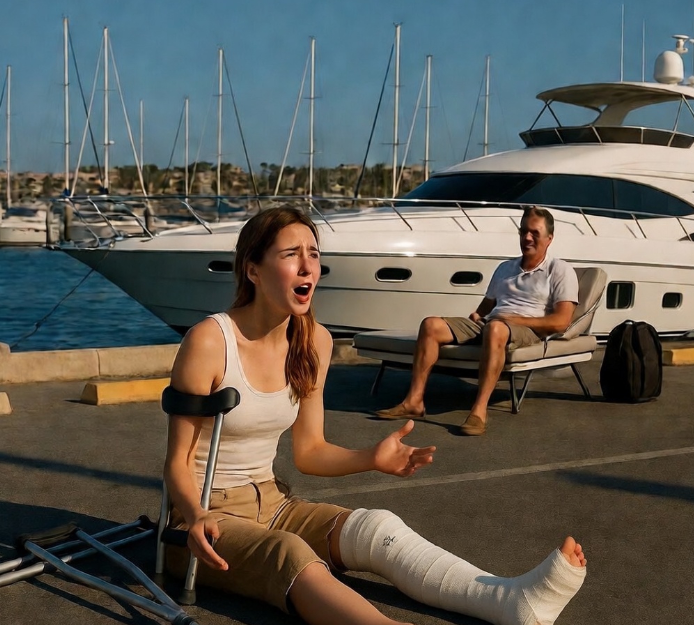
They Chose a Boat Over My Health – “You’ll manage, El. You always do. Maybe you can get a cool cane with a sword in it.”
The humidity in Savannah, Georgia, felt like wet wool, heavy and smelling of salt marshes and diesel. I sat on the edge of a rusted metal exam table in a clinic that smelled of floor wax and desperation. My right leg, encased in a temporary brace, throbbed with a rhythmic, sickening heat.
Dr. Aris, a man whose weary eyes suggested he had seen too many soldiers break in ways that didn’t involve bullets, sighed as he looked at the scans.
“Elena, the shrapnel from that training accident did more than nick the bone. The infection is aggressive. I can save the leg, but I need to operate by Friday. If we wait, the nerve damage becomes permanent. You’ll have a limp at best, or a prosthetic at worst.”
“How much?” I asked, my voice sounding thin even to my own ears.
“With your current insurance gap? Five thousand dollars upfront for the specialist and the facility fee. I’m sorry. I know the timing is hell.”
I walked out of the clinic on crutches, the sun blindingly bright. Five thousand dollars. To a twenty-three-year-old Army Specialist who had spent her meager savings on a cross-country move after her discharge, it might as well have been five million.
I called the one place I thought was safe. Home.
The Luxury of Apathy
My father answered on the second ring. I could hear the clinking of ice against glass and the distant, rhythmic cry of seagulls.
“Dad? It’s Elena. I just left the doctor.”
“Oh, hey, Peanut,” he said, his voice breezy and light. “Listen, you caught us at a great time. We’re down at the marina.”
“Dad, I need help. The leg—the surgery—it’s five thousand dollars. If I don’t get it by Friday, I won’t be able to walk right again. Dr. Aris said—”
“Five thousand?” My father’s tone shifted, the breeziness replaced by a sharp, paternal disappointment. “Elena, we talked about budgeting. Responsibility. We just closed on the Lady Lucinda this morning. Thirty-two feet of pure fiberglass heaven. The slip fees alone are a nightmare.”
“Dad, I’m talking about my leg,” I whispered, my grip tightening on the phone.
My mother’s voice drifted in from the background, muffled but clear. “Is that Elena? Tell her a limp builds character. It’ll teach her to be more careful. Responsibility isn’t bought, it’s earned.”
“You heard your mother,” Dad said, sounding almost sympathetic. “Bad timing, kiddo. You’re young; you’ll adapt. Humans are resilient. Besides, a slight limp has a certain… rugged charm, doesn’t it?”
In the background, I heard my sister, Chloe, laugh. “You’ll manage, El. You always do. Maybe you can get a cool cane with a sword in it.”
The line went dead.
I stood in the parking lot, the heat rising off the asphalt in shimmering waves. I wasn’t just a daughter to them; I was a line item that had been deleted to make room for a boat.
I drove to my brother’s tiny, oil-stained garage on the outskirts of town. Leo was twenty-five, a high school dropout who could fix anything with an engine but couldn’t seem to fix his own bank account. He was covered in grease, leaning over the manifold of a beat-up Chevy.
“Hey, Sis,” he said, wiping his hands on a rag. “You look like hell.”
I told him. I told him about the five thousand, the boat, and the “rugged charm” of being disabled.
Leo didn’t say a word. He walked to the back of the garage, to the heavy, red Snap-on toolbox that was his only inheritance from our grandfather. It was his livelihood. Without those tools, he couldn’t take on private jobs. He’d be stuck as a minimum-wage oil changer at the local Jiffy Lube.
He started hauling the heavy drawers out, loading them into the back of his rusted truck.
“Leo, what are you doing?”
“Selling ’em,” he said, his jaw set. “The guy at the pawn shop has been eyeing this set for a year. He’ll give me eight hundred for the lot if I move fast.”
“Leo, no. You can’t work without those.”
He stopped and looked at me, his eyes fierce. “I can buy more tools, El. I can’t buy you a new leg. It ain’t much, but it’s a start. Take the eight hundred. Get a loan for the rest. Do what you gotta do.”
He didn’t know what was coming. None of us did.
The Golden Ticket
That evening, I stopped at a dilapidated gas station to buy a bottle of high-strength ibuprofen and a cheap sandwich. My leg was screaming. As I stood at the counter, my eyes fell on a “Mega-Multiplier” scratch-off ticket.
I had exactly two dollars left in my pocket after Leo’s eight hundred was tucked safely into my bra.
I scratched it in the car, my hands shaking from the pain.
I didn’t scream. I didn’t cry. I just sat there, watching the neon sign of the gas station flicker in the rearview mirror. Ten million dollars.
I didn’t call my parents. I didn’t call Chloe. I didn’t even call Leo.
I drove straight to a predatory payday loan office. I used Leo’s eight hundred as a “good faith” deposit and took out a high-interest loan for the remaining four thousand two hundred. I needed the surgery now. I wasn’t going to wait for the lottery commission to verify the ticket. I was going to save my leg with the money Leo had bled for, and then I was going to burn the world down.
The Glass Room
Three weeks later, I walked into the offices of Sterling, Vance, & Associates. I wasn’t using crutches anymore; I was using a sleek, carbon-fiber cane, walking with a slow, deliberate stride that showed only the faintest hint of a hitch. I was wearing my dress blues, every medal polished to a mirror finish.
The receptionist looked at my uniform with a mix of respect and confusion. This was a firm that dealt with hedge fund managers and real estate moguls, not junior NCOs.
“I have an appointment with Mr. Sterling,” I said.
I was led into a corner office with floor-to-ceiling soundproof glass. Arthur Sterling, a man who looked like he was carved out of expensive mahogany, looked up from a file.
“Specialist Mitchell. You mentioned a… significant asset protection matter?”
I reached into my pocket and laid the winning ticket on his glass desk. Beside it, I placed the bill for my surgery and a photo of the Lady Lucinda docked at the Savannah marina.
Sterling stared at the ticket. He pulled a magnifying loupe from his drawer, checked the serial number, and slowly looked up.
“Ten million,” he whispered.
“I want five million placed in a blind trust for my brother, Leo Mitchell,” I said, my voice as cold and hard as the desk between us. “He is never to know where it came from. He is to receive a ‘grant’ to open his own custom shop, fully equipped with the best tools money can buy. The rest stays with me.”
“And the other matter you mentioned on the phone?” Sterling asked.
“My parents,” I said. “I want a forensic accounting. I want to know every penny they’ve hidden, every tax deduction they’ve faked, and every cent they owe on that boat. I want to know the legal status of the ‘Lady Lucinda.'”
Sterling leaned back, tapping a gold pen against his chin. “You realize, Specialist, that if I find irregularities—and with people who buy boats while their children are in medical crisis, there are always irregularities—I will be obligated to report them? This is an act of war against your own blood.”
I looked down at the faint purple scar running down my calf. I remembered my mother’s voice: A limp builds character.
“My blood chose a fiberglass boat over my ability to walk,” I said. “Start digging, Mr. Sterling. And don’t stop until you hit the bottom of the marsh.”
The Sinking Ship
The blow fell two months later.
I was sitting in a small, upscale bistro across from the marina, sipping a glass of iced tea. I watched through the window as two men in dark windbreakers—IRS Criminal Investigation Division—walked down the dock toward the Lady Lucinda.
My parents were on the deck, dressed in white linen, popping a bottle of expensive champagne. They looked like the picture of success.
Then the men flashed their badges.
It turns out my father hadn’t “just bought” the boat with savings. He had used a fraudulent PPP loan from the pandemic, funneled through a shell company he’d set up in Chloe’s name. He had also failed to report three years of rental income from a property in Florida.
As the agents began to lead my father away in handcuffs, my mother screamed, her voice carrying over the water. Chloe stood by, her face a mask of terror as she realized her name was on the fraudulent documents.
My phone buzzed. It was a text from my mother.
ELENA! Dad is being arrested! There’s been a terrible mistake! We need money for a lawyer! Please, you’re a veteran, they’ll listen to you! We’re family!
I didn’t reply.
I looked at the second text on my phone, this one from Leo.
EL! You won’t believe it! Some ‘Veteran Business Grant’ just cleared! I got the shop, El! I got the Snap-on Master Set! I’m back in business! Where are you? Let’s get dinner!
I smiled, the first real smile in months. I stood up, gripped my cane, and walked out of the bistro.
As I passed the marina gate, my mother saw me. She ran to the fence, her face streaked with mascara. “Elena! Help us! You have to have some money saved! Use your GI Bill! Anything!”
I stopped. I looked at her through the chain-link fence. I looked at the Lady Lucinda, which was already being draped in “Seized Property” tape.
“I took out a loan, Mom,” I said quietly. “A predatory one. It taught me a lot about responsibility. Just like you wanted.”
“Elena, please! He’s your father!”
“Resilience, Mom,” I said, repeating her words back to her. “Humans are resilient. You’ll adapt to the prison orange. It has a certain… rugged charm, doesn’t it?”
I turned and walked away. Every step was solid. Every step was mine.
Behind me, the boat sat in the water, expensive and useless, while I walked into a future they would never be a part of.