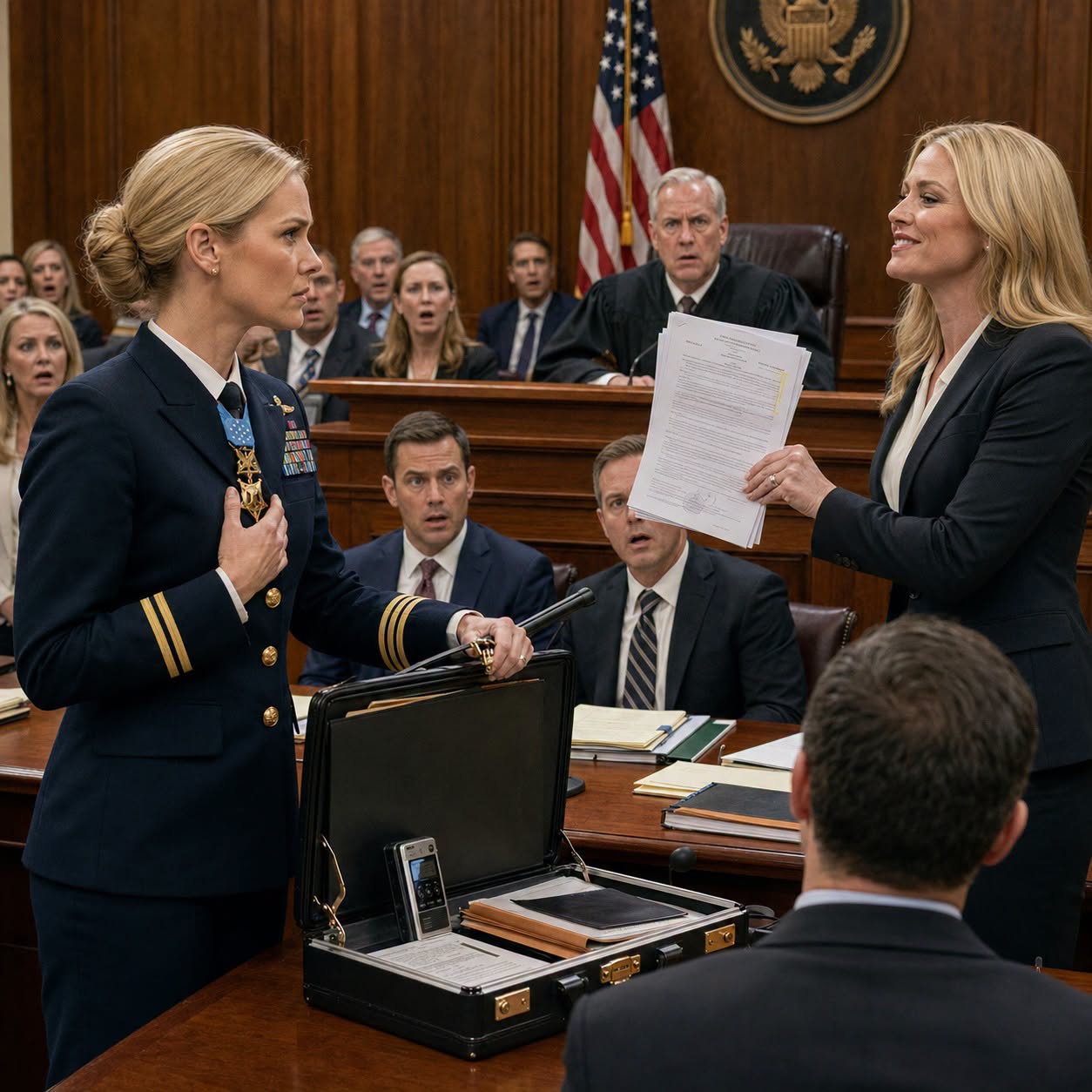
The Medal They Tried to Strip Away. The judge’s voice cut through the courtroom like a dull blade across polished wood. “Take off that war trophy—or I’ll have the bailiff do it.” Silence followed. Not the respectful kind. The kind that waits to see whether someone will break
Under the harsh fluorescent lights, Major Eleanor Brooks sat perfectly still in her Army dress uniform. The Navy Cross rested above her heart, its ribbon precise, its weight familiar. She had worn it straight from Sergeant Luis Ortega’s memorial. There had been no time to change, and she would not have changed even if there had been.
Across the aisle, her sister-in-law Melissa leaned back in her chair and smiled—slow, satisfied, certain. The kind of smile that believed the work was already finished. Forged signatures, altered probate papers, a brother worn down by months of quiet pressure. Melissa thought the house was already hers: the white clapboard, the green shutters, the oak their father had planted the year Eleanor was born, the porch that still creaked in the same place near the steps.
Judge Richard Harland tapped his pen against the bench as if the medal itself offended the dignity of his courtroom.
“This is not a stage for military theater,” he said. “Remove it.”
Eleanor did not look at him at once. She looked at the two older men in the third row—veterans’ caps, one still wearing a faded USS Midway patch. Their eyes had locked on the Cross the moment the judge spoke. They knew what it meant. Melissa never had. At Thanksgiving she had once called it “that blue necklace thing” while cutting store-bought pie.
Eleanor’s attorney, Evan Foster, shifted beside her. She touched two fingers to his sleeve. Not yet.
“Is that a formal order of the court, Your Honor?” she asked.
Harland’s face hardened. “Yes.”
The court reporter’s keys kept moving—click, click, click—preserving every word. Somewhere above the clerk’s desk the official recording system gave a soft electronic chirp, the quiet sound of a machine that never forgot.
Eleanor rose slowly. Melissa whispered, just loud enough, “Finally.”
She opened the battered briefcase instead of reaching for the medal.
The latch sounded louder than the gavel had earlier.
Inside lay two folders, her mother’s handwritten cornbread recipe, and one sealed probate envelope. She took only the blue folder and requested permission to approach. Harland waved her forward with the impatient flick of a man dismissing an inconvenience.
He opened the folder.
Award citation. Department of Defense verification. Federal guidance on the wearing of decorations in official proceedings. A prepared notice of judicial conduct complaint, ready for immediate filing.
Harland read the last page twice. The air in the room changed—subtle, but absolute. Melissa’s attorney stopped writing. The veterans in the gallery sat forward. Melissa herself leaned toward her counsel and whispered something sharp that received no answer.
Power had shifted without a single raised voice.
Harland cleared his throat. “The decoration may remain… for now.”
Eleanor returned to her seat without touching the medal. She folded her hands and looked directly at Melissa. No anger. No triumph. Only the calm of someone who had already measured the distance to the end.
Melissa expected rage. Silence unsettled her more.
Because the medal had never been the weapon.
The sealed probate envelope still waited in the briefcase. And the recording Eleanor was about to play had been waiting longer than any of them knew.
She opened the second folder.
Melissa’s smile finally began to fracture.
PART 2
Eleanor did not open the sealed envelope.
Not yet.
She reached instead for the small digital recorder resting beneath the second folder—the one she had carried through three time zones and two memorial services without ever powering it down. The device was ordinary. Black. Unremarkable. The kind of thing a person might use to capture a lecture or a grocery list.
Melissa’s attorney noticed it first. His pen stopped mid-stroke.
Eleanor placed the recorder on the table in front of her, aligned precisely with the edge of the wood. Then she looked at Judge Harland.
“Your Honor,” she said, voice steady, “before we proceed further on the question of ownership, I request that the court hear a short recording made on the evening of March fourteenth of this year. The speakers are my brother, David Brooks, and the plaintiff, Melissa Brooks. The conversation took place in the kitchen of the house currently under dispute.”
Melissa’s smile had already begun to thin. Now it vanished completely.
“Objection,” her attorney said, rising too quickly. “This is the first we’ve heard of any recording. No foundation. No authentication. This is trial by ambush.”
Evan stood with her. “The recording was disclosed in discovery two weeks ago, Your Honor. Page fourteen of our supplemental production. Counsel simply chose not to listen.”
Harland’s eyes narrowed. He looked from the recorder to Eleanor’s face, then to the veterans still watching from the gallery. Something in his expression had shifted—less contempt now, more calculation.
“Play it,” he said.
Eleanor pressed the button.
For a moment there was only the soft hiss of an empty kitchen. Then David’s voice, tired and low:
“I can’t keep signing these things, Mel. The dates don’t match. The notary stamp looks wrong. If Eleanor ever sees—”
Melissa’s voice cut across his, sharp and impatient.
“She won’t see. She’s either deployed or buried in some base somewhere feeling sorry for herself. By the time she comes home the house will already be listed. You just keep signing what I put in front of you. The college fund needs the money. The car needs replacing. I’m not living in that old place another winter while she plays soldier.”
A pause. The sound of a chair scraping.
David again, quieter: “That’s not what Mom and Dad wanted.”
Melissa laughed—short, dismissive.
“What they wanted doesn’t matter anymore. They’re gone. And your sister will fall in line once she understands how expensive it is to fight me. I’ve already spoken to someone who can handle the paperwork if she gets difficult. Just do what I tell you.”
The recording ended.
No one spoke.
The fluorescent lights continued their thin, insectile buzz. Somewhere outside, a truck shifted gears on Main Street. Inside the courtroom the silence had weight.
Melissa’s face had gone the color of old paper. Her attorney sat down without a word. David, who had been ordered to appear but had remained silent in the back row until now, lowered his head into his hands.
Judge Harland stared at the recorder as if it had personally betrayed him.
Eleanor did not smile. She did not look at Melissa. She simply reached into the briefcase one final time and withdrew the sealed probate envelope.
“Your Honor,” she said, “this contains the original last will and testament of my parents, executed three years before the version the plaintiff filed with the court. The signatures have been verified by the same forensic document examiner who reviewed the forged instruments. I am prepared to mark it as an exhibit.”
She placed the envelope on the table between them.
The paper was thick. Cream-colored. The red wax seal her father had always used for important family documents still unbroken.
Melissa made a small, involuntary sound—half breath, half protest.
Harland’s gavel remained untouched. His pen lay still. For the first time since the hearing began, the judge looked uncertain.
Eleanor kept her hands folded. The Navy Cross caught the overhead light and held it.
She had not raised her voice once.
She had not needed to.
The recording still hung in the air like smoke after a controlled detonation—quiet, precise, and irreversible.
And the sealed envelope waited.
Judge Harland did not speak for nearly half a minute.
The courtroom waited with him. Even the air-conditioning unit seemed to hold its breath. Melissa sat rigid, her hands clenched so tightly the knuckles had gone white. Her attorney stared at the sealed envelope as if it might explode. In the back row, David Brooks had not lifted his head.
At last Harland cleared his throat.
“Mark the recording as Plaintiff’s Exhibit One for identification,” he said, voice flatter than before. “Mark the sealed document as Defendant’s Exhibit A. Bailiff, take both into custody. Counsel, I will hear argument on authenticity after a short recess.”
He did not look at Melissa when he spoke the next words.
“Ms. Brooks, you will remain in the courtroom. Do not leave the building.”
The gavel came down once—soft, almost reluctant.
During the recess Eleanor did not move from her chair. She kept her hands folded, the Navy Cross still resting above her heart. Evan leaned close and murmured that the forensic examiner was already on the way. Eleanor only nodded. She was watching her brother.
When the recess ended, the examiner’s report arrived faster than anyone expected. The original will was genuine. The version Melissa had filed was not. The notary stamp on the forged documents belonged to a retired clerk who had died two years earlier. The signatures matched neither parent’s known hand.
Harland listened in silence. When the examiner finished, the judge removed his glasses, rubbed the bridge of his nose, and spoke without looking up.
“The plaintiff’s motion for forced sale is denied. The forged instruments are stricken. The original will controls. Title to the property remains as the testators directed—equal shares to the two children, with right of first refusal to either sibling.”
He paused.
“Further, this court will refer the matter of the forged filings to the district attorney’s office for review.”
Melissa made a sound that was not quite a word. Her attorney placed a restraining hand on her arm. She shook it off.
Eleanor rose.
She did not look at the judge. She looked at her brother.
David finally raised his face. His eyes were red. He opened his mouth, closed it, then managed only one sentence.
“I didn’t know how to stop her.”
Eleanor studied him for a long moment. The same quiet she had used in the courtroom settled over her now.
“You could have told me the truth,” she said. Not angry. Not soft. Simply true. “That would have been enough.”
She turned, collected the briefcase, and walked toward the aisle. The two veterans in the third row stood as she passed. One of them, the man with the Midway patch, gave her a single, precise nod. She returned it.
Outside, the late afternoon light was clean and hard. The courthouse steps still held the day’s heat. Eleanor paused at the top and looked down the street toward the old neighborhood she had fought to keep. Somewhere beyond the brick buildings, an oak tree was still waiting, its roots deep, its branches indifferent to every argument that had ever been made beneath them.
She touched the medal once, lightly, then let her hand fall.
The recording had done its work. The will had spoken. The house would not be sold for a new car or a college fund or anyone’s convenience. It would remain what her parents had left it to be—a place that remembered them.
Eleanor started down the steps.
Behind her the courthouse doors closed with a heavy, final sound.
She did not look back.
THE END