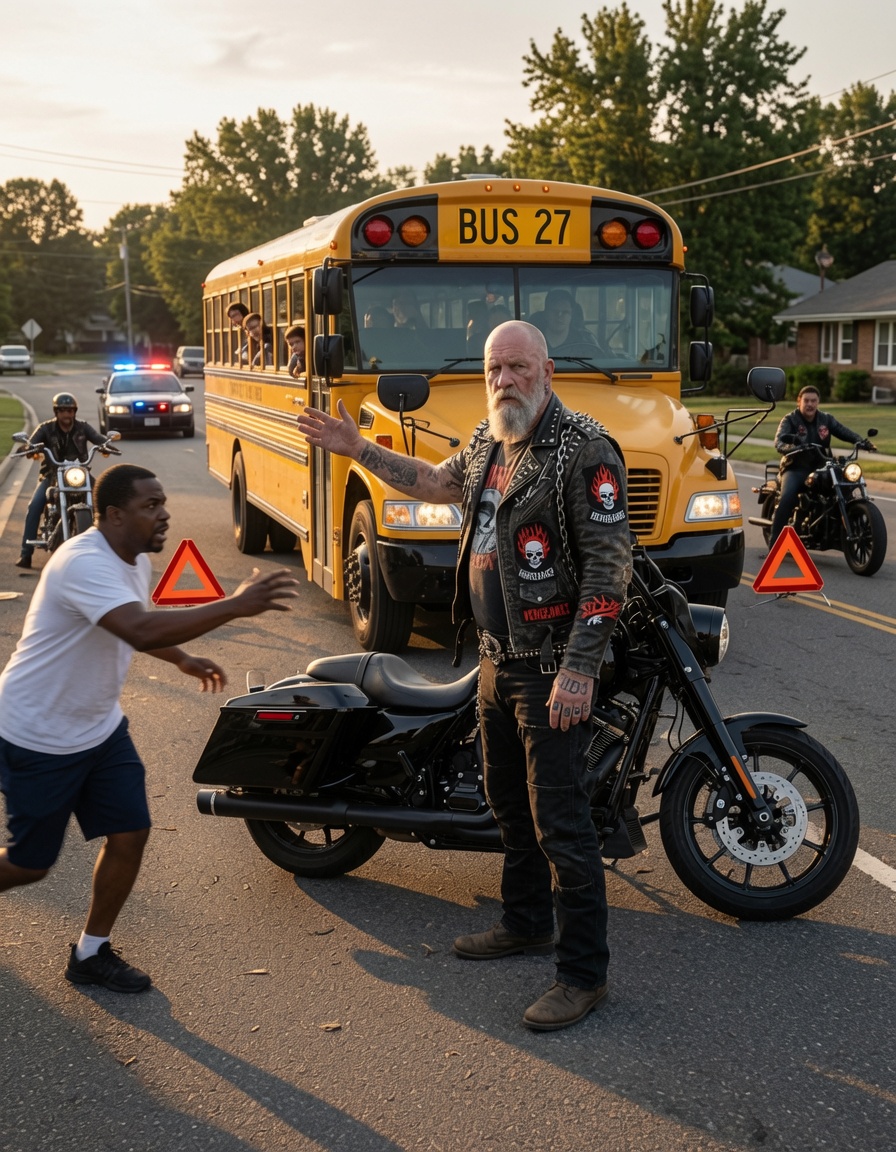
A Tattooed Biker Turned His Harley Sideways in Front of My School Bus While Parents Screamed — Then the Sound Beneath One Rear Wheel Explained Why He Refused to Move
Part 2 — The Man Who Heard What the Rest of Us Missed
The story began four miles before Silas blocked Bus 27, although I did not understand that until later.
I had left Cedar Ridge Elementary at 2:51 p.m. with twenty-six students, three backpacks in the aisle that I made their owners move, and one fourth grader upset because another child had taken the window seat. It was the kind of ordinary afternoon a school bus driver learns to value.
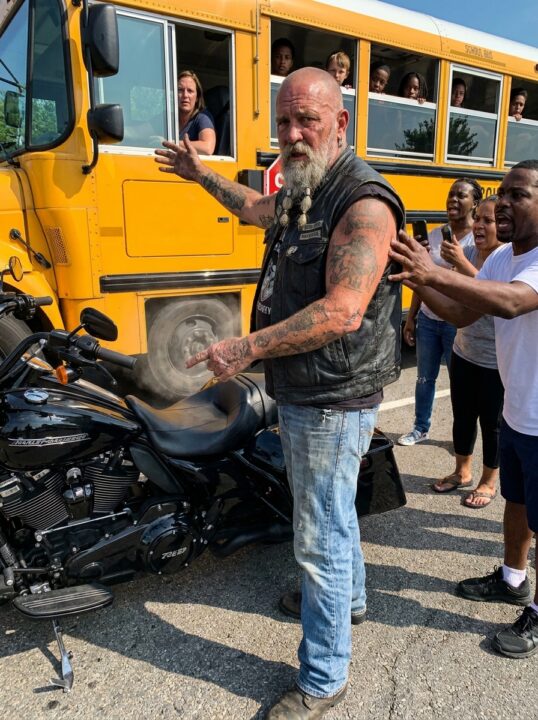
Bus 27 was a nine-year-old diesel with 143,000 miles on its odometer. It rattled over potholes, sighed when the air brake released, and produced enough background noise to hide a child unwrapping candy three rows behind me.
The bus had passed its annual state inspection. That morning, I had checked the lights, mirrors, tires, emergency exits, fluid levels, brake pressure, and visible lug nuts. Nothing looked wrong.
Silas was fueling his Harley at the Green Lantern station when we passed.
He heard the first click from across two lanes.
Later, he described it as a dry metallic tick followed by a softer scrape, repeating once per wheel rotation. The rhythm quickened as the bus accelerated and slowed when I approached the next light.
Most people would have mistaken it for a stone trapped in a tire.
Silas knew stones did not make that second sound.
He abandoned six dollars of prepaid gasoline, closed the cap, and started his Harley. The V-twin struck the air with two heavy pulses before settling into its familiar uneven idle.
He followed us east along Patterson Road.
At first, I barely noticed him. Motorcycles often rode behind the bus because passing opportunities were limited. When he moved into my left mirror and pointed downward, I thought he wanted to pass.
I waved him back.
He fell behind, listened through another turn, then accelerated beside the driver’s window at the next straight stretch. His beard moved in the wind, and one tattooed hand pointed toward the rear axle.
All I saw was a biker riding too close to children.
I closed the window.
He tried again at the traffic light near County Road 8. I kept the door locked and motioned for him to move away. A line of cars formed behind us, and someone began honking.
Silas looked toward Sutter Hill.
The hill waited three stops beyond Brookstone Avenue. It descended through two sharp bends bordered by a drainage ditch and mature sycamore trees. I drove it every afternoon at less than thirty miles per hour.
Silas knew the road better than I did.
His repair shop stood near the bottom.
He also knew that a school bus placed more than twice its empty weight on the rear axle when loaded with children, fuel, and equipment. On a downhill curve, lateral force would work against any wheel assembly already losing clamping pressure.
He had no proof yet.
Only a sound.
At Brookstone, he made the decision everyone saw. He passed at low speed, reached the stop before me, and placed the most valuable thing he owned across the road.
His Harley.
That detail mattered. Had I failed to stop, the bus would have crushed the motorcycle and probably Silas with it. He did not wave from a safe shoulder or hope I understood another hand signal.
He forced the question.
Who was this man willing to risk arrest and a thirty-thousand-dollar motorcycle over a noise no one else could hear?
His full name was Silas Joseph Kane, though nearly everyone along Highway 35 called him Rivet. He was fifty-three, a certified heavy-diesel technician, owner of Kane Roadside & Diesel, and road captain of the Iron Lantern Riders.
He had also served eighteen months in state prison.
The town remembered the last fact more easily than the others.
Silas began working around engines at fourteen in his uncle’s farm shop. He could identify a failing alternator bearing from across a parking lot, balance twin carburetors by ear, and detect a loose heat shield before most mechanics opened the hood.
At twenty-four, he joined the Beckford County school transportation garage. He spent six years maintaining buses, snowplows, and district vans.
Drivers trusted his inspections because he never treated a small noise as an inconvenience.
Then his wife, Dana, died from an aggressive cancer eleven months after diagnosis.
Silas was thirty-one. Their daughter Grace was eight.
After a warehouse accident injured his shoulder, he was prescribed pain medication. He used it as directed at first. Then he used it to sleep. Later, he used it to get through days he no longer knew how to carry.
The pills changed what grief had not.
He stopped showing up on time. He borrowed money. When that ran out, he falsified inventory records and sold several district-owned engine components through a private buyer.
The theft was discovered.
Silas confessed without a trial. He lost his job, his certifications, his home, and temporary custody of Grace. The court sentenced him to eighteen months.
Grace moved in with Dana’s older sister in Kettering.
For years, people told the story as if that was where Silas Kane became a criminal.
Grace remembered a different version. She remembered a father who attended every school concert before the pills, packed crackers in her lunch because she hated cookies, and once stayed awake all night rebuilding a broken wheelchair lift so a student would not miss a field trip.
Both versions were true.
That was what made him difficult to summarize.
In prison, Silas stopped using pills. Withdrawal took the comfort from his body before grief had finished taking it from his mind. He joined every recovery meeting available, repaired laundry carts without being asked, and kept a photograph of Grace beside a yellow school bus taped above his bunk.
He called her every Sunday.
Some Sundays, she spoke.
Some Sundays, she did not.
Seven months into his sentence, Grace boarded Bus 12 for school. A man named Elias Brooks happened to be riding behind it on an old Harley Electra Glide.
Elias heard a clicking sound from the left rear wheel.
He tried signaling the driver. She misunderstood him. At the entrance to Sutter Hill, Elias rode around the bus and blocked the lane with his Harley.
Parents screamed.
The driver sounded the horn.
A father shoved Elias against a guardrail.
The bus mechanic who responded found four loosened lug nuts and two cracked studs. One fragment had been trapped between the dual wheels.
Grace’s bus had been less than a mile from the same steep descent.
No one was injured.
That evening, Elias visited Silas in prison.
They spoke through scratched glass using heavy black telephones. Elias was sixty-two, lean, gray-haired, and wore a denim work shirt because club colors were not permitted in the visiting room.
He placed a dark piece of broken steel against the glass.
Silas recognized it immediately.
A wheel stud.
“Grace was on that bus,” Elias said.
Silas gripped the telephone until his knuckles whitened.
“Is she hurt?”
“No.”
“Where is she?”
“With your sister-in-law. Safe.”
Silas lowered his head.
Elias waited.
“What do you want?” Silas finally asked.
“Nothing.”
“You came here for something.”
“I came because a noise asked for an answer today.”
Silas looked at the broken stud.
Elias’s next words remained with him for twenty-two years.
“Noise asks once, brother. After that, consequences do the talking.”
When Silas was released, Elias met him outside the gate on the same old Harley. He gave Silas the broken stud, a leather cord, and a job sweeping floors in his motorcycle shop.
Silas earned back his diesel certifications one examination at a time. He repaid the district for every stolen part. He rebuilt his relationship with Grace without demanding that she forget anything.
It took years.
Elias founded the Iron Lantern Riders around one rule: nobody wearing their patch rode past a stranded person because the situation looked inconvenient.
Silas eventually bought the shop when Elias retired.
The old man died six years later from a stroke, leaving Silas the black Road King and a note inside the saddlebag.
Keep listening.
That was the motorcycle now parked across my bus.
That was the history hidden beneath Silas’s leather cut.
But on Brookstone Avenue, none of us knew it.
We saw an ex-con standing between parents and their children.
Silas saw a yellow bus approaching Sutter Hill.
And beneath everything we shouted at him, he could still hear the click.