STREAMING NOW ON NETFLIX: THE HIGH-STAKES BRITISH DRAMA EXPOSING THE BITTERSWEET REALITY OF CHILDHOOD TRAUMA!
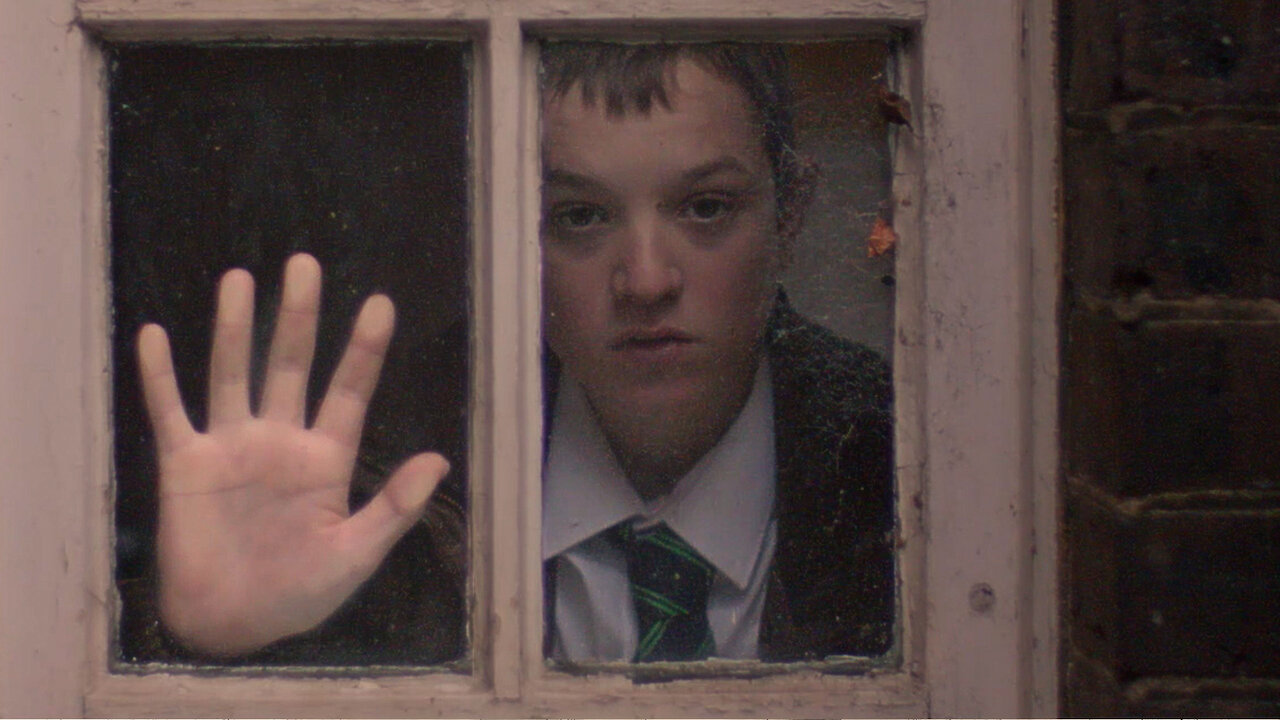
A lonely hand pressed against a fogged windowpane, a pale young boy in a school uniform, and the overwhelming weight of past scars. When confronting the darkest chapters of youth becomes the only way to find ultimate peace, on NETFLIX, this powerful British film delivers a haunting, deeply moving story of survival based on true events of childhood abuse. Trapped behind the silence of his own mind, he fights to navigate the heavy aftermath of emotional isolation from an orphanage. The melancholic, intense imagery captured in this exact moment proves why Big Boys Don’t Cry still unsettles viewers long after the credits.
Released in 2020 and later discovered by a much wider audience on NETFLIX, Steve Crowhurst’s 90-minute drama is not a glossy prestige picture. It is a compact, independent British film that part-fictionalizes the life of Paul Connolly, who was abandoned as an infant and spent years at St Leonard’s Children’s Home in Hornchurch, Essex. The home, run by a London borough council from the late 1960s until it closed in 1984, later became notorious in inquiries and prosecutions for the harm inflicted on children in its care. The film does not pretend to be a documentary. It compresses decades, invents some adult plotlines, and uses suggestion more often than graphic detail. What it insists on is the long echo: how a childhood spent in fear can shape the man who later tries to love, work, and stay upright.
The story moves on two tracks. In the present, adult Paul—played with coiled intensity by Michael Socha, familiar to many from This Is England—is trying to live a life that looks ordinary enough from the outside. In the film’s version of events he is recently out of prison, working as a bouncer, sliding toward the kind of cash-in-hand violence that feels like the only language he was taught. Then two things arrive at once. He begins a relationship with Anthea, a police officer played by Zoë Tapper, and detectives start asking questions about St Leonard’s after the death of his boyhood friend Liam. The investigation is not abstract. It is a knock at the door that pulls the past into the room.
The other track belongs to young Paul, played by Mitchell Norman. The boy in the school uniform at the fogged window is the film’s most durable image, and it is the image the caption describes with unusual accuracy. Crowhurst returns to fragments rather than staging long, explicit sequences: a child at a pane of glass, a whispered conversation, the sudden cruelty of an adult in authority. Viewers and reviewers have noted that the film often implies rather than displays, a choice consistent with Connolly’s involvement as executive producer and source. The point is not spectacle. The point is that the institution that was supposed to replace a family taught silence instead.
That silence is the real subject. The title is not a slogan so much as an indictment. Boys in the home are told to swallow pain, to treat tears as weakness, to accept that they are disposable. Adult Paul carries the lesson in his posture. Socha plays him as a man who can intimidate a nightclub queue and still look lost when Anthea asks a simple question about his past. The romance is not a subplot pasted on for relief. It is the test. Can someone who learned that closeness is dangerous let another person see him? The film is bittersweet precisely because the answer is never clean. Love does not erase the home. It only makes the cost of staying silent harder to justify.
Fact and fiction sit side by side, and the film is more honest if that distinction stays visible. The real Paul Connolly was left in a dustbin as a two-week-old baby in 1962 and later spent about twelve years at St Leonard’s. He has said he suffered beatings there. In later life he became a boxer until injury ended that path, then a gym instructor and one of Britain’s early celebrity personal trainers; he learned to read in his mid-twenties and published memoir work, including Against All Odds. He did not serve the prison stretch the movie gives its protagonist. Liam’s death and the police inquiry function in the script as a dramatic engine—the event that forces confrontation with people who once held power over the boys. Brett Fancy appears as Bill Starling, a house parent later convicted and imprisoned for serious offences against children at the home. The film is using a public criminal record and a survivor’s testimony; it is not inventing the institution’s reputation out of nothing.
On NETFLIX, that mixture of testimony and genre is part of why the title travelled. When the film landed on the platform in late 2022 in the United Kingdom and other territories, viewers who had never heard of St Leonard’s found themselves talking about it in the same breath as more famous true-crime dramas. Some were devastated. Some were angry that the story felt both specific and unfinished. Critics were mixed in a different way. The Guardian called it a painful examination of lasting impact and also wished Connolly’s later achievements had more room than the conventions of a gritty crime drama allowed. That tension is fair. Ninety minutes cannot hold an entire life: the abandoned infant, the years in care, the friend who does not survive, the adult who wants a relationship, the wish for reckoning. Crowhurst chooses mood and rupture over a complete biography.
What the film does well is geography of feeling. Kent locations, including Deal’s seafront, pier, and ordinary streets, stand in for a Britain that looks damp, working-class, and unimpressed by trauma as a talking point. A chip shop, a club, a flat, a police interview room: these are not picturesque. They are the rooms in which a man either says what happened or keeps performing toughness. The cinematography of Louie Blystad-Collins favors faces at windows and bodies that do not know where to put their hands. The score stays low. Nothing in the craft asks you to enjoy the pain. It asks you to notice that the boy at the glass and the man at the door are the same person.
There is a wider British context the streaming audience may not know. St Leonard’s processed thousands of children. Inquiries and trials in later decades confirmed that some staff abused their positions over many years. Films cannot prosecute the past, but they can refuse the old instruction to move on without looking. Big Boys Don’t Cry is most useful when it is understood as one survivor’s version, shaped for a narrative feature, not as a substitute for official records or for the many other children whose names never became a title on NETFLIX.
The high stakes, then, are not plot twists in the Hollywood sense. They are the stakes of memory. If Paul speaks, he risks the life he is trying to build with Anthea. If he stays quiet, Liam’s death and his own childhood remain a private weather system that storms whenever someone knocks. The film’s most honest scenes are the ones in which talking does not feel like victory. It feels like work—ugly, late, necessary work.
That is why the fogged window matters. A child cannot leave. An adult can, and still finds the glass in front of him. Big Boys Don’t Cry, streaming on NETFLIX, does not offer a tidy peace. It offers a portrait of a man who was told not to cry and who, decades later, has to decide whether silence is still the price of being a “big boy.” The melancholic image in that uniform is not decoration. It is the argument: childhood trauma does not stay in the orphanage. It walks out with the child, puts on a man’s jacket, and waits to see whether anyone will finally listen.